.svg)
Subscribe to our newsletter and get insights on how to grow your personal brand.
Thank you! Your submission has been received!
Oops! Something went wrong while submitting the form.
.svg)


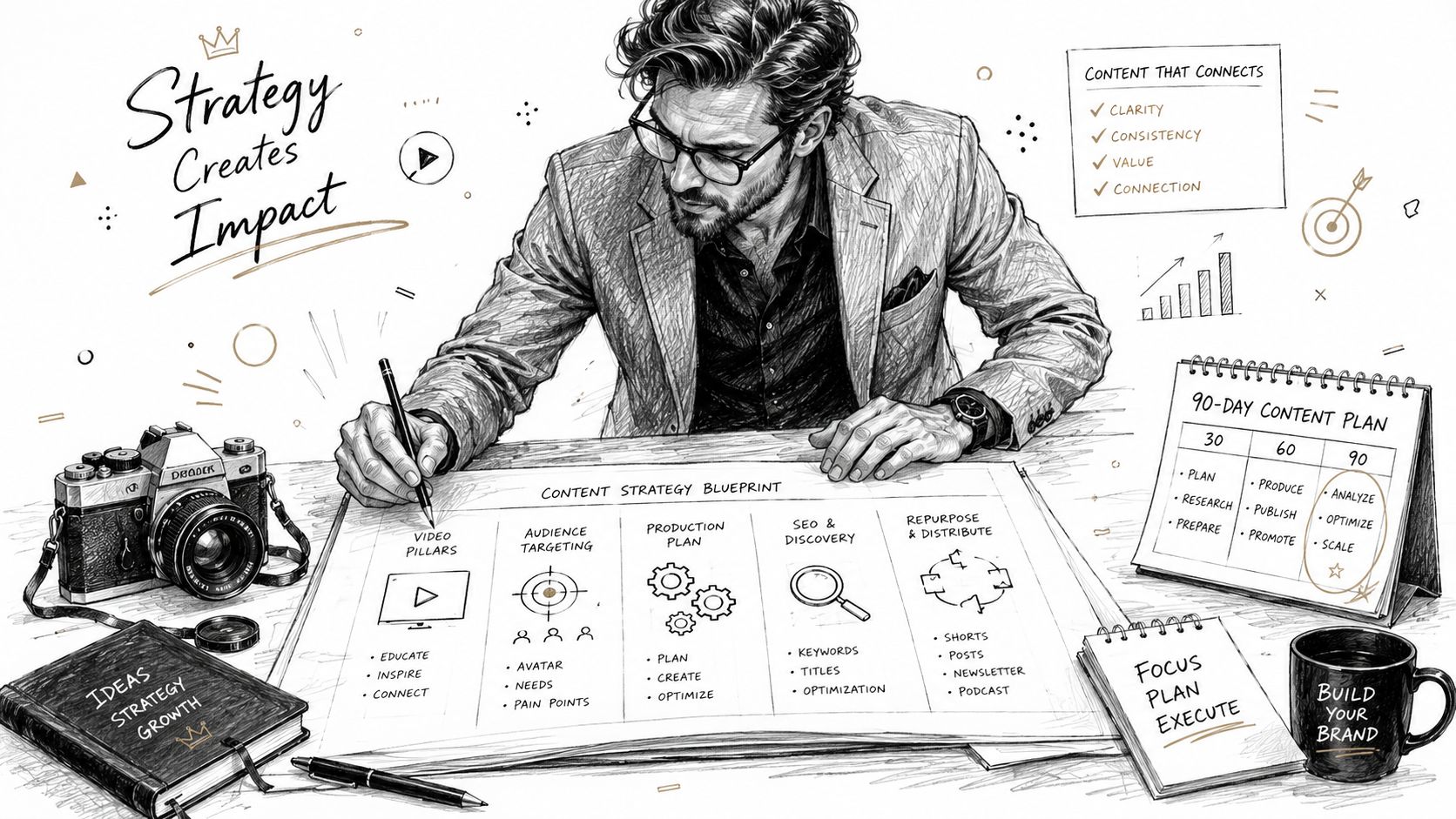
The worst YouTube advice on the internet is still the most popular: just post consistently.
That advice creates busy creators, not strong businesses. It tells founders and experts to feed a machine without deciding what the machine is supposed to produce. More videos. More effort. More editing. More burnout. Usually for a pile of views that never turns into trust, leads, or revenue.
A real YouTube channel strategy starts somewhere else. It starts with the business outcome. If your channel doesn't strengthen authority, attract the right audience, and move people toward a commercial next step, you haven't built an asset. You've built a job.
That's the shift I want you to make. Stop thinking like a creator trying to keep up. Start thinking like a legacy builder. Every video should have a reason to exist. Every topic should support your positioning. Every call to action should move the viewer deeper into your world.
The fastest way to waste a year on YouTube is to treat it like a posting quota.
Founders, consultants, and subject matter experts do this every day. They publish every week, chase topical ideas, and call it strategy. What they build is a production burden that rarely creates demand, sharpens positioning, or sends qualified buyers anywhere useful.
A YouTube channel should function like a business asset. It should build authority at scale, attract the right audience, and create clear paths into your offers, newsletter, sales process, or ecosystem. If it only produces views, you are renting attention instead of building equity.
Consistency has value. It trains your audience to expect you and gives the platform more chances to test your content. But consistency without strategic intent turns average decisions into recurring mistakes.
I see the same failure pattern constantly. A smart expert publishes solid videos for months. The topics are too broad to attract the right buyer. The message sounds informative but generic. The call to action is an afterthought. The channel collects passive viewers, not people with urgency, budget, or fit.
Use one hard filter before you publish anything: what business outcome should this video support?
If you cannot answer that in one sentence, do not make the video.
That standard will save you from a lot of polished irrelevance.
A legacy builder does not judge a channel by surface-level momentum alone. Views and subscribers matter only if they lead somewhere that strengthens the business.
Track the outcomes that signal asset growth:
This is the difference between creator logic and operator logic. Creator logic asks, "Did this video perform?" Operator logic asks, "Did this video improve the business?"
A video can pull modest public numbers and still be extremely valuable if it attracts the right buyer, answers a high-intent question, and leads to action. The reverse is also true. A video can get broad attention and contribute almost nothing if it pulls the wrong audience and trains people to know you for topics that never convert.
If your bigger goal is authority, not just attention, build your channel around a clear point of view and visible expertise. That is the core foundation of thought leadership for personal brands.
Revenue strategy matters here too. If your only monetization idea is ad revenue, your channel will stay small in all the ways that count. This YouTube channel monetization guide is useful because it pushes you to evaluate offers, sponsorships, lead generation, and other business models that turn content into cash flow.
Build for compounding trust. Build for qualified demand. Build for long-term brand equity.
That is how a YouTube channel stops being a treadmill and starts becoming an asset.
Before you plan thumbnails, upload schedules, or gear, decide what the channel is for. Many creators skip that step because it feels less exciting than filming. That's why most channels drift.
“Growth” is not a strategy. It's a vague wish.
Your YouTube channel strategy needs one business-facing metric that matters more than everything else. For a consultant, that might be qualified discovery calls. For a SaaS founder, it might be demo requests. For a coach, it could be email subscribers who fit the ideal buyer profile.
Use YouTube metrics to diagnose performance. Use business metrics to judge success.
A simple filter works well:
| Channel type | Better North Star metric | Weak metric |
|---|---|---|
| Consultant | Discovery calls booked | Subscribers |
| Founder | Demo requests | Views |
| Educator | Email opt-ins | Impressions |
| Service business | Qualified inbound leads | Likes |
If you need help thinking through the revenue side of the model, this YouTube channel monetization guide is a useful reference because it forces you to evaluate monetization paths beyond ad revenue.
Most channels fail because the creator talks to “everyone interested in business,” “people who want to grow,” or “entrepreneurs.” That isn't an audience. That's a crowd.
You need a specific viewer with a specific frustration and a specific ambition. Write down:
Personal brands gain an advantage. You don't need to imitate a media company. You need to articulate a point of view your audience already wants help with.
If your positioning still feels fuzzy, study how authority is built across platforms. This clear guide to building influence through thought leadership is worth reading because it sharpens the difference between sharing content and owning a category.
A lot of YouTube advice tells small channels to chase low-competition keywords. That's incomplete advice, and often bad advice.
Data discussed in this analysis of underserved YouTube niches shows that creators often miss high-value topics in education, B2B, and finance, where outlier performance is inconsistent. That inconsistency matters. It means large channels don't dominate every time, which creates room for smaller personal brands with real expertise.
Don't ask, “Where is competition low?” Ask, “Where is buyer value high and incumbent execution inconsistent?”
That's where serious personal brands win. Not by being generic in easy categories, but by being specific in profitable ones.
A strong channel doesn't run on random ideas. It runs on a content ecosystem.
That means your videos don't live as isolated posts. They reinforce a handful of themes you want to own in the market. Those themes become your content pillars. Everything else branches from there.

If you cover too much, the audience gets confused. If you cover too little, the channel becomes fragile. Three to five pillars is the sweet spot for most personal brands.
A founder in B2B might choose:
Those pillars should reflect expertise and commercial relevance. They should also support repeatable formats, not one-off inspiration.
You don't need more ideas. You need better containers for your ideas.
A pillar becomes powerful when it produces multiple video types. Take “operational how-to” as an example. That single pillar can become:
This is how a channel becomes easier to run over time. You stop asking what to film. You start selecting from a strategic menu.
The platform also rewards discipline over chaos. The established ideal cadence for most channels is 1 to 3 videos per week to balance quality with consistency, and the best approach mixes trending topics with evergreen content, according to OutlierKit's YouTube growth strategy breakdown.
Here's the practical split:
| Content type | Role in your channel | Best use |
|---|---|---|
| Evergreen | Long-term discovery and authority | Core educational topics |
| Trending | Timely attention and relevance | Industry shifts, news, reactions |
| Opinion-led | Positioning and differentiation | Contrarian takes, frameworks |
| Conversion-led | Business movement | Problem-aware buyer content |
For a deeper execution model, this video content creation guide for founders does a good job of translating strategy into a practical production rhythm.
A useful example helps make this concrete:
Most YouTube channels don't have a content problem. They have a packaging problem.
You can record a sharp, useful, well-argued video and still bury it with a weak title, a cluttered thumbnail, and an intro that takes too long to get to the point. If people don't click, the video dies. If they click and leave quickly, the video dies faster.

A lot of outdated YouTube strategy obsesses over keywords. Keywords still matter, but most professionals who want meaningful growth should care more about Browse. That's where titles and thumbnails do the heavy lifting.
A rigorous approach targets 65–70% retention in the first 30 seconds, and success is strongly tied to traffic from Browse features, which means your title and thumbnail need to create curiosity, not just match a search term. Text-heavy thumbnails are a common mistake because they reduce visual impact and contribute to early drop-off, based on this YouTube strategy breakdown.
That has two immediate implications:
Here's the difference:
| Weak packaging | Strong packaging |
|---|---|
| “How to Build a Personal Brand on YouTube” | “Why Most Personal Brand Channels Never Convert” |
| “Email Marketing Tips for Founders” | “The Email Mistake Costing Founders Qualified Leads” |
| “B2B Marketing Strategy Explained” | “The B2B Content Strategy That Looks Smart and Fails” |
The stronger examples create tension. They imply a gap, a mistake, or a payoff.
Most intros are bloated because the creator is trying to sound professional. That instinct kills retention.
Skip the branded opener. Skip the throat-clearing. Skip the “in today's video” script. Open with the problem, the stake, and the promise.
Use this sequence instead:
If the thumbnail promises one thing and the intro delivers another, viewers leave. The algorithm notices.
Title, thumbnail, and hook must align. They are not separate tasks. They are one system.
Founders and experts usually overcomplicate thumbnails because they think more information creates more clarity. It doesn't. It creates friction.
A cleaner approach works better:
That last point gets ignored constantly. If the thumbnail implies a result, a mistake, or a key moment, your intro should confirm it quickly. Otherwise viewers feel baited, and retention falls.
A serious YouTube channel strategy needs a production system that survives real life. If your workflow depends on perfect energy, open calendar space, and constant creativity, it's broken.
You need a repeatable engine.

Most professionals do better with batching than with constant creation. One planning block, one recording block, one review block. That structure removes decision fatigue.
A reliable workflow looks like this:
You do not need a studio to start. A clean frame, strong audio, decent lighting, and a clear point of view beat fancy gear every time.
Repurposing isn't clipping random moments and flooding every platform. That creates disconnected content.
Start with one strong pillar video. Then derive assets with distinct jobs:
| Asset | Job | Best angle |
|---|---|---|
| Short clip | Spark curiosity | One sharp tension point |
| LinkedIn post | Build authority | Contrarian insight or lesson |
| Deepen trust | Story plus takeaway | |
| X thread | Expand reach | Breakdown of argument |
| Sales enablement clip | Support conversion | Objection handling |
If you want a detailed playbook for this, this guide on repurposing content and multiplying reach is a useful operational reference.
Many creators often squander Shorts.
Shorts shouldn't act like separate entertainment units if your business depends on long-form trust. They should function as curiosity hooks that point into the main idea. Data cited in this 2025 YouTube growth article says bridging Shorts to long-form can increase session time by 47%, and creators using the curiosity-hook method see 30% higher long-form retention.
Operational advice: Cut Shorts from a precise unresolved moment. Don't summarize the whole video. Make the viewer need the next piece.
If you want to systemize this at scale, especially across uploads, metadata, or internal dashboards, a technical lead should understand the developer's guide to YouTube API. Not because every creator needs code, but because scalable content operations eventually need structure.
Views feel exciting. Revenue, inbound demand, and category authority matter more.
That is the Legacy Builder standard. Treat your channel like a business asset. Measure whether your videos attract the right people, hold their attention, and move them into your pipeline. Subscriber count belongs on the scoreboard, not in the driver's seat.
A serious YouTube strategy needs two dashboards.
The first is platform performance. Watch click-through rate, average view duration, new versus returning viewers, and comment quality. Those metrics answer practical questions fast. Is your packaging strong enough to earn the click? Does the video keep attention after the promise? Are you building a loyal audience or pulling in random traffic that never comes back?
The second is business performance. Track email opt-ins, booked calls, qualified leads, sales conversations, and closed revenue tied to specific videos. Use dedicated landing pages, distinct calls to action, content-specific lead magnets, and a simple “How did you hear about us?” field on every form. If you do not connect content to outcomes, you are running a media hobby.
Here is the blunt truth. A video with modest views that sends three qualified leads beats a high-view upload that attracts the wrong audience and produces nothing.
Your best strategy clues are already in the channel.
Study the videos that outperform your normal baseline. Focus on the ones that drove strong retention, attracted comments from real buyers, sparked direct messages, or led to inquiries. That is where your market is telling you what it values.
Then review them with discipline:
| Question | What to inspect |
|---|---|
| Why did people click? | Title specificity, thumbnail contrast, topic urgency |
| Why did they stay? | Opening hook, structure, pacing, clarity |
| Why did they respond? | Relevance to buyer pain, authority of the point of view, trust signals |
| Why did they convert? | CTA fit, offer match, audience intent |
| Should this become a series? | Repeatable angle, clear demand, strong business relevance |
This is how a channel stops drifting. You stop publishing based on taste and start building around proof.
Founders waste time hiring for status.
Your first hire should remove the constraint that keeps the channel from becoming consistent and useful. If recording is easy but publishing is always late, hire an editor. If the ideas are sharp but the packaging is weak, hire a thumbnail designer. If content goes live and nobody reviews patterns, bring in an operator who can track performance and report what deserves another swing. If the channel is generating demand, tighten sales follow-up before you add more production capacity.
Keep the split clean. The founder owns message, viewpoint, and authority. The team owns execution, workflow, and reporting.
That structure protects the one thing you cannot outsource, which is your earned perspective.
If your strategy includes interviews or a show format as part of authority building, this expert guide for B2B YouTube podcasts can help you shape the format without turning the channel into another generic talk show.
Individuals don't need more theory. They need a sequence.
The first ninety days should build a usable asset, not a perfect channel. You're trying to create strategic clarity, publishing rhythm, and early performance signals you can trust.
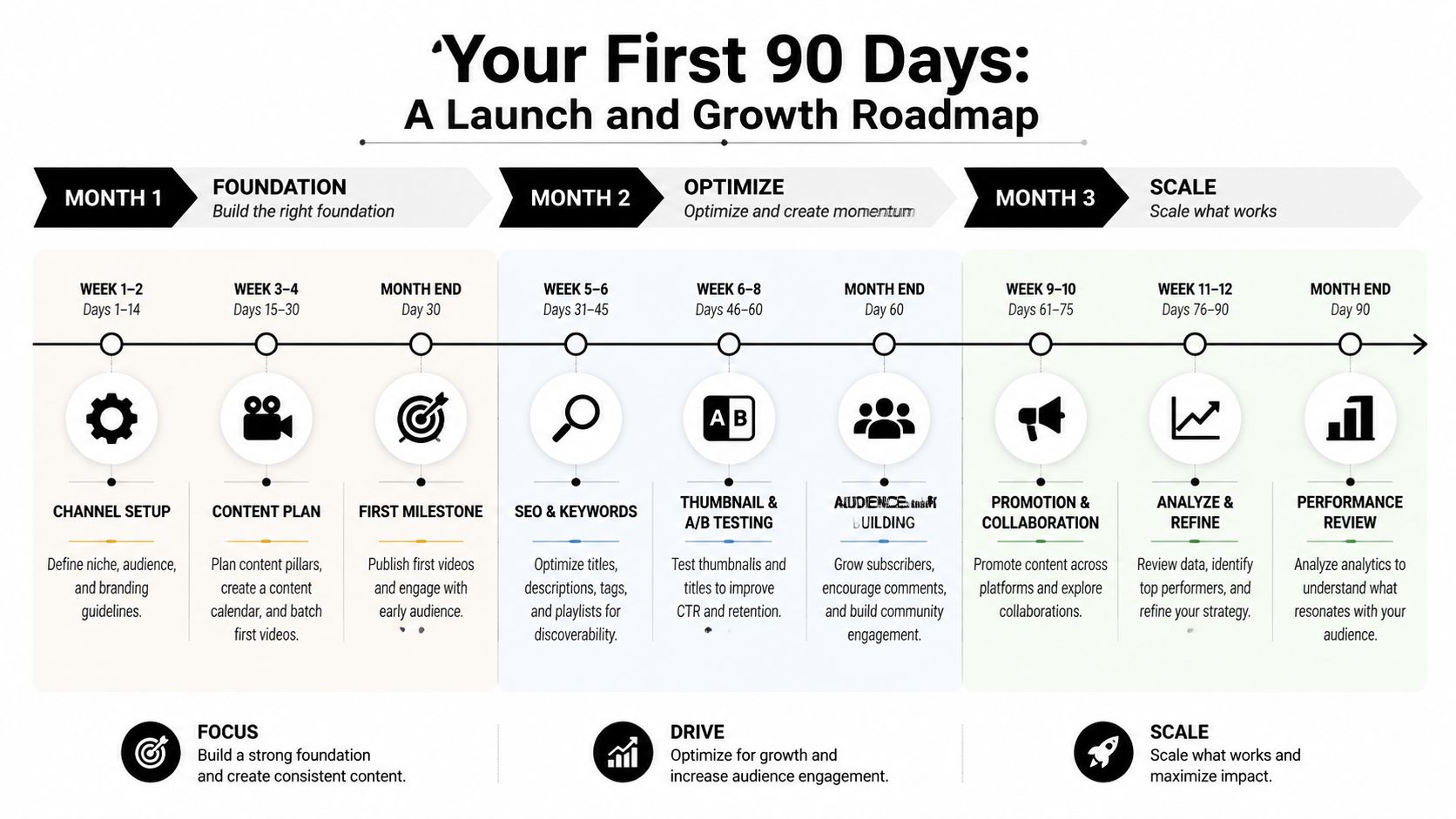
Start with positioning, not production.
Define your North Star metric. Lock in your audience profile. Choose your content pillars. Write a short channel promise that explains who the channel serves and what shift the viewer can expect.
Then batch your first set of videos. Keep the topics close to core pain points. Avoid broad inspirational fluff. Also tighten your profile, banner, about section, and channel homepage so the channel looks intentional from day one.
If your format includes interviews or a show-style structure, this expert guide for B2B YouTube podcasts is useful for shaping a channel that supports authority rather than becoming another forgettable talking-head feed.
Now publish and observe.
Stick to your planned cadence. Don't pivot because one video feels slow. Watch for pattern signals instead. Which titles get stronger clicks? Which intros hold attention? Which topics attract comments or messages from the right people?
Use this period to improve packaging. Refine thumbnails. Tighten opening hooks. Adjust CTAs based on audience readiness. If the right viewers are watching but not taking action, the issue usually isn't the topic. It's the bridge to the next step.
At this stage, the channel becomes a system.
Turn your strongest long-form videos into a repurposing pipeline. Cut Shorts designed to trigger curiosity. Publish supporting text content on LinkedIn, email, or X. Respond to comments with intent, especially when they reveal objections, interest, or repeated pain points.
Then review the full picture:
By the end of this phase, you shouldn't just have a YouTube channel. You should have the beginnings of a business asset. That's the point of a serious YouTube channel strategy. Not endless output. Not borrowed influence. A durable engine for authority, trust, and revenue.
If you want help turning your expertise into a YouTube-driven personal brand that attracts the right audience and creates real business momentum, Legacy Builder helps professionals build content systems that compound authority instead of draining time.


You could – but most in-house teams struggle with the nuance of growing on specific platforms.
We partner with in-house teams all the time to help them grow on X, LI, and Email.
Consider us the special forces unit you call in to get the job done without anyone knowing (for a fraction of what you would pay).
Short answer – yes.
Long answer – yes because of our process.
We start with an in-depth interview that gives us the opportunity to learn more about you, your stories, and your vision.
We take that and craft your content then we ship it to you. You are then able to give us the final sign-off (and any adjustments to nail it 100%) before we schedule for posting.
No problem.
We have helped clients for years or for just a season.
All the content we create is yours and yours alone.
If you want to take it over or work on transitioning we will help ensure you are set up for success.
We want this to be a living breathing brand. We will give you best practices for posting and make sure you are set up to win – so post away.
Subscribe to our newsletter and get insights on how to grow your personal brand.
