.svg)
Subscribe to our newsletter and get insights on how to grow your personal brand.
Thank you! Your submission has been received!
Oops! Something went wrong while submitting the form.
.svg)


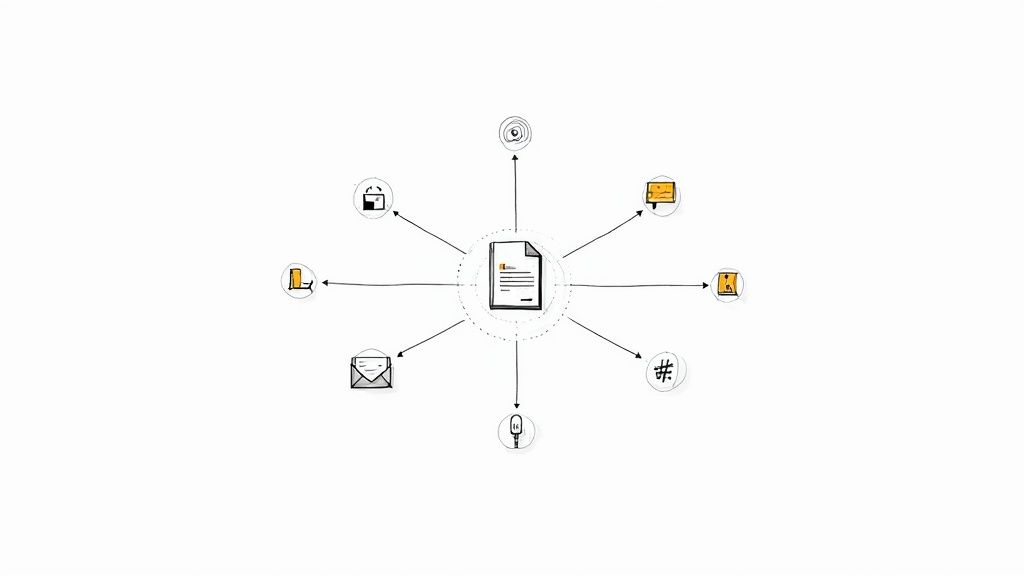
You've probably heard the term "content repurposing" thrown around, but what does it actually mean?
It’s simple: you take one piece of high-value content that’s already working and chop it up into a bunch of new formats. Instead of endlessly creating from a blank page, you’re adapting your proven winners into fresh assets like social media posts, videos, or newsletters. This isn't about being lazy; it's about being smart and getting the most out of every single idea.
If you feel like you’re stuck on a content treadmill, you’re not alone. The constant pressure to publish something new is exhausting, and frankly, it’s not the most effective way to grow.
The secret isn’t always to produce more stuff. It's to get more mileage out of the home runs you've already hit. This is the entire game when it comes to repurposing content—working smarter, not just cranking out post after post.
Think about your best-performing blog post or that one in-depth video that got a ton of engagement. That single piece of content is a goldmine. It's packed with killer quotes, data points, and concepts. Instead of just letting it collect dust after its initial launch, you can systematically break it down into dozens of smaller assets.
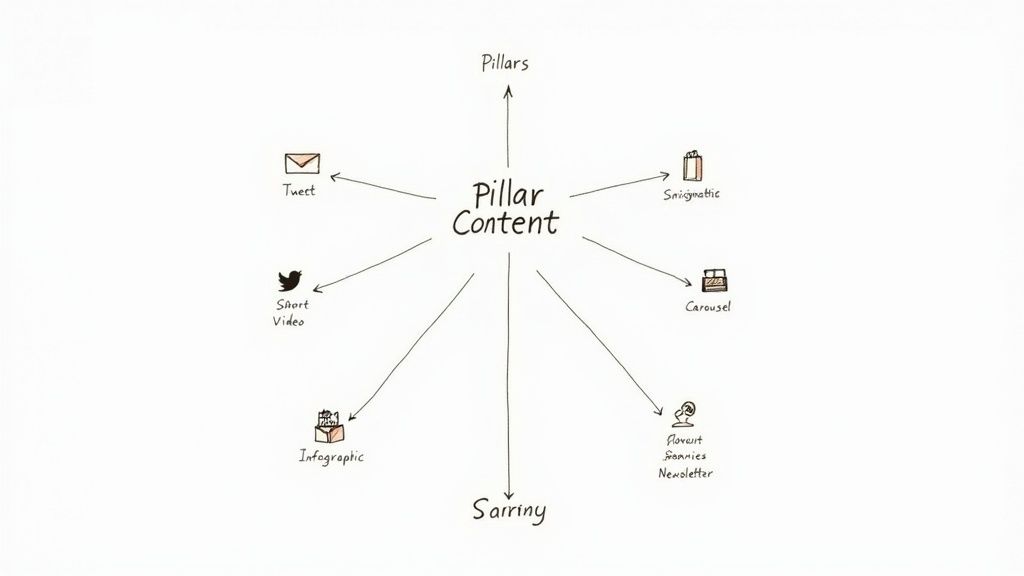
I like to think of this as the "Pillar and Spoke" model. Your big, foundational piece of content is the pillar. From that one pillar, you can create countless spokes—smaller, bite-sized pieces tailored for different platforms that all point back to the original.
Here’s why this works so well:
This isn’t just a theory; the data backs it up. A recent survey showed that 46% of marketers believe repurposing is more effective than creating content from scratch, and a whopping 65% say it’s far more cost-effective. The smartest people in the room are moving toward getting maximum value from every asset.
To see just how powerful this is, check out this quick comparison of the time investment versus the output.
The numbers don't lie. You're putting in less time for exponentially more output and reach.
Once you adopt this mindset, you stop treating your content like a final product. Instead, it becomes the raw material for a much bigger, more impactful campaign. We dive deep into how to organize your best material in our guide to building a foundational https://www.legacybuilder.co/asset.
Repurposing isn't just a time-saving hack; it's a distribution strategy. It allows one powerful idea to work for you across your entire digital footprint, from a 2,000-word article all the way down to a 15-second video clip.
At the end of the day, this approach transforms your content creation from a series of disconnected sprints into a cohesive, integrated system. To get even more ideas on how to put this into practice, check out these 10 proven content repurposing strategies.
Before you start chopping up your content, you need a filter. A pretty critical one, actually.
Not every blog post, video, or podcast episode deserves a second life. The whole point of repurposing is to get more mileage out of your best ideas, not just to create more noise. So, how do you find those proven winners—your content goldmines?
It all starts with a content audit. Don't let that term scare you off. It's just a fancy way of saying you need to look at what you’ve already created and separate the high-performers from the stuff that fell flat. You're looking for pieces that have already proven their worth, either through hard data or genuine feedback from your audience.
First stop, always: analytics. Numbers don't have opinions; they tell you exactly what your audience finds valuable. Fire up your primary content hubs and start looking for the quantitative proof.
Look for these key indicators:
Your most valuable assets for repurposing are often hiding in plain sight within your analytics. A piece of content with high traffic, strong engagement, and a good conversion rate is the trifecta you're looking for.
Beyond the immediate numbers, you need to spot your evergreen content. These are the pieces that stay relevant long after you hit "publish." Think foundational guides, timeless frameworks, or deep dives into core industry principles.
A blog post about a fleeting social media trend from three years ago? A poor choice. But an article like "A Founder's Guide to Building a Personal Brand"? That’s going to be just as relevant in five years as it is today.
Focusing on evergreen topics ensures your repurposed assets have a much longer shelf life. You get the maximum return on your effort. These pieces are the ultimate source material when you're figuring out how to repurpose content that actually works.
Data tells a huge part of the story, but it doesn't capture everything. Some of your best content goldmines reveal themselves in your DMs and comment sections. These qualitative signals show you which topics spark real passion and curiosity.
Pay close attention to content that generates:
When you combine the hard data from your analytics with these human insights from your audience, you get the complete picture. This balanced approach makes sure you're not just repurposing what’s popular, but what truly connects. This is the strategic foundation you need for a content repurposing system that actually gets results.
So, you've pinpointed your content goldmines—the articles, videos, and podcasts that are already pulling their weight with traffic and engagement. Now comes the fun part: breaking them down. This is where one killer piece of content becomes a full-blown, multi-platform campaign.
Stop thinking of your pillar content as a finished product. Instead, see it as a block of raw material. Your job is to chisel away and pull out the best quotes, the sharpest data points, and the most compelling stories hidden inside. Each little piece you extract can be polished into something new for a specific audience on a specific platform.
Let's make this real. Imagine your big winner is a 3,500-word blog post called "The Entrepreneur's Guide to Authentic Personal Branding." It's loaded with research, personal stories, and clear, actionable steps. Here’s how we’d start taking it apart.
First things first, you need to go on a mining expedition. Read through your pillar piece with one mission: find the raw materials. Forget about formats for a minute; just focus on spotting the valuable nuggets.
You're hunting for things like:
Once you’ve done this, you'll have an inventory of micro-content ready to go. From here, you can start strategically matching each building block to the right platform and format. You can learn more about organizing all these assets in our guide to building a robust content system.
With your inventory in hand, the real work begins. Every social platform has its own vibe and expectations. You can't just copy and paste—you have to adapt.
Using our personal branding blog post as an example, here’s what that deconstruction could look like:
The visual below shows a simple way to think about this discovery process, using your analytics, engagement, and conversion data to find the best pieces to deconstruct.
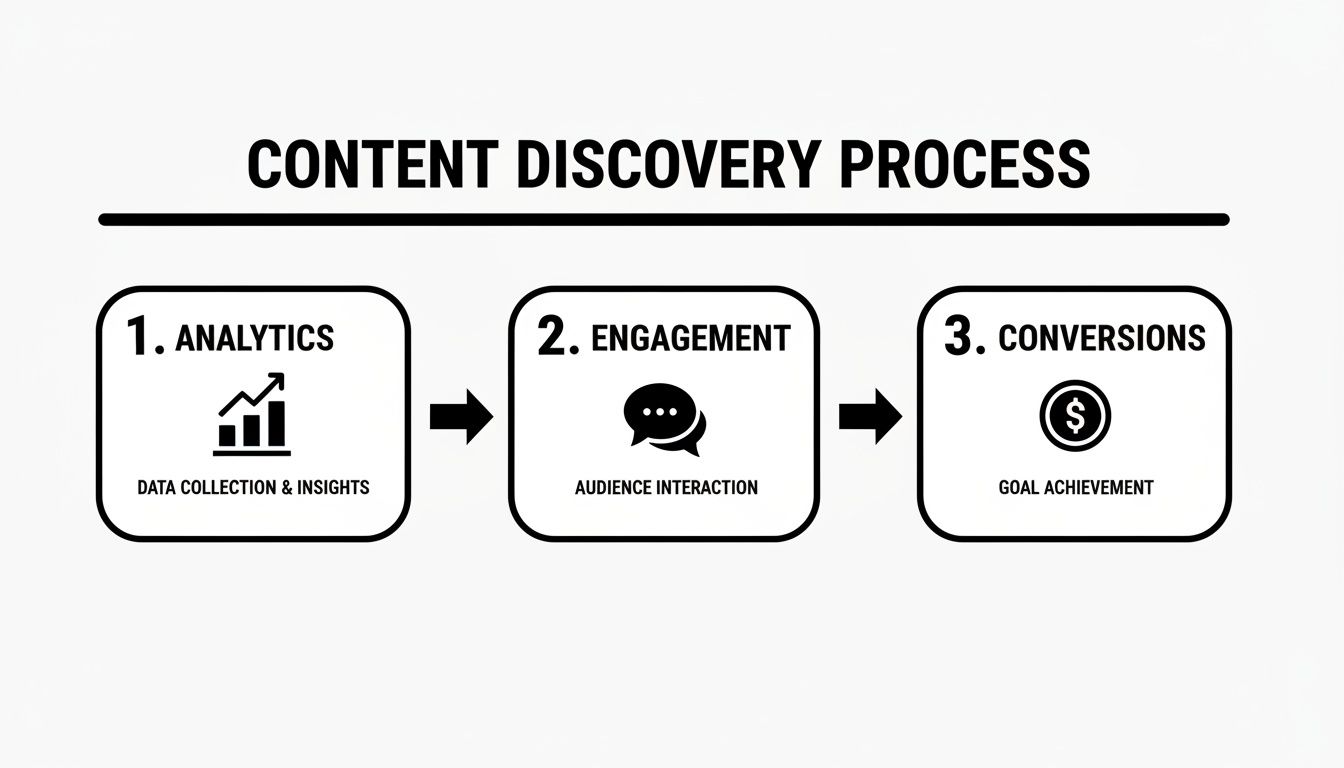
This workflow helps you systematically figure out which parts of your content have the best shot at performing well in a new format.
The goal isn't just to repeat information; it's to re-contextualize it. A statistic that supports an argument in a blog post can become the headline of a social graphic, completely changing its impact and reach.
To make this process repeatable and not a total time-suck, you need a workflow. A simple template can be your guide, making sure you don't miss any opportunities to squeeze more value out of your best work.
Here’s a simple workflow template you can steal and adapt for your own process. It helps you map out exactly how a pillar piece can be spun into multiple assets.
Having a map like this ensures you're thinking strategically about every piece of content you break down.
As you get into the nitty-gritty of deconstruction, it helps to learn the specific techniques for each format. For example, turning a long video into clips requires a different skill set. Diving into a practical guide on creating YouTube Shorts from existing videos is a great next step. This is how you turn theory into actual results.
Ultimately, deconstructing content is a mindset shift. You stop seeing your content as a one-off event and start seeing it as a library of valuable ideas. By learning to systematically pull them out, reformat them, and get them in front of new audiences, you build an engine that constantly works to amplify your message and solidify your authority.
Let's be honest. Taking a monster blog post or an hour-long podcast and slicing it into dozens of micro-assets sounds exhausting. If you're a solo founder or running a small team, it can feel downright impossible.
But here’s the good news: you don't have to do it all by hand. The right tech stack turns this mountain of a task into a molehill, automating the grunt work and cutting down what used to take days into a few hours.
The secret isn’t finding one magical, do-it-all app. It’s about building a small, smart toolkit of specialized platforms that handle specific parts of the repurposing process. This way, you can pump out high-quality content at scale without a massive budget or a dedicated production crew.
AI isn't some futuristic buzzword anymore—it's your new content assistant. Modern AI tools can digest your pillar content and spit out a whole range of smaller assets automatically. This is, hands down, the fastest way to get your first drafts done so you can focus on the human touch: refining and polishing.
You can feed these platforms one piece of content and watch them work their magic:
These tools are game-changers. Some platforms report boosting engagement by up to 200% by turning one blog post into a flurry of social snippets and video scripts. And the cost savings? Many businesses are cutting content production costs by 50-70% because the AI handles all the heavy lifting. You can dig deeper into how AI is changing content repurposing on netguru.com.
Video editing is often the biggest bottleneck in repurposing content. It’s technical, tedious, and a massive time suck. Luckily, a new wave of editors built specifically for repurposing has completely changed the game.
Look for tools that have features like:
The best repurposing tools get the technical stuff out of your way. Your job is to be the curator of your best ideas, not a video engineer fighting with software just to add text to a clip.
You don't need a design degree to create great-looking visuals. Platforms like Canva or Adobe Express give you thousands of templates designed specifically for social media.
These are your best friends for quickly whipping up assets like:
Using templates means your brand stays consistent everywhere, and you're not spending hours messing with fonts and colors.
At the end of the day, your goal is to build a practical, affordable tech stack that does the hard work for you. Just remember, these tools are assistants. They aren’t you. You still need to add your expertise, your voice, and your final polish to everything they generate. That blend of smart automation and human oversight is the real key to a content system that actually works.
Look, creating a library of killer content assets is a massive win, but it’s only half the battle. Seriously. The real magic happens when you have a smart, strategic way to get it in front of the right people—and you know exactly what’s working.
Without a plan, your best content ends up collecting digital dust. Or worse, you overwhelm your audience by blasting everything everywhere all at once.
This is the point where you stop being just a content creator and become a content strategist. It’s all about building a system that gets the right piece to the right platform at the right time. This is how you maximize your visibility without feeling spammy.
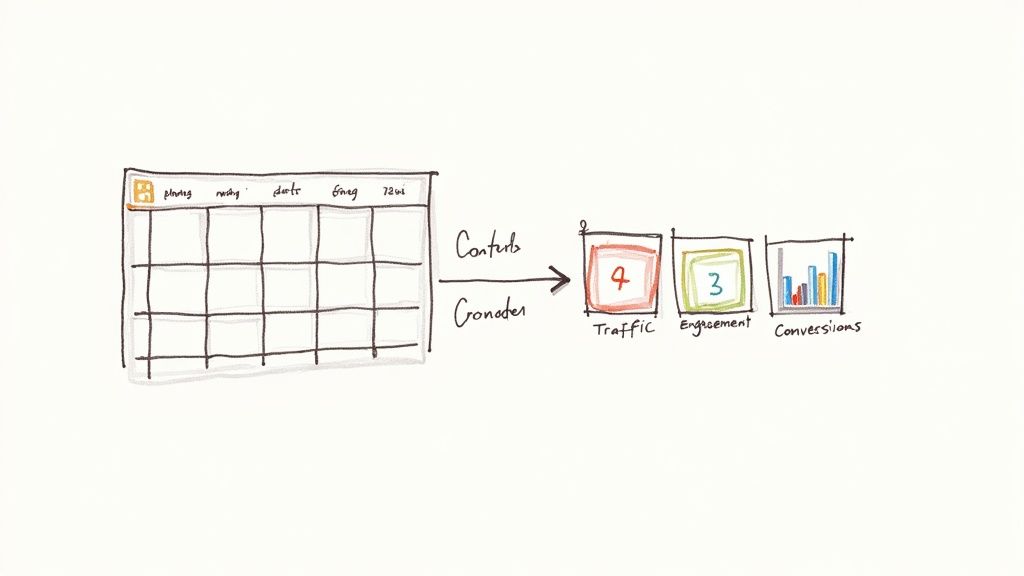
A dedicated content calendar for your repurposed assets isn't optional. It’s your blueprint. It turns a random pile of posts into a coordinated campaign that builds momentum.
The goal is a steady drumbeat of value, not a flash flood of content.
For instance, after you publish a big pillar blog post, don’t just schedule 10 social posts for the next day. That’s a rookie mistake. Instead, map out a rollout over several weeks.
This paced approach keeps the conversation going. It lets you reach different parts of your audience over time, making your content feel fresh for weeks, not just for a day. This is a core part of building a modern B2B social media strategy that works, because it’s all about sustained value, not short-term noise.
A great distribution system doesn’t just push content out; it orchestrates a conversation. By spacing out your repurposed assets, you give each piece room to breathe and perform, maximizing the lifespan and impact of your original pillar content.
Okay, so your content is out in the wild. Now what? You have to track it. But let’s be real—not all metrics are created equal.
Likes and views feel good, but they don't pay the bills. They don't tell you if your repurposing efforts are actually growing your business. It's time to ditch the vanity metrics and focus on data that actually helps you make better decisions.
The goal here is simple: create a feedback loop. When you understand what’s working, you can double down on it. This makes your entire content engine smarter and more efficient over time.
To get a real sense of your ROI, you need to be tracking these specific, action-oriented metrics for every piece of repurposed content you create.
Tracking these numbers transforms repurposing from a creative guessing game into a data-driven growth strategy. This feedback loop is what separates the amateurs from the pros, letting you refine and improve with every single piece of content you create.
Once you start thinking about repurposing, a bunch of "what-if" questions usually pop up. That’s a good thing. Asking these questions now means you can build a real strategy instead of just winging it.
Let's walk through the most common questions and roadblocks I see people hit. Getting these details right can be the difference between a strategy that works and one that fizzles out.
This is a big one, and the answer isn't a hard number. It's less about repetition and more about reinvention. You can pull ideas and assets from a single pillar piece for months, as long as every new piece of content you create brings a fresh perspective or format to the table.
Here's a good rule of thumb: let your analytics be your guide. If a pillar blog post is still pulling in consistent traffic six months after you published it, that's a flashing neon sign. The topic resonates, has staying power, and is practically begging to be broken down further.
You can easily spin one long-form article into dozens of smaller assets over time. The trick is to sprinkle them throughout your content calendar. This prevents your audience from getting fatigued and lets that single pillar piece do the heavy lifting for you, week after week.
Your best content isn't a one-hit wonder. It's an album you can release singles from for months. As long as each new spin feels valuable and distinct, you're not overdoing it.
This is probably the most common fear, but it's almost always based on a misunderstanding of how search engines actually work. Google's duplicate content rules are there to stop spammers who are maliciously trying to game the system, not people who are strategically repurposing their own work.
Think about it. When you turn a blog post into a LinkedIn carousel, a video script, or an infographic, you're creating entirely new, distinct assets. The format is different. The presentation is different. The context is different.
Here are a few simple ways to make sure you're always in the clear:
So, don't let this fear paralyze you. As long as you're genuinely adapting your work for a new context, you're adding value—not creating duplicates.
Feeling like you don't have a "goldmine" of content to pull from? That’s where almost everyone starts. You don’t need a huge library; you just need one or two pieces that have already proven themselves.
Start by looking at the content you do have, even if it’s just a handful of posts. Find the single best-performing piece—the one that got the most views, the most comments, or the most shares. That’s your first pillar.
Pour all your initial energy into deconstructing that one piece. The goal isn’t to launch a massive, multi-channel machine overnight. It’s simply to prove the concept works on a small scale. Trust me, turning one solid blog post into five great social media assets is a huge win.
At Legacy Builder, we specialize in transforming your core ideas into a powerful, multi-platform presence. If you're ready to amplify your expertise and build an authentic brand without the content creation burnout, let's talk. Explore our services at https://www.legacybuilder.co.


You could – but most in-house teams struggle with the nuance of growing on specific platforms.
We partner with in-house teams all the time to help them grow on X, LI, and Email.
Consider us the special forces unit you call in to get the job done without anyone knowing (for a fraction of what you would pay).
Short answer – yes.
Long answer – yes because of our process.
We start with an in-depth interview that gives us the opportunity to learn more about you, your stories, and your vision.
We take that and craft your content then we ship it to you. You are then able to give us the final sign-off (and any adjustments to nail it 100%) before we schedule for posting.
No problem.
We have helped clients for years or for just a season.
All the content we create is yours and yours alone.
If you want to take it over or work on transitioning we will help ensure you are set up for success.
We want this to be a living breathing brand. We will give you best practices for posting and make sure you are set up to win – so post away.
Subscribe to our newsletter and get insights on how to grow your personal brand.
