.svg)
Subscribe to our newsletter and get insights on how to grow your personal brand.
Thank you! Your submission has been received!
Oops! Something went wrong while submitting the form.
.svg)


Most advice about video content creation is backward. It tells founders to chase camera quality, mimic creators, and wait until they feel confident on camera. That's why so many smart professionals post inconsistently, burn out, or produce polished videos that say nothing memorable.
The problem isn't talent. It's the absence of a system.
Video already dominates digital attention. It accounted for about 82% of all internet traffic in 2025, and 93% of businesses use video as a marketing tool, according to SellersCommerce's video marketing statistics roundup. That doesn't mean you need to become a full-time creator. It means you need a repeatable operating system for showing up with clarity, speed, and authority.
If you're a founder, executive, consultant, or operator, your edge is not production flair. Your edge is perspective. Your job is to package that perspective into a format people will consume, then do it often enough that your market starts associating your name with a specific idea.
Authenticity is not “just be yourself.” That advice is lazy. On camera, authenticity is a strategic choice about what parts of your experience, conviction, and communication style you amplify consistently.
Without that choice, you ramble. You over-explain. You sound different in every video. Your audience leaves without a clear idea of what you stand for.
Start with a core message. Not ten themes. One.
Ask yourself: when someone watches five of your videos, what should they believe you are known for? For a founder, that might be operational discipline, category insight, customer empathy, or contrarian leadership. For a consultant, it could be practical strategy over theory. For a CEO, it might be calm decision-making in uncertain markets.
Your core message needs three traits:
Practical rule: If your message can't fit in one sentence, it's still too vague.
Many professionals hide behind broad labels like innovation, growth, or leadership. Those words are empty until you attach a sharp point of view. “Teams often don't need more ideas. They need tighter execution.” That's usable. “I help businesses grow” is not.
If you need a sharper lens on what authentic positioning looks like, review this guide on what brand authenticity is and why it matters.
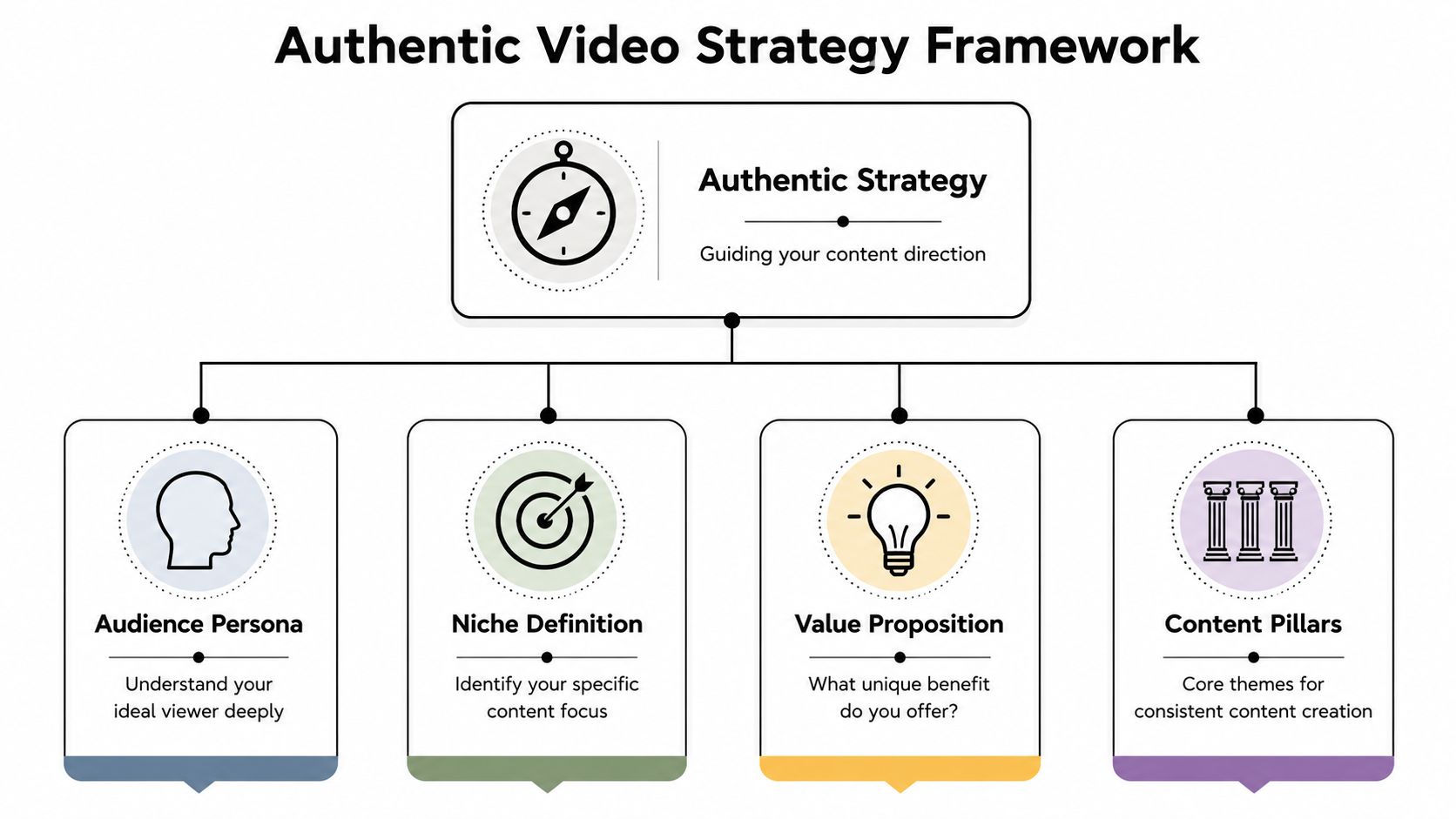
Most founders make content for “entrepreneurs” or “business owners.” That audience is too broad to serve well.
Build a minimum viable audience instead. Pick the people who are most likely to act on your ideas now. Be specific about their stage, pressure, and ambition. A startup founder hiring their first sales team needs different content than a mature agency owner trying to improve margins.
Use this simple filter:
| Question | Strong answer | Weak answer |
|---|---|---|
| Who is this for? | B2B founders with small teams and no content system | Anyone building a business |
| What are they stuck on? | Inconsistent visibility and weak positioning | Growth |
| What do they need from me? | Clear, practical frameworks they can apply this week | Inspiration |
When your audience gets narrower, your content gets stronger. People don't trust creators who speak to everyone. They trust people who clearly understand a specific problem.
Your on-camera voice should be an extension of how you think at your best, not a copy of what performs on short-form platforms.
Use these three voice decisions:
Most audiences don't want performance. They want signal. That's one reason AI-powered video content marketing strategies have become more useful when they support positioning and workflow rather than replace judgment.
A strong strategy does one thing well. It removes guesswork. Once you know your message, your audience, and your voice, video content creation stops feeling like public speaking and starts feeling like disciplined communication.
Inconsistent creators usually blame discipline. That's rarely the issue. They don't have a dependable way to generate ideas, so every posting day starts from zero.
A 2025 industry analysis on business video workflows found that 64% of creators who fail to sustain daily posting cite workflow fragmentation and lack of a systematic ideation process as the main cause, not a lack of ideas. That should change how you think about consistency. You don't need more creativity. You need fewer decision points.
If you sell expertise, your best content usually starts with friction your audience already feels.
Create a simple matrix with two columns. In the first, list recurring problems. In the second, list your opinion on the fix. Don't aim for originality first. Aim for usefulness with a point of view.
Examples:
This matrix gives you dozens of posts fast because each row can become multiple formats:
Founders sit on more content than they realize. Every hiring mistake, pricing lesson, awkward sales call, failed launch, customer win, and strategic pivot can become useful video content if you extract the lesson.
Don't rely on memory. Keep a running story bank in Apple Notes, Notion, Google Docs, or whichever tool you'll open.
Capture stories under these buckets:
The most credible founder content doesn't come from polished inspiration. It comes from processed experience.
A strong story bank prevents the common trap of saying the same generic advice in slightly different ways.
Your audience tells you what to post. Most creators ignore that gift.
Any question that appears in email, sales calls, comments, Slack groups, DMs, meetings, or onboarding belongs in your content system. If one person asked it clearly, others are wondering too.
Use this simple decision framework:
That turns your content from self-expression into demand capture.
Don't brainstorm every day. That's amateur behavior.
Use one recurring block each week to sort ideas into a short publishing queue. A practical setup looks like this:
| Content source | What to capture | Best use |
|---|---|---|
| Audience questions | Repeated objections and FAQs | Conversion content |
| Story bank | Personal experiences with lessons | Trust-building content |
| Problem matrix | Operational or strategic issues | Authority content |
Most founders don't need infinite ideas. They need enough strong ideas to keep publishing without panic. Build the engine once, then keep feeding it. That's how daily video content creation becomes sustainable instead of exhausting.
The expensive-gear obsession is one of the worst habits in video content creation. It gives busy professionals a perfect excuse to delay. They tell themselves they'll start once they buy the better camera, cleaner lens, nicer office, or more “professional” setup.
That's nonsense. Most audiences care more about clarity, pace, audio, and relevance than cinematic polish.
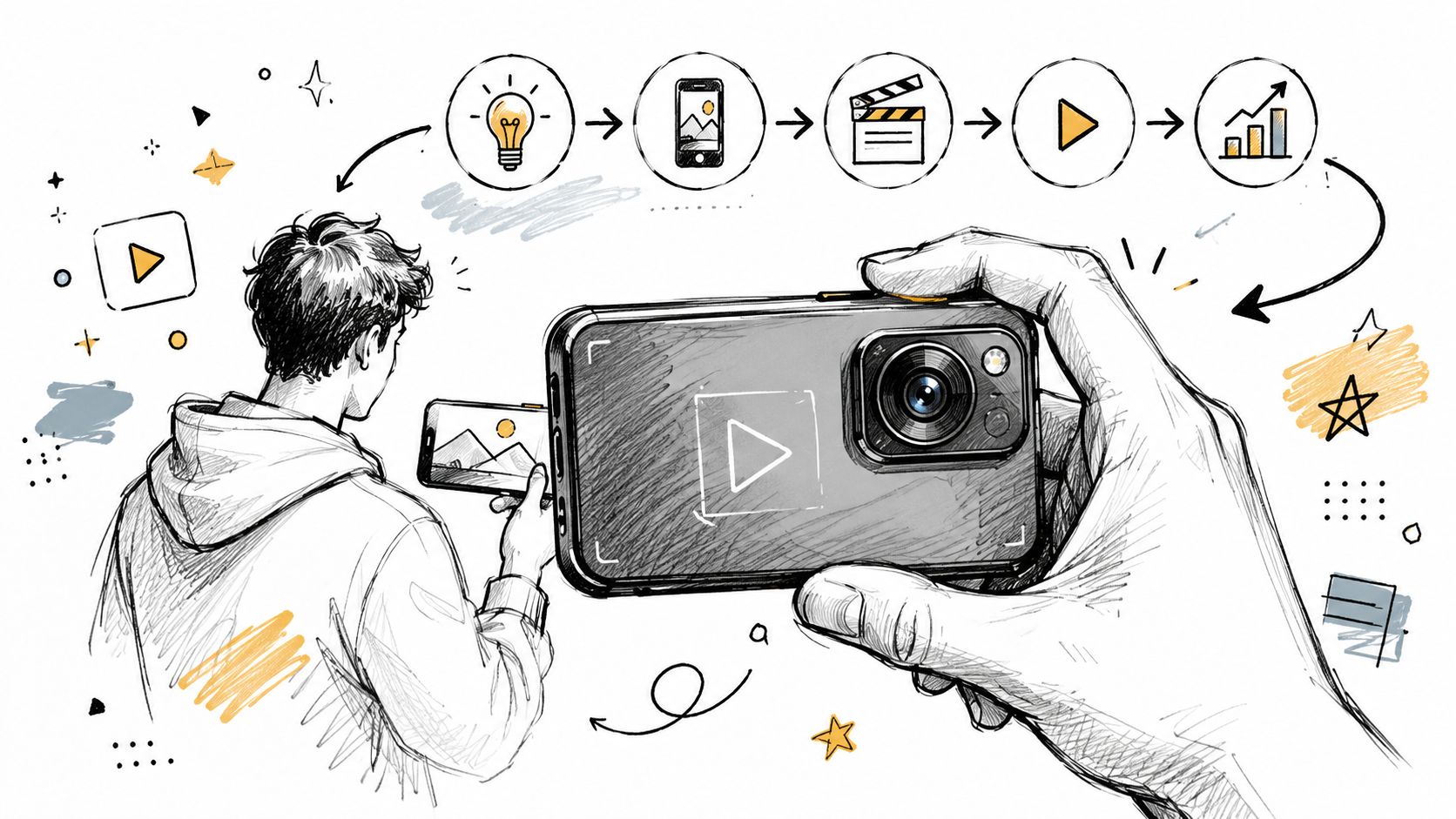
Analysis shared by Twirl's guide on filming angles for creator content found that 78% of top-performing social videos use simple, relatable framing. The useful takeaway isn't “stop caring.” It's “stop overcomplicating.”
Your recording setup should be boring enough to use often.
For most professionals, that means:
That's enough. Consistency beats novelty here. If your environment looks and sounds predictable, your audience starts focusing on your message instead of your setup.
If you want a short list of software and gear options worth considering, this roundup of tools for content creators in 2026 is a useful starting point.
Most tutorials talk about angles like they're decorative choices. They're not. They shape how viewers interpret your authority, openness, and relatability.
Use angle intentionally:
Here's a useful visual example of clean, practical production choices:
Pick one primary angle for each content type and stop improvising every shoot. Your audience doesn't need variety for its own sake. They need visual consistency that reinforces your message.
Most founders waste time by recording one video, watching it back, fixing tiny flaws, then losing momentum. Record in batches instead.
Use this sequence:
Record while your thinking is sharp, not when your calendar happens to be free.
A practical solo workflow often looks like this:
| Minute | Action |
|---|---|
| 1 to 3 | Set framing, light, audio |
| 4 to 6 | Rehearse openers |
| 7 to 15 | Record multiple clips |
That rhythm works because it reduces friction. You're not trying to become a filmmaker. You're building a repeatable communication habit that fits inside a founder's week.
Editing is where good intentions go to die. Founders record useful material, then let the footage sit because post-production feels tedious, technical, or endless.
That's usually a systems problem, not an editing problem.
According to Kapwing's 2026 video marketing statistics roundup, 51% of marketers already use AI for video creation or editing. The same source says these tools can reduce production costs by 80% and cut content creation time by more than half for over 60% of users. If you're still editing every video from scratch, you're choosing slowness.
Your first editing priority isn't speed on the timeline. It's removing repeated decisions.
Create a standard project template with:
Once those decisions are fixed, editing becomes a sorting task rather than a creative struggle every time.

Most non-editors make the process harder by trying to perfect everything in one go. Break the job into clean passes.
Try this workflow:
Import and label
Rough cut
Polish
Export and check
This is faster because each pass has one job.
AI is most useful in post-production when it removes repetitive labor. Use it to generate transcripts, strip filler words, identify pauses, create captions, and suggest strong short clips from long footage.
That doesn't mean surrendering taste. It means preserving your time for decisions that matter:
Fast editing comes from standardization first, software second.
Don't edit daily if your schedule is already crowded. Batch it.
A clean weekly block might look like this:
| Block | Focus |
|---|---|
| First segment | Sort and trim all clips |
| Second segment | Add captions and branding |
| Final segment | Export, name, and queue uploads |
That rhythm protects your attention. Recording and editing are different cognitive tasks. Keep them separate and both get easier. The best post-production system is the one you'll still use when work gets busy.
Posting one video and hoping it spreads is not a distribution strategy. It's wishful thinking.
Strong creators don't squeeze all value from a video in a single upload. They treat each recording as a source asset, then break it into formats that match different platforms, contexts, and audience behaviors.
Start with one substantial piece of content. That might be a founder lesson, a tactical breakdown, a client-facing explanation, or a commentary clip. Then turn it into smaller assets with distinct jobs.
A simple waterfall looks like this:
This is how you stop creating from scratch every day. You're not making more ideas. You're extracting more value from the ideas you already have.
For a deeper walkthrough of this process, this guide on how to repurpose content and multiply your reach is worth reading.
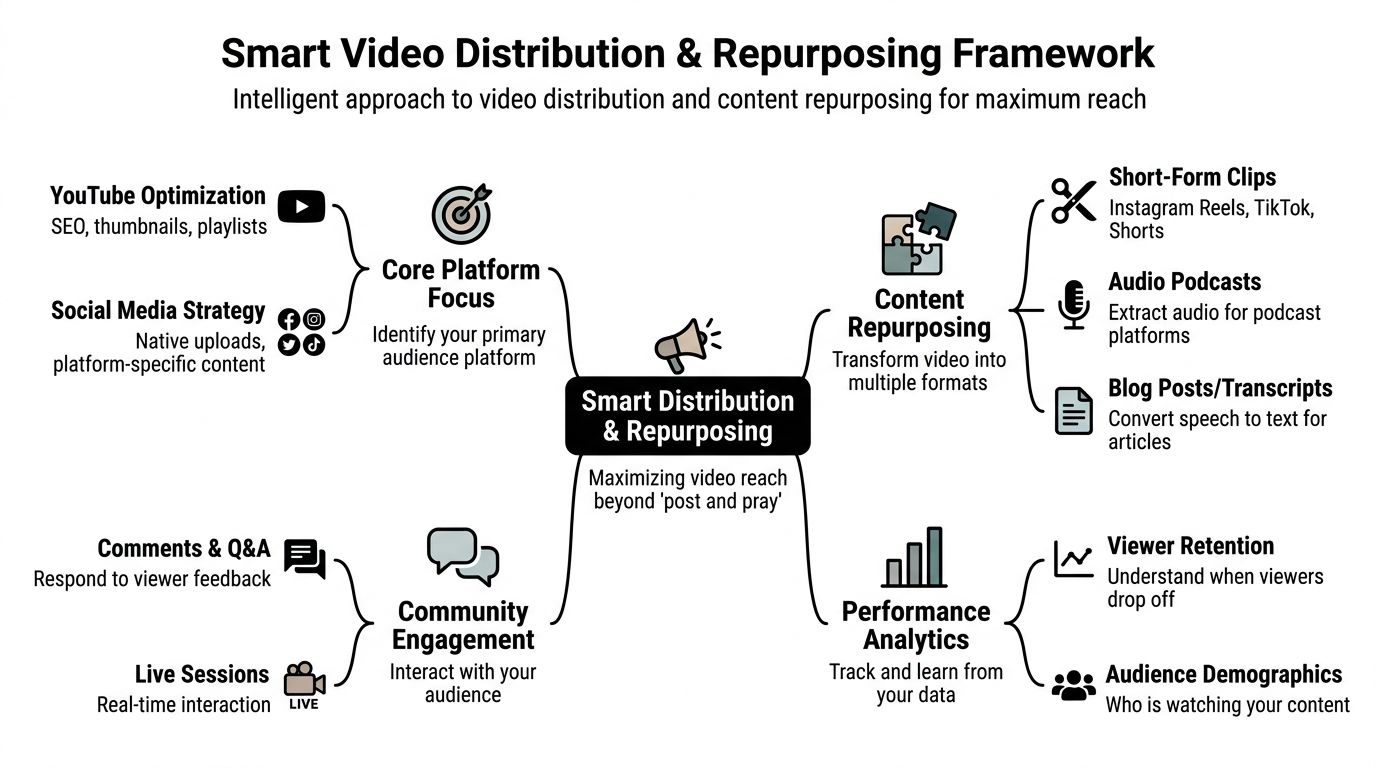
A lot of professionals sabotage distribution by linking out instead of uploading directly to the platform where they want attention.
That mistake is expensive. G2's video marketing statistics article notes that native videos uploaded directly to social platforms generate 10x higher viral reach than sharing external links such as posting a YouTube link on Facebook. If you want performance on LinkedIn, Instagram, or other social feeds, give those platforms native files, native captions, and platform-appropriate framing.
Use external links strategically. Don't use them as your default publishing method.
Not every platform should do the same job for your brand.
Use role-based distribution:
That structure helps you repurpose with intent instead of dumping identical posts everywhere.
The distribution phase isn't over when the video goes live.
The strongest follow-up actions are simple:
A viewer who comments thoughtfully is often more valuable than a passive viewer who scrolls by. Attention matters. Conversation matters more.
Most founders track video like creators, not operators. They watch views, likes, and follower bumps, then wonder why content isn't driving business momentum.
Vanity metrics are not useless, but they're not enough. A video with modest reach can still influence a buying decision, trigger a referral, or start a high-quality sales conversation. If you only measure public reactions, you miss the commercial signal.
Track two categories.
Audience metrics tell you whether the content is holding attention and creating response. Think watch behavior, saves, shares, comment quality, and message resonance. If you need a practical primer on evaluating these signals, this breakdown of social media engagement metrics is a useful reference.
Business metrics tell you whether your content is changing opportunities. Track:
A founder's content is working when it shortens trust-building, not just when it collects reactions.
You don't need a giant analytics dashboard. A basic spreadsheet is enough if you review it objectively.
Use columns like these:
| Video | Topic | Strong audience signal | Business signal | Keep, cut, or refine |
|---|---|---|---|---|
| Video title | Core idea | Comments, saves, replies | DMs, leads, call mentions | Decision |
This review forces a better question than “Did it perform?” Ask, “Did it attract the right kind of attention?”
Most creators change strategy too early because one post flops. That's emotional management, not analysis.
Look for patterns over time:
Then adjust one variable at a time. Improve the opener. Tighten the topic. Simplify the framing. Change the CTA. Keep the core message stable long enough for the market to recognize it.
Video content creation becomes far more effective once you stop treating it like performance art and start treating it like brand infrastructure.
If you want a team to help turn your expertise into consistent, high-impact content without losing your voice, Legacy Builder helps professionals build authentic personal brands through strategy, creation, distribution, and daily execution.


You could – but most in-house teams struggle with the nuance of growing on specific platforms.
We partner with in-house teams all the time to help them grow on X, LI, and Email.
Consider us the special forces unit you call in to get the job done without anyone knowing (for a fraction of what you would pay).
Short answer – yes.
Long answer – yes because of our process.
We start with an in-depth interview that gives us the opportunity to learn more about you, your stories, and your vision.
We take that and craft your content then we ship it to you. You are then able to give us the final sign-off (and any adjustments to nail it 100%) before we schedule for posting.
No problem.
We have helped clients for years or for just a season.
All the content we create is yours and yours alone.
If you want to take it over or work on transitioning we will help ensure you are set up for success.
We want this to be a living breathing brand. We will give you best practices for posting and make sure you are set up to win – so post away.
Subscribe to our newsletter and get insights on how to grow your personal brand.
