.svg)
Subscribe to our newsletter and get insights on how to grow your personal brand.
Thank you! Your submission has been received!
Oops! Something went wrong while submitting the form.
.svg)



Let’s be honest, the term "thought leadership" gets thrown around so much it’s almost lost all meaning. But strip away the buzzword fluff, and you’re left with a powerful, straightforward concept.
It’s about becoming the go-to person in your industry. The one people trust not because you have a sales pitch, but because you consistently deliver real, valuable insights that help them solve problems. You're not just part of the conversation; you're shaping it.

Think of it like this: you’re leading a group through a dense, unfamiliar forest at night. Anyone can hold a flashlight and point at the path directly in front of them. That's what most "experts" do.
A true thought leader, however, carries a lantern. They understand the entire terrain, anticipate the dips and turns ahead, and offer the kind of wisdom that makes the whole journey smoother and safer. That’s the role you want to play for your audience.
You’re not just repeating what everyone else is saying. You’re offering a new lens, a fresh perspective that challenges the status quo and gets people thinking differently.
This is where a lot of people get it wrong. Thought leadership isn't just a fancy term for content marketing. While content is the vehicle, the real engine is the original thinking that powers it. It’s the difference between reporting what happened and explaining what it means for the future.
This distinction is everything. Plenty of people create content, but very few achieve real thought leadership because they're missing the key ingredients:
True thought leadership isn't about pretending you have all the answers. It's about asking the right questions and steering the conversation in a more productive direction. It shifts your position from just another vendor to a trusted advisor.
The end goal? To become the first person or brand people think of when they need guidance in your niche. This takes a serious commitment to building genuine relationships and a community around your ideas. It’s a two-way street—it demands listening and engaging just as much as it demands broadcasting.
Some of the most effective thought leaders elevate their work beyond simple blog posts, creating specialized hubs of influential ideas, almost like their own dedicated organizations akin to a think tank. This is how you build an unshakeable foundation of trust that naturally attracts clients, opportunities, and top talent, cementing your status as an indispensable voice in your field.
Let's be real. Putting in the work to become a thought leader isn't just about stroking your ego or getting a few more followers. It's one of the most powerful moves you can make for your business. It fundamentally changes how the market sees you, flipping the script from being just another option in a crowded field to the essential authority.
That shift doesn't just feel good—it creates real, tangible results that hit your bottom line and set you up for long-term success.
It all starts with credibility. When you consistently share valuable, hard-won insights, you build a foundation of trust. People stop seeing you as someone trying to make a sale and start seeing you as a reliable guide who genuinely gets their problems.
Credibility is the entry fee, but the real prize is brand authority. This is the point where your name becomes the first thing people think of when they have a problem in your niche. You become the automatic answer.
That kind of authority is a massive differentiator. In a noisy market where all your competitors are shouting the same things, your expertise cuts through it all. It builds a protective moat around your brand that's nearly impossible for others to copy because it’s built on real intellectual capital and trust, not just a bigger marketing budget.
This authority also acts like a magnet, pulling in high-value opportunities that you'd otherwise have to chase down. We see this all the time:
Here's the biggest game-changer: you stop hunting for leads and start attracting clients. They come to you. Thought leadership shortens the sales cycle because you establish trust long before a sales call ever happens.
Think about it. Your audience has already read your posts, watched your videos, and gotten value from your insights. By the time they reach out, they're already sold on you. The entire conversation shifts from "Why should I pick you?" to "How do we get started?"
The data backs this up. A staggering 73% of decision-makers say an organization's thought leadership is a more trustworthy way to judge its capabilities than its marketing fluff. And the impact on sales is direct: 60% of buyers are willing to pay a premium to work with a company that’s a clear thought leader.
Ultimately, becoming a thought leader is about playing the long game. It's an investment in building an asset that pays dividends for years in the form of a stronger brand, a shorter sales cycle, and a steady stream of clients who are excited to work with you.
To dive deeper into how to build this kind of influence, read our guide on how to become a thought leader. It’s how you become the one everyone wants on their team.
Building real influence isn't some mysterious art form. It's a structured process, and like any strong structure, it needs a solid foundation. True thought leadership rests on four distinct pillars. Nail these, and the fuzzy idea of "influence" becomes a clear, achievable goal.
These pillars don't work in isolation—they feed into each other, creating a powerful cycle of credibility and impact. If one is weak, the whole thing wobbles. But get all four right, and you'll go from just another voice in the crowd to the voice in your field.
Let's break them down.
First things first: you have to actually know your stuff. I mean, really know it. This isn't about repeating what you heard on a podcast or skimming a few blog posts. It’s about owning a specific corner of your industry so completely that you understand its past, present, and where it’s headed.
This is the hard-won wisdom that comes from being in the trenches—the "10,000 hours" of real-world practice, research, and hands-on work. Your expertise can't just be theoretical; it has to be battle-tested. You've seen what works and what flops, and more importantly, you can explain the why behind it all.
Key Takeaway: True expertise is the price of admission. It’s the non-negotiable foundation that gives you the right to have a strong opinion and earns you the initial respect of your audience.
This isn't just about feeling smart. That deep expertise is what kicks off the entire value chain.
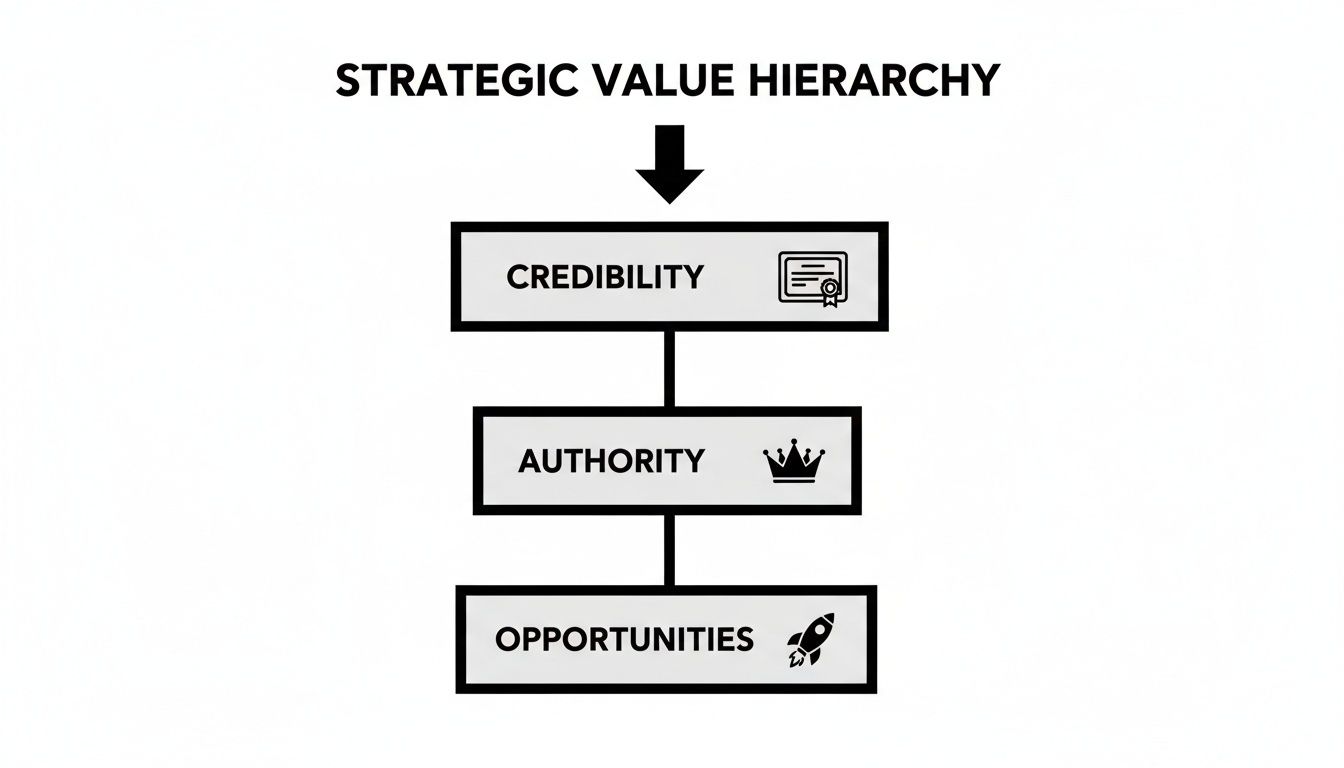
As you can see, expertise is what builds your Credibility. That credibility grows into recognized Authority, which is what ultimately unlocks high-value Opportunities.
Expertise gets you in the door, but your unique point of view is what makes people pull up a chair and listen. The internet is drowning in generic, rehashed advice. Your distinct perspective is your single greatest asset—it’s your angle, your "so what?" that cuts through the noise.
This doesn't mean you need to be a contrarian just for the sake of it. It’s about offering a fresh lens. A strong point of view shows up in a few key ways:
Your perspective is your brand. It’s what makes your content stick and gives people a damn good reason to follow you instead of the thousands of other so-called experts.
Look, having brilliant ideas locked in your head is useless. The third pillar is all about consistently turning your expertise and unique viewpoint into content that genuinely helps your audience. Consistency is the engine of thought leadership.
A single viral post is a fluke. A steady drumbeat of valuable insights is a strategy.
This means committing to showing up for your audience again and again, whether that's through articles, videos, podcasts, or social media posts. Every single piece you publish should reinforce your authority and build a stronger connection with your community. It’s not about pumping out content for the sake of it—the key is value. Every time you hit "publish," you should be aiming to teach, inspire, or solve a real problem.
Finally, thought leadership isn't a monologue shouted from a stage; it's a conversation. You can't build a loyal following by just broadcasting your ideas and walking away. The fourth pillar is about rolling up your sleeves and actually engaging with the community you're trying to build.
That means replying to comments. Answering DMs. Jumping into relevant discussions. It’s about being a real, accessible human who is genuinely interested in what other people have to say.
This kind of authentic engagement is what turns a passive audience into a loyal tribe. It closes the feedback loop, giving you priceless insights into their biggest challenges—which, in turn, fuels your next great piece of content. It's the final piece of the puzzle that makes your leadership feel earned.
Look, having deep expertise and a unique point of view is a great start. But let's be real—without a plan, your best ideas are going to collect dust. This is where you have to get your hands dirty and turn theory into action.
A solid content strategy is what connects your knowledge to your influence. It’s how you turn abstract ideas into real assets that build your authority, one post at a time. This isn't about creating more content. It's about creating the right content, consistently, so you don't burn out and every single piece you publish has a purpose.
Before you write a single word, stop and figure out who you're talking to and what conversation you want to own. The single biggest mistake I see aspiring thought leaders make is trying to be everything to everyone. It doesn't work. Your real power is in specificity.
Don't be a generic "business consultant." Be the go-to expert on "scaling SaaS companies from $1M to $10M ARR with product-led growth." See the difference? Your niche gives you your audience, your topics, and your value. It’s the small pond where you can finally become a big fish.
Ask yourself these three questions to nail it down:
Okay, you’ve got your niche. Now you need a core message. This is the big idea, the philosophy that ties all of your content together. Think of it as your thesis statement for your entire industry.
A strong core message is punchy, memorable, and usually a little provocative. It should challenge the old way of doing things and offer a better path forward.
For example, a marketing expert’s core message might be: "Stop chasing vanity metrics. Build a small, obsessed community that actually drives revenue." That one idea can fuel hundreds of pieces of content, all hammering home the same powerful theme.
Your core message is your North Star. It keeps your content focused and makes sure that, over time, your audience knows exactly what you stand for.
You don't need to be on every platform. In fact, you shouldn't be. The key is to pick the formats and platforms that play to your strengths and, more importantly, where your audience already spends their time. Our guide on crafting a modern playbook for personal branding for leaders dives deeper into this.
Your main goal is to pick one "pillar" format for your deep-dive content and a few "micro" formats for daily engagement and distribution.
Here’s the simple strategy: Create one big piece of pillar content, then slice it up into dozens of micro-content pieces for your social channels. This system maximizes the value of your ideas without you having to constantly reinvent the wheel.
Consistency is the engine that drives authority. A content calendar is the simple, practical tool that makes it happen. It's just a schedule that maps out what you'll post, when, and where.
This isn't about being rigid; it's about being reliable. A calendar kills the daily "what should I post?" panic and helps you build momentum. It also lets you think strategically, planning content themes weeks or months out so they build on each other and tell a cohesive story.
You can start simple with a weekly plan:
This structured approach turns content creation from a chore you react to into a proactive, strategic process. It’s the framework that lets you execute your vision and consistently show up as the expert people can rely on.

Creating brilliant content is only half the battle. Let’s be real—even the best ideas are useless if no one ever sees them.
This is the exact spot where most aspiring thought leaders get stuck. They obsess over crafting the perfect article or video but completely drop the ball on distribution. You have to stop thinking like a creator and start acting like a master of amplification.
Your content needs a powerful second act. It's all about getting your message in front of the right people and then—this is the crucial part—sparking a real conversation. This is how you go from talking at your industry to talking with it.
Forget the old "spray and pray" method. Blasting your content across every social media platform is just creating noise, not influence.
The real key is to pick one or two platforms where your ideal audience actually hangs out and is ready to talk business. For most founders, execs, and serious professionals, that platform is LinkedIn.
It’s where decision-makers are actively hunting for insights. This makes it the perfect ground to build your authority. Your strategy should be built around this one central hub, systematically breaking down your big ideas and sharing them there to drive traffic and get people talking.
Once you've chosen your main stage, you need to own it. This is about more than just tossing up a post and hoping for the best. It’s about turning your profile into a magnet for your ideal audience and getting active in the community.
Here’s how to turn a platform like LinkedIn into your personal influence engine:
The goal is not just to be seen, but to be sought out. A well-executed distribution and engagement strategy ensures your insights find their way into the daily feeds and conversations of the people who matter most to your career and business.
The final step—and maybe the most important one—is making the shift from a broadcaster to a community builder. This is what separates the flash-in-the-pan experts from true, lasting thought leaders.
It’s not enough to post your ideas and just walk away. You have to stick around and foster a real dialogue.
When people take the time to comment on your posts, reply. Don't just "like" it—add to the conversation. This simple act shows you're actually listening and turns passive followers into a loyal community. If you want to dive deeper into this, check out our guide on how to write LinkedIn posts that build your personal brand.
And don't just wait for people to come to you. Go out and find conversations happening in your niche. Find posts from other industry players and drop your unique perspective in the comments. This is how you build relationships and get your expertise in front of entirely new audiences.
Pouring your heart and soul into creating content is a huge investment of time and energy. So, how do you know if it's actually working?
True thought leadership isn't measured in likes and followers. Let's get that straight. It's tracked by real-world results that move the needle for your business and your career.
It’s time to look past the vanity metrics. Sure, high engagement numbers feel good, but they don't pay the bills. The real question is: are the right people paying attention? Your influence is best measured by the quality of the conversations you're starting, not just the quantity of clicks.
This means we need to shift our focus to indicators that prove you're building genuine authority.
To see the real return on your efforts, you have to connect your content to concrete business outcomes. These are the metrics that actually matter because they signal real momentum.
Instead of just counting likes, start tracking these:
Tracking these outcomes proves you're building more than just a following—you're building a reputation. It transforms your content from a line item expense into a strategic asset that creates opportunities.
The analytics on platforms like LinkedIn are your secret weapon. They give you a direct feedback loop, showing you who's viewing your content, their job titles, and what industry they're in. Use this intel to figure out which topics truly connect with the people you want to reach.
This data-driven approach lets you double down on what works and cut what doesn’t. Are certain types of posts sparking more conversations with VPs of Sales? Do specific topics lead to more connection requests from potential partners? Learning how to measure brand awareness and fuel your growth is how you stop guessing and start building a real strategy.
When you start monitoring these metrics, you prove that thought leadership isn’t some vague, fluffy concept—it's a measurable business strategy with a clear and powerful ROI.
Jumping into thought leadership can feel like a huge commitment, and it's totally normal to have a few questions before you go all-in. It’s not about just flipping a switch.
Let's clear the air and tackle the most common questions and roadblocks I hear from founders. This will help you set the right expectations from day one.
Let's be real: this is a marathon, not a sprint. You're building trust, and that doesn't happen with a few viral posts. It’s about showing up, day in and day out.
With a solid, consistent strategy, you'll start to see real traction within 3-6 months. This looks like more DMs, more connection requests from the right people, and higher engagement on your posts. But to become the undisputed go-to name in your space? That usually takes 12-24 months of relentless execution. The magic is in the consistency—every single post builds on the last, creating a snowball of influence.
Authority is built brick by brick, not in a single leap. The goal isn't instant fame but steady, compounding influence that creates lasting impact and opportunity.
Absolutely not. This is one of the biggest myths out there. Your authority has nothing to do with your title and everything to do with your perspective.
An engineer who has a totally unique way of looking at software development can become a thought leader. So can a project manager who's created a game-changing new workflow. Your title doesn't earn you respect—your insights do. It’s all about owning a specific conversation in your niche, no matter where you sit on the org chart.
This is a fear I hear all the time, but it’s easier to solve than you think. You don't have to come up with a brilliant, earth-shattering idea every single day.
First, lock in three to five core themes you’re actually passionate about. These are your content pillars. Then, just listen. The questions your audience asks in your comments, the problems they're venting about in industry groups—that's your content goldmine. Add your take on current trends, and you're set.
If you have a simple system for mapping your core topics and you're actively listening, you’ll never run out of things to say. You'll have an endless stream of valuable content just waiting to be shared.
Building a personal brand that positions you as a thought leader takes work, but the payoff is massive. If you're ready to turn your expertise into real influence and opportunities but aren't sure how to start, Legacy Builder is here to help. We take your unique insights and turn them into a consistent flow of high-impact content that builds your authority.
Book a discovery call with us today to start building your legacy.


You could – but most in-house teams struggle with the nuance of growing on specific platforms.
We partner with in-house teams all the time to help them grow on X, LI, and Email.
Consider us the special forces unit you call in to get the job done without anyone knowing (for a fraction of what you would pay).
Short answer – yes.
Long answer – yes because of our process.
We start with an in-depth interview that gives us the opportunity to learn more about you, your stories, and your vision.
We take that and craft your content then we ship it to you. You are then able to give us the final sign-off (and any adjustments to nail it 100%) before we schedule for posting.
No problem.
We have helped clients for years or for just a season.
All the content we create is yours and yours alone.
If you want to take it over or work on transitioning we will help ensure you are set up for success.
We want this to be a living breathing brand. We will give you best practices for posting and make sure you are set up to win – so post away.
Subscribe to our newsletter and get insights on how to grow your personal brand.
