.svg)
Subscribe to our newsletter and get insights on how to grow your personal brand.
Thank you! Your submission has been received!
Oops! Something went wrong while submitting the form.
.svg)


Here's a hard truth: most small businesses get social media all wrong. They post randomly, chase follower counts, and wonder why they aren't getting any real business from it.
A winning small business social media strategy isn't about just posting. It's a focused plan—a system—that’s tied directly to your business goals, designed to generate leads, build brand awareness, and create a genuine community. Every single post, every interaction, needs a "why."

The biggest mistake I see? Posting without a plan. Being effective on social media isn't about being on every single platform. It’s about being strategic where it really counts.
So, how do you build that strong foundation? It all starts with two key steps: taking an honest look at where you are now and setting crystal-clear goals for where you want to go.
Before you can build, you have to know what you’re working with. A social media audit is your reality check. It shows you what's working, what's a total waste of time, and where the hidden opportunities are.
Start by pulling up all your social media profiles. Look at them with a critical eye. Is your branding consistent? Is your bio actually telling people what you do and giving them a clear next step?
Next, you need to get into the numbers. The native analytics tools on platforms like Instagram and Facebook are goldmines. Look at your top-performing posts from the last 90 days. Are they videos? Carousels? Simple text updates? This isn't about vanity; it’s about understanding what your audience actually wants from you.
Also, look past the likes. Are people actually commenting? Starting conversations? Genuine interaction is a much stronger signal of a healthy account than a high follower count. Your audit should give you a simple report card for each platform, highlighting what to keep and what to kill.
Key Takeaway: An audit isn't about beating yourself up over past mistakes. It's about gathering cold, hard data to make smarter decisions. Stop guessing and start building a strategy based on what actually works.
Once you know your starting point, it's time to define your destination. Vague goals like "get more followers" lead to scattered, pointless activity. We don't do that here.
Instead, use the SMART framework. It turns fuzzy wishes into real, actionable business objectives.
Let's see this in action. We're going to turn a flimsy goal into something you can actually execute on:
See the difference? That level of clarity is everything. To really nail this, you need to understand the core principles of Social Media & Community Management. When your goals are this specific, every piece of content you create has a clear purpose, moving you one step closer to a real return on your time and effort.
Stop talking to everyone. It’s a waste of your time and theirs.
A social media strategy that actually works is built on one thing: knowing exactly who you’re talking to. Posting content without a clear audience is like shouting into the wind. You’re making noise, but no one is really listening.
To make your efforts count, you have to go deeper than basic demographics. Forget just age and location. You need to build detailed audience personas that feel like real people. What are their biggest professional headaches? What goals keep them up at night? What kind of content will they actually stop scrolling for?
An audience persona isn't just a creative writing exercise. It's a strategic tool. This is a semi-fictional character you build from data and a little bit of educated guesswork. Give them a name, a job title, and a story.
Let's say you're a business coach. You might be targeting "Startup Sarah." She's a 35-year-old founder, completely overwhelmed by operations and trying to figure out how to scale her team. Her biggest pain point? She’s stuck in the day-to-day grind and can't find time for high-level strategy. You know she’s on LinkedIn during her lunch break, scrolling for quick, actionable leadership tips.
See how that changes everything? Once you know "Sarah," creating content for her feels natural. You know her problems, you know where she hangs out online, and you know what solutions she's looking for.
If you want to go deeper on this, check out our full guide on how to find your target audience for a personal brand.
Once you have a clear persona, picking your social media platforms is no longer a guessing game. Forget spreading yourself thin across every network out there. Focus your energy on the 1-3 platforms where your ideal customer is already active and listening. Go where the conversations are already happening.
The trick is to match the platform's user base and content style with your business and your audience.
Don’t just chase trends. A viral TikTok dance isn't going to sell your high-ticket consulting package. Pick platforms where your presence feels authentic and actually adds value to your specific audience.
Choosing a platform also means understanding how people actually interact on it right now. The social media world changes fast. What worked last year is probably already outdated. You need to know which platforms are giving you the best bang for your buck in terms of interaction.
The data shows huge differences. For example, TikTok has become an engagement powerhouse with an average rate of 5.3%, blowing other platforms out of the water. On Instagram, Reels get 35% more engagement than standard videos, even though the platform's overall rate is just 0.48%.
Meanwhile, Facebook's engagement has cratered to a measly 0.06%, making organic reach a serious uphill battle. For B2B brands, LinkedIn is where the action is—posts with images or native video get twice as many comments as text-only updates.
This isn't just trivia; it's critical intel for your strategy. It tells you not only where to be but how to show up. If you're on LinkedIn, you need visuals. If you're on Instagram, you better be making Reels. Focusing your resources on the right platforms and formats is the fastest way to get real results.
Alright, you know who you’re talking to and where they are. Now, the real work begins: deciding what you’re actually going to say. This is where your small business social media strategy goes from an idea on paper to something tangible.
Let’s be honest, consistent, high-value content is the engine that drives everything on social media. But it doesn't just happen. You have to be intentional.
The goal is to get out of that frantic, "what do I post today?" mindset. Instead, you'll build a deliberate system with core topics—we call them content pillars—and an efficient workflow so you can create a ton of content without burning yourself out.
Content pillars are the 3-5 core subjects you’ll talk about over and over again. These are the topics where your expertise, your business goals, and what your audience actually needs all overlap. Think of them as the main sections of your brand’s library.
When you stick to these pillars, you're training your audience. They learn what to expect from you, and you become their go-to source on those specific subjects.
Here’s what this looks like in the real world:
Expert Tip: Stop talking about your product features. Your content pillars should solve the problems your audience is facing. Your product becomes the obvious solution within that conversation, not the entire conversation itself.
Everything flows from this core strategy—defining who you're talking to, picking the right platform, and then creating content that resonates.
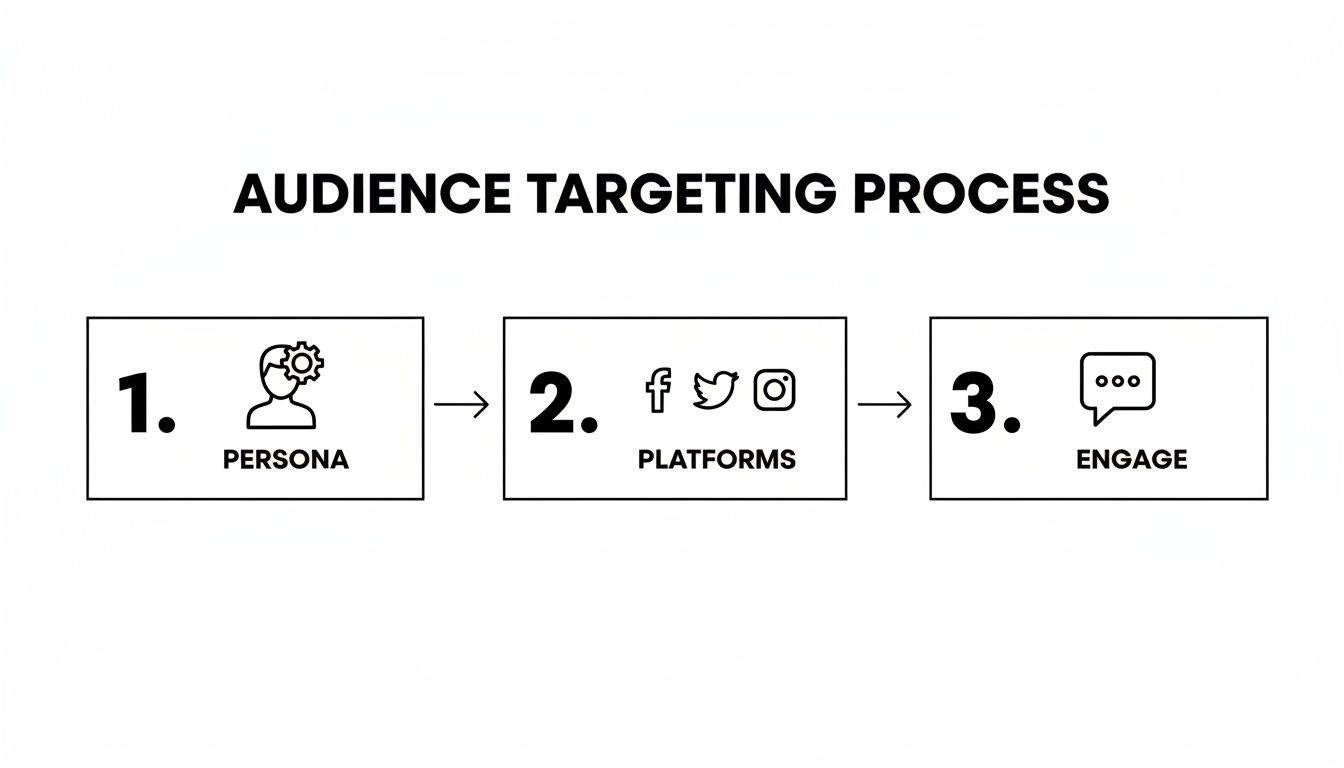
Effective engagement is the final piece of the puzzle, but it only works if you've done the foundational work of understanding your audience first.
Got your pillars? Good. Now you need to think about all the different ways you can present that information. If you only post text, your feed will get stale, fast. A smart strategy mixes things up to keep your audience hooked.
Let's go back to the accounting firm and their "Small Business Tax Tips" pillar. Here's how they could slice and dice that one topic into multiple formats:
Mixing it up like this keeps your audience engaged because you’re catering to everyone. Some people love video; others just want to scan a quick carousel. Give them both.
Here's the secret to staying consistent without living on social media: content repurposing.
This is how you work smarter, not harder. You take one big idea and break it down into dozens of smaller pieces of content.
Let's say you host a 30-minute webinar on "Financial Planning for Entrepreneurs." That one webinar is a content goldmine.
To show you what I mean, here's a simple table outlining a repurposing workflow. This is how you can turn a single long-form asset into multiple pieces of social media content.
Content Repurposing Workflow Example
From just one webinar, you can easily create video clips, quote graphics, educational carousels, a full blog post, and a Twitter thread. You now have over a dozen assets ready to go.
This process ensures your valuable insights reach the widest possible audience across every platform you're on. It's the key to building a sustainable and effective social media strategy without the burnout. For a deeper dive into scheduling, check out our content calendar template for social media that actually works.

Having a solid content plan is a great start, but it’s only half the battle. Let's be real—social media isn't a megaphone for shouting promotions. It's a living, breathing space for real connection.
The magic happens when you stop just posting and start actively participating. This is how you transform passive followers into a genuine community of people who trust you and champion your brand. It’s about being human, showing up, and proving you’re actually listening.
Consistency in engagement is just as critical as your posting schedule. You need a simple, daily routine to manage it all without getting glued to your phone 24/7. This just means carving out a focused block of time each day to build your community.
Your daily checklist should be simple:
This daily habit proves there's a real person behind the account who cares. A "post and ghost" strategy will never build the deep connections that this simple act of showing up does.
Good content gets likes. Great engagement starts conversations. Your goal isn't just to state facts; it's to get a response and turn your feed from a monologue into a real dialogue.
Try asking open-ended questions in your captions. Instead of saying, "Here are three ways to improve productivity," ask, "What's your biggest productivity blocker this week?" See the difference? That tiny shift invites people to share their own stories.
Promptness matters more than you think. Most people on social media expect brands to be responsive. Aim to reply to comments within 24 hours. That's how you build the kind of loyalty that turns casual followers into true fans. You can find more insights on the latest social media trends for small businesses on SBDC.uh.edu.
And don't forget to use the tools the platforms give you. Polls, quizzes, and Q&A stickers on Instagram Stories are perfect for easy, low-effort interaction. They give your audience a simple way to engage and give you valuable feedback at the same time.
Community building isn't just about what happens on your own profile. You also have to get out there and network within your niche—but you have to do it without being pushy or self-promotional.
Spend 10-15 minutes a day engaging with other accounts. I’m talking about leaving thoughtful comments on posts from peers, potential clients, or brands you admire. A good comment asks a question or adds a genuine perspective. A bad comment is just, "Great post!"
Here are a few tactics to try:
This approach positions you as a helpful, engaged expert. People will naturally get curious about who you are, leading to organic profile visits from followers who are already warmed up to what you do.
If you can't measure your efforts, you can't improve them. It's that simple. A real social media strategy isn't built on guesswork or gut feelings; it's forged with data. But it's easy to get lost in a sea of numbers that don't actually tell you if you're getting closer to your business goals.
The biggest mistake I see is focusing on vanity metrics. A rising follower count might give you a nice ego boost, but it doesn't pay the bills. Instead, we need to track the key performance indicators (KPIs) that signal real business impact.
Forget obsessing over likes and followers for a moment. To truly understand if your social media is working, you have to look at the numbers that connect directly to your bottom line. These are the metrics that show whether your time and effort are generating actual business value.
Here are the KPIs that I tell my clients to obsess over:
Focusing on these numbers gives you a clear picture of your return on investment (ROI). Knowing how to track them is essential. We break it down in our guide on how to measure social media ROI for your personal brand.
Let's be real. Building a meaningful presence and seeing tangible results takes time. While some tactics can bring quick wins, a strong social media strategy is a long game. It's about building trust and relationships, and that doesn't happen overnight.
Key Insight: Meaningful ROI from social media often requires 3-6 months of consistent effort. You're not just posting; you're building brand equity, and that's an investment that pays off over time.
In fact, research shows that social media marketing can deliver an average ROI of $5.28 for every $1 spent. While some businesses see positive returns within the first month, the real results—qualified leads and consistent sales—build momentum over that 3-6 month period. To keep improving, you'll want to dig into a complete guide to social media optimisation (SMO) to keep refining your process.
A great strategy is a living thing; it evolves. The best way to make sure your strategy stays effective is to run a simple performance review at the end of each month. This isn't about creating a massive, complicated report. It's a quick, focused check-in to see what worked, what didn't, and why.
Just set aside an hour and ask these three questions:
The answers here are your roadmap for next month. They give you actionable insights to double down on what works and stop wasting time on what doesn't. This cycle of posting, measuring, and optimizing is the engine that drives a powerful and profitable social media strategy.
Even with a solid plan, you're going to have questions. It's completely normal. When you're the one wearing all the hats in your business, it’s easy to get bogged down in the details of social media.
Let’s tackle some of the most common roadblocks I see founders run into. My goal isn't just to give you quick answers, but to help you make smart, efficient decisions so you can get back to business.
Consistency beats intensity. Every single time. You don't need to live on social media to get results, but you do need to be intentional with your time.
Aim for a dedicated 30-60 minutes a day. If you try to do more than that right out of the gate, you're just signing up for burnout.
Here’s a realistic way to break down that time:
Using a scheduling tool is a total game-changer here. When your content is scheduled in advance, your daily time block can be dedicated almost entirely to engagement—which is where the real growth happens.
You absolutely do not need to drop a fortune on fancy software to run a powerful social media presence. In fact, many of the best tools have free versions that are more than enough to get you started and look professional.
Start with this simple, free tech stack:
My advice? Only upgrade your tools when you genuinely outgrow their free features. Start lean. Reinvest your money back into the business, maybe on some targeted ads, but only after you have an organic strategy that’s actually working.
This is one of the biggest mental hurdles I see, and it’s built on a myth. On social media, authenticity is always more engaging than polished creativity. People follow you for your expertise and your unique point of view, not for a Hollywood production.
Forget the pressure to be "creative." Just start documenting. Your best content ideas are hiding in plain sight in your daily work.
Often, the simplest formats are the most powerful. A quick video shot on your phone explaining a concept can be incredibly effective. A single, powerful quote from your area of expertise can become a highly shareable graphic. Your unique experience is your most valuable asset—use it.
Before you spend a single dollar on ads, you need to earn the right to. Running ads to a weak or empty profile is like pouring water into a leaky bucket. It's a waste. Build your organic foundation first.
Run through this quick checklist before you even think about your first ad campaign:
Once you can check all three boxes, you’re ready. Start small—even $5-$10 a day—and "boost" your best-performing organic posts to a targeted audience. This way, you’re putting money behind content that’s already proven to work. Ads should accelerate a good strategy, not fix a broken one.
At Legacy Builder, we specialize in taking these questions off your plate. We transform your expertise into a consistent stream of high-impact content, managing everything from strategy to daily posting so you can focus on running your business. Explore how we can build your legacy online.


You could – but most in-house teams struggle with the nuance of growing on specific platforms.
We partner with in-house teams all the time to help them grow on X, LI, and Email.
Consider us the special forces unit you call in to get the job done without anyone knowing (for a fraction of what you would pay).
Short answer – yes.
Long answer – yes because of our process.
We start with an in-depth interview that gives us the opportunity to learn more about you, your stories, and your vision.
We take that and craft your content then we ship it to you. You are then able to give us the final sign-off (and any adjustments to nail it 100%) before we schedule for posting.
No problem.
We have helped clients for years or for just a season.
All the content we create is yours and yours alone.
If you want to take it over or work on transitioning we will help ensure you are set up for success.
We want this to be a living breathing brand. We will give you best practices for posting and make sure you are set up to win – so post away.
Subscribe to our newsletter and get insights on how to grow your personal brand.
