.svg)
Subscribe to our newsletter and get insights on how to grow your personal brand.
Thank you! Your submission has been received!
Oops! Something went wrong while submitting the form.
.svg)


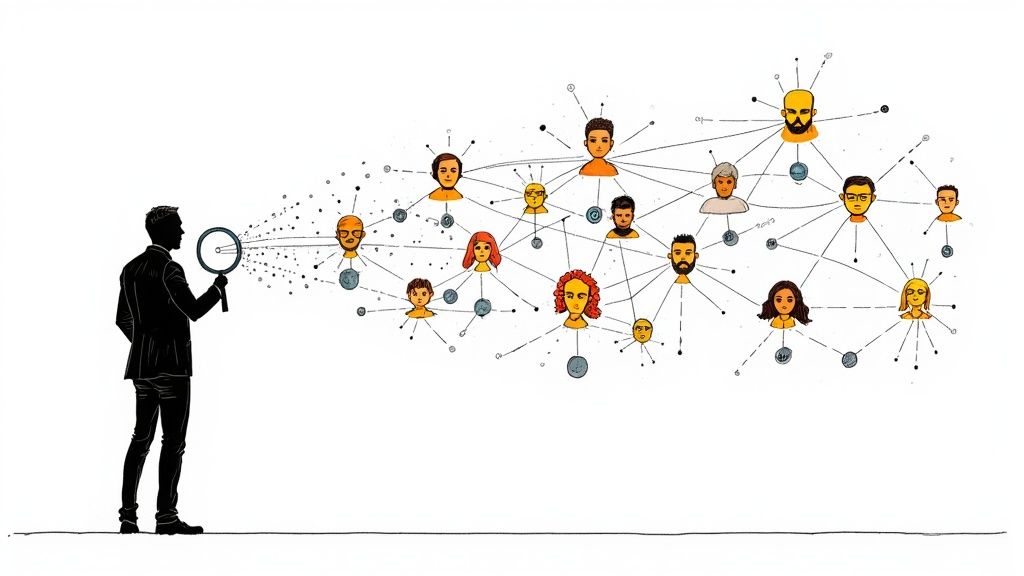
Before you even think about finding your audience, you have to look in the mirror.
Seriously.
It’s so easy to get distracted by analytics, demographics, and social media stats. But the most powerful personal brands aren’t built by chasing an audience; they’re built by becoming a magnet for the right one.
This all starts with getting crystal clear on who you are and what you stand for. You need to know your own destination before you ask anyone else to come along for the ride.
Think of it this way: trying to find your audience without first defining your brand is like shouting into a void. You might make some noise, but you won’t connect with anyone meaningful.
The goal here is to nail down your own value so tightly that the people who need you can’t help but stop and listen. Appealing to everyone is a surefire way to resonate with no one.
Let’s break it down.
Your Unique Value Proposition (UVP) is what makes you, you. It's not just your job title. It's the unique blend of your skills, your story, and the specific way you get results.
Ask yourself: What do I know or what have I experienced that almost no one else has?
A "financial advisor" is a dime a dozen. But what about "a financial advisor who helps freelance creatives build sustainable wealth by blending artistic passion with pragmatic financial planning"? Now that is specific. It instantly tells you who it's for and what makes it different.
To get to your own UVP, dig into these areas:
This simple, three-step flow is everything. It all starts with your value, which points you to the problem you solve, which then helps you craft the message that attracts your people.
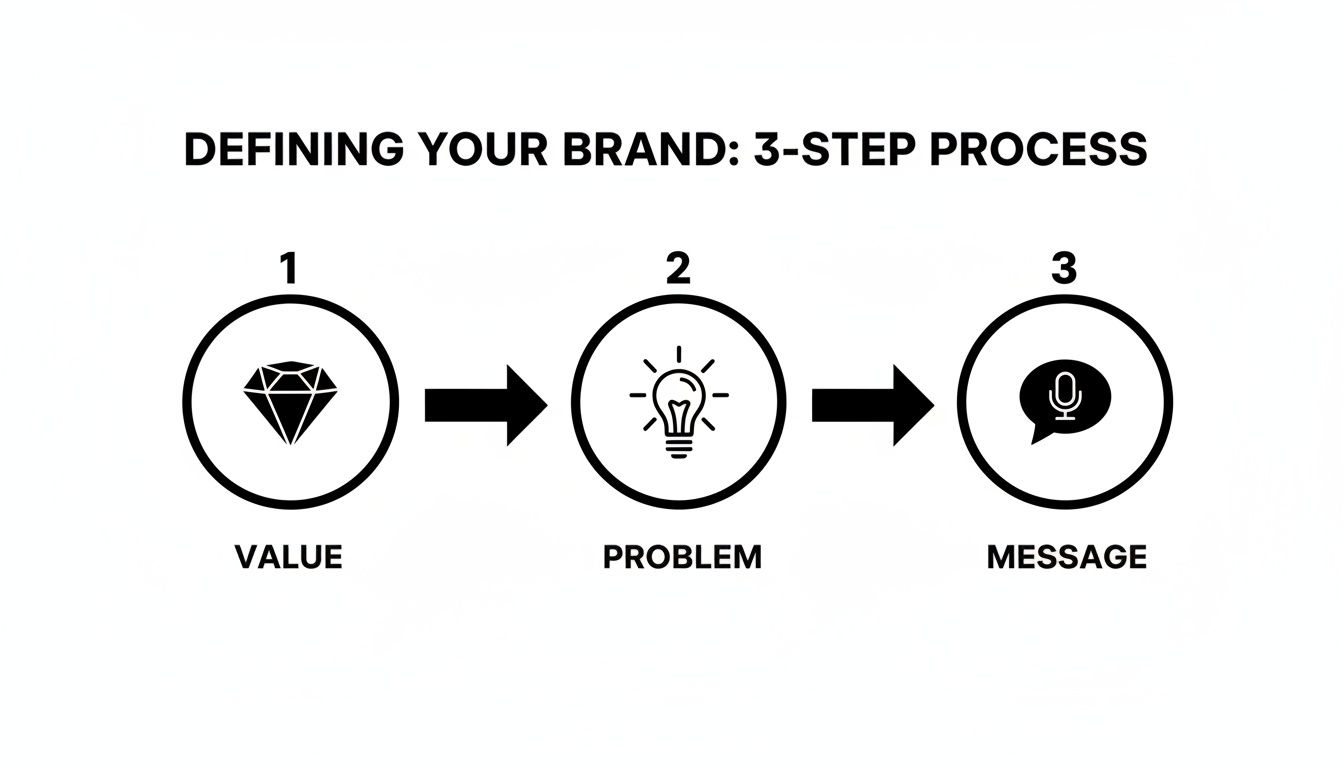
Get this foundation right, and everything else becomes ten times easier.
Here’s a hard truth: people don’t follow experts just for the sake of it. They follow experts who can solve their problems.
Your next move is to connect your value directly to a pain point you can eliminate.
Let's go back to our financial advisor for creatives. The problem they solve isn't just "managing money." It's so much deeper. They solve the crippling anxiety artists feel about their finances, the stress of a fluctuating income, and the fear that they’ll have to give up their passion to be financially stable.
When you define the problem with real empathy, you stop being just another service provider. You become the solution. This is how you build a loyal following that truly trusts you.
Once you have this figured out, you're on the path to building true brand authority—the kind that naturally pulls the right people into your orbit.
Last step. You need to boil down your value and the problem you solve into a single, repeatable core message. This is your one-liner, your bio, the North Star for all your content.
Keep it simple, clear, and powerful.
This isn’t some fluffy tagline. It’s a promise. It tells people exactly what they get by paying attention to you.
For example, a career coach for new tech managers could have a core message like: "I help new tech leaders navigate tricky team dynamics and ship incredible products without burning out." In one sentence, you know who they help, the problem they solve, and the outcome they deliver.
With your value, problem, and message locked in, you now have a powerful filter. From here on out, all your audience research will be smarter and way more effective. You're not just looking for anyone anymore.
You're looking for your people.
Alright, you've nailed down your core message. Now, it's time to stop looking inward and start looking out. We need to become audience detectives.
This isn't about guesswork or making assumptions about who your people are. It's about finding real, tangible proof of what they struggle with, where they hang out online, and what they secretly wish someone would create for them.
We're going to blend the hard data from analytics with the rich, human stories you find in communities and one-on-one chats. This is where the magic happens—turning a fuzzy idea of an "audience" into a crystal-clear picture of a person you can actually help.

Before you go digging for new information, look at the goldmine right under your nose: your existing digital footprint. Your social media and website analytics are packed with clues about who's already paying attention.
Instagram and Facebook, for example, will give you a demographic breakdown of your followers—age, gender, location. Google Analytics goes even deeper, showing you your website visitors' interests, how they found your site, and which blog posts or pages they spent the most time on.
This is your baseline. It gives you an initial hypothesis about who your audience might be, which you can then test and flesh out with more detailed research. It's the first real step in how to find your target audience.
Want a shortcut? Go look at the audiences of established brands or competitors in your niche. Seriously. They've already done the heavy lifting of building a community. Your job is to go learn from it.
Pop over to their Instagram, LinkedIn, X, or TikTok profiles and spend some time in the comments.
Look, this isn't about ripping off their strategy. It’s about understanding the conversation that's already happening so you can find a gap where your unique perspective can shine. Maybe they only scratched the surface on a topic you can go deep on.
Social media gives you the "what," but online forums and niche communities give you the "why." Places like Reddit, Quora, and industry-specific Facebook Groups are unfiltered treasure troves. People go there to vent, ask for help, and share their wins.
This is where you'll find the raw, emotional language that makes your content feel like you're reading their mind. You’re not just looking for topics—you’re looking for feelings, fears, and the deep-seated problems keeping them up at night.
Try searching for keywords related to your expertise. If you're a career coach, you might search for things like:
The search results will hand you the exact vocabulary your target audience uses to describe the problems you solve. For anyone just starting out, learning how to find low-competition niches can be a game-changer, helping you pinpoint these underserved conversations.
Choosing the right mix of research methods is key to getting a well-rounded view of your audience. Each approach has its own strengths and weaknesses.
This table breaks down the most common methods to help you decide which ones make sense for you.
No single method is perfect. The best approach is to combine the quantitative data from analytics with the qualitative insights from listening and interviews.
Data and digital snooping are great, but nothing beats a real conversation. I call this an "Audience Listening Tour"—a series of quick, informal chats with people who fit your potential audience profile.
This isn’t a sales pitch. It’s not a formal interview. It's a conversation driven by pure curiosity.
The goal is simple: listen way more than you talk. Reach out to a few folks in your network or post in a relevant online group offering to trade 15 minutes of their time for a virtual coffee.
Your goal is to understand their world. Ask open-ended questions about their goals, their biggest challenges, and what they've already tried to solve their problems. This qualitative data adds the color and context that quantitative numbers can never provide.
Globally, there's a huge pool of potential clients online, with an estimated 5.2–5.66 billion social media users in 2024–2025. Data helps you narrow that down. Instead of a vague goal, you can form a real hypothesis, like targeting professionals aged 25–34 in India on Instagram, a massive and active demographic.
Once you have that clearer picture, we have tools that can help you discover exactly how to connect with them authentically.
All that research you did? That's just the raw material. Now it's time to take those scattered data points and interview notes and build a persona that actually feels human.
This isn't about slapping a stock photo on a generic profile. It’s about creating an empathy map that guides every single piece of content you create.
The goal is to know this person so well that creating content stops feeling like marketing and starts feeling like a helpful conversation with a friend. When you can picture that one specific person, your messaging gets sharper, your topics land better, and your brand feels real.
A killer persona is the bridge between understanding your audience and actually connecting with them. Forget the vague descriptions. A powerful persona is built on the nitty-gritty details you dug up during your research, blending the 'who' (demographics) with the all-important 'why' (psychographics).
First things first, give your persona a name. It’s a simple trick, but it instantly makes them feel more real.
Let’s say you’re a career coach for people in the tech industry. Based on your lurking in LinkedIn groups and tech forums, you sketch out a persona named "Alex, the Ambitious Tech Manager."
Next, you start layering in the details. Don't just list facts—weave a story around them.
Demographics (The 'Who'): This is the basic framework. Go beyond just age and location. What's their title? Ballpark salary? This context is everything for understanding their lifestyle and priorities. For Alex, it might be: Age 34, Senior Engineering Manager at a mid-sized SaaS company, living in a tech hub like Austin.
Psychographics (The 'Why'): This is where the magic happens. What drives them? What keeps them up at night? What are their real aspirations? This is where your community listening pays off big time. Alex isn't just a manager; he's driven by a desire to be seen as an innovative leader but secretly fears he's not as technically sharp as the engineers on his team.
As you put these pieces together, remember that real people have flaws and complex motivations. To avoid common pitfalls in customer persona development, you have to ditch the idea of a "perfect customer." Your persona should reflect that reality.
Once you have a feel for who Alex is, you can zero in on the specific problems you’re here to solve. The most effective personas are defined by the gap between what they want and what’s stopping them.
For Alex, this might look like:
When you can articulate your persona's challenges in the same language they use, you've found the key. Your content's job is no longer to sell, but to directly solve these frustrations.
This level of detail is what separates surface-level targeting from truly understanding who you're trying to reach.
A persona is only useful if you know where to find them. This is where you map out their online "watering holes"—the specific corners of the internet where they spend their time, learn, and connect with peers.
So, where does Alex hang out online?
This list doesn't just tell you where to post. It tells you what to create. A deep-dive article is perfect for his LinkedIn audience, while a quick, actionable tip might hit harder as a comment on Reddit.
By building this complete, empathy-driven picture of Alex, you’ve created more than just a marketing tool. You’ve built a compass that will guide your entire content strategy, making sure you’re always talking to a real person with real problems.
Alright, you’ve put in the work. You’ve done the research, pieced together the clues, and built what you believe is a solid persona. But here's a hard truth I've learned over the years: a persona is just a very educated guess until it meets reality.
This is the moment of truth. It's time to stop theorizing and start collecting actual data. We’re going to run a few small, low-cost experiments to see if people really react the way you expect them to. This step is what separates the personal brands that take off from the ones that feel like you're shouting into a void.
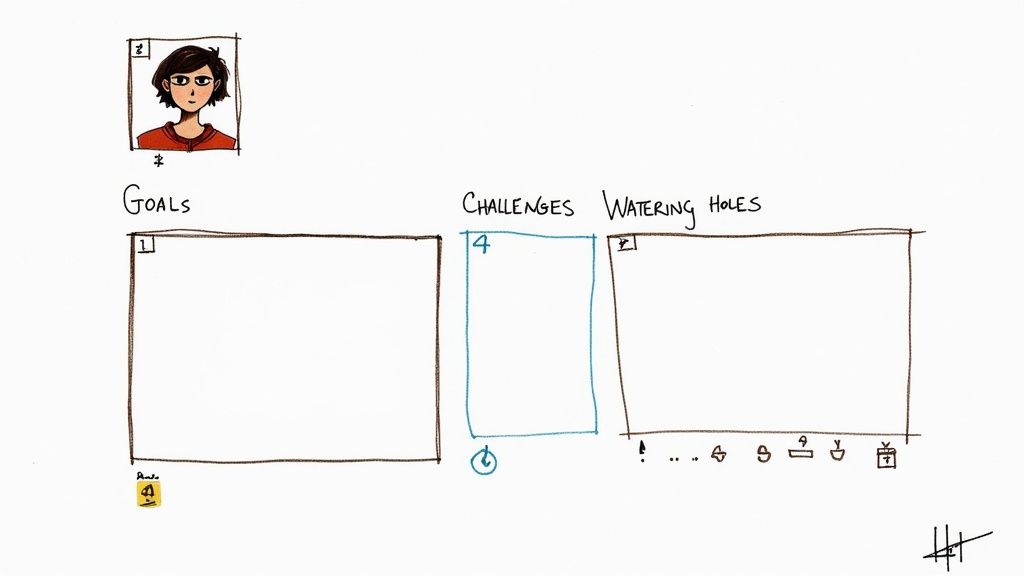
One of the fastest ways to get a reality check is with a tiny, targeted ad campaign on a platform like Instagram or LinkedIn. You don't need a huge budget for this—even $50-$100 can give you some incredibly valuable feedback.
Remember, the goal isn't sales. It’s data.
Let’s say your persona is "Ambitious Tech Manager Alex." You could spin up two different ad sets to test your targeting:
Push the exact same ad to both. Within a few days, you'll see which group gives you a better click-through rate (CTR) or leaves more relevant comments. That’s your signal telling you which targeting is closer to the bullseye.
Another go-to method is a quick-and-dirty landing page to validate a specific value proposition. This is perfect for confirming that the "problem" you think your audience has is something they're actually looking to solve right now.
Imagine you believe your audience of freelance creatives is struggling with client negotiation. You can use a simple tool like Carrd or Mailchimp to create a landing page offering a freebie: "The 5-Step Script for Nailing Your Next Client Negotiation."
Drive a little traffic there from your social profiles or a small ad spend. The conversion rate—the percentage of people who give you their email—is your proof. A high conversion rate is a massive green light that you've hit on a real pain point.
This takes you way beyond vanity metrics like likes. An email signup is a genuine signal of intent. It proves someone is invested enough to trade their contact info for your solution.
Getting the data is just step one. The real skill is in understanding the story it's telling you.
This whole process is a loop. You start with a guess, test it with something small and measurable, and then use the results to sharpen your focus.
For statistically sound results, I usually recommend running tests for at least 7–14 days. This helps smooth out any daily weirdness in the data. It also helps to have a baseline; knowing that LinkedIn's user base is roughly 56.9% male and 43.1% female globally can help frame your initial hypotheses. As you gather more data, you can start scoring your audience segments by conversion rate, potential lifetime value (LTV), and acquisition cost to see which groups are actually sustainable for your brand. If you need more demographic data to get started, you can discover more insights about social media demographics here.
Ultimately, testing is never really "done." You test, you learn, you refine your persona, and you test again. Each cycle gets you closer to a real, evidence-backed understanding of who your audience is and what they truly need from you.
So you've done the research. You've dug into the data, run the interviews, and built out a crystal-clear persona. That's the hard part, right?
Not quite.
All that incredible insight is completely useless if it just collects dust in a Google Doc. The real magic happens when you turn that knowledge into a tangible content strategy—a plan that dictates every single thing you create and post.
This is where you stop guessing and start building. It’s the bridge between knowing who your audience is and knowing what to give them so they feel seen, understood, and genuinely helped.
Let’s get one thing straight: one of the biggest mistakes you can make is trying to be everywhere at once. It's a classic rookie move that leads straight to burnout.
Your persona research gives you a massive cheat code here. It shows you exactly where your audience already hangs out—their digital "watering holes."
Instead of shotgunning your content across every social media app known to man, you can focus your limited time and energy where it will actually make a difference.
If your ideal client, "Ambitious Tech Manager Alex," lives on LinkedIn and nerds out on niche tech newsletters, then that’s your playground. Forget mastering TikTok dances or creating the perfect Instagram Reel if that's not where Alex is.
Your channel strategy should be a direct mirror of your persona's daily digital life:
The goal is to go deep, not wide. Get known on one or two key channels before you even think about expanding.
How you say something matters just as much as what you say. Your brand voice isn't about what you sound like; it's about matching the communication style of the people you want to attract.
Think back to the online communities you researched. That's a goldmine. Was the language formal and buttoned-up? Or was it casual, packed with slang, memes, and industry inside jokes?
Your brand voice should feel like a natural part of the conversations your audience is already having. If they're direct and data-driven, your content needs to be sharp, concise, and full of proof. If they're more creative, you can lean into storytelling and more evocative language.
Getting this right builds subconscious trust. It signals that you're an insider, not just another marketer yelling at them from the outside.
Now that you have a laser-sharp focus on your audience's biggest headaches and ambitions, you can define your content pillars.
These are the 3-5 core topics you will own. They're the subjects you’ll talk about over and over again to solve your persona's most pressing problems. Think of them as the main categories on your blog or the recurring themes in your social media feed.
For our tech manager, Alex, the content pillars might look something like this:
From here on out, every single piece of content you create should tie back to one of these pillars. This approach does two crucial things: it cements your expertise in a specific niche and guarantees you’re always creating something your audience desperately needs.
If you want to go deeper on this, our guide to building a powerful content engine lays out the entire framework.
This is how you build a brand that matters. You stop throwing content at the wall and start creating a cohesive library of resources that serves a specific group of people. Your insights have officially become your action plan.
Even with the best game plan, a few questions always seem to pop up when you're digging in to find your target audience. It's totally normal. Let's walk through some of the most common ones I hear from professionals building their personal brands.

You need to be specific enough to picture a single person in your head and talk directly to their problems. That’s the secret sauce. This is what makes your message actually land instead of just floating by.
Forget about targeting "people interested in fitness." That's way too broad.
Instead, zero in on something like, "busy working moms in their 30s who need effective 30-minute home workouts." See the difference?
Here’s the thing people miss: this kind of sharp focus doesn't shut other people out. It actually makes your message incredibly powerful for the right people. Those are the ones who will become your ride-or-die advocates, and they'll spread your message better than any generic ad campaign ever could. Specificity builds real connection.
First off, that’s a great problem to have. It means you've uncovered multiple opportunities. But—and this is a big but—you can't serve everyone at once. Trying to will just burn you out and dilute your message.
You have to prioritize. Rank each group based on a few crucial factors:
Pick one. Just one. Go all-in on that primary audience. Once you've built a solid foundation and have a system that works, then you can think about expanding to the next group on your list.
Think of your personas as living documents, not a "one-and-done" task you check off a list. You should be constantly tweaking them in small ways.
Formally, I'd say give them a full review at least once a year.
Informally? You should be checking in all the time. Pay attention to the words your audience uses in the comments. Listen to the questions they slide into your DMs. If there’s a major shift in your industry or your own business goals, that’s your cue for a persona refresh. The key is to stay curious.
At Legacy Builder, we're experts at taking your unique story and turning it into high-impact content that connects with the right people. We manage the strategy, creation, and distribution so you can stay focused on building your legacy.
Learn how we can help you build an authentic personal brand.


You could – but most in-house teams struggle with the nuance of growing on specific platforms.
We partner with in-house teams all the time to help them grow on X, LI, and Email.
Consider us the special forces unit you call in to get the job done without anyone knowing (for a fraction of what you would pay).
Short answer – yes.
Long answer – yes because of our process.
We start with an in-depth interview that gives us the opportunity to learn more about you, your stories, and your vision.
We take that and craft your content then we ship it to you. You are then able to give us the final sign-off (and any adjustments to nail it 100%) before we schedule for posting.
No problem.
We have helped clients for years or for just a season.
All the content we create is yours and yours alone.
If you want to take it over or work on transitioning we will help ensure you are set up for success.
We want this to be a living breathing brand. We will give you best practices for posting and make sure you are set up to win – so post away.
Subscribe to our newsletter and get insights on how to grow your personal brand.
