.svg)
Subscribe to our newsletter and get insights on how to grow your personal brand.
Thank you! Your submission has been received!
Oops! Something went wrong while submitting the form.
.svg)


Let’s get one thing straight: the basic formula for social media ROI is simple. It's just (Profit / Investment) x 100. But actually measuring it? That's where the real work begins.
It's about setting the right goals, tracking the metrics that actually matter, and putting a real dollar value on the actions people take. This is how you prove that all the time and effort you’re putting into social media is actually moving the needle for your business.

Pouring resources into social media without knowing the return is like driving blindfolded. It just doesn't make sense.
For professionals and personal brands, every single piece of content, every ad dollar spent, and every hour you invest in engagement needs to tie back to a bigger business goal. Measuring your ROI is the only way to connect those dots.
It’s how you quantify the value you’re getting back from your investments. And this isn't just about money—it's about justifying your strategy, fine-tuning your approach, and proving that your authentic online presence is generating real, tangible results.
One of the biggest traps I see people fall into is obsessing over vanity metrics. Likes, shares, and follower counts feel good, but they don't pay the bills.
Sure, these numbers can signal that your audience is paying attention, but they aren’t direct measures of business success.
Let me put it this way: a post with 10,000 likes that generates zero leads is worthless compared to a post with 100 likes that brings in two high-value client consultations. The goal is to shift your focus from chasing popularity to driving profitability.
"True ROI measurement forces you to ask the hard questions: Is this content driving traffic? Are these conversations turning into leads? Is our brand story actually impacting the bottom line?"
This mindset shift is everything for personal brands, where authenticity and connection are the name of the game. It ensures your storytelling isn't just for show—it’s a strategic asset for growth.
Not all returns are purely financial or happen overnight. To really understand your impact, you have to look at the different kinds of value you’re creating.
To get a complete picture of your performance, it helps to break down the different types of returns you can track.
A quick overview of the various returns you can track to get a complete picture of your social media performance.
By tracking these different layers, you get a much clearer, more accurate view of what’s really working.
And for those who want to go even deeper, this complete guide to measuring social media ROI is a fantastic resource.
This article will give you the framework to calculate each one, helping you turn your personal brand into a measurable engine for growth.
Before you even think about calculating ROI, you have to answer a simple question: What does "success" actually look like for you?
If you don't have a clear target, you're just throwing content into the void and hoping something sticks. Setting specific, measurable goals is the bedrock of any social media strategy that actually drives results.
This means we have to move past vague goals like "get more followers" or "increase engagement." Those sound nice, but they don't tie back to your bottom line.
A freelance consultant shouldn't just be chasing likes on LinkedIn. A much stronger objective sounds like this: "Increase qualified leads from LinkedIn by 20% in Q3 by driving more traffic to my booking page." Now that's a goal. It's specific, you can measure it, it's realistic, and it has a deadline.
One of the biggest mistakes I see people make is confusing busywork with business growth. The key is knowing the difference between vanity metrics and action metrics.
Vanity Metrics: These are the shiny objects. They look impressive on the surface but don't mean much for your business. Think likes, follower counts, and impressions. They feel good, but they don't pay the bills.
Action Metrics: This is where the money is. These numbers track real user behavior that's directly linked to your business goals—things like click-through rates (CTR), conversion rates, leads generated, and actual sales from social.
You have to focus on action metrics. Period. A viral post is great for your ego, but a post that gets ten people to sign up for your newsletter is an asset that builds your business.
For personal brands, the ultimate goal isn't just to be seen—it's to be trusted and to inspire action. Action metrics are the clearest indicators that you're achieving both.
Once you've locked in your business objectives, it's time to pick the right Key Performance Indicators (KPIs) to track your progress. Think of KPIs as the bridge between your social media activity and your bank account.
If your main goal is to build thought leadership and grow your audience, you'll want to focus on metrics around brand awareness. We actually have a whole guide on how to measure brand awareness and fuel your growth that dives deep into this.
But if your goal is straight-up lead generation, your KPIs will look completely different. You’ll be obsessed with form completions, cost per lead (CPL), and how many discovery calls were booked from your social links.
The key is alignment. Every single metric you track should answer the question, "Is this activity helping me hit my real business objective?"
To make this crystal clear, here’s a simple way to map your goals to the right KPIs.
This table is your cheat sheet for selecting the right metrics that align with your specific personal branding and business goals. Stop guessing and start measuring what matters.
Using a framework like this ensures every piece of data you collect has a purpose. It cuts through the noise and gives you clear, actionable insights to steer your strategy forward. No more flying blind.
Once you know your objectives and what you're measuring, it's time to build the technical backbone that actually captures the data. A lot of people get intimidated here, but it's simpler than it sounds. You just need a solid system to connect your social media activity to real business outcomes. We call this attribution.
Without a proper tracking framework, you're flying blind. Sure, you might see website traffic go up or a few new leads trickle in, but you won't know for sure if it was that LinkedIn article or the Instagram Reel you spent hours on. Getting this right is the difference between thinking you know what works and having the hard data to prove it.
One of the easiest and most powerful tools you have are Urchin Tracking Module (UTM) parameters. Think of them as little breadcrumbs you add to the end of a URL to track exactly where your website visitors came from.
When someone clicks a link with UTMs, that info gets sent straight to your Google Analytics. This lets you see which platform, which campaign, or even which specific post drove that click.
Let's say you're a consultant sharing a new case study on both LinkedIn and X (formerly Twitter). Instead of just dropping the same link on both, you'd create two unique URLs:
yourwebsite.com/case-study?utm_source=linkedin&utm_medium=social&utm_campaign=q3_casestudyyourwebsite.com/case-study?utm_source=twitter&utm_medium=social&utm_campaign=q3_casestudyNow, you can log into Google Analytics and see precisely how much traffic each platform sent over for that case study. This is how you figure out where your time is best spent. Using UTMs consistently is non-negotiable if you're serious about measuring ROI.
Pro Tip: Set up a standardized naming convention for your UTMs from day one. It keeps your data clean and makes analysis way easier down the road. Trust me, a little organization upfront saves massive headaches later.
UTMs are fantastic for tracking where clicks come from, but to track what happens after the click, you need pixels. A tracking pixel is just a small snippet of code you add to your website that talks back to the social media platforms.
The classic example is the Meta Pixel (for Facebook and Instagram). Once it's installed on your site, it can track when a user who saw your ad then goes on to book a call, download a guide, or buy something. This direct link between an ad and an action is how you calculate the ROI on your paid campaigns.
Picture this: a potential client sees your Facebook ad for a coaching package, clicks to your site, and books a discovery call. The Meta Pixel follows that whole journey, telling Facebook that your ad just generated a lead. That data is gold—it tells you which ad copy, images, and audiences are actually making you money.
This all fits into a simple framework: your goals determine your metrics, which then dictate your actions.
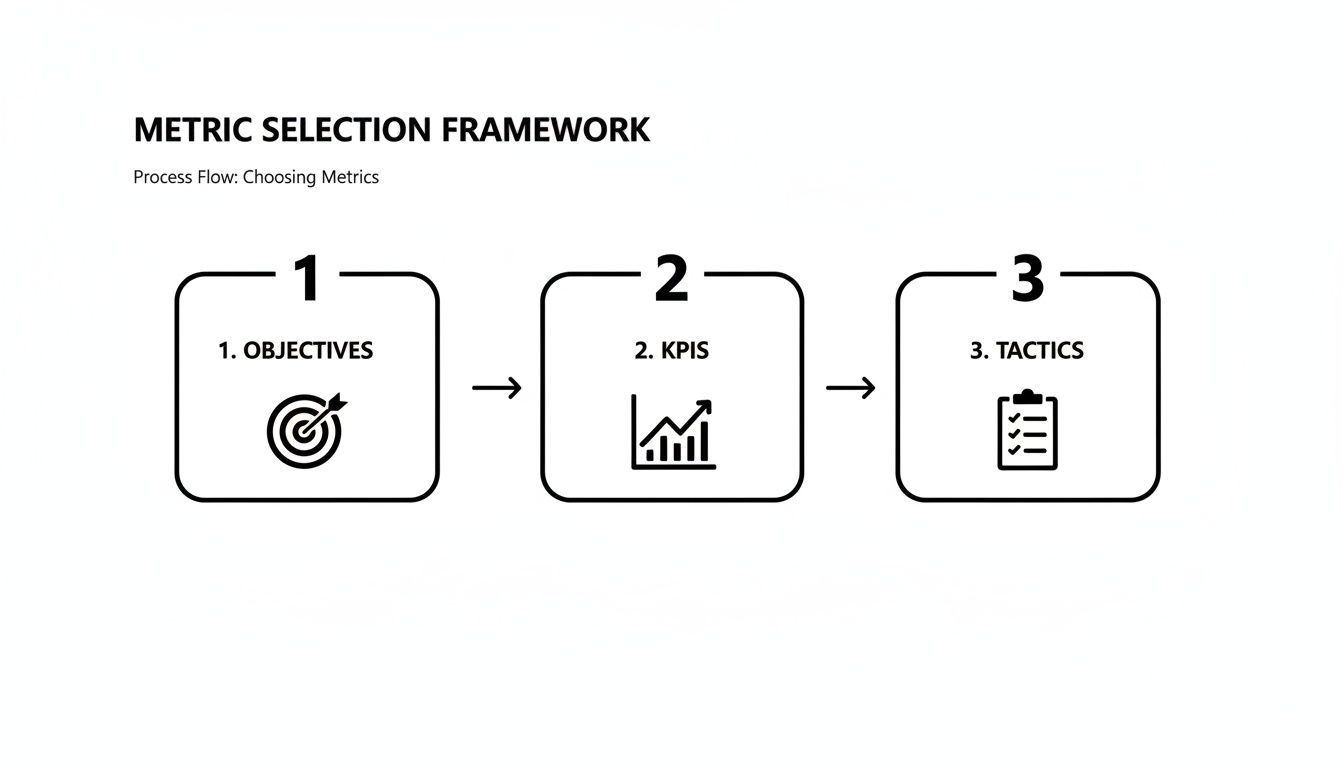
As you can see, successful measurement starts with a clear business goal. Everything else flows from there.
For most of us, the path from a social media like to a signed contract isn't instant. It can take weeks, even months. This is where your Customer Relationship Management (CRM) system becomes your best friend.
When you connect your CRM to your website forms, you can trace a client's entire journey from start to finish. Imagine someone clicks a link in one of your LinkedIn posts (tracked with a UTM, of course) and fills out your contact form. That lead's origin—"LinkedIn"—is automatically saved in your CRM.
Fast forward a few months. You close a $5,000 contract with that person. You can go right into your CRM and see that their journey started with that specific LinkedIn post. This closes the loop and gives you undeniable proof of the financial return on your content. To make this happen consistently, you need a plan, which is where a content calendar template for social media that actually works can help you organize these trackable campaigns.
Alright, you've set your goals and have tracking in place. Now for the fun part: crunching the numbers. This is where all that planning pays off, turning your social media hustle into a hard, quantifiable result.
The formula itself is pretty simple, but its real power comes from how well you define what goes into it.
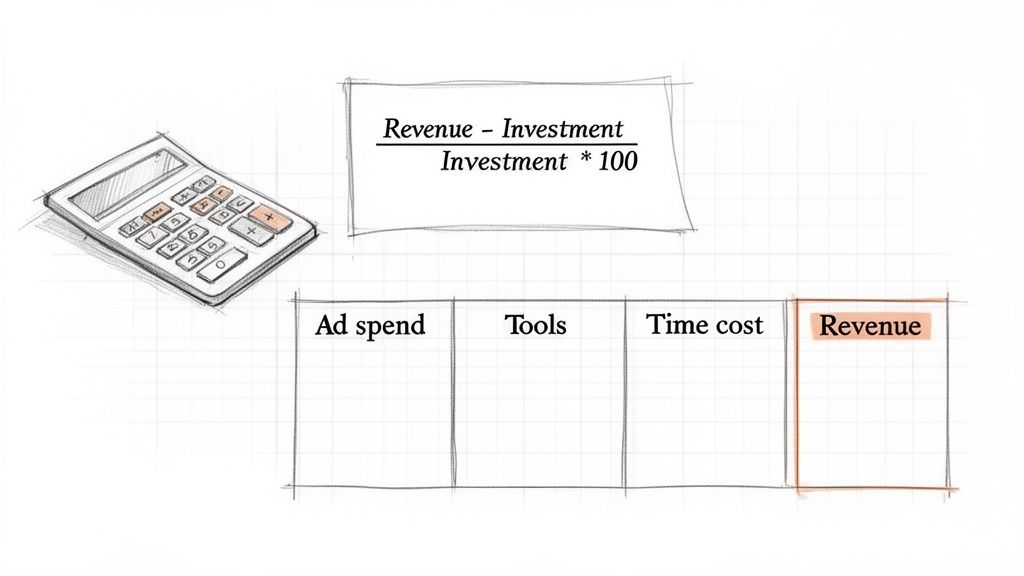
The classic ROI formula looks like this:
ROI = [(Revenue – Investment) / Investment] * 100
This gives you a straight-up percentage showing the return on every dollar you've put in. If it’s positive, you’re making money. If it’s negative, it's time to rethink the strategy.
Getting this number right has never been more important. Deloitte's Annual CMO Survey highlighted a major drop in digital marketing spend, forcing everyone to double down on what actually works—and social media is at the top of that list.
Think about it: if you sink $1,500 into content and $5,000 into ads (a $6,500 total investment) and pull in $10,000 in revenue, your ROI is a very solid 53.85%. That's a win.
First things first, you need to get real about what you're actually spending. This is where most people get it wrong. They only count ad spend, which gives them a totally skewed (and usually inflated) ROI.
Your total investment isn’t just your ad budget. It’s everything.
Don't sleep on this. If you’re a consultant billing at $150/hour and you spend 10 hours a month on social, that’s a $1,500 investment. You have to count it.
Let's walk through an example. Imagine a business coach using LinkedIn to land clients for her high-ticket program.
Objective: Get 5 new clients in Q1.
Program Price: $3,000 per client.
Here's how her Q1 investment breaks down:
By the end of Q1, her tracking shows she landed 4 new clients straight from her LinkedIn activity. That's $12,000 in revenue (4 clients x $3,000).
Now, let's plug it into the formula:
ROI = [($12,000 – $8,090) / $8,090] * 100
ROI = [$3,910 / $8,090] * 100
ROI = 48.3%
A 48.3% ROI is a clear sign her strategy is working. She can keep investing in LinkedIn with confidence, and maybe even find ways to scale what's getting results. This is just for social, but if you want a bigger picture, you should explore effective strategies for measuring overall marketing ROI too.
But what about the leads that ghost you? Or the brand awareness that doesn't immediately turn into a sale? You can still put a dollar value on these things using a metric like Customer Lifetime Value (CLV).
CLV is the total amount of money you expect to get from a single customer over time.
Once you know your CLV, you can work backward. For example, if your average client is worth $5,000 and you know that 1 in 10 leads from social media eventually signs up, then every single lead is worth $500 ($5,000 / 10).
This lets you measure the ROI of top-of-funnel activities, like getting someone to sign up for your newsletter. It's not just about the immediate sale; it's about building a pipeline that pays off down the road.
Getting that final ROI number is a huge step, but don’t pop the champagne just yet. That number—whether it’s a killer 48% or a disappointing -15%—is just a single data point. The real magic happens in what you do next.
Think of it like this: your ROI figure is the diagnosis from the doctor. The number itself doesn't fix anything. The value is in the treatment plan you create from it. A positive ROI tells you what's working so you can pour gas on the fire. A negative ROI is just as valuable—it's a bright red flag showing you exactly where you need to pivot.
A single ROI percentage gives you the 30,000-foot view, but all the profitable insights are buried in the details. You have to start segmenting your data to figure out which specific actions are actually moving the needle.
Stop thinking of your "social media" as one big blob. Break it down.
Calculate the ROI for:
This is how you find the gold. You might discover that while your overall ROI is a lukewarm 10%, the LinkedIn video series you've been testing is pulling in a massive 150% ROI. The takeaway couldn't be clearer: make more LinkedIn videos. This is how you stop guessing and start making precise, strategic investments with your time and money.
Here’s a hard truth: not every social media platform is going to work for you. The goal isn't to be everywhere; it's to find the one or two channels where your brand resonates and delivers a real return. Then, you focus your energy there.
Industry-wide, some platforms consistently perform well. A May 2023 Statista survey of over 1,200 global marketers named Facebook as the platform with the highest ROI, a finding often echoed by others like HubSpot who point to its powerful ad targeting. You can even dig into the full research about social media platform ROI yourself.
But let me be blunt: broad trends don't matter as much as your data. If your analytics prove that LinkedIn is where you find and convert high-ticket clients, that's your power alley. Period.
Your data is telling you a story about where your ideal clients hang out online. Listen to it. If one platform is driving 80% of your leads and sales, it deserves 80% of your attention.
The pros don't just "check their ROI" once a quarter. They create a constant feedback loop where data is always informing strategy. It’s not a static report; it's a living, breathing process.
The loop is simple but incredibly powerful:
Let's say you find that your "behind-the-scenes" Instagram Stories drove a way higher ROI than your polished feed posts. The action is obvious. You take that winning concept and figure out how to repurpose content and multiply your reach, turning those story ideas into Reels, LinkedIn posts, or even short blog articles.
This is how you stay ahead. You’re no longer just creating content; you’re building a system that consistently grows your brand and your bottom line.
Even with a solid framework, a few questions always seem to pop up when we start talking about social media ROI. This is where we tackle those common sticking points. I'm going to clarify the gray areas and give you the confidence to actually put your measurement strategy into practice.
Think of this as the final polish on your ROI expertise.
This is probably the question I get asked most, and it's a great one. Not every social media goal is about getting a sale today. Sometimes you're playing the long game—building brand awareness, growing your audience, or cementing yourself as a thought leader.
While these goals don't have a direct dollar sign attached, you can (and should) assign them a monetary value. The key is to connect these "softer" metrics to future business value.
For Brand Awareness: Look at how your awareness efforts impact other channels. Did a spike in brand mentions on X lead to a rise in direct traffic to your website? You can attribute a portion of that traffic's value back to your social efforts.
For Audience Growth: Figure out the potential value of a new follower. If you know that, on average, one out of every 500 followers eventually becomes a client worth $2,500, then each new follower is technically worth $5 to your business.
This isn't just vanity math. It’s how you justify long-term brand-building activities by connecting them to tangible, future revenue. You have to have the numbers to back it up.
The honest answer? It completely depends on your objectives. The metrics that matter most are the ones tied directly to the goals you set at the very beginning.
Chasing the wrong metric is just as bad as chasing no metrics at all.
That said, if you're looking for a hierarchy, metrics that show action are always more valuable than those that show passive consumption.
A click, a form submission, or a saved post will always be more impactful than a simple impression or view. Focus on the numbers that signal intent and move a person closer to becoming a client.
For a B2B consultant, cost per lead (CPL) and the conversion rate on a webinar sign-up page are mission-critical. For an e-commerce brand, it's all about revenue from social channels and average order value (AOV). Your KPIs have to align with your specific business model.
Measuring your ROI shouldn't be a once-a-year event you dread. The right cadence really depends on the length of your sales cycle and how intense your campaigns are.
A good rule of thumb is to run a full-blown ROI analysis quarterly. This gives you enough data to spot real trends without getting lost in the noise of daily fluctuations.
Beyond that, you should be checking in on specific campaigns much more frequently.
This hybrid approach gives you both the big-picture strategic view and the tactical, in-the-moment insights you need to make smart adjustments on the fly.
Let's clear this up: you don't need a massive, expensive tech stack to get started. The best tools are the ones that give you clear data without overcomplicating everything. For most professionals and personal brands I work with, a simple combination of a few key platforms is perfect.
Here’s a practical, effective toolkit:
Start with these three. As you grow, you can explore more advanced platforms, but this simple combination is more than enough to build a rock-solid measurement framework.
I've put together a quick FAQ table to cover some other common questions that come up. These are the rapid-fire answers to help you get moving.
Hopefully, that clears things up and gives you a clear path forward. The goal isn't just to measure for the sake of measuring, but to get real insights that help you make smarter decisions.
Ready to stop guessing and start building a personal brand that delivers measurable results? At Legacy Builder, we specialize in transforming your expertise into high-impact content that grows your influence and your bottom line. Let's build your legacy, together. https://www.legacybuilder.co


You could – but most in-house teams struggle with the nuance of growing on specific platforms.
We partner with in-house teams all the time to help them grow on X, LI, and Email.
Consider us the special forces unit you call in to get the job done without anyone knowing (for a fraction of what you would pay).
Short answer – yes.
Long answer – yes because of our process.
We start with an in-depth interview that gives us the opportunity to learn more about you, your stories, and your vision.
We take that and craft your content then we ship it to you. You are then able to give us the final sign-off (and any adjustments to nail it 100%) before we schedule for posting.
No problem.
We have helped clients for years or for just a season.
All the content we create is yours and yours alone.
If you want to take it over or work on transitioning we will help ensure you are set up for success.
We want this to be a living breathing brand. We will give you best practices for posting and make sure you are set up to win – so post away.
Subscribe to our newsletter and get insights on how to grow your personal brand.
