.svg)
Subscribe to our newsletter and get insights on how to grow your personal brand.
Thank you! Your submission has been received!
Oops! Something went wrong while submitting the form.
.svg)



So, what exactly is a thought leadership content strategy? Think of it as your game plan for becoming the go-to expert in your niche. You're not just creating content; you're intentionally building a reputation by consistently sharing original, insightful ideas.
This isn't about just joining the conversation—it's about shaping it. The end goal is to build deep authority and trust by giving away your most valuable expertise and unique perspectives.
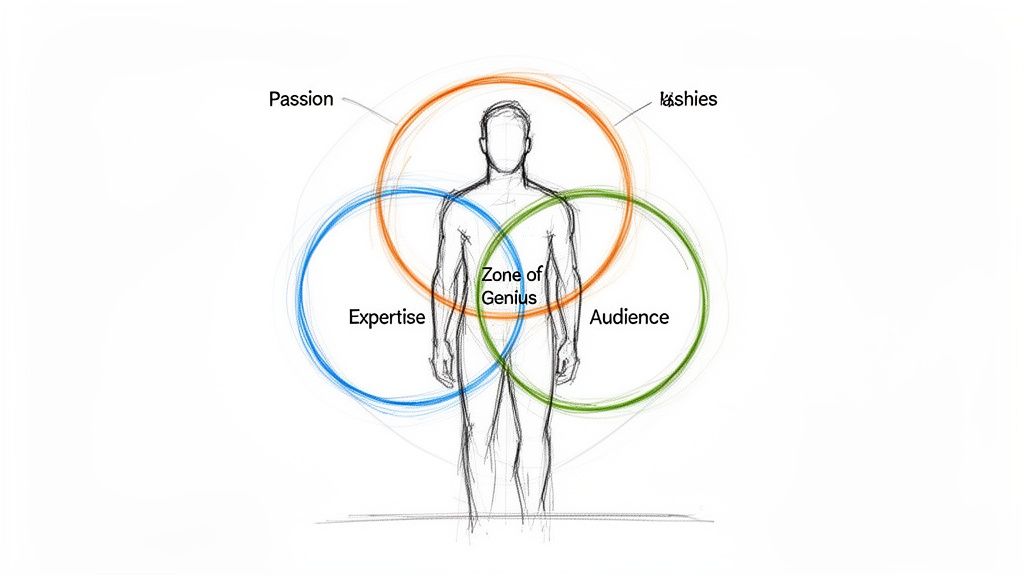
Before you even think about writing a post or hitting record on a video, the real work begins. It’s internal. A solid strategy isn't built by chasing the latest trends; it's grounded in authenticity and a clear purpose. This is where you dig deep and figure out your unique value.
To get started, it helps to understand what is thought leadership marketing at its core and how it’s different from just pumping out regular content.
The mission here is to define not just what you know, but why it matters and—more importantly—who it matters to. Without that clarity, you're just another voice shouting into the void.
Your best, most magnetic content will come from what I call your "Zone of Genius." This isn't just about what you're good at. It’s that sweet spot where three key things overlap:
Here’s a practical example: A SaaS founder has deep expertise in product development, a genuine passion for minimalist UX design, and an audience of non-technical entrepreneurs who feel overwhelmed by the process of building an app. Her Zone of Genius is creating content that makes the development process simple and accessible for that specific group.
Once you've locked in your Zone of Genius, it's time to sharpen your point of view (POV). True thought leadership isn't about echoing what everyone else says. It’s about offering a fresh, maybe even controversial, take that makes people pause and think. Your POV is your unique filter on the world.
A strong point of view acts as a filter for all your content. It ensures consistency and helps you stand out by taking a memorable stance instead of trying to please everyone.
Think about a leadership coach. There are thousands of them talking about "effective communication"—it’s generic and forgettable. But a coach with a sharp POV—like, "Radical candor is the only path to high-performing teams"—instantly carves out a niche. That specific angle makes their content pop and attracts clients who are all-in on that philosophy. If you want to go deeper on this, exploring a modern playbook for personal branding for leaders is a great next step.
Finally, you need to anchor your strategy with clear, realistic goals. Otherwise, you're just creating content for the sake of it. Your goals for thought leadership should tie directly back to what you're trying to achieve in your business or career.
Ditch the vague targets like "become a thought leader" and get specific.
Setting concrete targets like these turns your content from a hobby into a strategic asset that actively drives your growth. It gives you focus, motivation, and a clear way to see what's actually working.
Look, if your thought leadership strategy tries to speak to everyone, it's going to fail. Hard. The entire point is to become the one indispensable voice for a very specific group of people. Your expertise needs to be a magnet, pulling in the right opportunities, not just random traffic.
This means you have to go way beyond surface-level demographics. Forget about generic job titles and company sizes for a minute. You need to get inside the head of your ideal audience member—understand their real challenges, their secret ambitions, and where they actually go looking for answers.
The first real step is building a detailed audience persona. And no, this isn't just some fluffy marketing exercise. It’s about building genuine empathy for the person on the other side of the screen. Give them a name. A role. A story.
Let's say you're a financial consultant. Your target audience isn't just "small business owners." That’s lazy. A much stronger persona would be "Sarah, the 35-year-old founder of a bootstrapped e-commerce brand. She's a genius at product and marketing but is completely overwhelmed by cash flow and lives in fear of making a critical financial mistake that could sink her company."
See the difference? Now you’re not just creating generic content about "financial tips." You’re creating content that speaks directly to Sarah's fears and gives her clear, actionable solutions for her specific situation. To get this right, you have to truly understand how to find your target audience for a personal brand by focusing on their internal struggles, not just their external labels.
Once you have your "Sarah" in mind, map out her world. What keeps her up at night? What does winning actually look like for her?
This information is pure gold. It literally tells you what content will stop her scroll and gives you a roadmap for creating resources that solve her most urgent problems.
After you have a crystal-clear picture of your audience, it's time to scope out the competition. The goal here isn't to copy what everyone else is doing. It's to find the gaps in the conversation—the underserved topics or unique angles that nobody else is nailing.
This is where your unique point of view becomes your secret weapon. If everyone in your space is talking about high-level strategy, you might find a powerful niche by focusing on tactical, step-by-step implementation.
A defensible niche is found at the intersection of your unique expertise, your specific audience's unmet needs, and the topics your competitors are ignoring or addressing poorly.
Decision-makers are actively looking for this kind of specialized insight. In fact, 54% spend at least an hour every week engaging with thought leadership, and 24% are consuming it daily. Why? Because over 70% use it to spot industry trends and find new ideas to stay ahead. You can discover more insights about thought leadership consumption to see just how hungry the market is for real expertise.
By filling a specific gap, you're not just adding to the noise. You’re providing a critical resource they are already searching for.
This focused approach is what ensures your content doesn't just get seen; it gets valued. You stop being a generalist and start becoming the go-to expert for a specific problem, for a specific person. That’s the entire game.
Trying to come up with a groundbreaking idea every single day is a surefire way to burn out. Fast. The real secret to a high-impact thought leadership strategy isn't about working harder—it’s about working smarter.
It all comes down to the pillar content model.
This is all about creating one massive, high-value piece of content (your "pillar") and then strategically slicing it up into dozens of smaller assets. This way, your core message gets in front of way more people, on different platforms, in the exact format they prefer to consume.
Your pillar content is the foundation. It’s the magnum opus on a specific topic you want to own in your niche. Think of it as the main course—everything else you create is just a side dish derived from it.
But let's be clear: great pillar content is much more than just a long blog post. It's the definitive resource, the go-to guide that proves you know your stuff inside and out.
Pillar content usually looks like one of these:
The goal is to create something so valuable that you'll be proud to point people to it for months, even years. It becomes the single source of truth on that subject for your audience.
The diagram below shows how you can find the perfect topics for these pillars. It’s a simple process of zeroing in on your ideal persona, their biggest pains, and the gaps your competitors are leaving wide open.
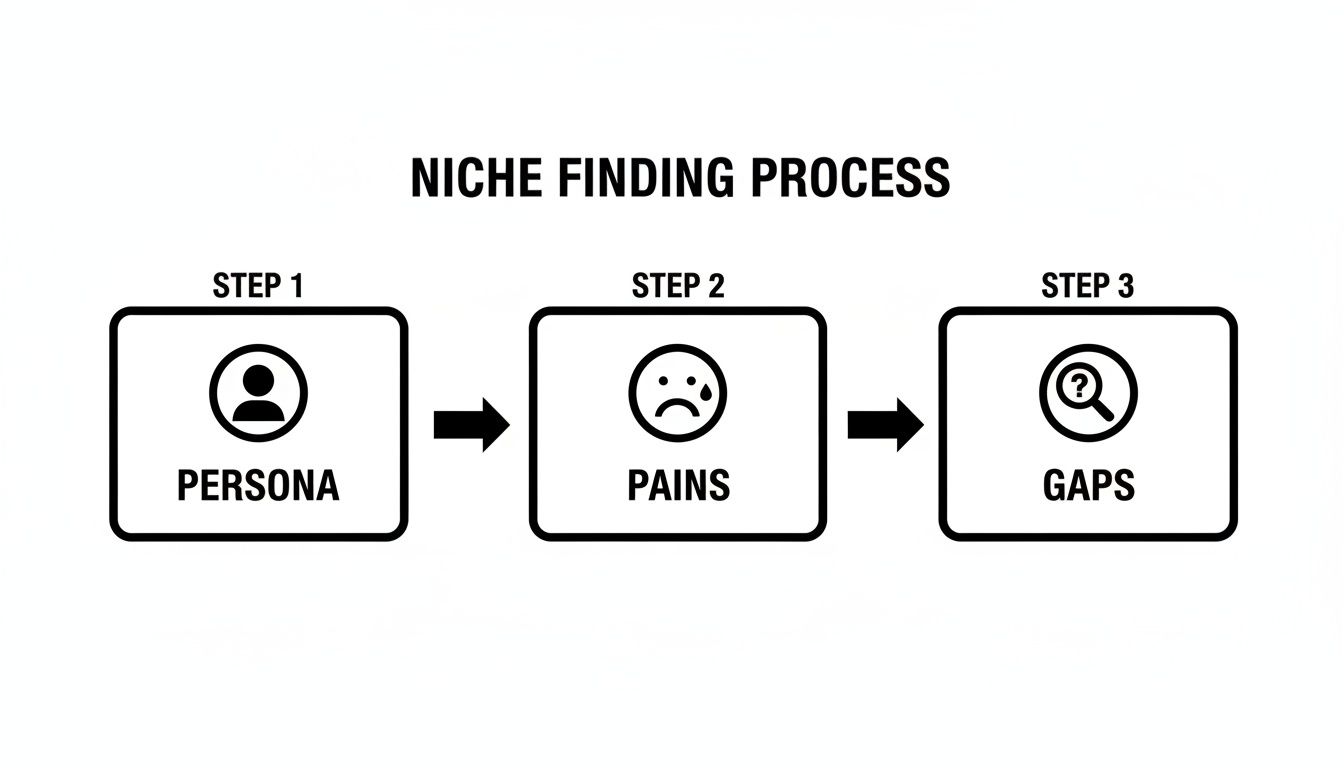
This process ensures your pillar content isn't just noise. It’s a targeted solution to a real problem.
Once your pillar is built, the real fun begins. "Atomizing" is just a fancy word for breaking that one huge piece of content down into dozens of micro-assets. This is the engine that will power your entire strategy.
Think of your pillar content as a block of marble. Atomizing is the art of chipping away at it to create numerous smaller, beautiful sculptures. Each one has its own purpose, but they all come from the same core material.
When you do this right, you can maintain a consistent presence everywhere without constantly scrambling for new ideas. Every post, video, and email is rooted in the deep value you've already created.
Here’s a quick-glance table to show you just how versatile one piece of pillar content can be. We’ll take a webinar as our pillar and break it down into several formats tailored for different platforms.
This matrix is just a starting point. The possibilities are endless once you start thinking about how to slice and dice your core ideas.
Let’s get practical. Imagine your pillar content is a 60-minute webinar called "The Bootstrapper's Guide to Scaling to Seven Figures."
From this one asset, you can easily generate a month’s worth of high-quality content. This is a game-changer, and our full guide on how to repurpose content and multiply your reach has even more tactical ideas.
Here’s how that single webinar breaks down:
Just like that, one hour of work has turned into over a dozen unique pieces of content. This isn't about being lazy; it's about being strategic. You're delivering your best insights in the exact format your audience wants, right where they're already hanging out.
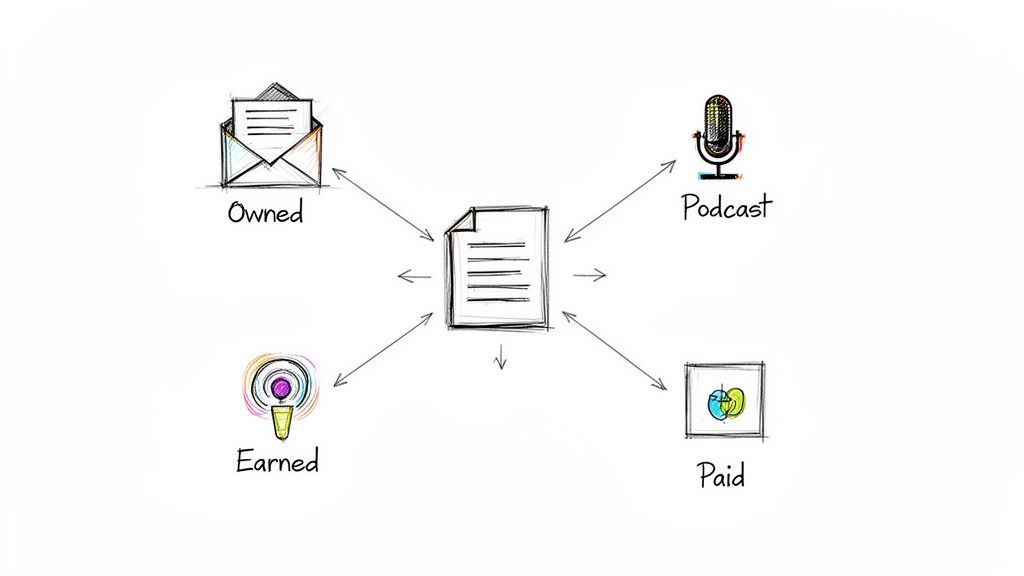
Let's get one thing straight: creating a killer piece of pillar content is only half the battle. If no one sees it, it might as well not exist.
Too many smart professionals fall into the "post and pray" trap. They publish something they've poured hours into, cross their fingers, and just hope people find it. This is a recipe for disappointment, every single time. A real thought leadership strategy needs a powerful, intentional distribution engine behind it.
Think of it as your system for getting your best ideas in front of the right people, over and over again. It’s the difference between being a passive publisher and a proactive promoter of your own expertise. A well-oiled system ensures every single piece of content you create gets the attention it deserves.
The data backs this up. B2B marketers are all-in on this stuff. In fact, 47% plan to create more original research and data-driven content. But here's the kicker: while 96% of them are producing thought leadership, only a measly 4% feel their programs are actually best-in-class. That’s a massive gap, and it almost always comes down to weak distribution. You can discover more B2B content trends for 2026 to see just how crowded the field is getting.
A solid distribution engine never relies on just one channel. It’s all about balancing three different types of media to create a ripple effect that amplifies your reach far beyond what you could ever achieve on your own.
Owned Channels: These are the platforms you own and control completely. Think of your personal blog, your website, or your email newsletter. This is home base for your pillar content and your most direct line to your core audience.
Earned Channels: This is where you get visibility on other people's turf. We're talking guest spots on podcasts, writing for industry publications, or getting quoted by journalists. Earned media is gold because it comes with built-in credibility from a trusted source.
Paid Channels: You don't have to go crazy here, but a little strategic spending can give you a major boost. This could be running targeted ads to promote a cornerstone piece of content or sponsoring a niche newsletter to get in front of a very specific audience, fast.
The soul of a great distribution strategy is genuine engagement, not just shouting your message into a crowded room. This means you need to identify and build real relationships with key people in your space—influencers, collaborators, even friendly competitors.
Start by making a "dream 100" list of people and publications whose audiences are a perfect match for yours. But don't just slide into their DMs asking for a share. That’s lazy. Instead, invest the time to build actual rapport.
True amplification comes from community and collaboration, not just promotion. When you consistently provide value to others, they will naturally want to share your work with their own audiences.
This means you need to be in the trenches with them. Comment thoughtfully on their posts. Share their work when it’s genuinely good. Look for ways you can team up on content. For this kind of professional networking, platforms like LinkedIn are essential. It’s the perfect spot to have meaningful conversations and build the relationships that become the backbone of your entire distribution network.
To kill the "post and pray" habit for good, you need a repeatable process for every major piece of content you publish. This simple checklist ensures nothing falls through the cracks and you get maximum mileage out of all your hard work.
Publish on Your Home Base: Your pillar content should always live on your blog or website first. This makes it the official source.
Tell Your Email List: Your subscribers are your most loyal audience. Send them a dedicated email that doesn't just link to the content, but sells them on why it's a must-read for them.
Plan Your Social Rollout: Don't just post the link once and call it a day. Schedule a series of posts across your main platforms for the next two weeks. Use different angles, pull quotes, stats, and images to keep it interesting.
Tap Your Inner Circle: Send a personal email to 5-10 colleagues or influential friends who you know would find the content truly useful. The key is to not ask for a share directly; just let them know you made something you thought they’d appreciate.
Engage in Relevant Communities: Find online communities, forums, or Slack channels where your content provides a direct answer to a common question. Always lead by adding value, not just dropping a link.
Putting out great content is a solid start, but it's only half the battle. If you aren't paying close attention to what's working—and what isn't—you're just throwing stuff at the wall and hoping it sticks. A real thought leadership strategy is built on data, not guesses.
And let’s be clear: this isn’t about chasing vanity metrics. Likes and shares feel good, but they don't pay the bills. They won't tell you if you’re actually building influence, creating real opportunities, or making your personal brand the go-to in your space. We need to track the numbers that actually move the needle.
Don't just take my word for it. The data shows that thought leadership has a massive impact on business. A wild 55% of B2B decision-makers said they've increased the amount of business they do with a company specifically because of their content. Even more telling, 73% of executives now trust thought leadership more than traditional marketing when evaluating a potential partner. You can dig into the full research on these B2B findings yourself.
This proves one thing: measuring your impact isn't just a "nice-to-have." It’s a business necessity.
To get a real sense of your performance, you have to track KPIs that tie directly back to your goals. Likes are superficial; we're hunting for genuine engagement and tangible results.
A simple, effective measurement dashboard focuses on a few key areas that show you the real health of your strategy.
Audience Growth and Quality: Are the right people following you? Don’t just count followers. Look at their job titles, their companies, and how they interact. A small, dialed-in audience of decision-makers is infinitely more valuable than a huge, disengaged crowd.
Engagement Quality: Look past the thumbs-up. Are people leaving thoughtful comments? Are they asking smart questions? That's when you know your content is actually making people think, not just scroll.
Lead Generation and Opportunities: Is this whole thing actually leading somewhere? Track inbound connection requests, discovery calls booked from your content, or invites to speak on podcasts. Those are real business outcomes.
You don't need some fancy, expensive software to get started. A simple spreadsheet is all you need to create your dashboard. The goal is to have one place to look every week or month to see what’s trending up or down.
Here’s a practical way to set it up:
When you track things this way, measurement stops being a chore and becomes your most powerful strategic tool. It gives you clear signals on where to double down.
Data tells you what's happening. Your audience tells you why. The last piece of the puzzle is building a system to listen and react.
Your comments section isn't just a list of notifications to clear. It’s a free focus group telling you exactly what they want to see next.
Pay close attention to the comments, DMs, and questions you get. These aren't just interactions; they're content prompts. If you see the same question pop up over and over, that's your next blog post or video topic, handed to you on a silver platter.
This feedback loop is a game-changer. It does two critical things:
Combine the hard data from your dashboard with the qualitative feedback from your audience, and you create a powerful cycle of continuous improvement. You'll know exactly what to create to build your legacy, one powerful piece of content at a time.
Look, even the best roadmap can't prepare you for every pothole on the journey. I get it. Building a thought leadership platform isn't just about strategy; it's about navigating the real-world challenges that pop up along the way.
Here are the questions I hear most often from busy founders and execs.
This is always the first—and most important—question. And the honest answer is: it depends entirely on your system.
If you’re trying to come up with brand-new content from scratch every single day, you're going to burn out. Fast. But if you stick to the pillar content model we've been talking about, the time commitment becomes surprisingly manageable.
Here’s what a realistic rhythm looks like for a busy professional:
All in, you're looking at about 3-5 hours a week. It’s a real commitment, no doubt. But it’s a strategic investment that compounds over time, not a frantic, day-to-day content grind.
Ah, the classic. That nagging feeling that you're a fraud is something almost everyone deals with, especially when you first start putting your ideas out there.
The trick is to completely reframe what being an "expert" actually means. You don’t have to be the #1 authority on the planet. You just need to know a little more than the person you're trying to help. Your unique journey, your mistakes, your wins—that’s where the value is.
Imposter syndrome is a game of comparison. The only way to win is to stop playing. Shift your focus from "Am I good enough?" to "Who can I help with what I already know?" That one mental switch changes everything.
Start small. Share a single, specific insight from a project you just finished. Talk about a mistake you made and what you learned. The moment you get a "this was so helpful!" comment from just one person, you’ll start to realize your voice matters. Your experience is your qualification.
Creator's block isn't a lack of creativity; it's a symptom of looking for ideas in all the wrong places. Your best content isn't going to magically appear during a brainstorming session. It's already there, hidden in your daily workflow.
You have an endless well of content ideas. You just need to know where to look:
Stop trying to invent topics. Start documenting the solutions and insights you're already producing every single day. Your daily work is a content goldmine just waiting to be tapped.
Ready to stop guessing and start building a personal brand that actually drives results? Legacy Builder provides the strategic expertise and dedicated team to transform your insights into high-impact content that grows your influence. Let's build your legacy together.


You could – but most in-house teams struggle with the nuance of growing on specific platforms.
We partner with in-house teams all the time to help them grow on X, LI, and Email.
Consider us the special forces unit you call in to get the job done without anyone knowing (for a fraction of what you would pay).
Short answer – yes.
Long answer – yes because of our process.
We start with an in-depth interview that gives us the opportunity to learn more about you, your stories, and your vision.
We take that and craft your content then we ship it to you. You are then able to give us the final sign-off (and any adjustments to nail it 100%) before we schedule for posting.
No problem.
We have helped clients for years or for just a season.
All the content we create is yours and yours alone.
If you want to take it over or work on transitioning we will help ensure you are set up for success.
We want this to be a living breathing brand. We will give you best practices for posting and make sure you are set up to win – so post away.
Subscribe to our newsletter and get insights on how to grow your personal brand.
