.svg)
Subscribe to our newsletter and get insights on how to grow your personal brand.
Thank you! Your submission has been received!
Oops! Something went wrong while submitting the form.
.svg)


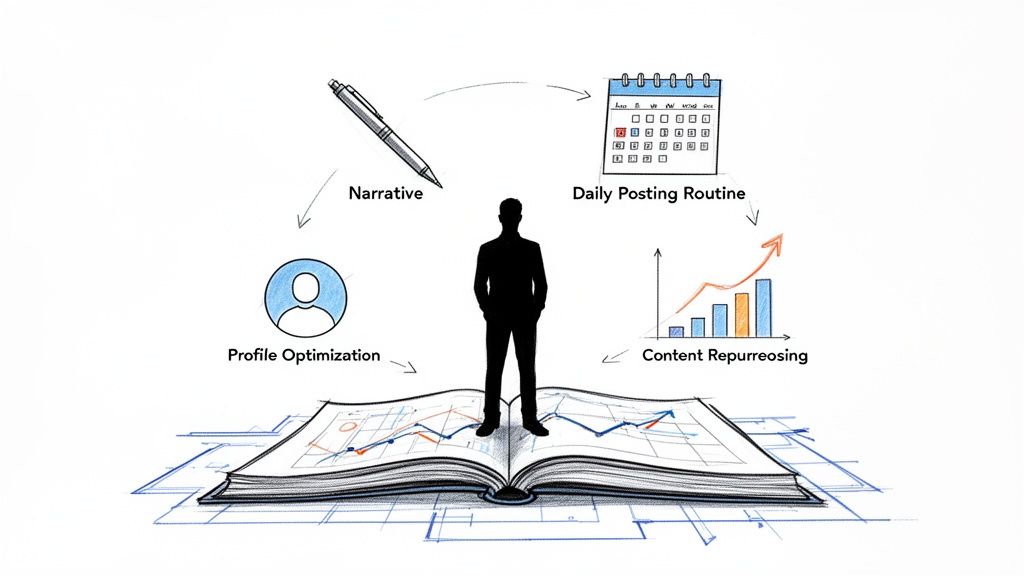
Let's get one thing straight: a personal brand isn't a "nice-to-have" for leaders anymore. It’s a core function of your job. It's the intentional, strategic work of shaping how people see you—your values, your expertise, your vision—and turning that reputation into a real asset for you and your company.
In a world where everyone vets you online before they ever shake your hand, a weak or nonexistent personal brand is a massive liability. It creates a vacuum of trust.
Think about it. Your brand is what people say about you when you're not in the room. If you aren't actively shaping that story, someone else will. And their version probably won't do you any favors.
A strong personal brand is your business moat. It builds rock-solid credibility and gives you a platform to share your company's mission with genuine authenticity. When leaders are visible and share what they know, they humanize the entire organization. It makes you relatable, trustworthy, and real. This isn't about ego—it’s about strategic influence and building a legacy that lasts.
The impact of a leader's brand isn't just a feeling; you can measure it. Did you know that 82% of people are more likely to trust a company when its senior executives are active on social media?
For financial audiences, it’s even more dramatic—they trust leaders with visible personal brands six times more than those who are invisible online. The data clearly shows that personal branding for leaders directly boosts corporate credibility. In fact, 57% of consumers say that a visible leadership team influences their buying decisions.
This is what it looks like in practice:
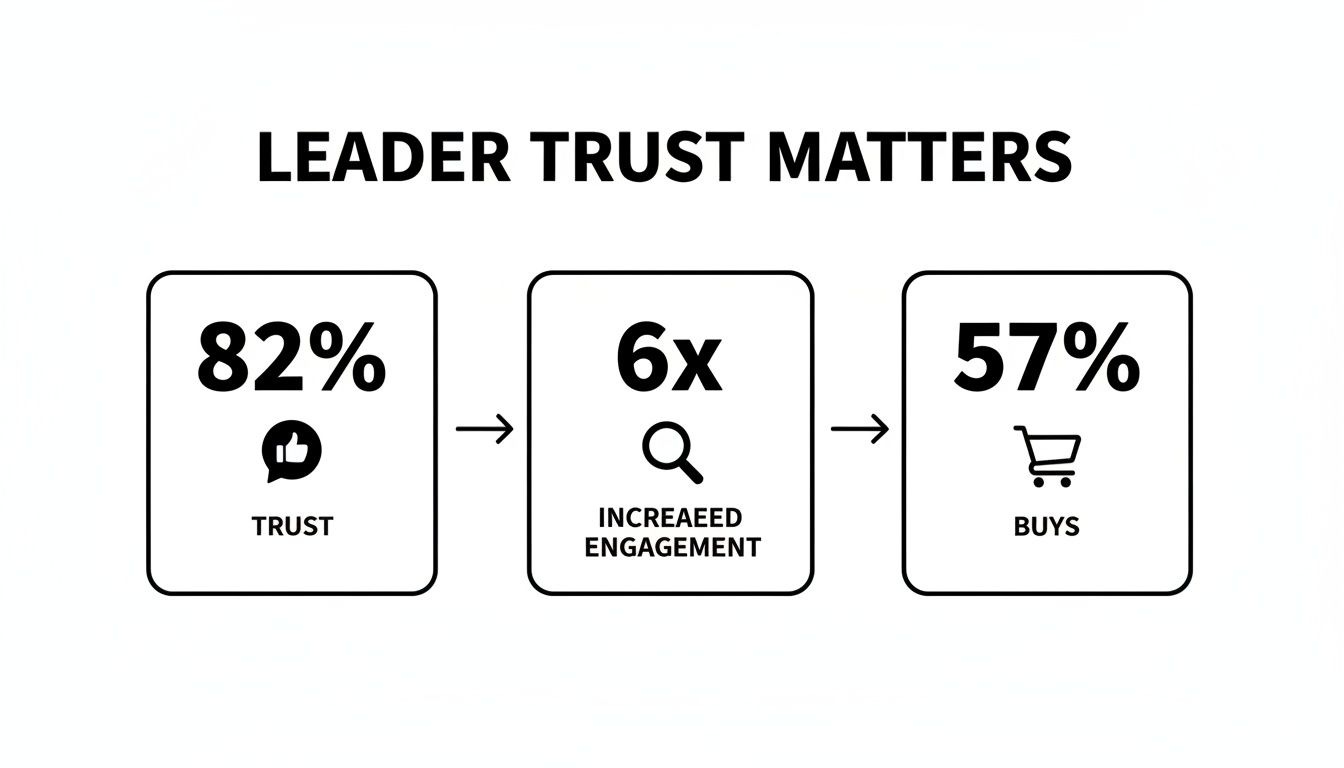
The takeaway here is simple but powerful. A visible leader creates a ripple effect, turning personal credibility into corporate trust and real revenue.
A word of caution: Your online presence must be an authentic extension of who you are offline. A strong digital brand has to be backed up by consistent behavior in meetings, on calls, and at events. It's one and the same.
Before we move on, let's look at the concrete ROI you can expect and the risks you're taking by ignoring your brand.
This table breaks down the clear benefits leaders gain from investing in a strong, authentic personal brand, connecting your actions to real-world business outcomes.
Ultimately, investing in your brand is about future-proofing your career and your company. The payoffs are undeniable.
At the end of the day, investing in your brand means you’re setting yourself—and your company—up for the future. It’s how you:
This foundation of trust is how you build true authority. But to really master this, you need a repeatable system that turns your expertise into content that commands attention. To dive deeper, check out our full guide on how to build authority and become the go-to voice in your industry.
Let's get one thing straight: an effective personal brand isn't a fake persona you put on for social media. It's the intentional, crystal-clear communication of who you already are. Before you even think about writing a post or hitting 'record' on a video, you have to lock in your core message.
This is the blueprint for everything. It ensures every piece of content you create is consistent, feels authentic, and pushes you toward a single, unified goal.
Forget the buzzwords and corporate jargon for a minute. This isn't about creating something from thin air. It's about excavation. We're digging into your unique experiences, your core values, and your vision to build a narrative that only you can own. This is the bedrock of real personal branding for leaders.

Your brand needs to stand on a few core pillars—those specific areas of expertise or passion where you want to be seen as a leading voice. These aren't just your job duties. They're the themes you can talk about with genuine authority and excitement, day in and day out.
To nail these down, ask yourself some honest questions:
A CTO’s pillars, for instance, aren't just "software engineering." They're more specific, like "Building Human-Centric AI," "Scaling Remote Engineering Teams," or "Mentoring the Next Gen of Tech Leaders." See the difference? Those are compelling and offer endless ideas for content.
Your brand isn't just what you've done. It's how you think about your work and the future you're trying to build. That forward-looking vision is what makes people want to follow you.
Once you have your pillars, it's time to connect them to your personal journey. People don't connect with a résumé; they connect with a story. Your narrative is the thread that ties your professional wins and personal experiences into something memorable.
A powerful leadership story usually has these elements:
Your story gives your expertise context and meaning. It's the difference between being a generic "Marketing Executive" and being known as "the CMO who built a brand from zero by relentlessly listening to community feedback."
With your pillars and story locked in, you can now write your Unique Value Proposition (UVP). This is just a short, punchy statement that answers the question: "Why should anyone listen to me?"
A solid UVP clearly states:
Think of it as your personal tagline. For a financial leader, a UVP might sound like this: "I help early-stage SaaS founders navigate the chaos of fundraising with battle-tested financial frameworks that prioritize sustainable growth over short-term hype." It’s specific, targeted, and immediately establishes authority.
From here, your visual identity needs to match the message. To make sure you look the part, it's worth learning how to prepare for professional headshots to present a cohesive, professional image. This whole narrative is the foundation of your brand, guiding every piece of content you create and every conversation you have.
Think of your leadership narrative as the blueprint. Your content? That's the actual structure you build from it. This is the moment your expertise stops being an internal asset and becomes an external force—one that shapes opinions and builds real influence.
Creating content that builds authority isn't about shouting into the void. It’s about consistently showing up and delivering real value that solves real problems for your audience. The goal is to stop being just another voice and become the trusted resource they turn to.
This transformation happens when you start translating your unique insights and experiences into content that's not just informative, but memorable and relatable. Every article, video, or post needs to be a direct reflection of your core narrative, reinforcing who you are and what you stand for.
This isn't about chasing viral trends. It’s a deliberate, strategic practice of sharing what you know in a way that helps other people win. Genuine authority is earned through generosity with your knowledge.
Different platforms and audiences demand different approaches. A one-size-fits-all content strategy will just dilute your impact. Knowing where and how to use specific formats is a non-negotiable for any leader serious about building their personal brand.
Think of your content formats like tools in a toolbox. Each one is built for a specific job:
The key is to match the format not just to the platform, but to the depth of the idea you're sharing. A complex business framework deserves a full-blown article, not a 30-second clip.
The fear of running out of things to say paralyzes so many leaders. But here’s the secret: you don't need to invent new ideas every single day. You just need to document the insights you already have.
Your daily work is a content goldmine.
Your expertise isn't just in the big wins; it’s in the everyday problems you solve, the questions you answer, and the mental models you use to make decisions. That's the raw material for your content.
Adopt a simple framework to keep the ideas flowing. I like to organize my thoughts into these buckets:
By categorizing your ideas, you ensure your content feed stays varied and engaging. This approach transforms what you already know into a reliable system for creating content that builds authority. For those looking to implement this systematically, our insights on transforming your vision into high-impact content offer a deeper look into this process.
Data and frameworks build your credibility, but stories are what make your message unforgettable. People forget statistics, but they remember a compelling narrative. As a leader, weaving storytelling into your content is what will truly set you apart.
Instead of just presenting the facts, frame them inside a story. Don't just say, "Our strategy increased efficiency by 30%." Tell the story of the team that was struggling, the specific changes you implemented, and how those changes transformed not just their workflow, but their morale.
Use these simple storytelling moves:
This structure turns a dry case study into a powerful lesson. By combining hard data with human stories, you create content that doesn’t just inform—it inspires and influences. And that's the hallmark of a leader who has truly mastered their personal brand.
A powerful personal brand isn’t built overnight or in a single weekend workshop. It’s forged in the daily grind—the commitment to show up, share what you know, and actually talk to people. For leaders juggling a million priorities, the thought of adding "brand building" to the list can feel totally overwhelming.
But here’s the secret: you don’t need to find more time. You just need a better system.
The goal is to weave these high-impact activities into your existing workflow, making them a natural extension of your leadership. Consistency will always beat cramming. A little bit of focused effort each day compounds over time, turning this from a chore into a powerful habit.
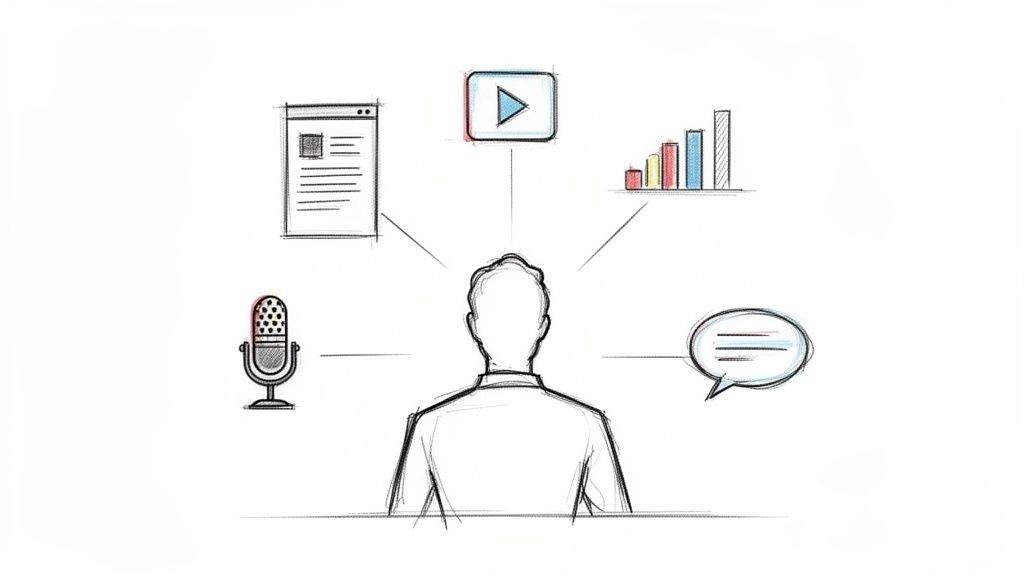
"I don't have time" is the number one reason executives give me for not building their brand. Let's kill that excuse right now with a simple, hyper-focused routine that takes just 15 minutes. It’s all about connection, not just creation.
Here’s how you break it down:
This simple routine keeps you visible and builds real momentum without ever feeling like a second job.
The goal isn't to be everywhere at once. It's to be consistently present where it matters most. Fifteen minutes of focused, strategic engagement is far more powerful than an hour of mindless scrolling.
You poured hours into that killer article or video. The biggest mistake you can make is to post it once and just let it die. That one piece of content is a goldmine.
Repurposing isn’t about being lazy; it’s about being smart. You're respecting the effort you already put in while getting your message in front of more people in the formats they prefer.
Think about it this way. One blog post can become:
With this playbook, one hour of writing can fuel an entire week of content. For a deeper dive, we've mapped out a daily system for building your personal brand with more advanced workflows.
Let's put this all together into a simple, repeatable schedule. This framework makes sure you're covering all your bases—from engagement to content—without getting bogged down.
This is a sample plan I give my clients to get them started. The key is to find a rhythm that works for you and stick to it.
This kind of structured routine turns the abstract idea of "personal branding" into a series of simple, daily actions.
Think of your online presence as a critical asset, just like a personal website. For many experts, especially in creative fields, that often starts with designing an author website with a solid brand strategy to act as a home base for their ideas. By making these small, consistent moves every week, you build an authentic brand that works for you long after you've logged off.
Building a powerful personal brand is a must for any leader, but it's a path loaded with traps. I've seen even the smartest founders make mistakes that can crush their reputation faster than they can build it. Steering clear of these pitfalls is just as critical as the content you create.
And the stakes are sky-high. Think about it: 70% of employers are already checking you out on social media, and 54% have flat-out rejected candidates because of what they found. For leaders, that scrutiny is dialed up to eleven. With 72% of US adults on these platforms, a single misstep can unravel years of hard-earned credibility. You can find more data on why an authentic brand matters at Human to Brand.

The fastest way to lose an audience? Projecting a persona that isn't really you.
People smell a fake a mile away. When your online content reads like it was churned out by a corporate marketing bot, it creates a massive disconnect. That breeds distrust.
Your brand has to be a genuine extension of your leadership style, your values, and your actual voice. Don’t copy another leader’s style or chase trends that you don't actually care about. Being authentic isn't about spilling your life story; it's about being the same person online and offline.
Your personal brand is what people say about you when you're not in the room. If your online and offline personas don't align, the conversation will focus on that inconsistency, not your expertise.
Another common mistake is treating your brand like a series of random, disconnected thoughts. One day you’re an expert on AI, the next on supply chains, and the day after that you’re posting a generic motivational quote.
This "spray and pray" approach just confuses people and waters down your authority.
Every single piece of content should tie back to the core narrative you’ve already defined. This constant reinforcement hammers home what you stand for and what problems you solve. Without it, you’re just more noise in an already crowded room, not a recognized authority.
Here’s how to stay sharp and focused:
It’s not a matter of if you'll get negative feedback, but when. How you handle it is a public stress test of your leadership.
Deleting comments, getting defensive, or ignoring valid points is a disaster. It screams that you’re not open to dialogue and can’t take accountability. That’s a brand killer.
Instead, see criticism as a chance to show your character. Acknowledge the feedback publicly and professionally. If you made a mistake, own it. Explain what happened and what you're doing about it.
Engaging with criticism constructively can turn a potential crisis into a masterclass in confident, authentic leadership. That builds way more trust than a perfect-but-sterile online presence ever could.
Even with the best playbook, getting started with a personal brand brings up some real-world questions. It's totally normal to wonder about the time suck, if it's actually worth it, and how to pull it off without it becoming another full-time job.
Let's cut through the noise and tackle the most common things leaders ask. I'll give you direct, no-fluff answers to get you moving forward.
This is always the first question, and the answer is probably not what you expect: it takes way less time than you think—if you have a system. You can forget the idea of spending hours glued to your screen every day. A killer personal brand is built on consistency, not cramming.
For most leaders I work with, 15-20 minutes of focused effort a day is all it takes to see real momentum. This isn't about mindless scrolling; it's about making every minute count.
The goal isn't to be everywhere. It's to be consistently present where it actually matters. Fifteen minutes of sharp, strategic engagement will always beat an hour of wandering around online.
Just build a small habit—maybe while you're having your morning coffee—to drop a few insightful comments, share a quick thought, and reply to people in your network. It seems small, but that habit compounds into massive visibility over time.
Look, you can and absolutely should get help, but you can't completely hand off your personal brand. Your authentic voice, your stories, your take on things—that's your biggest asset. Nobody can fake that for you.
Bringing in support is a smart move for any busy exec. Here’s the right way to think about it:
This kind of partnership lets you scale your presence without losing the very thing that makes it work: you. The trick is to find someone who acts as an amplifier for your voice, not a replacement.
Measuring the return on your brand isn't as fuzzy as it sounds. You won't always be able to draw a straight line from one LinkedIn post to a seven-figure deal, but you can absolutely track clear signals that show it's working.
The ROI shows up in ways you can count and ways you can feel.
Metrics You Can Actually Track:
The "Soft" Returns That Hit Hard:
This fear holds so many brilliant leaders back. Let me be clear: you don't need to be a professional writer or a polished keynote speaker to build a brand that connects. Authenticity crushes perfection every single time.
People aren't looking for a flawless speech. They're looking for real insights from someone who's actually been in the trenches and knows what they're talking about.
Here are a few dead-simple ways to get over this hurdle:
Your unique perspective is the only thing that matters. The goal is just to share it in whatever way feels most natural to you.
At Legacy Builder, we specialize in turning your hard-won expertise and unique vision into a powerful online presence. We handle the content creation, strategy, and daily management, allowing you to focus on leading while we build your legacy. https://www.legacybuilder.co


You could – but most in-house teams struggle with the nuance of growing on specific platforms.
We partner with in-house teams all the time to help them grow on X, LI, and Email.
Consider us the special forces unit you call in to get the job done without anyone knowing (for a fraction of what you would pay).
Short answer – yes.
Long answer – yes because of our process.
We start with an in-depth interview that gives us the opportunity to learn more about you, your stories, and your vision.
We take that and craft your content then we ship it to you. You are then able to give us the final sign-off (and any adjustments to nail it 100%) before we schedule for posting.
No problem.
We have helped clients for years or for just a season.
All the content we create is yours and yours alone.
If you want to take it over or work on transitioning we will help ensure you are set up for success.
We want this to be a living breathing brand. We will give you best practices for posting and make sure you are set up to win – so post away.
Subscribe to our newsletter and get insights on how to grow your personal brand.
