.svg)
Subscribe to our newsletter and get insights on how to grow your personal brand.
Thank you! Your submission has been received!
Oops! Something went wrong while submitting the form.
.svg)


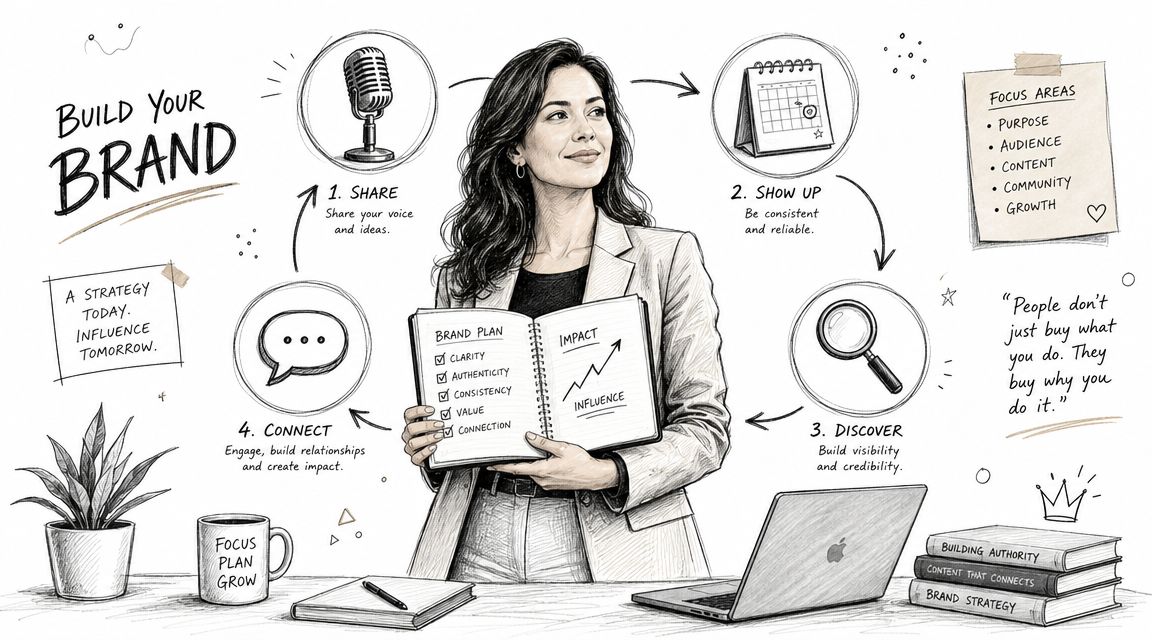
Most personal branding advice is lazy. It tells you to post more, show up more, optimize more, and somehow trust that opportunity will follow.
I don't buy that.
If your personal brand development plan doesn't aim at qualified leads, strategic partnerships, speaking opportunities, or stronger deal flow, you don't have a plan. You have a hobby with a Canva template. Visibility by itself is worthless. Plenty of people are visible and still ignored when real buying decisions happen.
The importance of a personal brand is undeniable. Employers research 98% of candidates online, 70% say a strong personal brand matters more than a résumé, 44% have hired someone because of their brand, and 54% have rejected candidates because of a poor online presence, according to these personal branding statistics. That doesn't just apply to job seekers. Founders, consultants, operators, and executives are being evaluated the same way. Buyers search your name. Partners scan your profile. Event hosts check whether you look credible before they invite you.
So stop treating your brand like self-expression first and business infrastructure second.
A real personal brand development plan is a 90-day operating system. It tells you what to say, where to say it, how often to publish, who to engage, and how to measure whether your reputation is turning into revenue.
Individuals often fail because they start with output instead of outcome.
They ask, “What should I post?” when the better question is, “What result should this brand create?” If you skip that step, you end up publishing generic insights, chasing likes from the wrong audience, and building recognition that never converts into anything useful.
“Post every day” is incomplete advice. Frequency matters, but only if your message points toward a clear commercial outcome.
A founder should use a personal brand to attract buyers, partners, talent, and distribution. An executive should use it to build authority inside and outside the company. A consultant should use it to reduce trust friction before the first sales call. If your content doesn't support one of those goals, it's noise.
Practical rule: Don't create content until you know what conversation you want it to start.
Here's what weak plans usually look like:
I think most personal brands break down because people confuse attention with influence. Attention is just the top of the funnel. True influence is established when attention changes how people perceive your expertise and what they do next.
That means your personal brand development plan needs to answer four hard questions:
If you can't answer those in one sitting, don't post another motivational thread.
The right mindset is simple. You're not building a creator brand unless that's your business. You're building a market-facing trust asset.
That changes everything. Your profile becomes a landing page. Your posts become proof. Your comments become distribution. Your network becomes deal flow. Your content calendar becomes a business development system.
Visibility without a commercial objective creates busywork. Visibility tied to a clear offer creates momentum.
That's the lens I want you to use for the rest of this article. Not “How do I grow faster?” but “How do I make my expertise easier to find, easier to trust, and easier to buy?”
Individuals don't need more confidence. They need tighter positioning.
The biggest mistake I see is trying to build a personal brand around everything you've done. That feels honest, but it kills memorability. The market doesn't reward broad self-descriptions. It rewards clear relevance. A major gap in most personal brand plans is the conflict between what you want to be known for and what the market will reward, as discussed in this analysis of personal brand narratives and strategic content.
Start here:
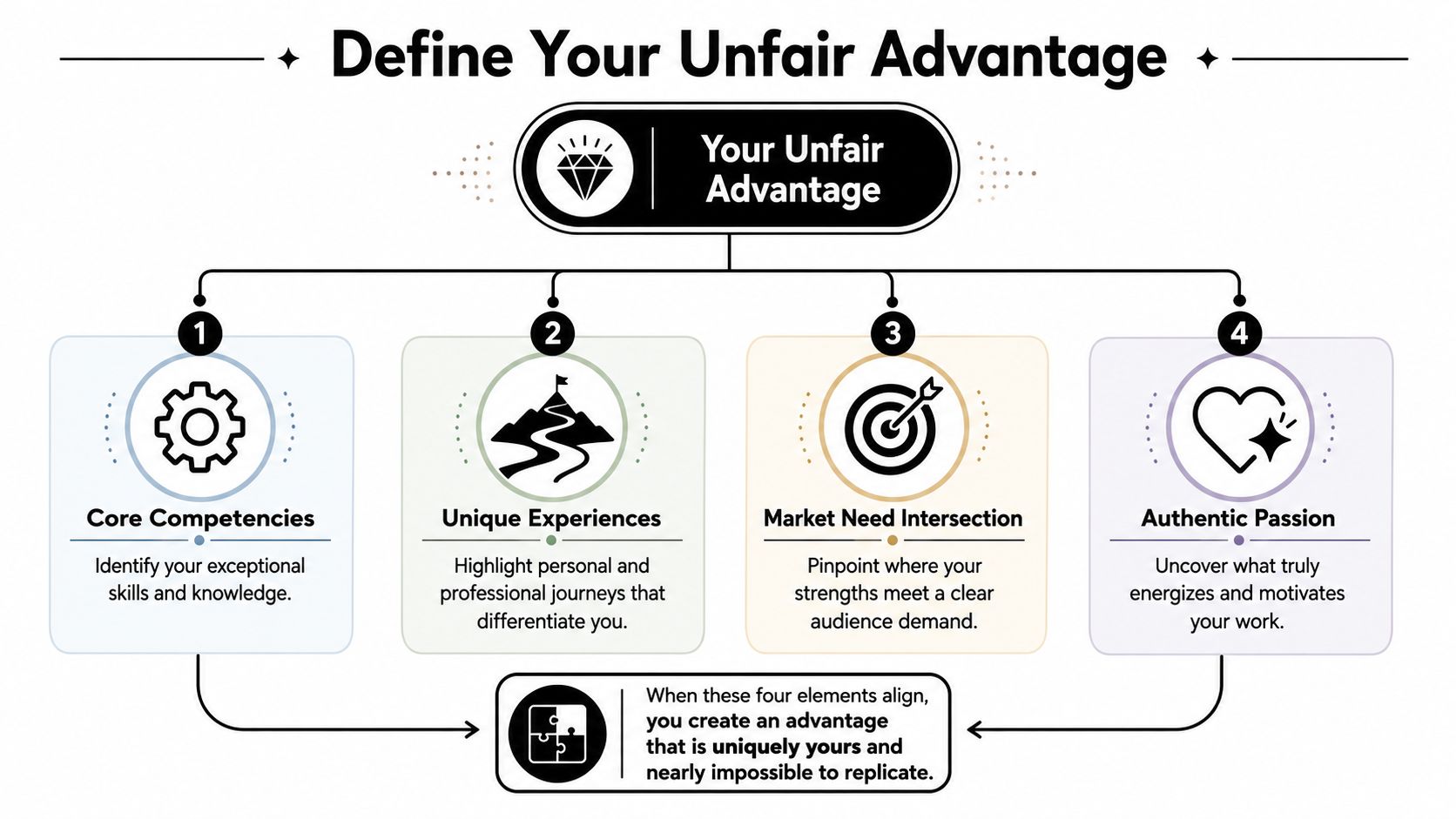
Your unfair advantage sits at the intersection of four things:
That sounds obvious. It isn't. Individuals often overweight passion and underweight demand. Or they pick a niche that's profitable but doesn't fit their actual strengths, so their content feels borrowed.
Use this filter:
| Question | Bad answer | Better answer |
|---|---|---|
| What do you do? | I help businesses grow | I help B2B founders turn expertise into authority-driven content |
| Who is it for? | Entrepreneurs | SaaS founders, consultants, and executive operators |
| What problem do you solve? | Visibility | Inconsistent content, weak positioning, low inbound trust |
| Why you? | I've done a lot of things | My background gives me direct pattern recognition in this niche |
A broad background isn't a weakness if you package it properly. It becomes a weakness when you present it as a list instead of a thesis.
I like a blunt formula:
I help [specific audience] solve [specific problem] through [specific method], so they can achieve [business outcome].
Examples:
That statement should guide your headline, bio, featured links, speaking topics, outreach, and content pillars.
If you need help tightening that message, this guide on strategic positioning and finding your market edge is worth reading.
Your niche doesn't need to capture your whole identity. It needs to capture your most credible commercial value.
Before you lock in your positioning, run three checks.
Credibility check
Can you point to real work, real opinions, or real experience that supports this angle?
Demand check
Are people already paying to solve this category of problem?
Durability check
Can you create at least a few recurring themes around it without forcing it?
If your answer is shaky, narrow further.
A strong personal brand isn't built on self-description. It's built on defensible relevance.
Later, when you publish, your audience should think, “This person understands my problem,” not, “This person seems interesting.”
Once you've got that, watch this for another perspective on sharpening your message and making it marketable.
You do not need more content ideas. You need a repeatable machine.
Building a brand like an amateur often leads to burnout. This involves posting when inspiration hits, copying trending formats, and spreading oneself across too many platforms. That approach collapses the second real work gets busy.
A smarter personal brand development plan acts like a small media operation with tight constraints.
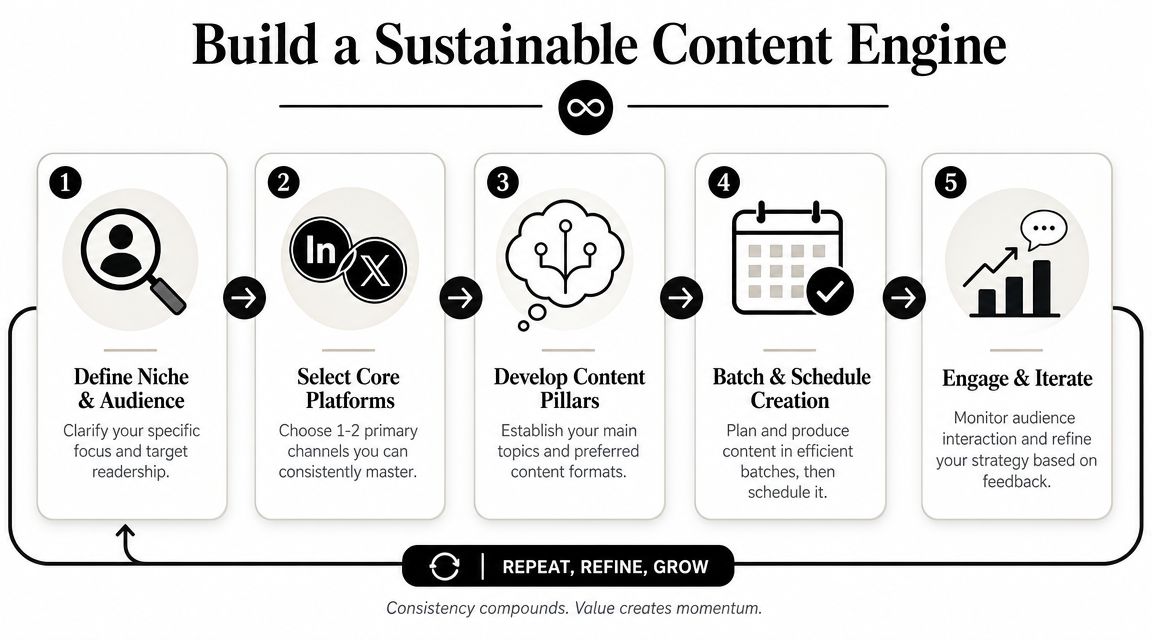
I recommend choosing one primary platform and one secondary platform at most. If your audience is on LinkedIn, don't pretend you'll also master X, Instagram, YouTube, and a newsletter all at once. You won't.
Your content system should include:
For most professionals, three to five content pillars are enough. More than that and your brand starts drifting.
AI can help you move faster. It can outline posts, organize ideas, repurpose transcripts, and clean rough drafts. What it can't do well on its own is sound like you.
That matters more now because content volume is rising quickly. LinkedIn reported a 40% increase in video creation and a 34% increase in video engagement year over year, as covered in Northeastern's guidance on building your personal brand. More content doesn't automatically create more trust. It just raises the bar for originality and signal.
Here are my guardrails:
If your audience could swap your name with someone else's and the post still works, your voice is missing.
One strong idea can become a week of assets.
A founder can turn a sales call insight into:
That's the system. Not endless creation. Intelligent reuse.
If you want a practical framework for planning that workflow, this guide on how to create a content plan for your personal brand is useful.
I also recommend setting a simple weekly cadence. One long-form asset or core idea. A few short-form derivatives. Daily engagement. One review session at the end of the week. That's sustainable. That's how you stay visible without becoming content's full-time employee.
Most advice reaches its breaking point. It tells you what matters, then leaves you to figure out the execution.
Don't do that to yourself. Run a 90-day sprint.
A practical 90-day personal brand development plan is commonly organized in three phases: Days 1 to 30 for audit and setup, Days 31 to 60 for publishing rhythm and engagement, and Days 61 to 90 for doubling down and measuring business outcomes such as leads and partnerships, according to this 90-day brand-building framework.
Let's use a hypothetical example. Say you're a B2B SaaS founder who wants more inbound demos, better partnership conversations, and more credibility with buyers before the first call.
Your 90 days shouldn't look like random posting. They should look like deliberate sequencing.
| Phase | Focus | Key Actions | Success Metric |
|---|---|---|---|
| Days 1 to 30 | Audit and setup | Clean up search results, tighten headline and bio, define one core message, choose content pillars, publish first three posts | Clear positioning and first public proof assets live |
| Days 31 to 60 | Publishing rhythm and engagement | Lock in a realistic cadence, comment on peer content, send targeted messages, track which topics create real conversations | Consistent output and stronger response quality |
| Days 61 to 90 | Acceleration and measurement | Double down on best-performing topics, launch one strategic partnership, systematize workflow, review lead and partnership signals | Early business outcomes tied to content activity |
Don't start by “building audience.” Start by making sure anyone who looks you up understands what you do.
Your first month should include:
Those first posts should do different jobs. One should tell your story or thesis. One should teach something practical. One should show a sharp opinion about your category.
This is the point where people usually disappear.
Don't. Keep publishing. Beyond that, start behaving like a participant in your market, not a broadcaster. Leave thoughtful comments. Tag relevant peers when it makes sense. Send direct messages after meaningful interactions. Look for repeated questions and objections. That's message research disguised as networking.
The fastest way to improve your content is to notice what smart buyers keep asking you in private.
At this stage, judge topics by whether they produce business conversations, not whether they collect empty engagement.
By now, patterns will be obvious. Certain topics get replies from qualified people. Certain formats feel easier to maintain. Certain conversations keep turning into calls, intros, or invitations.
Push harder on those.
A founder at this stage might:
You don't need a giant media brand in 90 days. You need proof that your personal brand can influence business outcomes.
If you're seeing more inbound questions, stronger partnership interest, or better-quality calls, the system is working. Then you refine it and keep going.
Once your content is working, your profile has one job. Convert curiosity into trust.
Most profiles fail because they read like résumés. That's backward. Your LinkedIn profile, X bio, featured links, and banner should function like a lightweight sales page for your expertise.

Most visitors won't read everything. They scan.
So optimize in this order:
If LinkedIn is a key channel for you, this guide on how to increase profile views on LinkedIn can help you tighten the basics.
I automate logistics, not relationships.
That means it's smart to use tools for drafting, scheduling, clipping, note capture, and asset organization. It is not smart to automate comments, fake engagement, or outsource your opinions to generic ghost text.
A lean stack might include:
That last option only makes sense if you already know your message and need help executing consistently.
Good systems remove friction from publishing. They should never remove your judgment.
If you want faster authority, stop relying only on your own audience.
One of the strongest moves is guesting on other people's platforms. Podcasts are especially useful because they let you show depth, personality, and lived experience in a way short posts can't. If you're deciding where to invest your energy, this breakdown of the benefits of podcast guesting makes a solid case for borrowing established audiences instead of building everything from scratch.
Profile optimization and workflow optimization are underrated because they aren't flashy. I still treat them as force multipliers. Better content gets attention. Better profiles and cleaner systems turn that attention into action.
If you only measure likes, you'll build a brand that entertains people and confuses you.
A serious personal brand development plan needs business metrics. Otherwise, you can't tell whether you're building authority or just feeding an algorithm. The most actionable metrics are qualified leads, conversion rate, search volume for your name, and the number of speaking or collaboration invitations, and visibility alone isn't the target. Business outcomes are, according to this piece on measuring the ROI of personal branding.
Here's what I'd monitor every month:
Those metrics tell you whether your reputation is gaining commercial traction.
You don't need a complicated dashboard. A spreadsheet is enough.
Track:
Then review patterns. Which ideas attract buyers? Which formats create trust fastest? Which platform gives you the highest quality conversations?
I also think it's smart to pay attention to how your brand appears in AI-driven discovery environments. As more people use AI tools to evaluate companies and experts, learning about optimizing brand presence in AI search becomes part of modern visibility strategy.
A personal brand becomes an asset when you can connect content activity to pipeline activity.
This is the standard I want you to use. Not “Am I growing?” but “Is my brand creating opportunities I can name?”
Start the 90-day sprint. Pick your niche. Tighten your message. Build the system. Publish consistently. Measure what matters. Then keep the parts that produce leads, partnerships, and authority.
If you want help turning your expertise into a consistent content system, Legacy Builder helps professionals shape their story, sharpen positioning, and maintain steady brand output without sounding generic.


You could – but most in-house teams struggle with the nuance of growing on specific platforms.
We partner with in-house teams all the time to help them grow on X, LI, and Email.
Consider us the special forces unit you call in to get the job done without anyone knowing (for a fraction of what you would pay).
Short answer – yes.
Long answer – yes because of our process.
We start with an in-depth interview that gives us the opportunity to learn more about you, your stories, and your vision.
We take that and craft your content then we ship it to you. You are then able to give us the final sign-off (and any adjustments to nail it 100%) before we schedule for posting.
No problem.
We have helped clients for years or for just a season.
All the content we create is yours and yours alone.
If you want to take it over or work on transitioning we will help ensure you are set up for success.
We want this to be a living breathing brand. We will give you best practices for posting and make sure you are set up to win – so post away.
Subscribe to our newsletter and get insights on how to grow your personal brand.
