.svg)
Subscribe to our newsletter and get insights on how to grow your personal brand.
Thank you! Your submission has been received!
Oops! Something went wrong while submitting the form.
.svg)



So, what exactly is strategic positioning?
Think of it as deliberately carving out a specific, valuable spot for your brand inside your ideal customer's mind. It’s not about trying to be the best at everything for everyone. It’s about being uniquely different in a way that truly matters to a select group of people. This clarity becomes your North Star, guiding every single decision you make.
In a market overflowing with noise, blending in is the fastest way to become irrelevant. Strategic positioning is the foundational work that stops this from happening. It's the difference between shouting into a void and having a real conversation with an audience that actually wants to listen.
Without it, your marketing, your content, even your product development is just guesswork.
Let me give you a simple example. Imagine two coffee shops on the same busy street.
One sells "good coffee." The other sells "the fastest, most reliable coffee for busy commuters on their way to the train."
The first shop is just a commodity. It’s forced to compete with every other café on price and convenience. The second has a strategic position. It knows exactly who it serves (commuters) and the unique value it delivers (speed and reliability).
That single point of clarity changes everything:
That’s the power of strategic positioning. It transforms a generic business into a specific solution for a specific problem.
For founders and CEOs, a strong strategic position isn't just some marketing buzzword; it's a core business strategy. It tells you how to spend your money, who to hire, and where to innovate next.
A well-defined position gives you a framework for growth, making sure that as you scale, you don't lose the magic that made you special in the first place. This intense focus is how emerging brands can go head-to-head with established giants—not by outspending them, but by out-thinking them.
Strategic positioning isn’t about being number one; it’s about being the only one in the minds of your ideal customers. It shifts the competition from a battle of features to a connection based on unique value.
This is even more critical for personal brands. As a content creator or thought leader, your expertise is your product. Without a clear position, you’re just another voice in the crowd. With one, you become the authority.
It’s the difference between being a "marketing consultant" and being "the go-to expert on LinkedIn content strategy for B2B SaaS founders." The second one has a defined audience, a clear promise, and a serious competitive edge.
It's easy to get strategic positioning mixed up with general marketing, but they play on completely different fields and have different goals. Nailing this distinction is the key to building a brand that lasts.
Marketing gets you noticed today. Positioning ensures you’re remembered tomorrow.
Here’s a quick breakdown to make it crystal clear.
In short, positioning is the long game. It’s the strategy behind the brand, while marketing is the collection of tactics you use to bring that strategy to life day in and day out. You need both, but one has to come first.
A killer positioning strategy isn't a single "aha!" moment. It's a structure you build, piece by piece. Think of it like building a house. You don't just throw up a roof and call it a day. You have to pour a solid foundation, put up a strong frame, and then add the details that make it yours.
It’s the same with your brand. Your positioning needs four core pillars to stand on. Each one helps you answer a critical question that turns your brand from just another option into the only choice for your ideal customer.
Let's break them down.
First thing's first: Who are you even talking to? The absolute starting point is to get crystal clear on your target audience. And I don’t mean just their age or where they live. That’s surface-level stuff. You need to go deeper into their psychographics—their values, what keeps them up at night, their biggest goals, and how they think.
You have to be able to answer questions like:
When you zero in on a specific niche, you can stop shouting into the void and start whispering directly to the people who need you. You quit being a generalist for everyone and become the go-to specialist for the right few.
Okay, you know who you're serving. Now you have to nail why they should care. That's your Unique Value Proposition (UVP). It's a short, punchy statement that spells out the specific benefit you deliver that nobody else can. It’s the answer to your audience’s unspoken question: "What makes you different, and why is that better for me?"
A strong UVP isn’t just a slick tagline; it's the core promise of your brand. It has to be specific, easy to remember, and focused on something your audience actually values. If you're feeling stuck, check out these powerful personal value proposition examples to see how others have nailed their unique angle.
This diagram shows how these pieces fit together. You start with a solid foundation, which gives you a competitive advantage, and that ultimately builds a memorable brand.
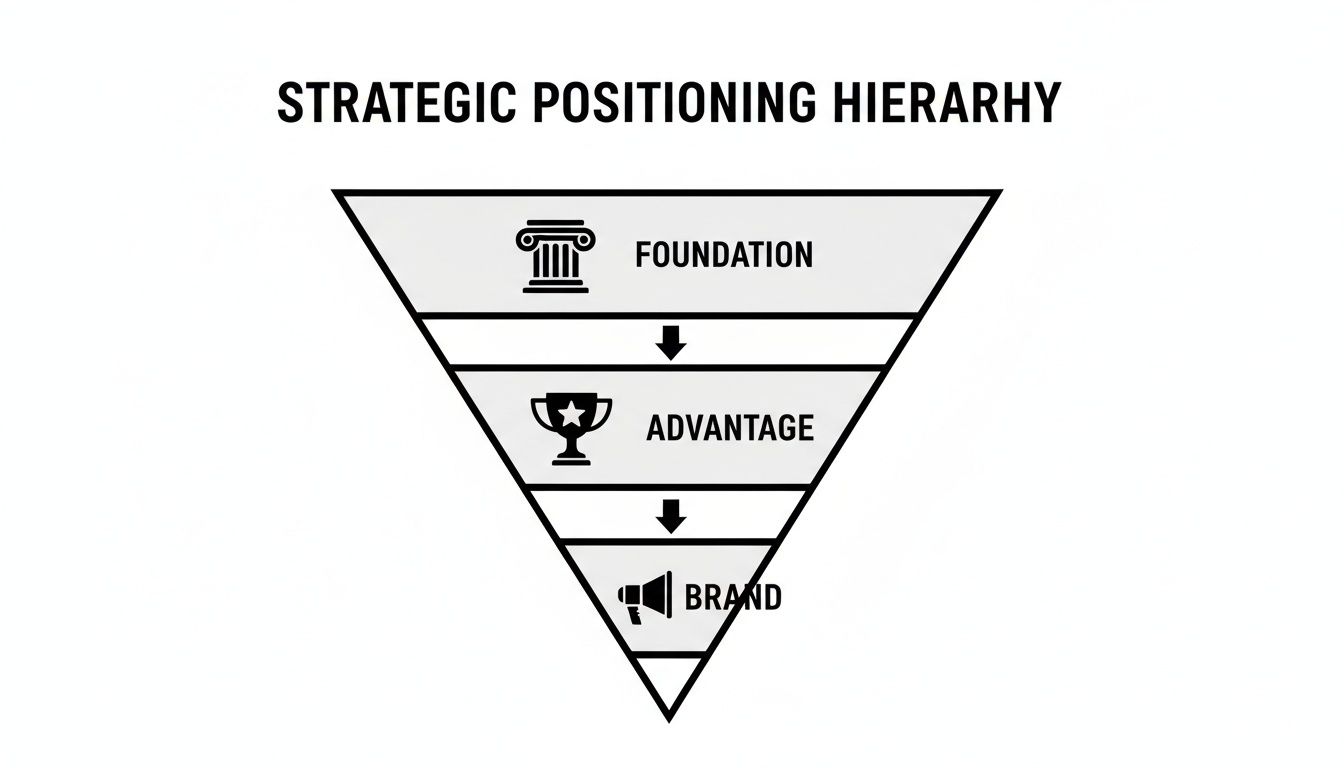
See how that works? A strong brand isn't the starting point—it's the result of doing the foundational work first.
You’re not building your brand in a vacuum. Your position is always relative to the competition. The point of checking out your competitors isn’t to copy them. It's to find the gaps they've left wide open. You're looking for that sweet spot—a space in the market that's valuable to your audience but completely ignored by everyone else.
A crowded market doesn't mean there's no room. It just means you have to get smarter about where you stand. You're searching for that uncontested space where the competition becomes irrelevant.
Start asking yourself:
The answers will point you toward opportunities to be different and claim a unique spot that everyone else has missed.
Finally, your brand identity is how your positioning comes to life. It’s the look, the feel, the voice—everything that communicates your value to the world. We’re talking about your logo, your colors, your fonts, and the way you write and speak.
Your brand identity is the real-world experience of your strategy. If your position is to be the most approachable, no-fluff expert in your space, then your brand better not feel stuffy, corporate, and cold.
Every single element needs to work together to reinforce the unique territory you’ve claimed. When your strategy and your execution are aligned, you build trust. And that's how you become recognized and remembered.
Knowing you need a unique position is one thing. Actually carving it out is a whole different ball game.
The good news? You don't have to stare at a blank canvas and hope for a stroke of genius. The smartest strategists rely on a few proven frameworks to turn abstract ideas into a concrete, actionable plan. These aren't just academic exercises; they're powerful tools for seeing your market clearly and confidently planting your flag.
Think of these frameworks as a GPS for your brand. You know the destination—a strong, defensible market position—and these tools give you the turn-by-turn directions to get there without getting lost.
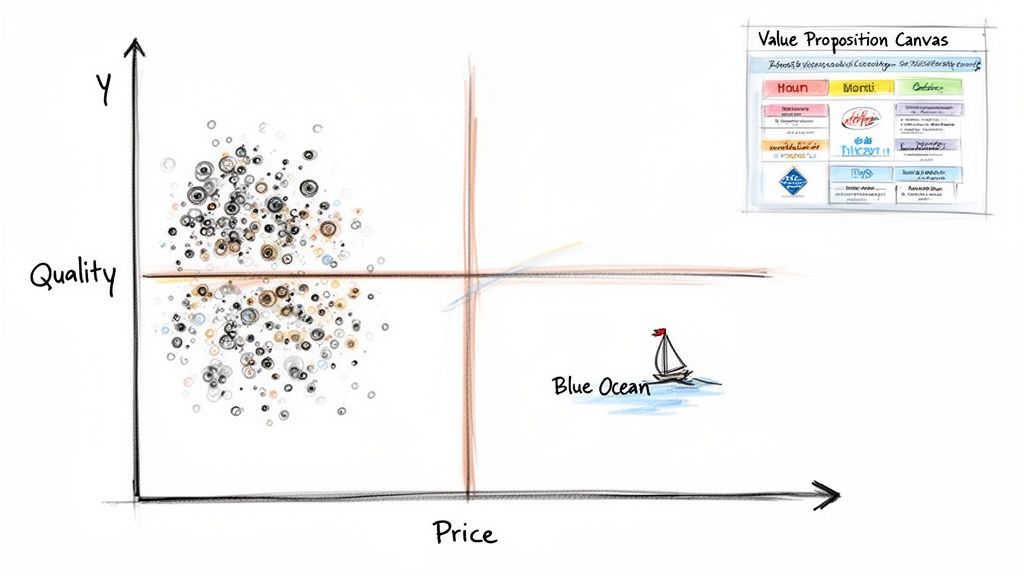
Let's walk through a few of the most effective models you can put to work today.
One of the simplest yet most eye-opening tools in the box is the perceptual map (also called a positioning map). It's basically a visual grid showing how your target audience perceives the different players in your space based on two key attributes. For example, you might map competitors on axes like "Price" (Low to High) and "Quality" (Basic to Premium).
Once you plot where everyone lands, you immediately see the crowded neighborhoods and—more importantly—the wide-open real estate. Those gaps are your opportunity. They're the unclaimed territories where you can build a unique position.
A perceptual map doesn't show you what the market is; it shows you what your audience thinks it is. This distinction is crucial, as positioning is ultimately a battle for the mind.
This simple visual exercise stops you from guessing and transforms competitor analysis into a treasure map that points directly to your opening.
Once you've spotted a potential opening, you have to make sure it's a spot your audience actually cares about. This is where the Value Proposition Canvas becomes your best friend. It’s designed to create a perfect match between what your customers desperately need and what your brand uniquely offers.
The canvas is split into two halves that force you to connect the dots:
A winning position lives in the sweet spot where your pain relievers and gain creators perfectly align with their pains and gains. With the failure rate for tech startups hovering around 90%, often due to a lack of market need, this tool is non-negotiable. It forces you to build your strategy around real customer problems, not just features you think are cool.
For founders and creators looking to make a much bigger splash, the Blue Ocean Strategy is a framework for creating entirely new market spaces. No more fighting for scraps. This concept splits the market into two oceans:
This framework pushes you to stop looking at your direct competitors and instead find ways to make them irrelevant. Instead of trying to be a little bit better, you focus on creating a massive leap in value for your audience. It's a bold move, but it’s how disruptive brands redefine entire industries.
Here’s a quick overview of these frameworks, helping you select the right tool based on your specific business goals or personal brand needs.
Each tool offers a different lens through which to view your market. The key is to pick the one that best suits your immediate challenge, whether that's finding a gap, validating an idea, or creating a whole new category.
Theory is one thing, but seeing strategic positioning in action is where the magic really happens.
The most iconic brands out there didn’t just trip and fall into market dominance. They were surgical about it. They meticulously carved out a unique position that hit home with a specific audience and culture.
They didn't win by outspending everyone; they won by out-thinking them.
One of the best case studies on this is how Starbucks tackled China. They didn’t just copy and paste their American coffee shop model and hope for the best. They knew that to win, they had to completely rethink their strategy from the ground up—building it on cultural insight, not a one-size-fits-all playbook.
This is a masterclass in adaptation, connection, and explosive growth.
When Starbucks landed in China, they ran straight into a wall: they were trying to sell coffee in a nation of tea drinkers.
A head-on approach pushing the quality of their coffee would’ve been a spectacular failure. They were smart enough to realize they couldn't just sell a beverage. They had to sell an experience.
Instead of being a quick, in-and-out coffee stop for busy commuters—their core play in the U.S.—Starbucks positioned itself as a "third place." It was a cool, aspirational spot between home and work where people could hang out, socialize, and just relax.
This was a brilliant move. It plugged directly into the growing Chinese middle class and their hunger for social status and modern experiences. That high price point wasn't a mistake; it was a core feature that screamed "premium" and reinforced its aspirational vibe.
Starbucks didn't just translate its menu and call it a day. They went all in, re-engineering their entire approach to fit local customs, showing a deep respect for the culture.
This hyperlocal strategy paid off—big time. By adapting its positioning for an international market, Starbucks absolutely crushed it in the world's second-largest economy. They opened their first store in 1999, and by 2023, they had over 6,500 locations, locking down a ridiculous 80% of China's premium coffee market.
That kind of growth doesn't happen by accident. It came from a strategic position that went way beyond just replicating what worked back home. You can find more insights on this approach by checking out global expansion for strategic positioning on meegle.com.
By selling an experience instead of just coffee, Starbucks created a new category for itself. It wasn't just another beverage option; it was a destination, a status symbol, and a comfortable retreat.
This is proof that the best positioning isn't about forcing your identity onto a new market. It’s about digging deep to understand what that market truly wants and needs, and then finding that unique space where your brand can deliver something no one else can.
It’s a powerful lesson: real success comes from connection, not just commerce.
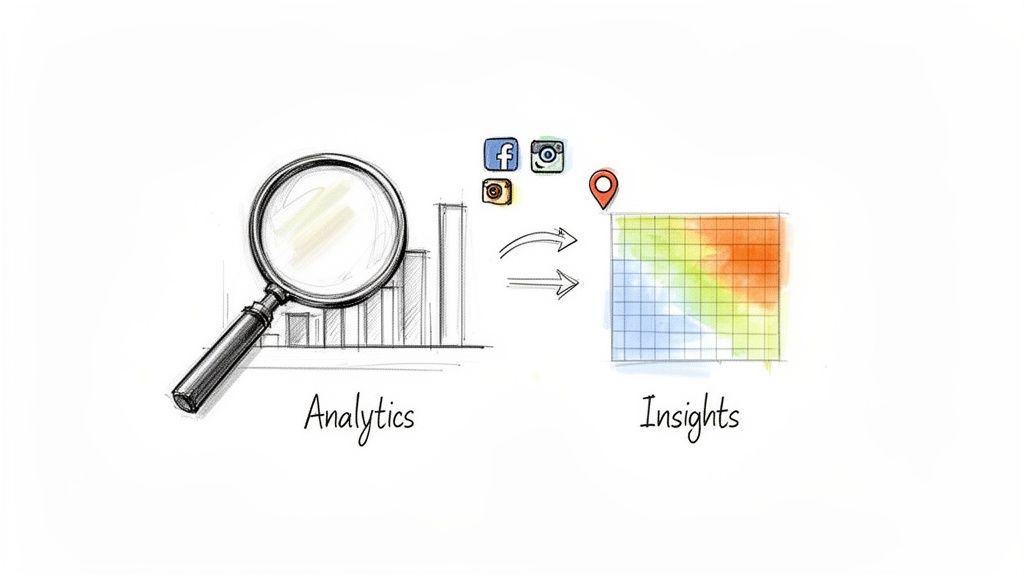
Gut feelings are great for pointing you in the right direction, but data gives you the actual roadmap. Let’s be real—the most powerful positioning isn’t based on a hunch. It’s carved out of a deep, objective understanding of your market, your audience, and your own performance.
This is how you turn raw numbers into a real competitive edge.
Instead of just assuming what your audience wants, data lets you listen to what their actions are telling you. Every click, every comment, every purchase is a clue. When you start piecing them together, you see what your audience truly needs and where their frustrations lie, allowing you to sharpen your position with surgical precision.
This evidence-based approach pulls you out of the world of opinions and plants your strategy firmly in reality. It’s how you validate your best ideas and, just as importantly, get a warning when you’re heading off course—before you sink a ton of time and money into it.
Here’s the thing: data by itself is just noise. The real magic happens when you interpret it to make smarter decisions. This is where you connect the dots between what the numbers are saying and what your brand should do next.
You're aiming to go from just looking at data to taking strategic action.
Here are a few gold mines to tap into:
This data-driven approach is becoming a massive economic engine. Take the global location analytics market, for example. It helps businesses pinpoint the best markets by understanding consumer behavior in specific areas. It was valued at $23.87 billion in 2025 and is expected to rocket to $74.63 billion by 2034. That surge shows just how critical data has become for making winning positioning choices. You can learn more about the growth of the location analytics market on fortunebusinessinsights.com.
Data allows you to stop guessing who your audience is and start knowing. It transforms your strategic positioning from a statement of intent into a reflection of proven market reality.
Strategic positioning isn't a "set it and forget it" kind of deal. Markets shift, new competitors pop up, and your audience's needs will change over time. That’s why your use of data has to be a continuous feedback loop, not a one-time project.
Set up a simple system to check your key metrics regularly. This could be a monthly dashboard tracking website engagement, social media sentiment, and the quality of your leads.
By watching these trends, you'll spot small shifts before they become big problems, allowing you to make proactive tweaks to your positioning. This ongoing analysis keeps your brand sharp and relevant, ensuring you're always perfectly aligned with the people you want to serve.
If you're ready to go deeper, you can also learn how to measure brand awareness to get an even clearer picture of the impact you’re making.
If you want to carve out a unique space for your brand, you have to understand the existing landscape first. This is where competitive analysis comes in, but probably not in the way you’re thinking.
This isn’t about obsessively stalking your rivals and copying their every move. Instead, think of it as a strategic hunt for the gaps they’ve left wide open for you to fill.
Imagine you're a real estate developer looking for the perfect spot to build. You wouldn’t just start construction on top of another skyscraper, right? You’d study the city map to find an underserved neighborhood where a new building would be a game-changer, not just another option. Competitive analysis is your market map.
The goal here is simple: pinpoint what your competitors do well, what they promise their customers, and—most importantly—where they’re dropping the ball. This completely reframes the competition. They're no longer just a threat; they become a source of priceless intel that shows you exactly how to be different and better.
Here’s a straightforward way to get started:
Understanding your rivals' online game is a huge piece of this puzzle. A practical guide on competitive analysis in SEO can give you some actionable steps to sharpen your edge here. This knowledge lets you proactively claim a space where you become the undeniable choice for your ideal audience.
And once you’ve found a promising gap, that’s the perfect time to make sure there's real demand. Don't skip this step. We've got a whole guide on how to validate a business idea that you should check out.
Netflix is the classic example of this in action. When they launched, Blockbuster was the undisputed king of home entertainment. A head-to-head fight would have been a death sentence.
So, instead of trying to be a better video store, Netflix zeroed in on Blockbuster’s biggest weaknesses: those infuriating late fees and the hassle of driving to a physical store.
Netflix didn't just compete with Blockbuster; they made its entire business model obsolete. They positioned themselves around convenience and selection, using the internet to fill a gap the brick-and-mortar giant simply couldn't.
This was a genius strategic move, and it was all powered by smart competitive analysis. Netflix saw the frustration their biggest rival was creating for customers and built their entire brand around solving it.
That sharp positioning, combined with smart content investments, helped them grow to 260 million global subscribers by 2023—a massive jump from 100 million back in 2017. This case proves that understanding your competition isn't just a defensive tactic; it's your most powerful offensive weapon for defining what makes you unique.
Even after laying out the whole game plan, a few questions always pop up when you start putting this stuff into practice. It's totally normal. Let's tackle some of the most common ones head-on so you can move forward with confidence.
I get this one all the time. Here’s the simplest way to think about it: positioning is the blueprint, and branding is the finished house.
Your positioning is the behind-the-scenes strategy. It’s the tough, internal work of figuring out exactly who you serve, what makes you undeniably different, and where you're going to plant your flag in the market. It answers the one question that matters most: "Where do we choose to compete?"
Branding? That's what everyone else sees. It's your logo, your voice, your website, your messaging—the entire vibe you put out into the world. Branding is how you bring your position to life. But here's the catch: you can't build a memorable brand on a shaky or non-existent position. It just doesn't work.
Absolutely. In fact, if you're building a personal brand, it’s not just a good idea—it’s everything. Strategic positioning is how you go from being just another voice in the crowd to the voice for a specific group of people.
It’s the difference between being a generic "business coach" and being "the coach who helps first-time SaaS founders lock down their first round of funding using killer storytelling." See the difference? One is forgettable. The other is a magnet for the right people.
A sharp position helps you attract dream opportunities, build a die-hard audience, and become the go-to authority in your space.
For a personal brand, strategic positioning isn't just marketing fluff. It’s how you turn your unique story and expertise into a real competitive advantage. It makes you essential.
Look, your strategic position isn't something you carve in stone and never touch again. While your core identity should have staying power, the world around you is constantly shifting.
I tell my clients to do a formal review of their positioning at least once a year. But you also need to be ready to reassess anytime the ground shifts beneath your feet.
That means hitting pause and re-evaluating when:
The goal isn't to constantly reinvent yourself. It’s to make sure your position stays sharp, relevant, and powerful no matter what the market throws at you.
Ready to stop being a generalist and start building a powerful, specialized personal brand? Legacy Builder is where founders and professionals like you craft a unique market position and turn it into content that builds authority and drives real growth. Let's build your legacy together.


You could – but most in-house teams struggle with the nuance of growing on specific platforms.
We partner with in-house teams all the time to help them grow on X, LI, and Email.
Consider us the special forces unit you call in to get the job done without anyone knowing (for a fraction of what you would pay).
Short answer – yes.
Long answer – yes because of our process.
We start with an in-depth interview that gives us the opportunity to learn more about you, your stories, and your vision.
We take that and craft your content then we ship it to you. You are then able to give us the final sign-off (and any adjustments to nail it 100%) before we schedule for posting.
No problem.
We have helped clients for years or for just a season.
All the content we create is yours and yours alone.
If you want to take it over or work on transitioning we will help ensure you are set up for success.
We want this to be a living breathing brand. We will give you best practices for posting and make sure you are set up to win – so post away.
Subscribe to our newsletter and get insights on how to grow your personal brand.
