.svg)
Subscribe to our newsletter and get insights on how to grow your personal brand.
Thank you! Your submission has been received!
Oops! Something went wrong while submitting the form.
.svg)


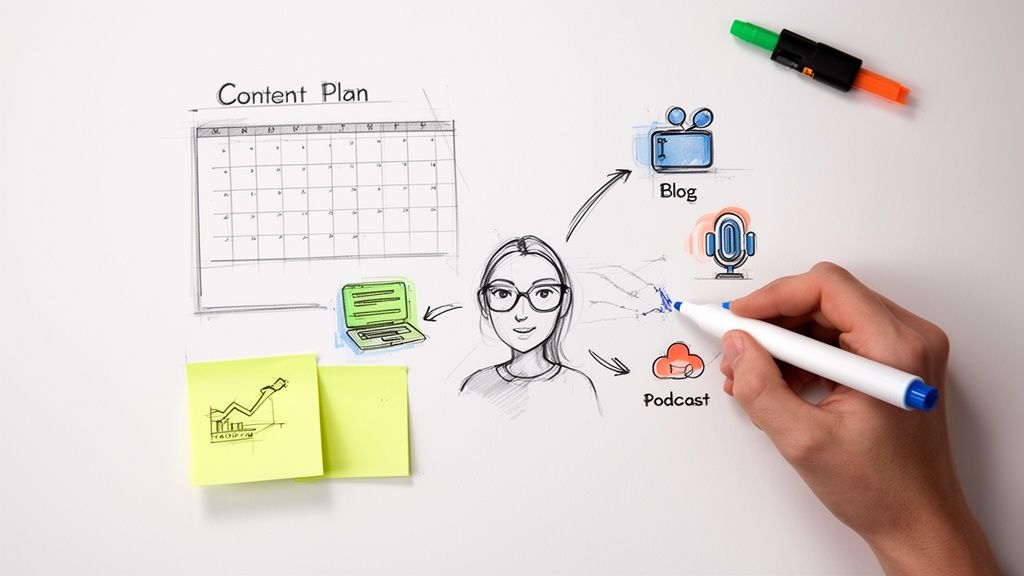
Let's get one thing straight: creating a content plan isn't about bureaucracy or busywork. It’s about turning random actions into a predictable system.
This is the one thing that separates inconsistent posting from intentional brand growth. It ensures every single piece of content you put out has a clear purpose and direction.
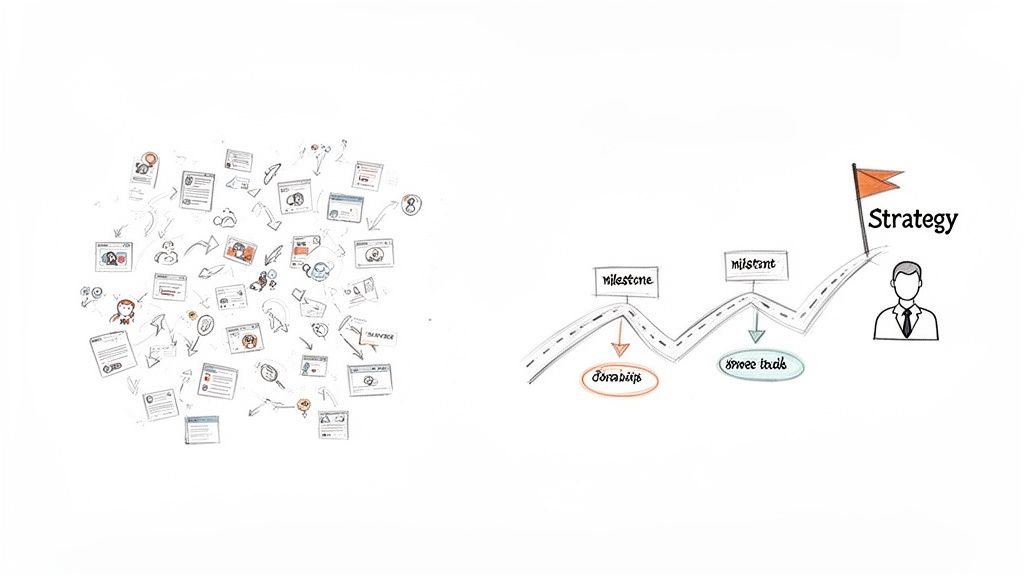
Does this sound familiar? You're creating content, you're posting, but you're just not seeing the results you want. So many professionals fall into this trap, posting without a clear plan and just hoping something sticks.
It’s a recipe for burnout, and you're left with very little to show for it. This scattergun approach isn’t just inefficient; it’s the biggest barrier to building an influential personal brand that actually attracts real opportunities.
The difference between scattered efforts and tangible growth is a documented strategy. Think of a well-crafted content plan as your roadmap—it's how you transform your expertise into a powerful, coherent story that people actually want to follow.
Without a plan, you're just guessing. You're creating content based on what feels right in the moment, which almost always leads to an inconsistent message that fails to connect with your audience.
It’s a common struggle. Believe it or not, only 47% of B2B marketers actually have a documented content marketing strategy. That means over half are operating without a clear guide.
With the industry projected to grow to over $107 billion by 2026, that gap represents a massive opportunity for anyone willing to get organized.
A documented plan brings clarity and purpose. It lets you:
The goal is to stop being just a content creator and start being a content strategist. Your plan is the tool that makes this shift happen, ensuring every post builds on the last to create a powerful, unified brand.
If you’re ready to move from random posts to a real strategy, you have to learn how to plan social media content the right way. This guide will walk you through building that foundational framework.
We're going to give you a practical system to define your message, connect with the right audience, and measure what truly matters for your brand's growth.
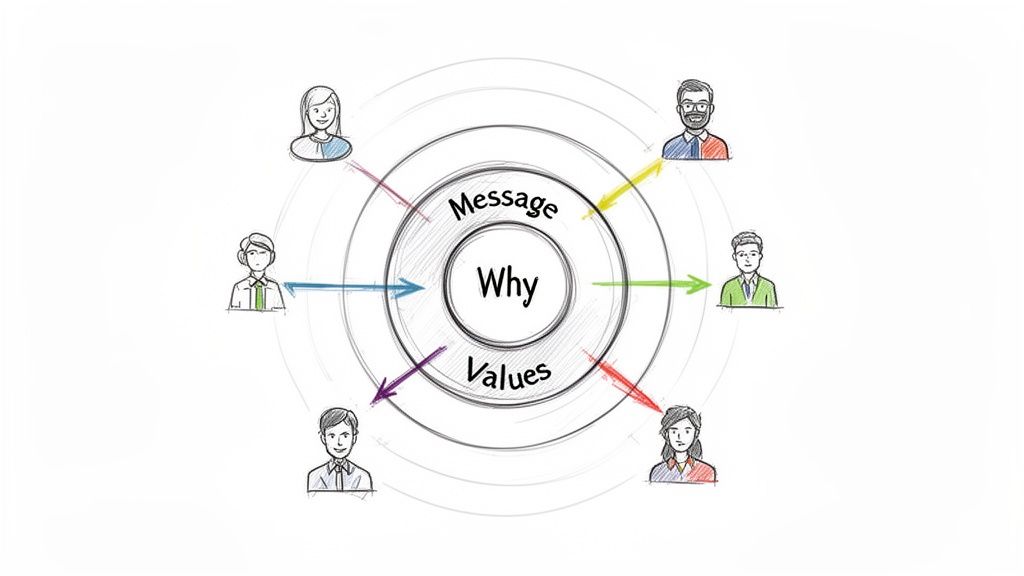
Before you ever hit record or write a single word, you need to answer two dead-simple questions. First, what do you want to be known for? And second, who are you actually talking to?
Skipping this step is like starting a road trip with no map and no destination. You’ll burn through a lot of gas and time, and you’ll definitely end up somewhere—but I guarantee it won't be where you wanted to go.
Your content needs a North Star. It all starts by defining your core message.
Your core message is your "why." It's the unique mission and point of view that separates you from the thousands of other voices in your space. It’s the reason people should give you their attention.
This isn’t about some slick marketing slogan. It’s about digging deep to find the authentic belief that drives everything you do.
To lock this in, ask yourself a few real questions:
Your answers here become the bedrock of your brand. For instance, a financial advisor's core message isn't "I help people invest." That's a service. A real message sounds more like, "I empower creative freelancers to build real wealth without selling out their art." One is a what, the other is a mission.
Once you know your "what," it's time to get crystal clear on your "who." One of the biggest mistakes I see professionals make is creating content for "everyone." Let me be clear: when you talk to everyone, you end up connecting with no one.
Great content feels like a one-on-one conversation. To pull that off, you need a detailed audience persona—a snapshot of your ideal follower or client.
And forget the generic stuff like age and location. For a professional brand, you need to go deeper into their professional world. What keeps them up at night? What are they trying to achieve?
Let's say a SaaS founder's core message is all about building human-centered software. She wants to mentor the next generation of product developers. Her persona could look something like this:
When you have this level of detail, your entire content process changes. You stop asking, "What should I post today?" and start asking, "What would genuinely help Alex solve his biggest challenge this week?"
This persona isn't just a fun exercise; it dictates every single move you make. It tells you which topics will hit home, what formats to use (podcasts and LinkedIn are a must for Alex), and what tone will build genuine trust. It’s the other half of your foundation, making sure your powerful message actually lands with the people who need to hear it most.
Okay, you’ve got your core message locked in and you know exactly who you’re talking to. Now for the fun part: building the actual framework of your content. This is where we bridge the gap between your "why" and the "what" you’ll be posting every day.
The goal here isn't to be a jack-of-all-trades. You need to become known for something specific. That's where content pillars come in. Think of these as the 3-5 core topics that branch directly from your expertise and solve your audience's biggest headaches. Any fewer, and you risk being too niche; any more, and your message gets muddled, leaving people confused about what you actually do.
These pillars need to be broad enough that you’ll never run out of ideas, but sharp enough to scream "expert."
Go back to your core message and that ideal audience persona we defined earlier. The magic happens at the intersection of what you know better than anyone and what they desperately need help with.
Let's stick with our SaaS founder who's targeting "Ambitious Alex," the junior developer. Her pillars wouldn't be generic fluff. They'd be specific and valuable:
See how they're all connected? Each one reinforces her brand from a slightly different angle. Every single piece of content she creates will fit neatly into one of these buckets. That’s how you build a powerful, consistent message.
Once your pillars are set, you have to decide how you're going to package your expertise. A brilliant idea in the wrong format is just noise. The format is just as critical as the message itself.
You don't need to be everywhere at once. It’s about picking the right tool for the job.
The data shows a massive disconnect between what audiences actually want and what most creators are making. For instance, podcasts have an insane 51.29% engagement rate, but just 10.51% of marketers make them a priority. At the same time, 83% of consumers are screaming for more video, and infographics are 30 times more likely to be read than a block of text. This tells us one thing: a strategic mix of formats is non-negotiable if you want to hold someone's attention.
Choosing a format isn't about chasing the latest trend. It’s about matching the medium to your message and, most importantly, to your audience's lifestyle. The best format is the one that gets your expertise into their hands (or ears) most effectively.
To make this crystal clear, I've put together a table breaking down the most popular content formats. Use this to figure out the best mix for your personal brand and the message you're trying to send.
Your final decision should come down to your pillars and your audience. If your expertise is super technical, a detailed blog post or a YouTube tutorial is probably your best bet. But if you’re a natural conversationalist, a podcast will let you share those nuanced insights that get lost in a short article.
The smartest creators I know use a "tentpole" strategy. They create one primary, in-depth piece of content—like a long video or a detailed article—and then slice it up into smaller assets for other channels.
This is how one big idea becomes a week's worth of powerful content. Want to master this? Check out our complete guide on how to repurpose content and multiply your reach. It’s the secret to maximizing your impact without burning yourself out.
So you’ve got your content pillars—the “what” of your strategy. But an idea without a plan is just a wish. This is where your editorial calendar comes in. It’s the “when” and “how” that turns your big ideas into a real, tangible content machine.
Think of it as your command center. This isn't about creating more stress; it's about building a system that makes content creation a manageable, consistent part of your routine. You need to know how to create a content calendar because it's the difference between randomly posting when you feel like it and building a reliable presence your audience actually trusts.
The whole process is pretty straightforward when you break it down. You start with your core message, branch out into your pillars, and then pick the right formats to bring it all to life.
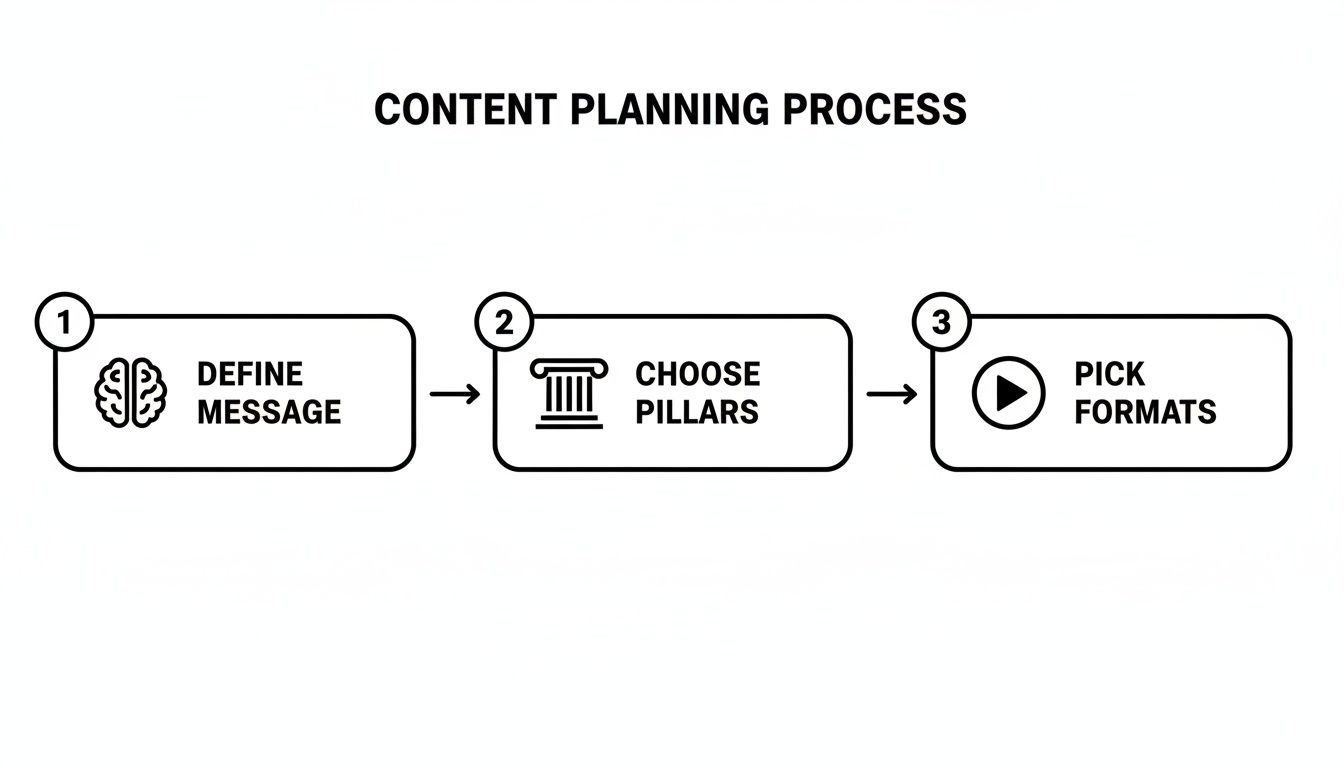
This workflow is the foundation that feeds directly into what you'll be scheduling day-to-day.
Look, for a busy professional, planning a year in advance is a fantasy. Let’s get real and plan one month at a time. This gives you structure but also leaves room to jump on timely topics or unexpected opportunities.
Just open a simple spreadsheet or your favorite project management tool.
Assign one of your content pillars to each week of the month. This simple rotation system is a game-changer. It forces you to give each of your core topics equal airtime, which builds a balanced and complete brand story over the long haul.
It’s as simple as this:
Suddenly, you're not staring at a blank page anymore. Each week has a theme, a creative constraint that makes brainstorming specific ideas a hell of a lot easier.
Here's the secret sauce to a content plan that doesn't burn you out: it’s not about creating more, it’s about creating smarter. Content repurposing is your best friend here. It’s the art of taking one big piece of content and slicing it up into a bunch of smaller assets.
This isn’t an afterthought—you need to plan for it from day one. That one long-form blog post you just wrote? That's not a one-and-done deal. It's the "tentpole" for your entire week of content.
Don’t think of it as creating five different things. Think of it as creating one big idea and presenting it in five different ways. This mindset shift is the key to maintaining consistency without burning out.
A single 1,500-word article can easily be spun into:
Just like that, one big effort populates your calendar for a whole week across multiple platforms. This is how you build a high-impact brand without living on your laptop 24/7.
Let’s say you’re a business consultant whose whole thing is operational efficiency. For "Week 1," her pillar is "Process Automation."
Her tentpole piece is a detailed guide: "5 Manual Tasks to Automate in Your Business This Quarter."
Here's how she builds out her week:
All of that came from one initial piece of content. She’s visible all week long, hammering home her expertise without starting from scratch every single day.
If you’re ready to get your own schedule dialed in, we've got you covered. Find a content calendar template for social media that actually works and get started.
Building a powerful personal brand isn’t about having a massive budget. It’s about having a smart one.
Too many professionals think high-quality content comes with a sky-high price tag. The truth? Strategic planning will always crush a huge, unfocused spend. The goal isn't to outspend everyone; it’s to invest wisely—whether that’s your time or your money—to fuel your brand's growth.
First things first, you need to know where your resources are actually going. It almost always boils down to two things: tools and talent.
Before you spend a single dollar, do a quick audit of yourself. What can you realistically handle on your own? Where does it make sense to bring in help? Be brutally honest about your skills and, more importantly, your time.
If you’re a great writer but can’t design to save your life, your money is better spent on a freelance designer for key visuals than on a fancy writing tool. On the flip side, if design is your zone of genius, maybe investing in a solid video editor or a writing assistant is the smarter play.
For a solo professional, here are a few high-return investments to consider:
Strategic budgeting isn’t about having a huge bank account. It's about knowing exactly where each dollar or hour will have the greatest impact on moving your brand forward. A small, well-placed investment is always better than a large, misguided one.
Look at the market, and you'll see a clear trend: people are investing more in content.
Nearly half of B2B marketers (46%) plan to increase their content budgets. The top performers? They’re dedicating a solid 10-24% of their total marketing spend to content. And it pays off—content marketing consistently delivers some of the best ROI, right up there with email. As you figure out how to build a content plan that can actually grow with you, knowing these numbers is crucial. You can find more 2026 content marketing statistics on Taboola.com.
This doesn't mean you need to match a corporate budget. Not at all. It just proves that setting aside a specific, intentional budget for your content is a winning strategy.
For professionals building a personal brand, the right tools are your secret weapon. They’re force multipliers. They automate the grunt work and level up the quality of your content without needing a whole team.
Here’s a simple breakdown of where to focus your tool budget:
The best part? Many of these tools have great free versions you can start with. The key is to pick tools that solve a real problem for you, not just to collect shiny new subscriptions.
To see what we recommend, check out our curated guide on the 12 best tools for content creators in 2026 to build your brand.
Let’s get one thing straight: your content plan isn’t a stone tablet you create once and never touch again. If you want to build a brand that actually drives opportunities, you have to treat your plan as a living, breathing roadmap.
This is the final, crucial piece of the puzzle. It’s what separates the pros from the amateurs who just post and pray. We're moving past the vanity metrics—the simple 'likes' and 'views' that give you a quick dopamine hit but don't tell you a thing about whether you're building real authority.
If you want to understand your real impact, you have to track the right Key Performance Indicators (KPIs). These are the numbers that signal actual brand growth, showing you if your content is hitting the mark with the right people and pushing them to take action.
Stop obsessing over surface-level stats and start tracking these four areas:
A content plan without a measurement system is just a list of good intentions. Reviewing your data is what turns that to-do list into a smart, responsive strategy that gets better every single month.
Consistency is everything—not just in your posting, but in how you review your progress. You need to block out time once a month for a quick content audit. This doesn't have to be some massive, complicated analysis.
Just ask yourself three simple questions:
This simple review cycle is how you build momentum. It takes the guesswork out of the equation and empowers you to give your audience exactly what they want, ensuring every post you make strengthens your influence and delivers real, measurable results.
When you're first figuring out how to create a content plan, a few common roadblocks always seem to pop up. Let's tackle them head-on with some quick, no-fluff answers.
For most professionals, planning one month ahead is the sweet spot.
This gives you enough runway to stay consistent without boxing you in. You still have the freedom to jump on a hot industry topic or run with a sudden spark of inspiration.
I usually recommend mapping out your big-picture themes or content pillars on a quarterly basis. But the actual, specific posts for each week? Handle those month by month. It's the perfect balance of having a solid game plan without feeling creatively suffocated.
Good news: you absolutely don't need to shell out for expensive software. In fact, keeping it simple is often the best way to make sure you'll actually stick with it.
At the end of the day, the best tool is the one you consistently open and use. Don't overcomplicate it.
Your content plan is a guide, not a prison. The most successful founders use their plan as a foundation for consistency, but they always leave room for those spontaneous, high-value ideas you just can't schedule.
This is the question I get most often, and the answer isn't about finding more hours in the day. It’s about being smarter with the hours you have.
The secret is content batching.
Stop trying to come up with something new every single day. It's exhausting. Instead, block out a few focused hours one day a week and create everything for the week ahead. Record all your videos, write all your posts, and get all your graphics done in one single, productive session.
The other key is to lean heavily on repurposing. Create one big, primary piece of content—like an in-depth article or a detailed video—and then spend your time chopping it up into a dozen smaller posts for different platforms. Trust me, consistency over intensity is the only sustainable way to build a personal brand that actually gets results.
Ready to stop guessing and start building a brand that attracts real opportunities?
At Legacy Builder, we transform your expertise into a high-impact content strategy that works for you, not the other way around. We handle the planning, creation, and distribution so you can get back to doing what you do best.


You could – but most in-house teams struggle with the nuance of growing on specific platforms.
We partner with in-house teams all the time to help them grow on X, LI, and Email.
Consider us the special forces unit you call in to get the job done without anyone knowing (for a fraction of what you would pay).
Short answer – yes.
Long answer – yes because of our process.
We start with an in-depth interview that gives us the opportunity to learn more about you, your stories, and your vision.
We take that and craft your content then we ship it to you. You are then able to give us the final sign-off (and any adjustments to nail it 100%) before we schedule for posting.
No problem.
We have helped clients for years or for just a season.
All the content we create is yours and yours alone.
If you want to take it over or work on transitioning we will help ensure you are set up for success.
We want this to be a living breathing brand. We will give you best practices for posting and make sure you are set up to win – so post away.
Subscribe to our newsletter and get insights on how to grow your personal brand.
