.svg)
Subscribe to our newsletter and get insights on how to grow your personal brand.
Thank you! Your submission has been received!
Oops! Something went wrong while submitting the form.
.svg)


Most advice on how to increase profile views on linkedin is lazy. It tells you to post more, post daily, post whatever comes to mind, and trust that visibility will follow.
That advice breaks the moment you're a founder, CEO, operator, or senior professional with an actual job.
I don't care if you get more profile views from random people who will never buy from you, hire you, partner with you, or refer you. I care whether the right people land on your profile and immediately understand why you matter. That's the standard. Not vanity. Not noise. Not fake momentum.
If you're busy, the answer isn't to become a full-time creator. It's to build a profile that converts, publish selectively, and engage with precision. Done right, LinkedIn becomes a reputation engine that works even when you're not posting every day.
More views sounds good. It isn't the primary goal.
Your goal is qualified attention. You want your profile seen by buyers, investors, recruiters, collaborators, podcast hosts, event organizers, and peers with influence. A pile of irrelevant views won't move your career or business forward. A small number of targeted views can.
It's common to chase traffic before fixing positioning. That's backwards. If your profile is vague, generic, or reads like a stale resume, more traffic just means more people bouncing after a quick glance. You don't need more eyeballs on a weak profile. You need a profile that makes the right person stop and think, "I should talk to this person."
A profile view is not a win. It's the start of a decision.
I tell clients to think like a buyer, not a broadcaster. When someone lands on your page, they're asking a few silent questions:
That's why the best LinkedIn strategy is narrower than generally assumed. You're not trying to impress everyone. You're trying to become obvious to the people who matter.
If you approach LinkedIn that way, every tactic gets simpler. Your headline gets sharper. Your content gets more useful. Your engagement gets more intentional. And your profile views start turning into conversations that lead somewhere.
If your profile isn't built to convert, content won't save you.
A weak profile wastes attention. Someone sees your comment, clicks your name, lands on your profile, and leaves because your headline says nothing, your photo looks amateur, and your About section reads like a corporate bio written by committee. That's the leak you need to fix first.

People judge your professionalism fast. LinkedIn is no different.
According to MBA Mission's LinkedIn visibility analysis, profiles with professional photos receive 21 times more views, and a fully completed profile with at least five skills can see up to 17 times more views. That's not a small lift. That's table stakes.
If you don't have a strong photo, fix that before anything else. Use a clean background, direct eye contact, strong lighting, and clothing that matches your market. If booking a photographer isn't practical, modern tools for AI headshots for LinkedIn can help you create a more polished first impression without dragging out the process.
Your banner matters too. Users often waste it.
Use it to reinforce your positioning. Not with clutter. Not with ten logos. One clean visual idea is enough. A short message, a niche identifier, or a simple brand line works better than a busy collage.
Your headline is prime real estate. Stop using only your job title.
According to Taplio's headline optimization guide, optimizing a LinkedIn headline with relevant keywords and a quantifiable result can increase search appearances by as much as 10x in under three weeks, with one reported example moving from 25 to 240 weekly search appearances. That should tell you how important this field is.
Most bad headlines have one of two problems. They're either empty buzzwords or plain job labels.
Here is the difference:
| Weak headline | Stronger headline |
|---|---|
| Founder at X | SaaS Founder helping B2B teams improve customer acquisition |
| Marketing Leader | B2B Marketing Executive focused on pipeline growth and category positioning |
| CEO | Speaker | Mentor | CEO building email marketing systems for growth-stage software companies |
The point isn't to stuff keywords. The point is to combine who you help, what you do, and what area you own.
A practical structure I like:
If you need ideas, study strong LinkedIn profile headline examples for personal branding and then rewrite yours in plain English.
Practical rule: If a stranger reads your headline and still can't tell what you want to be known for, rewrite it.
Your About section should not be a timeline of your career. Nobody cares that much, at least not at first.
Use it to answer three questions:
A simple structure works:
Example:
That second version creates direction. It gives the reader a handle.
Many users ignore the Featured section. That's a mistake.
If someone is interested enough to scroll, they want evidence. Give them curated proof, not a random pile of links. Put your best assets there:
Don't feature everything. Feature what answers the question, "Why should I trust this person?"
Your Experience section isn't just for job history. It's search inventory.
Write each role in a way that supports your positioning. Focus on scope, domain, and outcomes. If you're trying to attract SaaS work, your language should make that obvious. If you want speaking opportunities, your experience should show visible thought leadership and category expertise.
The Skills section is more important than typically realized. Keep it tight. Prioritize skills that support your niche and match what you want to be found for. Don't fill it with soft, mushy filler.
Use this filter before adding or keeping a skill:
A strong profile isn't long. It's clear. Every section should push the same message from a different angle. That's how you turn views into action instead of curiosity into nothing.
Content should deepen your positioning, not distract from it.
Too many professionals post whatever is easiest to write that day. A generic leadership lesson. A recycled productivity opinion. A vague motivational story. That kind of content doesn't build demand. It blends into the feed and dies there.
The content that attracts the right profile views does one thing well. It makes your expertise easy to recognize.
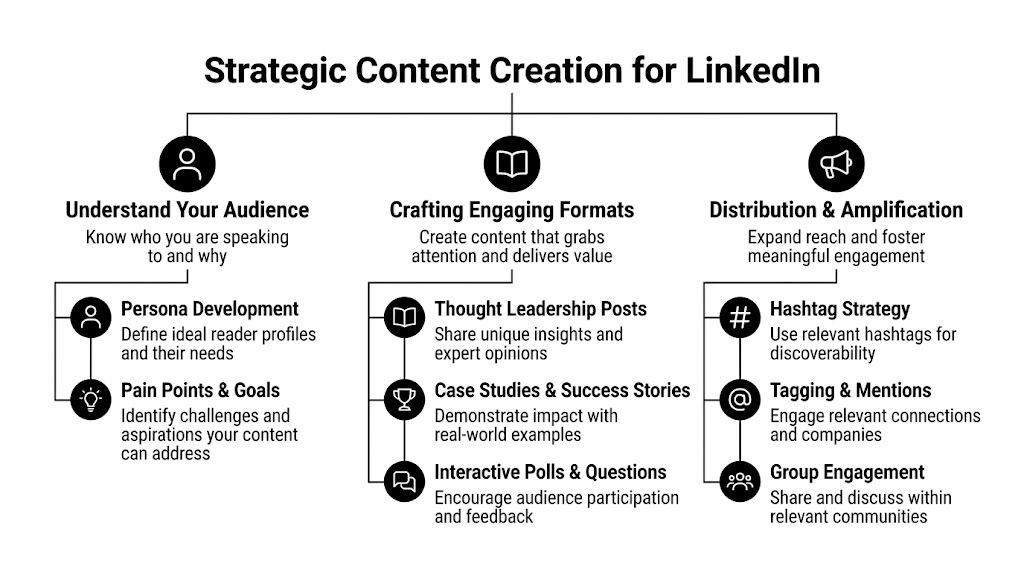
You do not need endless variety. You need recognizability.
I prefer three to four content pillars. That's enough range to stay interesting and enough focus to become known for something. A founder might use:
A marketing leader might use a different mix. A CEO in a traditional business moving online might use another. The point is the same. Pick themes that support your reputation.
When your content pillars are clear, writing gets easier, and profile visitors get a coherent impression of who you are.
Not everyone needs to become a polished storyteller. Not everyone should post long essays.
Use formats that feel natural and can be sustained:
| Format | Best use |
|---|---|
| Text post | Strong opinions, short lessons, direct insight |
| Carousel | Breaking down a framework or process clearly |
| Document post | Sharing a playbook, checklist, or teardown |
| Short video | Useful if your communication style is strongest verbally |
The biggest mistake is forcing a format that makes you sound stiff. If you think clearly in bullets, use bullets. If you're strong in stories, tell stories. If your best material comes from client conversations, turn those patterns into posts.
For a stronger system, study practical approaches to writing LinkedIn posts that build your personal brand.
Most LinkedIn content is forgettable because the author is trying not to offend anyone.
That instinct kills reach with the right audience. Strong personal brands aren't built on safe summaries. They're built on clear perspective. I'm not telling you to be obnoxious. I'm telling you to stop sanding every opinion down until it means nothing.
Here are post angles that usually work better than generic advice:
The best content doesn't try to look smart. It helps the right reader feel understood.
The hidden job of content is to earn the profile visit.
That means your post should create a gap the reader wants to close. They read your point of view, get curious, and click to see who you are. If your content and profile tell the same story, that click becomes a connection request, a follow, or a message.
A few practical rules help:
Good content attracts. Sharp positioning converts. You need both, but content only works when it reinforces what your profile already promises.
Daily posting is overrated for people who run companies, lead teams, or spend their day in actual meetings.
The smarter move is targeted engagement. If you comment well on the right posts, you borrow attention from existing conversations and send qualified people back to your profile. That works because it puts your thinking in front of people who already care about the topic.
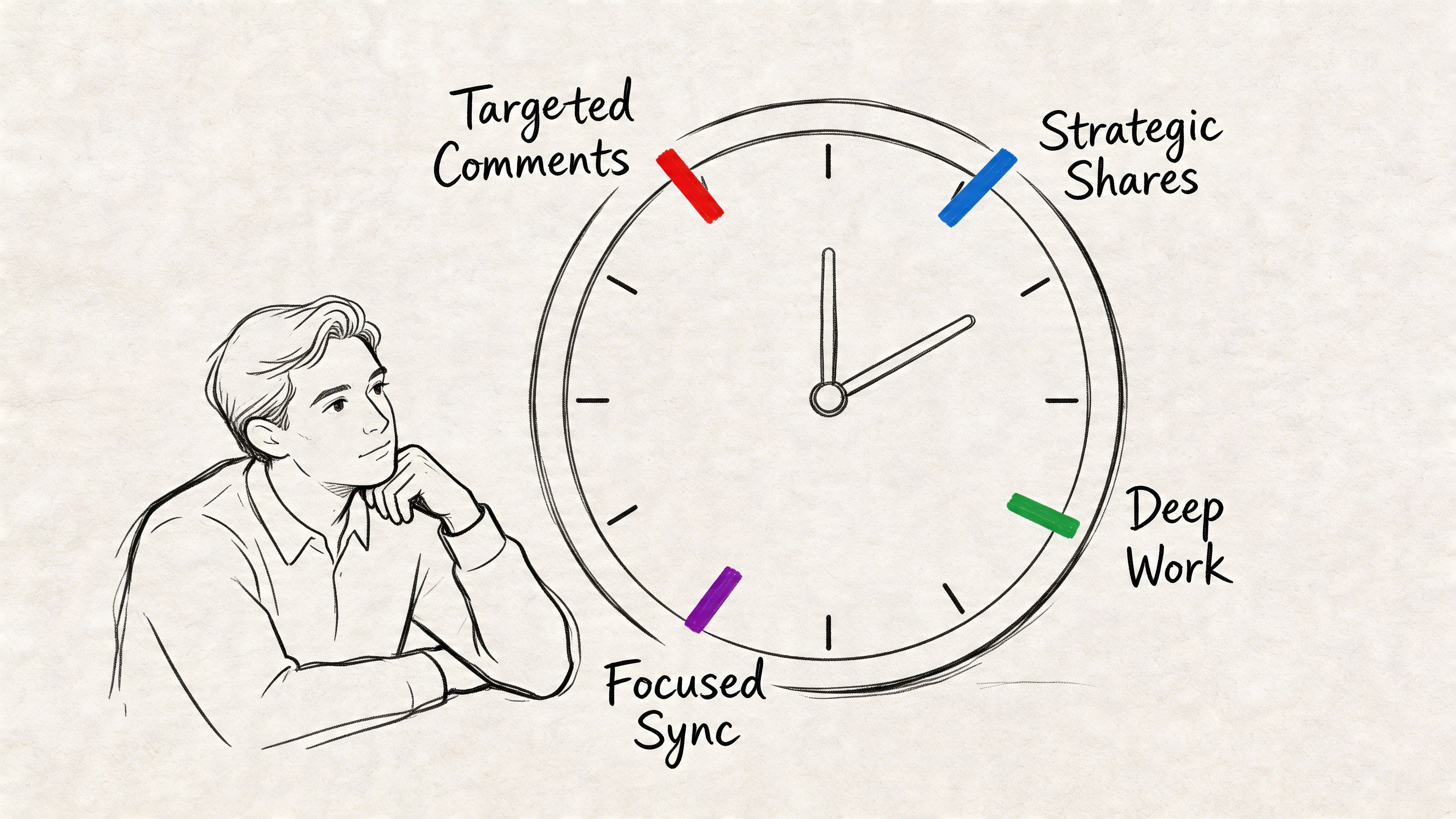
According to Career Contessa's analysis of LinkedIn visibility tactics, LinkedIn's algorithm favors meaningful interactions, and user experiments found that batch-commenting on 20 targeted posts per week can generate 200 to 500 targeted profile views without creating original content. The same source also notes a 40% drop-off from posting inconsistency, which is exactly why busy professionals need a model that doesn't collapse when the calendar gets full.
"Great post."
"Completely agree."
"Love this."
Those comments do nothing. They don't show expertise. They don't start conversation. They don't earn clicks.
A high-value comment does one of three things:
Here's the difference:
| Weak comment | Stronger comment |
|---|---|
| Great insight | I see this with SaaS founders all the time. They assume weak reach is a content problem when the real issue is vague positioning. |
| Agree completely | This also changes by market. In Europe, generic US-style growth language often underperforms because buyers search differently. |
| Thanks for sharing | The part most leaders miss is that the profile has to convert the click. Engagement without profile clarity wastes the attention. |
You do not need to live in the feed.
I like a simple weekly sprint. Block one focused session and leave with your visibility work done.
Choose your targets
Build a list of people whose audiences overlap with yours. Industry operators, recruiters in your space, category creators, podcast hosts, peer founders, and potential partners all make sense.
Comment where your expertise fits
Don't chase every large post. Go where you can add something specific. Relevance beats volume.
Prioritize recency
Early comments get more visibility and more conversation. If you can engage soon after a post goes live, do it.
Reply when people respond
The first comment creates exposure. The follow-up creates relationships.
My rule: If your comment could be copied and pasted under any post on LinkedIn, it isn't good enough.
A strategy only works if you can maintain it during busy weeks.
That's why I prefer a compact operating rhythm for executives:
That cadence is sustainable. Daily posting often isn't.
This short video gives a useful perspective on creating momentum without overcomplicating the platform:
This approach is especially effective if you're in one of these situations:
For busy professionals, this is one of the most practical answers to how to increase profile views on linkedin. Not louder activity. Smarter visibility.
Generic advice fails in competitive markets because generic language attracts generic attention.
If you're in SaaS, email marketing, consulting, fintech, or any other niche B2B category, broad terms don't help much. They usually make you harder to find, not easier. You don't need to sound more impressive. You need to sound more specific.

According to Executive Career Brand's analysis of LinkedIn profile visibility, for niche B2B sectors, swapping a saturated keyword like "leadership" for a more specific skill like "email automation" can boost relevant profile views by up to 700%. The same source notes that European profiles using localized keywords see 3x more search visibility than profiles using generic US-centric terms.
In this area, many strong professionals lose.
They write for peers instead of search behavior. They call themselves a "strategic leader" when the market is searching for "email automation," "GDPR-compliant SaaS," "revenue operations," or "B2B demand generation." Broad labels sound senior. Specific labels get found.
A fast way to tighten your profile is to compare these pairs:
The narrower term often does more work.
If you operate across regions, don't assume one positioning statement fits all.
A European SaaS founder may need language that reflects regional compliance, buying norms, and industry vocabulary. A US-style growth headline can sound imported and vague in another market. That's why localized keywords matter. They align your profile with how people in that region search.
Specificity beats prestige on LinkedIn search.
There's a tendency to obsess over posts and ignore durable assets that keep working after the feed moves on.
These are the ones I would use first:
If your niche is crowded, these assets give you room to explain what short posts can't.
If you don't measure the right things, you'll mistake motion for progress.
A rise in profile views can mean you're getting traction. It can also mean your name floated around in the wrong circles for a week. The number alone doesn't tell you much. The useful question is simpler: Are the right people finding you, and what happens next?
LinkedIn gives you enough data to make decent decisions if you read it.
Start with search appearances and profile viewer quality. Look at the job titles, industries, and companies behind the traffic. If you want founder clients and recruiters keep showing up, your profile message may still be tilted toward employment instead of authority. If peers are viewing but decision-makers aren't, your content may be too insider-focused.
If you need a cleaner explanation of visibility metrics, this guide on what impressions mean on LinkedIn is useful because it helps separate surface-level reach from signs of real attention.
For a broader personal brand review process, this framework for measuring content performance for your personal brand is a smart companion.
According to Mobilocard's LinkedIn optimization research, profiles with verified skills increase their chances of being contacted by recruiters by 30%, and having 5+ endorsements for top skills helps signal expertise to the algorithm.
That matters because profile credibility is often the difference between a passive view and an inbound message.
Use a short review checklist:
A profile view is only useful if you know how to respond to it.
When someone relevant engages with your content, views your profile, or accepts your request, don't jump into a pitch. Start a real conversation. Mention the context. Keep it short. Be specific.
Try messages like:
No hard sell. No instant calendar link. Just a professional opening that respects context.
If your profile earns attention but your follow-up feels transactional, you'll lose trust fast.
The fastest way to waste time on LinkedIn is to chase activity without intent.
If you want results, keep the model simple. Build a profile that converts. Share content that sharpens your reputation. Use targeted engagement to stay visible without turning LinkedIn into a second full-time job. That's the system.
Overcomplicating how to increase profile views on LinkedIn stems from a focus on volume. More posts. More reach. More noise. I think that's the wrong lens. The professionals who win are the ones who make every touchpoint clearer, more credible, and more aligned with the opportunities they want.
Use your profile like a landing page for your expertise. Use your content like selective proof. Use your comments like strategic introductions.
Do that consistently and profile views stop being a vanity metric. They become a byproduct of relevance.
That matters because LinkedIn isn't just a place to be seen. It's a place to shape how people understand your body of work over time. That's your real asset. Not the weekly graph. Your reputation.
It depends on what you change.
A stronger headline, better photo, and tighter keyword alignment can improve visibility quickly because those changes affect search and first impressions right away. Content and engagement usually take longer because they depend on repetition and audience fit. If your profile is currently weak, fixing the foundation often creates the fastest shift.
No.
Premium can give you more visibility into who's viewing you and offer extra outreach tools, but it isn't the core driver of profile growth. A clear profile, relevant keywords, stronger proof, and thoughtful engagement matter more. If your profile message is fuzzy, Premium won't fix that.
Start with positioning, not posting.
Get four things in place before you worry about content:
Once that's done, start connecting with relevant people and commenting on conversations in your niche. A brand new profile doesn't need more activity. It needs a clear identity.
They try to look broadly impressive instead of specifically useful.
That leads to vague headlines, bland content, inflated titles, and generic buzzwords. The market doesn't respond to that. People respond when they understand exactly what you do, where you fit, and why you're credible.
Yes.
For busy professionals, strategic commenting is one of the best visibility levers on the platform. It lets you show expertise inside existing conversations without carrying the burden of constant original content. That's often a better fit for founders and executives than trying to force a creator schedule they won't maintain.
No.
A resume documents your history. A LinkedIn profile should frame your market value. Some overlap is normal, but your profile needs more positioning, more clarity, and more proof. Write it for the person deciding whether to contact you, not for an HR filing system.
If you want the strategy without the execution burden, Legacy Builder helps busy professionals turn their experience, ideas, and reputation into a credible personal brand that grows. If you're ready to stop guessing and start building a LinkedIn presence that compounds, they're worth a look.


You could – but most in-house teams struggle with the nuance of growing on specific platforms.
We partner with in-house teams all the time to help them grow on X, LI, and Email.
Consider us the special forces unit you call in to get the job done without anyone knowing (for a fraction of what you would pay).
Short answer – yes.
Long answer – yes because of our process.
We start with an in-depth interview that gives us the opportunity to learn more about you, your stories, and your vision.
We take that and craft your content then we ship it to you. You are then able to give us the final sign-off (and any adjustments to nail it 100%) before we schedule for posting.
No problem.
We have helped clients for years or for just a season.
All the content we create is yours and yours alone.
If you want to take it over or work on transitioning we will help ensure you are set up for success.
We want this to be a living breathing brand. We will give you best practices for posting and make sure you are set up to win – so post away.
Subscribe to our newsletter and get insights on how to grow your personal brand.
