.svg)
Subscribe to our newsletter and get insights on how to grow your personal brand.
Thank you! Your submission has been received!
Oops! Something went wrong while submitting the form.
.svg)


Most personal brand advice is lazy. It tells you to post more, show up daily, stay visible, and trust that consistency will eventually pay off. That advice is incomplete at best and destructive at worst.
If your entire brand depends on your next post, you do not have a brand. You have a publishing habit.
A real personal brand content strategy does not start with a content calendar. It starts with an asset. Your positioning, point of view, proof, and distribution system should keep working when you are in meetings, on vacation, selling, hiring, or not in the mood to perform online. That is brand infrastructure.
Your online presence already shapes opportunity. 44% of employers have hired candidates based on positive social media content, while 54% have rejected applicants due to a poor online presence (Humantobrand). You do not get to opt out. You only get to decide whether your brand is intentional or accidental.
The founders who win are not always the loudest. They are the clearest. They operate in a defined micro-niche, publish around a few unmistakable ideas, and build a reputation people can repeat when they are not in the room.
Posting every day is not a strategy. It is a workload.
Too many founders confuse activity with authority. They fill a week with quote cards, trend reactions, and recycled advice, then wonder why none of it turns into quality leads, referrals, or category ownership. The problem is not effort. The problem is that random output does not create durable market perception.

A founder stuck on the content hamster wheel asks, “What should I post today?” A founder building brand infrastructure asks, “What should my market believe about me six months from now?”
Those are completely different games.
A calendar helps you ship. Good. Keep it. But calendars are production tools, not strategic foundations. If your message changes every week, your audience cannot remember you. If your content is broad, your buyers cannot place you. If your ideas only live inside social feeds, your authority disappears the moment your posting cadence slips.
That is why I push founders away from “post more” and toward message architecture. You need:
Your content calendar should serve your brand. Your brand should never depend on your calendar.
A lot of professionals skip this and go straight to tactics. That is how they end up looking busy and sounding interchangeable. If you need a primer on tightening the fundamentals first, this breakdown on how to develop a personal brand and build influence is useful.
You do not need to flood every platform. You need to become memorable in the right room.
One strong point of view published consistently in the right micro-niche beats scattered volume every time. The market does not reward generic effort. It rewards clear association. When someone hears your name, a specific problem, audience, and promise should come to mind immediately.
That is what brand infrastructure does. It gives your content gravity.
Most founders are not underqualified. They are underpositioned.
They know their craft, they have real experience, and they can help people. But when they try to build a personal brand, they describe themselves in language that could fit thousands of other profiles. “Helping businesses grow.” “Sharing leadership insights.” “Talking about entrepreneurship.” None of that is ownable.
Your foundation starts when you stop defining yourself by industry and start defining yourself by the specific problem you solve for a specific kind of person.
Broad niches create broad content. Broad content gets ignored.
What you want is a validated micro-category. That is the intersection of your expertise, your strongest proof, and a market problem people actively care about. According to LinkedIn’s 2025 Economic Graph report, creators operating in validated micro-niches see 3.2 times the engagement and 2.7 times higher lead conversion rates than generalists (University of Pennsylvania feature citing the report).
That should end the “I do not want to box myself in” excuse.
Specificity does not shrink your market. It makes you legible to it.
Before you create new content, audit the signals you already send.
Search your name. Review your LinkedIn headline, bio, pinned posts, featured links, YouTube descriptions, podcast bios, and the way other people introduce you. Ask three trusted people what they think you are known for. Then compare their answers to the reputation you want.
If there is a gap, do not post through it. Fix it.
Use this simple audit:
| Area | Bad signal | Strong signal |
|---|---|---|
| Headline | Broad title with no buyer relevance | Specific audience plus specific outcome |
| Bio | Resume summary | Market-facing point of view |
| Content | Mixed topics with no pattern | Repeated themes tied to one category |
| Proof | Claims with no receipts | Clear stories, examples, decisions, lessons |
| Referral language | Hard to introduce you | Easy one-sentence explanation |
If people cannot explain what you do without rambling, your positioning is weak.
A strong personal brand does not form around your interests. It forms around your audience’s expensive problems.
You need to know what frustrates your ideal buyer, what slows their progress, what they misunderstand, and what they are already trying that is not working. Many founders get lazy here. They build around what they want to say instead of what the market needs clarified.
Write down five things:
The problem they admit publicly
This is the polished version they say in meetings or on LinkedIn.
The problem they feel privately
This is the messier truth. Fear of being overlooked. Fear of plateauing. Fear of not knowing what to say.
The costly mistake they keep making
Maybe they publish inconsistently. Maybe they sound like everyone else. Maybe they chase reach instead of relevance.
The result they want
Not “more content.” They want authority, better leads, stronger referrals, or career advancement.
The belief you need to change
Every strong brand challenges a default assumption.
If your content does not attack a real buyer problem, it becomes self-expression with a Wi-Fi connection.
You need one sentence that acts like a filter for your content decisions. Use this structure:
I help [specific audience] solve [specific problem] through [distinct method or point of view], so they can [clear outcome].
Examples:
Those are stronger than “I help people grow online” because they tell the market where to place you.
For a broader look at how entrepreneurs can tighten this kind of market-facing identity, A Guide to Personal Branding for Entrepreneurs is worth reading.
Forget fluffy avatars. You do not need to know whether your buyer drinks oat milk. You need to know what they are trying to achieve and what language they use when they fail.
Your audience profile should include:
Role and context
Founder, CEO, consultant, creator, operator, executive
Current stage
Starting from zero, pivoting, scaling, repositioning, entering a new market
Primary frustration
Inconsistent visibility, weak authority, poor content fit, unclear positioning
Desired identity
Trusted expert, category voice, credible operator, known founder
Buying trigger
Hiring, fundraising, launching, expanding network, improving inbound leads
Content preference
Short opinion posts, deep articles, video explainers, podcast clips, founder lessons
When you know these details, your content stops sounding performative and starts sounding useful.
You do not need a hot take machine. You need a few durable convictions.
Your point of view comes from lived experience. What do you disagree with in your industry? What shortcuts do you reject? What do clients assume that usually hurts them? What have you seen behind the scenes that the market gets wrong?
That is where strong thought leadership starts. Not in motivational phrasing. In usable perspective.
A founder with a foundation does not wonder what to post. They know what they believe, who they help, what problem they own, and what category they are building inside. Everything else gets easier after that.
Once your positioning is clear, content ideation stops being chaotic. You no longer need to stare at a blank page and invent relevance from scratch. You build around a small set of ideas the market should associate with your name.
Those are your signature content pillars.
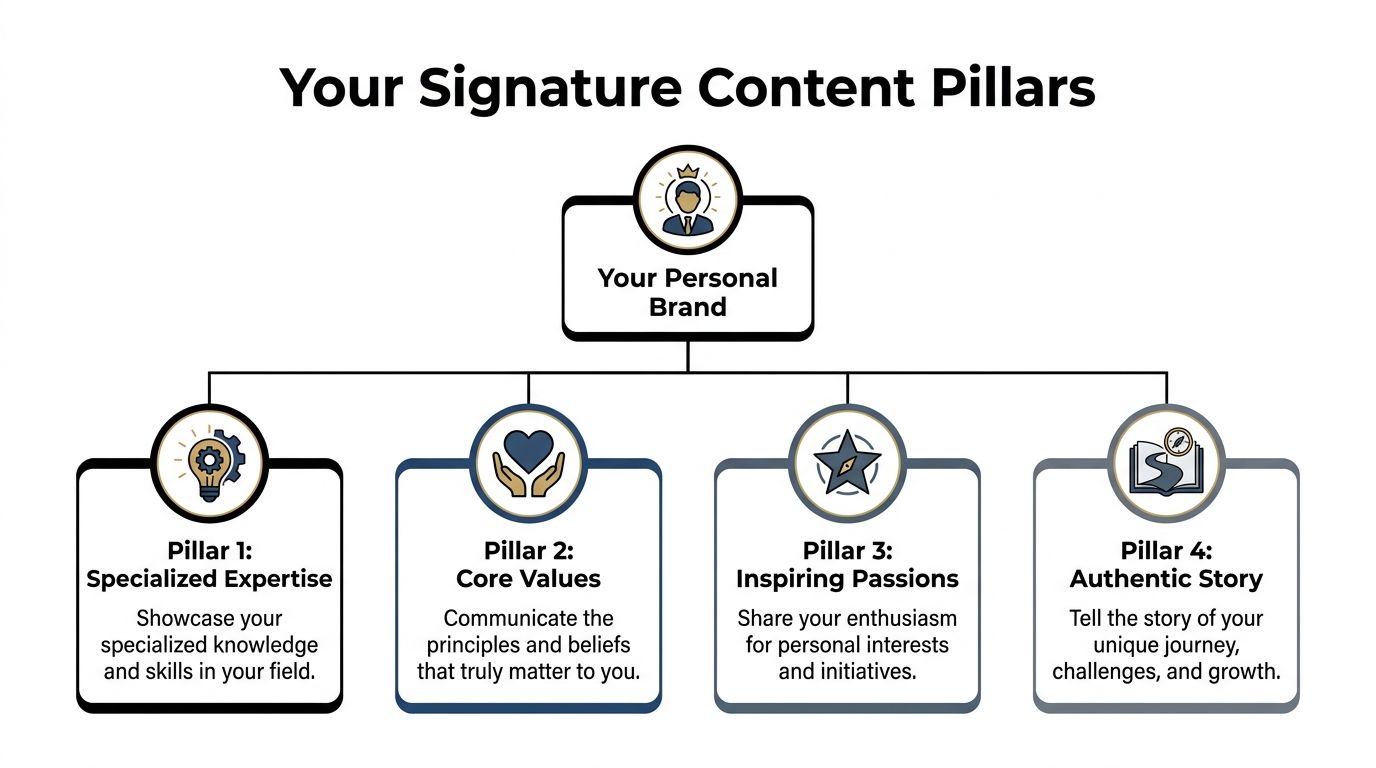
Weak pillars are broad labels like “business,” “mindset,” or “marketing.” They are too vague to guide content and too generic to create recall.
Strong pillars are narrow enough to build identity. They come directly from your positioning, buyer pain, proof, and point of view.
Here is the easiest way to pressure-test a pillar:
If the answer is no, cut it.
Most founders do well with three to five pillars. Fewer than that and your brand becomes repetitive. More than that and you start diluting the message.
Here is a useful model.
This is the practical lane you want to own.
If you are a SaaS founder, this might be product positioning, onboarding friction, or category messaging. If you are an agency founder, it might be client acquisition without paid ads. This pillar proves competence.
Here, your content becomes corrective.
Call out the bad assumptions your audience keeps making. Explain why they produce weak outcomes. Show what to do instead. These posts perform because buyers recognize themselves in them.
Most founders underuse this. They post opinions without receipts.
Talk about decisions you made, lessons from client work, frameworks you use, tradeoffs you considered, and why your process works. This pillar moves you from commentator to operator.
This is not inspirational fluff. It is strategic filtering.
What do you believe about quality, trust, leadership, growth, service, or brand building that separates you from lower-level operators? Your standards attract aligned buyers and repel poor-fit ones.
Used well, this humanizes you. Used badly, it turns your brand into a diary.
Share selective stories from your journey that reinforce your expertise or worldview. The key word is selective. Relevance beats vulnerability theater.
Good pillars reduce decision fatigue. Great pillars create market memory.
Compare these examples.
| Weak pillar | Strong pillar |
|---|---|
| Marketing tips | Founder-led authority building on LinkedIn |
| Leadership | Leading specialist teams without becoming the bottleneck |
| Content creation | Turning one operator insight into multi-format demand content |
| Sales | Trust-first inbound selling for high-consideration services |
The second column gives you immediate direction. You can create ten better posts from each of those without sounding generic.
A pillar is not a topic bucket. It becomes powerful when it gets attached to recurring formats your audience recognizes.
For example:
This is how consistency turns into trust. According to G2, maintaining a consistent brand presentation across all platforms can increase revenue by 10-20%, and 86% of shoppers prefer an authentic and honest brand personality on social media (G2 branding statistics).
Your audience should not have to rediscover who you are every time you publish.
If you want a practical companion piece for organizing these themes into a production rhythm, this guide on how to create a content plan for your personal brand is a useful next step.
Not every post must fit neatly into one box. But every post should strengthen one of the associations you want in the market.
That is the test.
If a topic is interesting but does nothing for your positioning, do not publish it. If a trend is popular but drags you away from your category, skip it. If a post gets attention from the wrong audience, it is not a win.
Your signature content pillars are not there to keep you busy. They are there to make your authority unmistakable.
Most founders do not fail because they lack ideas. They fail because they rely on mood.
A sustainable personal brand content strategy needs a production system. Not a heroic burst of posting. Not a weekend of batching followed by silence. A system.

The value of that system is obvious in the data. Only 47% of top performers have a documented strategy, and that group reports extreme success rates 22% of the time (Content Marketing Institute). Documented beats improvised.
Do not create seven separate pieces from scratch. That is how founders burn out and teams drown in shallow content.
Create one core asset each week, then atomize it.
A core asset can be:
From that one asset, you produce supporting content for the week.
Here is what atomization looks like in practice.
| Core asset | Repurposed outputs |
|---|---|
| One founder video on category mistakes | Short clips, quote graphics, a carousel, a text post, email summary |
| One article on buyer objections | LinkedIn post, thread, FAQ post, talking head video, sales enablement snippet |
| One podcast conversation | Clips, transcript pull quotes, blog summary, comment prompts, newsletter note |
This keeps your message consistent while adapting it to different formats.
You need a cadence that respects your actual capacity.
A clean workflow might look like this:
Review your pillars. Pick one core idea. Pull supporting material from calls, client notes, sales objections, Loom recordings, or recent decisions.
Write the article, script the video, or record the long-form piece. Focus on one idea only.
Turn the core asset into short-form posts, clips, carousels, quote cards, and email copy.
Ship the main piece. Then respond to comments, send relevant DMs, and place the content into conversations where it belongs.
Look at quality comments, profile visits, inbound messages, saves, reposts, and sales relevance. Keep notes on what deserves expansion next week.
This system works because it creates rhythm without forcing constant reinvention.
Publish from a library, not from panic.
Not every founder should build the same way.
If you think clearly in conversation, record video or audio first and transcribe with Descript or Otter. If you write well, start with a memo in Notion or Google Docs and adapt it into shorter platform-native versions. If you hate being on camera, use slides, screen recordings, or voiceover.
For founders exploring video without attaching their face to every asset, this practical guide on how to start a faceless YouTube channel gives a useful production model.
The wrong format creates resistance. The right one creates consistency.
A system gets stronger when you stop treating “content” as one task. It is several jobs.
Here is the breakdown:
If you are solo, you still need to think in roles. Otherwise you blend strategy, writing, editing, and publishing into one messy session and end up exhausted.
An outsourced option can help if you already know your voice and need execution support. Legacy Builder, for example, provides a team model that combines strategy, writing, design, and distribution support for personal brand content.
Founders lose consistency when every week requires fresh decisions. Fix that with a few rules.
Primary platform first
Choose one platform where your buyers already pay attention. Build depth there before chasing breadth.
One message, many expressions
Repeat the same core idea across formats instead of inventing new themes to look active.
Keep a raw material bank
Store ideas in Notion, Apple Notes, Google Keep, or Airtable. Pull from sales calls, investor questions, hiring conversations, and customer friction.
Use templates where they help
Canva for carousels, Figma for branded visuals, Notion for planning, and a scheduling tool if you need one. Templates reduce friction. They should not flatten your thinking.
A good publishing system does not feel exciting every day. It feels dependable. That is the point.
Here is a useful walkthrough on building repeatable content operations:
A lot of “consistent” founders are just consistently inefficient.
Watch for these traps:
Overproduction
Too many formats, too many platforms, no durable message
Under-documentation
Good ideas vanish because nobody captured them when they happened
Vanity batching
Creating a month of content with no room for live insight or current relevance
No review loop
Publishing without studying what sparked meaningful business conversations
Your publishing system should support authority, not drain it. If it cannot survive a busy month, it is not a system. It is a sprint plan.
Publishing is the midpoint. Not the finish line.
Founders who only post and wait are playing a weak game. They assume quality will carry itself. Sometimes it does. Usually it does not. Reach is pushed by distribution, and trust is built through interaction.

Broadcasting is simple. You post, maybe add a few hashtags, and hope the algorithm behaves.
Narrowcasting is different. You deliberately place your ideas in front of specific people, communities, and conversations that matter. That is how a personal brand becomes a network asset instead of a content stream.
The best distribution feels personal, not spammy.
Create a list of the people, companies, communities, hosts, and operators who matter in your category. Not celebrities. Relevant nodes.
Your list can include:
Then engage with precision. Comment on their posts with actual insight. Reference their ideas when relevant. Share their work when it deserves amplification. Send DMs only when you have context and something useful to add.
This is relationship building, not digital networking theater.
A smart comment placed in the right room can outperform a week of mediocre posting.
Most founders waste the comment section.
A thoughtful comment can attract profile visits, start peer relationships, and position you in front of the exact audience you want. Write comments the same way you write posts: clear, useful, and tied to your expertise.
Good comments usually do one of these:
Avoid comments that only perform politeness. “Great post” builds nothing.
Direct messages should continue a conversation, not ambush someone into a sales process.
A clean DM might say:
No pitch. No fake familiarity. No “just circling back” nonsense.
This approach compounds because it respects context. It also creates better opportunities than cold outreach disguised as networking.
Distribution improves when you think in touchpoints, not single uploads.
After publishing a strong piece, you can:
If you need practical ideas for turning one asset into several platform-ready versions, this guide on how to repurpose content and multiply your reach covers the mechanics well.
You do not need to build every audience from zero.
Spend time in relevant Slack groups, LinkedIn communities, founder circles, industry events, webinars, niche podcasts, and private groups where your buyers already exchange information. Show up as a contributor. Answer questions. Share frameworks. Clarify decisions. Bring signal.
This does more for authority than posting another generic “three lessons from entrepreneurship” thread.
The best distribution outcome is not likes. It is when other people can introduce you correctly.
You want peers saying things like:
That language is earned through repeated, relevant exposure across posts, comments, DMs, and communities.
Volume is noisy. Strategic distribution is precise. Pick precision.
Most founders either measure nothing or measure the wrong things.
They obsess over likes, follower spikes, and impressions because those numbers are easy to see. Then they miss the signals that tell them whether their personal brand content strategy is producing authority, trust, and pipeline.
The gap is costly. While 70% of professionals see branding as important, 80% fail to generate regular leads because execution breaks down. At the same time, 52-54% of C-suite executives and decision-makers spend more than an hour each week consuming thought leadership (We Are Tenet). The opportunity is there. Weak measurement is one reason founders do not capture it.
Vanity metrics are not useless. They are just incomplete.
A post with strong reach can tell you that the hook worked. It cannot tell you whether the right buyers now trust you more.
Track your brand in two layers.
These show whether your message is earning attention and relevance.
These show whether attention is turning into business value.
That second category matters more.
One of the strongest signals in personal branding is what I call Return on Relationships.
If better people start reaching out to you, if stronger peers include you in sharper conversations, if buyers ask more informed questions before the sales call, your brand is working. Even before revenue closes, the relationship quality changes.
That is not a vanity metric. It is market movement.
If your audience grows but your opportunities do not improve, your brand is entertaining people, not positioning you.
You do not need a bloated analytics setup. A clean Notion page, Google Sheet, or Airtable base works fine.
Track these monthly:
| Category | What to record |
|---|---|
| Attention | Top posts, saves, shares, profile visits |
| Relevance | Quality comments, DMs, peer engagement |
| Authority | Podcast invites, collaborations, speaking requests |
| Pipeline | Leads, booked calls, referral sources |
| Learning | Which pillar, format, and topic triggered the best conversations |
Then ask three questions:
This is how strategy gets sharper over time.
Sometimes a post “underperforms” publicly but works privately. It may trigger a buyer DM, a recruiter conversation, or a referral from someone who never leaves visible engagement.
That is why you need to log anecdotal evidence too. Save screenshots. Track exact phrases people use when they describe why they reached out. Watch for repeated words. That language tells you whether your positioning is landing.
Good measurement should help you decide what to double down on, what to cut, and where your authority is becoming durable.
Founders get stuck when they treat content as a daily obligation instead of a strategic asset.
The better path is simpler. Define a micro-category you can own. Build a point of view people can repeat. Create a few signature pillars. Run a publishing system you can sustain. Distribute with intent. Measure relationship quality and business outcomes, not just surface-level attention.
That is how you stop acting like a content creator and start operating like a category builder.
A strong personal brand content strategy should keep working when you are off-platform. It should shape how buyers describe you, how peers refer you, and how opportunities find you. That is the difference between fleeting visibility and durable authority.
You do not need to become louder. You need to become clearer.
And you do not need to win the internet every day. You need to build a body of work that trains the market to trust you.
If you want help turning your expertise into a durable personal brand asset, Legacy Builder helps professionals and founders translate their ideas, stories, and positioning into consistent content that supports authority, visibility, and long-term brand growth.


You could – but most in-house teams struggle with the nuance of growing on specific platforms.
We partner with in-house teams all the time to help them grow on X, LI, and Email.
Consider us the special forces unit you call in to get the job done without anyone knowing (for a fraction of what you would pay).
Short answer – yes.
Long answer – yes because of our process.
We start with an in-depth interview that gives us the opportunity to learn more about you, your stories, and your vision.
We take that and craft your content then we ship it to you. You are then able to give us the final sign-off (and any adjustments to nail it 100%) before we schedule for posting.
No problem.
We have helped clients for years or for just a season.
All the content we create is yours and yours alone.
If you want to take it over or work on transitioning we will help ensure you are set up for success.
We want this to be a living breathing brand. We will give you best practices for posting and make sure you are set up to win – so post away.
Subscribe to our newsletter and get insights on how to grow your personal brand.
