.svg)
Subscribe to our newsletter and get insights on how to grow your personal brand.
Thank you! Your submission has been received!
Oops! Something went wrong while submitting the form.
.svg)



To develop a personal brand is to intentionally shape how people see you, turning your expertise and passion into an identity everyone recognizes. It’s about being clear on your purpose, communicating what makes you different, and consistently putting out content that builds trust with the right people.
You're essentially shifting from just being another professional in the crowd to becoming an influential, go-to voice in your field.
Let's cut right to it. A personal brand isn’t some buzzword reserved for influencers; it's the single most critical asset in your career today.
In a world where trust is the ultimate currency and attention is incredibly scarce, a well-defined personal brand is what makes you stand out. Think of it as the digital handshake that happens long before a real one. It shapes how potential clients, employers, and partners see your value before you even have a conversation.
And this isn't about creating a fake online persona. It's about amplifying who you really are—your unique insights, your skills, and your values—to build a reputation that works for you 24/7.
Here’s the thing: people don’t connect with faceless logos. They connect with other people.
Your personal brand gives your work a human voice, creating the kind of genuine relationships that most corporate marketing can only dream of. When you share your expertise and your journey, you build a community around your message—a powerful network of supporters and advocates who believe in what you do.
This isn’t just a feel-good idea; it has a real impact on the bottom line. The concept of personal branding first popped up in 1997, but its importance has absolutely exploded. Google searches for 'personal brand' have jumped over 400% in the last few years, and a massive 80% of recruiters now say it's a critical factor when they're looking at candidates.
Let’s look at some more numbers that paint a clear picture.
This quick summary shows the direct benefits you get when you invest in your brand.
These aren't just vanity metrics. They represent real-world opportunities, revenue, and career growth that are directly tied to how well you manage your reputation. Want to dive deeper? You can find more powerful branding statistics that highlight the full impact of these numbers.
Without a personal brand, you’re just another line on an org chart or a resume in a stack. But when you actively build your brand, you transform yourself into a recognized asset.
You become the go-to expert. The person people seek out for specific knowledge. The first name that comes to mind when an opportunity pops up.
This journey from passive to active influence isn’t random; it follows a clear path of attracting, converting, and amplifying your message. This process shows how consistent effort builds momentum, turning your audience into a powerful network that advocates for you.
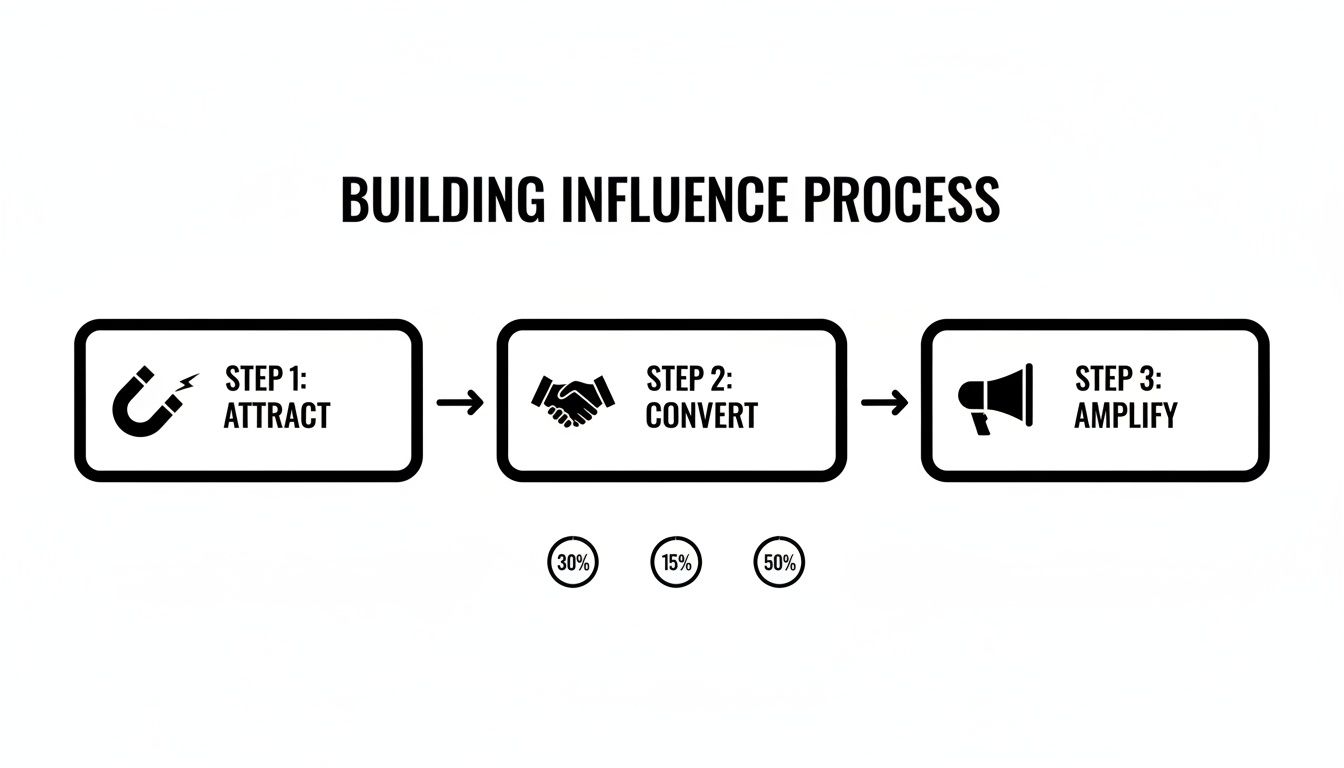
As you can see, building influence is a system, not an accident. It all starts with drawing in the right people and ends with them spreading your message for you.
A personal brand is your promise to your market. It's the story people tell about you when you're not in the room. By taking control of that narrative, you're not just building a career—you're building a legacy.
Whether you're a founder looking for investors, a professional aiming for a promotion, or a creator building a community, the rules of the game are the same. A strong personal brand ensures you aren't just participating in your industry—you're actively shaping it.
Let's get one thing straight: a powerful brand isn't about faking it 'til you make it. It's about amplifying who you already are. The personal brands that truly connect and last are built on a solid foundation of authenticity. It’s what makes you relatable and trustworthy in a world full of perfectly polished, yet empty, profiles.
This isn’t just some feel-good advice; it’s a strategic move. People are tired of overly curated content, and authenticity is the new gold standard. A huge 86% of consumers say it's a top priority when deciding which brands to support. As we've covered before in our guide on what brand authenticity is and why it matters, this is what separates a fleeting follow from a loyal community.
This hunger for real connection comes from a place of deep skepticism. Only 31% of Americans trust mainstream media, and over 75% are worried about businesses using AI to fake their communications. People are actively looking for human voices they can actually believe. The path forward is clear: your unique story and your honest perspective are your most powerful assets.
Before you write a single post or tweak your profile, you have to get brutally honest about your "why." This is the engine that drives your work and the unique value you bring to the table. It’s the answer to the question, "Why should anyone stop scrolling and listen to me?"
Start by digging into three core questions:
This isn’t just a one-and-done exercise. This is the bedrock of everything you will ever create.
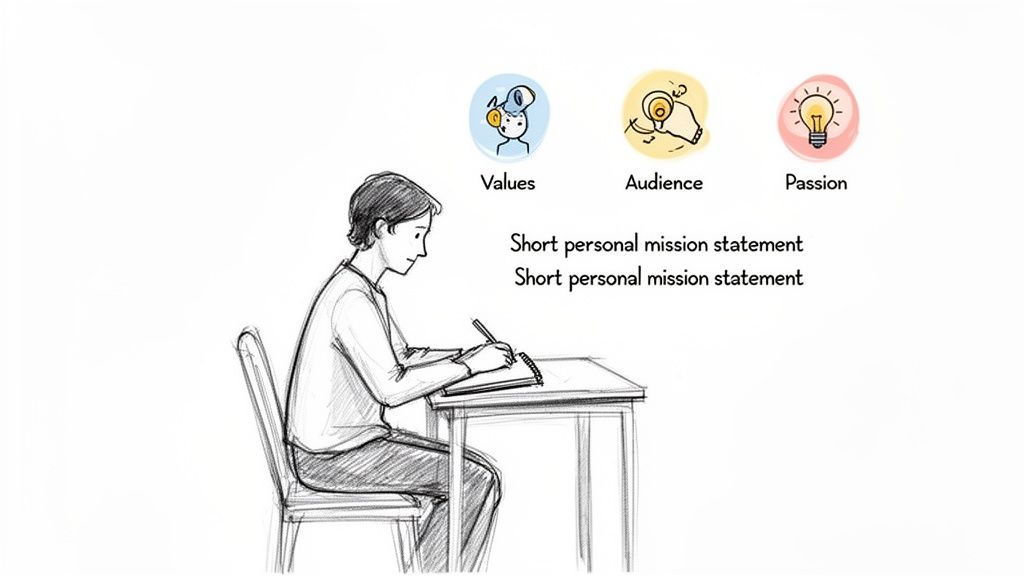
Once you’ve dug into your "why," it’s time to boil it down into a sharp, clear personal mission statement. This isn't a fluffy corporate slogan. It's a personal declaration that will steer every decision you make. A strong mission statement becomes your North Star, keeping everything you do aligned.
Your mission statement is your brand in a single sentence. It should spell out who you help, how you help them, and the transformation you deliver.
Here's a simple but powerful framework to get you started:
"I help [Your Ideal Audience] achieve [Their Desired Outcome] by [Your Unique Method/Perspective]."
Let's see how that plays out:
This statement is your new filter. If an opportunity or content idea doesn’t line up with your mission, the answer is a confident "no."
Trying to be the expert on everything makes you an expert on nothing. It just confuses people. The most effective brands pick their lane and own it. They focus on a few key areas of expertise—these are your core content pillars.
Think of three to five topics you can talk about with genuine authority and passion.
Your pillars should live at the intersection of these three things:
For example, a marketing leader's pillars might look like this:
Defining these pillars gives you instant focus. It stops you from chasing shiny objects and ensures every piece of content you create adds real value to a specific group of people. This is how you develop a personal brand that gets known for something specific.
Once you've nailed down that authentic foundation, it's time to turn your purpose into a story people actually want to hear. Let's be honest: facts are boring. Stories are what grab attention and make people lean in. Your narrative is the bridge connecting what you know to what your audience needs, making them feel like they have to listen.
This isn't about making up some fake persona. It's about taking who you already are and shaping how people see you. No one cares about a perfect resume, but they'll remember your journey—the wins, the failures, and the lessons learned along the way.
A killer narrative weaves together your personal experiences, your biggest professional wins, and your vision for the future into one clear, powerful message.
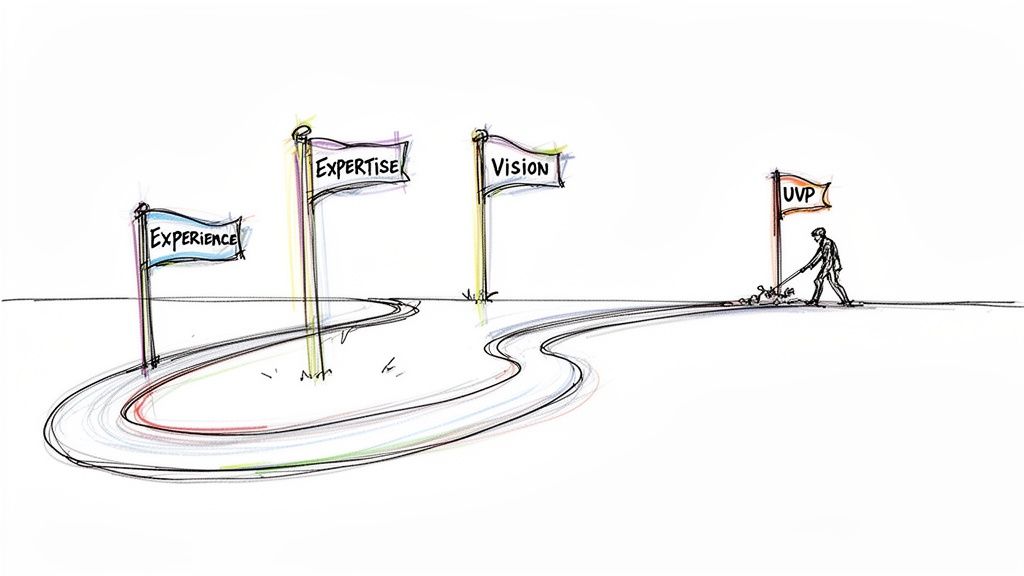
Your Unique Value Proposition (or UVP) is your sharp, no-fluff answer to the question, "Why you?" If someone's scrolling and has three seconds to understand what you do, your UVP is what makes them stop.
A weak UVP is confusing and generic. A strong one creates an instant connection and makes your ideal client think, "That's exactly what I need."
To build yours, you need to combine three things:
For example, a marketing consultant could go from saying "I help businesses with marketing" (which is what everyone says) to a UVP that lands clients: "I help early-stage B2B SaaS founders implement demand gen playbooks that lock in their first 100 customers—without a massive ad spend."
See the difference? It’s specific, it’s targeted, and it promises a result every founder craves.
Your UVP is your elevator pitch on steroids. It's not just what you do; it's the specific transformation you deliver that no one else can.
Now we get to the good stuff. Beyond your UVP is your Signature Story—that one core anecdote that makes your brand human. It's the story you tell that explains your "why" and shows people the real person behind the expertise.
Think about a pivotal moment, a hard lesson, or a challenge you overcame. That’s where the gold is.
A great Signature Story usually has four parts:
A career coach might share a story about getting laid off out of the blue. The turning point was when she realized she was actually good at helping her old colleagues fix their resumes. This led her to create a unique career transition framework, which she now uses to help hundreds of others.
That story makes her instantly credible and relatable. She's not just a coach; she's been in the trenches. For a deeper dive on this, check out our guide on how to build your brand with a storytelling framework that wins hearts.
Your story needs to be consistent, but how you tell it has to change depending on where you are. A one-size-fits-all bio is a recipe for being ignored. Every platform has its own vibe and audience.
For any serious professional or founder, LinkedIn is non-negotiable. If you really want to dial in your profile to tell a story that attracts opportunities, this comprehensive guide to personal branding on LinkedIn is a great place to start. And remember, keep your visuals—like your headshot and colors—consistent everywhere. It makes you instantly recognizable.
Having a killer brand narrative is one thing. Actually sharing it consistently? That’s where most people fall off.
This is the make-or-break point for your personal brand. But the secret isn’t about hustling harder or spending every waking moment creating content. It’s about building a smart, sustainable system that turns your big-picture strategy into a simple daily reality—without the burnout.
Forget the content hamster wheel. We're building a system based on efficiency, not exhaustion.
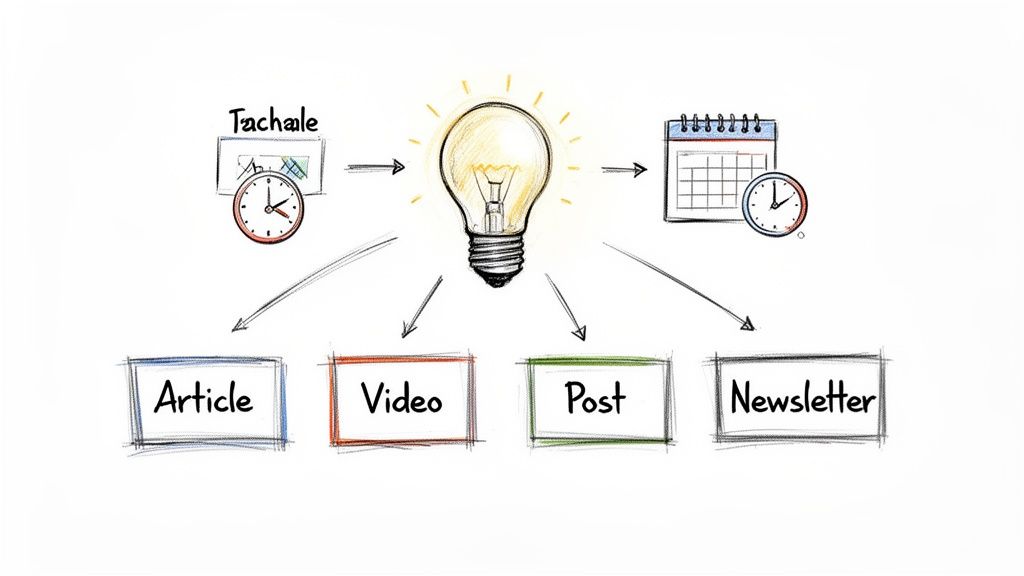
Let me tell you, the most productive people out there aren't creating something brand new every single day. They’ve just mastered the art of repurposing.
They'll take one core idea and slice and dice it into a dozen different pieces of content, each one perfectly suited for a different platform. This move respects your time and your audience's attention. Not everyone will read your 2,000-word article, but they might watch a 60-second video that nails the same point.
For example, let's say you write an in-depth blog post on "AI's Impact on B2B Sales." That one piece of content can fuel your entire week:
One core effort, five different touchpoints. That’s how you stay top-of-mind without completely draining your battery.
Staring at a blank screen is a creativity killer. The fix? Stop brainstorming from scratch.
Instead, organize your ideas into "content buckets" based on the brand pillars you already defined. Think of these as your go-to themes or formats that you can return to again and again. It gives you structure and makes content creation almost effortless.
Here are a few bucket examples I see work really well for founders:
With buckets, you’re never asking, "What should I post today?" You're just grabbing a proven idea and running with it.
Here's a hard truth: consistency trumps intensity every single time.
If your system is too complicated, you'll abandon it within a few weeks. The key is to build a simple workflow that actually fits into your schedule.
The best content system is the one you actually stick with. It should feel less like a chore and more like a natural extension of your work.
One of the most powerful techniques here is content batching. Instead of trying to create something new every day, you block off a specific chunk of time—maybe two hours on a Friday afternoon—to plan, write, and schedule everything for the next week.
This is a total game-changer. You get into a deep creative flow without daily interruptions. Plus, even on your most chaotic days, your content is already locked and loaded.
To give you a clearer picture, here’s what a simple weekly repurposing workflow could look like:
This table shows how one initial effort on Monday can systematically fuel your content for the rest of the week with minimal extra work.
To manage this, you don't need fancy software. A simple spreadsheet or a Trello board works perfectly. If you want a ready-made structure, this content calendar template for social media that actually works is a great starting point.
And one last pro-tip: capture ideas the moment they strike. Use a voice notes app on a walk or a simple notes app on your phone. This way, you'll have a backlog of raw material ready to go for your next batching session.
Let's get one thing straight: creating great content is only half the job. If no one sees it, you might as well have been whispering in a closet. Your message doesn't truly exist until it connects with people.
This is where distribution and engagement come in. It’s how you turn a monologue into a conversation that actually builds your brand. Forget "publish and pray." We're going to be intentional about getting your content in front of the right people, sparking real dialogue, and building relationships that do the heavy lifting for you.
Before you start pushing content out into the world, you have to make sure your home base is solid. For most of us, that means our social media profiles, especially on LinkedIn. These aren't just online resumes anymore; they're the front door to your reputation.
You need to optimize every single element to tell your story at a glance.
When your profiles are dialed in, they do the selling for you. The moment someone new discovers your content and clicks on your name, that first impression needs to be a powerful one.
Hitting "publish" is the starting line, not the finish. Real amplification happens when you see distribution as a non-negotiable part of your content plan, not some chore you do if you have extra time.
So, where do you start? Go where your audience already hangs out.
One of the best moves you can make is to become an active participant in relevant communities. I’m talking about niche groups on LinkedIn, Facebook, Reddit, or even industry-specific forums. But don't be that person who just drops a link and runs. That's the fastest way to get ignored (or booted).
Instead, lead with value. Answer questions. Offer a unique perspective. And only when it’s genuinely helpful, drop a link back to a resource you created. This simple shift frames you as a helpful expert, not just another self-promoter. To really get this right, you need to explore effective content distribution strategies.
A personal brand isn't built in isolation. It's forged in the conversations you start and the communities you contribute to. Your value becomes real when you share it freely.
Engagement isn't just about replying to comments on your own posts. That's reactive. We want to be proactive.
Proactive engagement is about starting conversations on other people's turf. It’s the daily practice of making your presence felt across your network in a way that actually means something. This is how you stay top-of-mind and build the relationships that turn into real opportunities.
Your mission is to become a recognized voice in the conversations that matter in your industry. And it only takes 15-20 minutes a day.
Here’s a dead-simple checklist to run through daily:
This isn't glamorous, but this consistent, low-effort work compounds like crazy. You're building social capital, getting more eyeballs on your profile, and proving your expertise in the most authentic way possible. This is a core pillar of building a personal brand that actually has influence.
Alright, let's get real for a second. The idea of building a personal brand sounds great, but it always comes with a flood of "what if" and "how do I" questions. It's totally normal.
Let’s cut through the noise and tackle the questions I hear all the time.
This is always the first question, and for good reason. You’re already busy.
The good news? This isn't about adding another 40-hour workweek to your schedule. It’s about being smart and consistent.
If you get a solid system down for batching and repurposing your content, you can knock out your entire weekly output in just 2-3 hours. Seriously. That covers brainstorming, creating one core piece of content, and chopping it up for different platforms.
On a daily basis? All you need is 15-20 minutes of focused engagement. Jump in, drop some thoughtful comments, reply to DMs, and connect with people.
The goal isn't to be online 24/7. It’s to make the time you are online count. Consistency beats intensity every single time.
If you're making any kind of impact, you're going to attract some negativity. It's just part of the game. The trick is to decide how you’ll handle it before it happens, so you're not reacting on emotion.
Not all feedback is the same. You have to know the difference.
Remember, a strong point of view gets a strong reaction—good and bad. It's a sign you’re actually saying something that matters.
Classic imposter syndrome. I’ve felt it. Every founder I know has felt it. Let me be clear: you don’t need to be the world's foremost authority to provide value.
You just need to know more than the person you're trying to help.
Stop thinking of yourself as an "expert" and start thinking of yourself as a "guide." You’re just a few steps ahead on the path, sharing what you've learned along the way. Your mistakes, your wins, your "aha" moments—that’s the stuff people actually connect with.
In fact, Nielsen research shows that 92% of people trust recommendations from their peers over a brand. Your relatable journey is way more powerful than some detached, ivory-tower "expert" persona. Sharing what you know now is how you become the expert people look for later.
It’s so easy to get hooked on likes, views, and follower counts. But let's be honest, those numbers rarely pay the bills. They feel good, but they don’t signal real business impact.
You need to track the metrics that lead to actual opportunities.
Instead of likes, start tracking these:
These are the numbers that tell you your brand isn't just making noise—it's building your network and opening doors.
At Legacy Builder, we specialize in turning your story and expertise into a brand that drives real opportunities. If you're done with the guesswork and ready to build an influential online presence with a team of experts behind you, let's talk.
Find out how we can build your legacy at https://www.legacybuilder.co.


You could – but most in-house teams struggle with the nuance of growing on specific platforms.
We partner with in-house teams all the time to help them grow on X, LI, and Email.
Consider us the special forces unit you call in to get the job done without anyone knowing (for a fraction of what you would pay).
Short answer – yes.
Long answer – yes because of our process.
We start with an in-depth interview that gives us the opportunity to learn more about you, your stories, and your vision.
We take that and craft your content then we ship it to you. You are then able to give us the final sign-off (and any adjustments to nail it 100%) before we schedule for posting.
No problem.
We have helped clients for years or for just a season.
All the content we create is yours and yours alone.
If you want to take it over or work on transitioning we will help ensure you are set up for success.
We want this to be a living breathing brand. We will give you best practices for posting and make sure you are set up to win – so post away.
Subscribe to our newsletter and get insights on how to grow your personal brand.
