.svg)
Subscribe to our newsletter and get insights on how to grow your personal brand.
Thank you! Your submission has been received!
Oops! Something went wrong while submitting the form.
.svg)



Think of a UX content strategist as the architect of a digital product's entire conversation. They’re not just filling in the blanks with words; they’re designing the entire communication framework that guides a user through an experience.
Their job is to make sure every single word—from a tiny button label to a detailed help guide—works together to create something that feels intuitive, helpful, and trustworthy.
Ever tried to find your way around a new city without any street signs, maps, or directories? It’s confusing, frustrating, and a massive waste of time. A UX content strategist is the urban planner for a digital product, making sure that kind of chaos never happens to your users.
They don't just write the signs. They decide where the signs should go, what they need to say, and how they all connect to create a seamless journey from point A to point B. This role is less about writing and more about strategy, blending a deep understanding of the user with the company's business goals.
A lot of people think this role is just a more senior version of a UX writer, but that's not quite right. While a UX writer is focused on crafting the specific words you see on an interface (the micro-copy), the UX content strategist operates at a much higher level. They create the system that governs all that copy.
They're the ones answering the big, foundational questions:
A UX content strategist’s main deliverable isn't just a bunch of words; it's a plan. They're creating the blueprint that guarantees every piece of content—both now and in the future—serves a clear user need and a specific business goal.
To make this crystal clear, it helps to see how the roles differ when you put them side-by-side.
As you can see, the strategist is focused on the "why" and "how" of the entire product's communication, while the writer and marketer are executing on specific parts of that user experience, whether inside the product or outside of it.
As AI gets better at handling basic writing tasks, the strategic side of content is becoming more valuable than ever. We're seeing a massive shift in the market. In fact, reports show that in 2026, there are over 440 open roles for content strategists at any given time, with giants like Amazon and Meta hiring aggressively.
This isn't just a trend. It's a signal that businesses are finally recognizing how critical strategic, human-centered planning is for building successful products. That demand is driving salaries way up, with senior roles fetching up to $165,000 and lead positions hitting $195,000. For those who specialize in AI, you can add a 20-24% premium on top of that, with principal strategists pulling in over $300,000 in total compensation.
You can dive deeper into this data by checking out the full 2026 content design salary report. The takeaway is clear: if you can think strategically about content, you’re not just future-proofing your career—you’re positioning yourself as an invaluable asset.
So, what does a UX content strategist actually do all day?
Hint: It's a lot more than just writing. Think of them as the master architect for a digital product. They’re the ones deciding where the informational highways go and placing the helpful signposts to guide people smoothly to their destinations, long before the first line of code is written.
Their real job is building a rock-solid content system—a blueprint that shapes the product’s success. It's a mix of analysis, creativity, and collaboration that touches every single stage of development. A UX Content Strategist is also on the hook for creating a powerful content and web page strategy that makes sure the content, SEO, and user experience all work together to get results.
This map shows you exactly how a UX content strategist sits at the center of it all, blending the roles of an architect, a writer, and a guide.
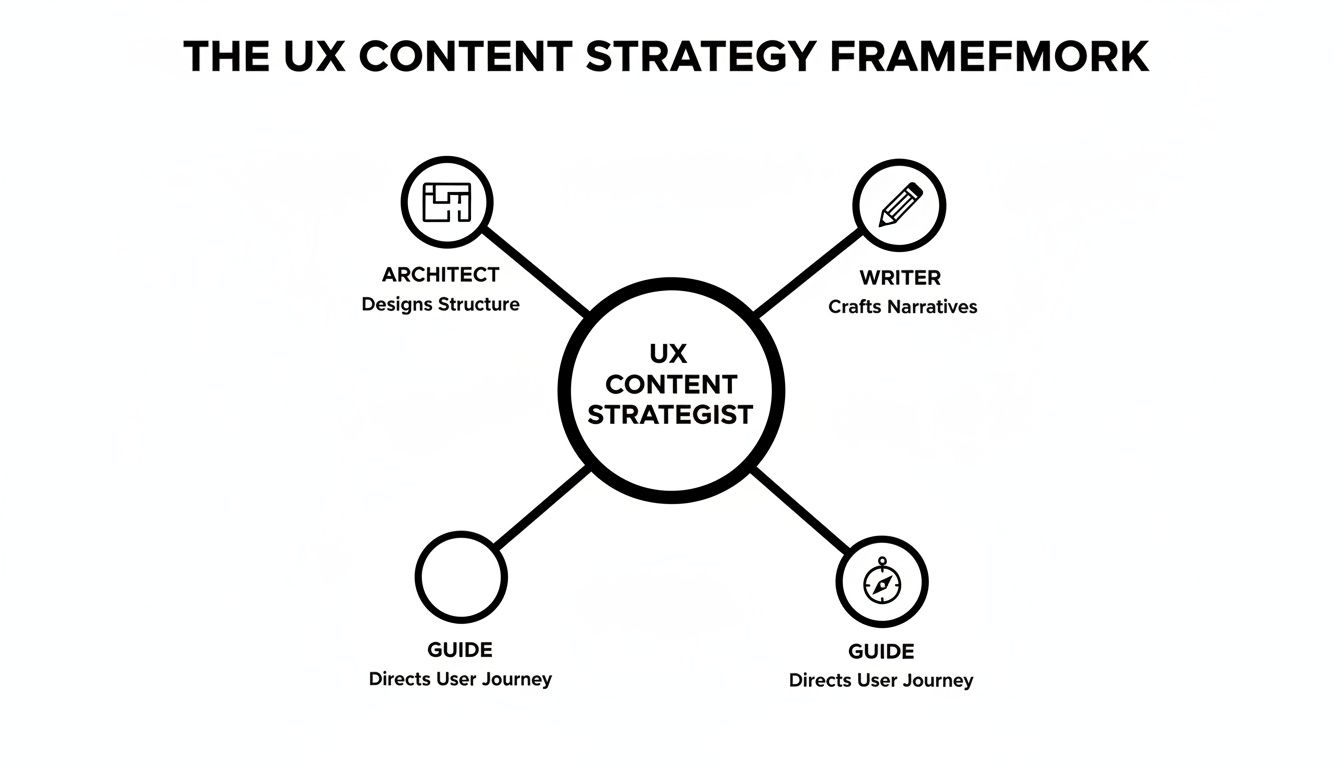
As you can see, strategy isn't just one thing. It’s a mix of big-picture planning, laser-focused execution, and understanding what the user actually needs.
First things first, a strategist has to figure out what they’re working with. This means diving deep with a comprehensive content audit. We're not just talking about a spell-check here; this is a full-on investigation into a website or app’s existing content to see what’s working, what’s not, and how it lines up with the business goals.
They’re asking the tough questions:
Using hard data and analytics, the strategist gets a crystal-clear picture of the current situation. This isn't guesswork—it's an evidence-based foundation for every single content decision that comes next.
Once they’ve mapped the terrain, the UX content strategist defines the product’s personality. They create detailed voice and tone guidelines, which are so much more than a simple list of words to use or avoid. Think of it as the ultimate rulebook for communication, ensuring everything from an error message to a welcome email sounds like it’s coming from the same, trustworthy source.
Voice is your brand's consistent personality. Tone is how that personality adapts to different situations. A strategist makes sure you sound authoritative in a help doc but encouraging during onboarding—all without losing who you are.
They also establish content governance. This is the system that answers: Who creates content? What’s the approval process? And how do we keep it all fresh and up-to-date? This is what prevents your digital presence from becoming a messy, outdated graveyard of information.
Here’s where the architect role really comes into play. A huge part of the job is designing the underlying information structure. This means creating things like content models and mapping out user journeys. A content model is essentially a blueprint for your content, defining all its parts and how they can be reused across different pages or even different platforms.
At the same time, they’re charting the user's path from A to B. By mapping out every step a person takes to get something done, they can anticipate exactly what information is needed, when it’s needed, and the best way to deliver it. This proactive approach is what makes an experience feel effortless and intuitive.
This strategic depth is why the job market is responding the way it is. While the market has been fiercely competitive since 2024, senior UX content strategist roles are recovering fast—because companies need that high-level judgment. Despite a flood of entry-level talent, data shows UX team sizes are holding steady or growing. The Bureau of Labor Statistics even projects strong growth for these roles in major industries like healthcare and finance, proving just how essential this expertise has become.
Let’s be real—to make it as a UX content strategist, you need a lot more than just good writing chops. This isn't about being a wordsmith. It's about being the translator, the researcher, the storyteller, and the diplomat all rolled into one.
The best strategists are the glue that holds a product team together. They have a unique ability to take messy user needs and turn them into crystal-clear language, and transform abstract business goals into stories that actually resonate. It’s this mix of skills that makes the role so powerful—it’s not just what you write, but how you think, research, and work with others.
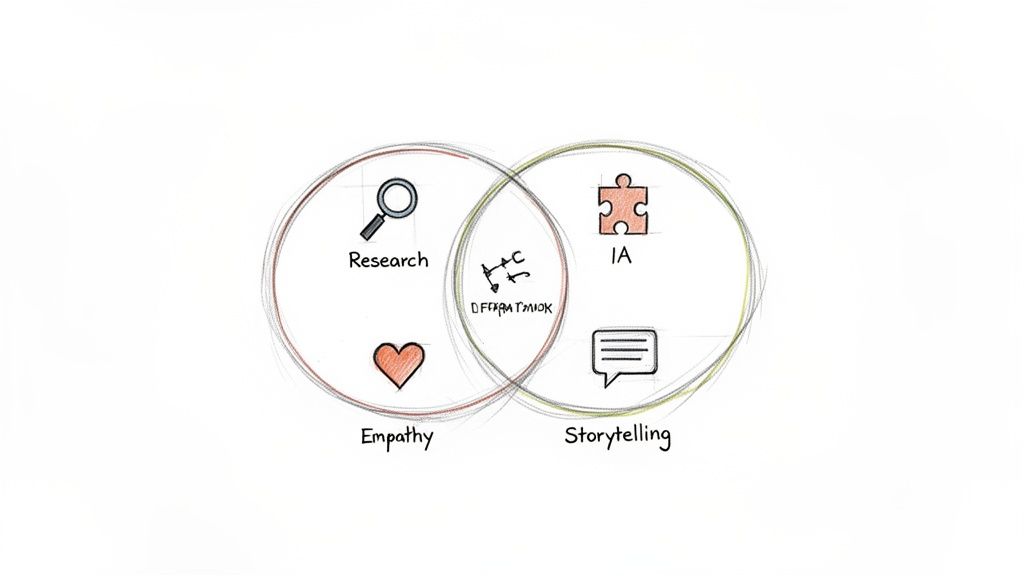
Your hard skills are the technical, teachable abilities you’ll use every single day. For a UX content strategist, these aren’t just nice-to-haves; they're the non-negotiables rooted in research, structure, and a deep understanding of the design process.
Here’s what you absolutely must master:
To create content that truly connects, you first have to know who you’re talking to. That’s why you need to understand how to create buyer personas. This is a foundational skill that makes sure every decision you make is grounded in a real understanding of your audience.
If hard skills are the "what," then soft skills are the "how." These are the interpersonal skills that separate a good strategist from an indispensable one. Honestly, they’re often more important than your technical abilities.
A UX content strategist with perfect writing skills but zero empathy or collaborative spirit will fail. Period. This job is fundamentally about connecting with people—both your users and your team—to build consensus and create clarity.
These are the human-centered skills that will set you apart:
Getting into UX content strategy is about more than just having the right skills—it’s about telling a compelling story. Your career path and your portfolio are how you tell that story. It’s not enough to say you can write. You have to prove you can think strategically, solve real user problems, and drive business results with your content.
Building that story starts with a simple shift in how you think. You’re not just showing off a finished piece of copy. You’re walking them through your entire strategic process, from the initial mess of a problem to the final, impactful solution. This is how you get noticed by hiring managers and build a real career.
Your portfolio is your single most important asset. Period. A huge mistake I see people make is just filling it with screenshots of polished UIs. Sure, a "before and after" can look nice, but it doesn't show a hiring manager how you think. A standout portfolio is all about the process and the impact.
Frame every project like a case study. Give it a clear beginning, middle, and end.
A portfolio that shows messy wireframes, research notes, and content models is often way more powerful than one with just slick final screens. It proves you’re a strategist who gets involved early and shapes the outcome, not just a writer who comes in at the end to clean things up.
This approach shows you’re a problem-solver, not just a copy-producer. Trust me, that’s a distinction that hiring managers are looking for.
If you really want to stand out, your portfolio needs to show the full range of what a UX content strategist can do. Don’t just show the words; show the strategic work that led to those words.
Here are some of the things you should think about including:
To help you get started, here's a checklist for building a portfolio that truly showcases your strategic value.
A portfolio built with these components tells a much stronger story than just a gallery of finished screens. It proves you're a strategic partner, not just a writer for hire.
In a crowded market, your network and personal brand are your secret weapons. Roles for a UX content strategist are more and more about product-level influence and systems thinking. As AI handles more of the basic writing, companies need strategists. An analysis from Academy UX highlights the evolving UX job market, showing that even with layoffs, the demand is growing for people who can adapt and think strategically. Just firing off applications isn't going to cut it anymore.
You need to be part of the conversation, and that conversation is happening on LinkedIn. Your profile is more than a resume—it’s a platform. Share your case studies, write about your process, and actually talk to other people in the field. This builds your authority and gets you on recruiters' radar. If you need help with this, check out our guide on how to optimize your LinkedIn profile for career growth.
Real networking isn't about asking for a job. It's about building genuine relationships by giving value first. Share good articles, leave thoughtful comments, and connect with people whose work you respect. This makes you a known, trusted professional—the kind of person who comes to mind when a great opportunity opens up.
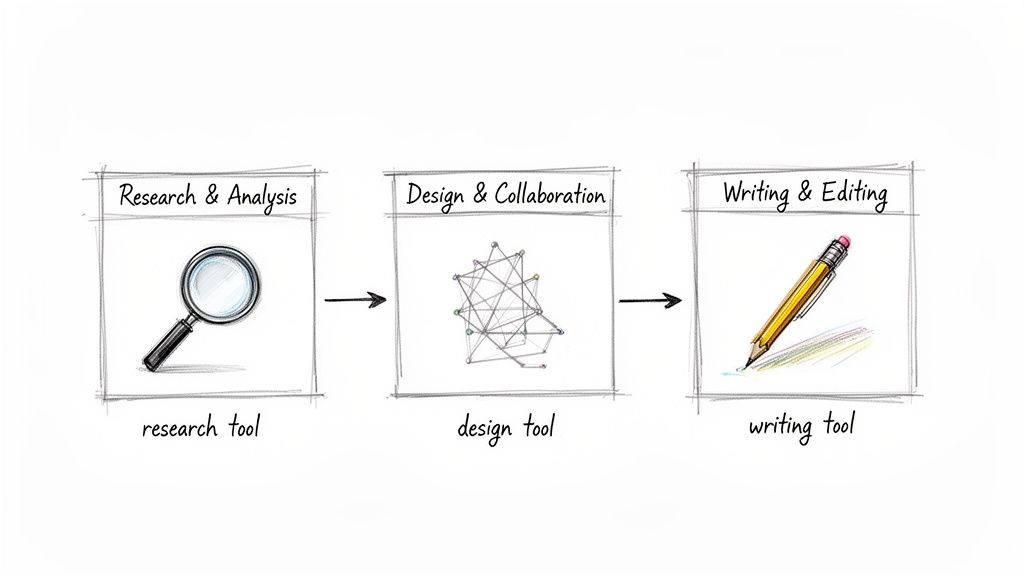
A top-tier UX content strategist doesn't just run on gut feelings. They come armed with a specific set of tools and frameworks that transform raw user needs into clear, effective content.
Think of it less like a list of software and more like a system for thinking. It’s what organizes the entire messy process, from digging into initial research all the way to the final polished word. The right toolkit makes your workflow repeatable, scalable, and grounded in proof—not guesswork.
Before you even think about writing, you have to get inside your user’s world. This is the evidence-gathering phase, where you stop assuming and start listening. These tools are all about finding out what users are really thinking and doing.
Frameworks are the mental models that turn chaos into clarity. They give your team a shared language and ensure every word you write has a purpose. A great strategist doesn't just follow them blindly; they know how to adapt them to the project at hand.
A framework is like a recipe. It gives you structure and a proven method, but a great chef—or strategist—knows when to adjust the ingredients based on what they have and who they're cooking for.
Two of the most powerful frameworks you'll see out there are:
Finally, it's time to bring the strategy to life. This is where the magic happens—collaborating with designers, testing copy, and refining every single word. The tools here are all about bridging the gap between planning and shipping.
You can find even more killer options in our guide to the best tools for content creators in 2026.
Becoming a UX content strategist isn't just about snagging a job with a fancy title. It's a commitment to building better, more human digital experiences. This is your chance to move beyond just writing words and start designing the conversations that forge real connections between a brand and its audience.
The principles that guide this work—clarity, empathy, and consistency—aren't just professional buzzwords. They're the ingredients that transform a product from merely functional into something genuinely great. When a user feels understood and guided through an experience, that's not an accident. It's the result of deliberate, thoughtful strategy.
This strategic mindset is your most valuable asset. It’s the ability to see the bigger picture, connecting user needs with business goals and cutting through all the digital noise. It’s about being the voice of the user in every meeting and backing up your decisions with data to prove the massive value of getting the content right from day one.
This is what separates a writer from a true UX content strategist. You’re not just filling in the blanks in a design file; you are the architect of the user's entire journey. You make sure every single interaction, no matter how small, adds up to a cohesive and trustworthy experience.
The most impactful work a strategist does often happens before a single word of final copy is written. It’s in the research, the information architecture, and the voice guidelines that a product's success is truly forged.
As you build your career, remember that your job is to bring order to chaos. You are the translator between what a business wants to say and what a user actually needs to hear. The skills you’ve learned—from creating content models to managing stakeholders—are the tools you'll use to build that bridge.
Use them to tell compelling stories, not just for your users but for your own career. Frame your work around the problems you solve and the impact you create. This is how you turn your vision into influential work that leaves a real mark on the products people use every day.
By shaping content, you are shaping experience. And by doing that, you are shaping the future.
At Legacy Builder, we help experts like you translate complex skills into a powerful personal brand. If you're ready to position yourself as a leader in your field and attract high-value opportunities, let's talk. We can show you how to articulate your impact and build a brand that works for you.
Book a free discovery call with me here.
Jumping into a new field always brings up a ton of questions. Let’s tackle some of the most common ones I hear from people looking to break into UX content strategy. Think of this as your quick-start guide to navigating the first steps of your career.
Nope, you don't need to be a designer. But you absolutely must be design-literate.
This just means you get the core principles of design, you can find your way around a tool like Figma without breaking a sweat, and you can talk shop with your design partners. Your superpower is strategy and words, but all your work happens inside a design. Knowing how your content shapes the design—and how the design shapes your content—is non-negotiable.
Honestly, some of the best strategists I know came from writing, marketing, or even user research backgrounds.
Think of it this way: an architect versus a builder.
The UX content strategist is the architect. They're the one drawing up the blueprints for the entire content world—the voice and tone guides, the information architecture, the content models. They figure out the "why" and the "how" behind everything the product says.
A UX writer is the builder. They take those blueprints and craft the actual words you see on the screen, like that button label or the error message that pops up. In smaller teams, sure, one person might do both. But the strategist is always focused on the bigger system, while the writer is focused on the words themselves.
The toughest part of being a new UX content strategist? Proving your value before a single word gets written. Too many teams still think content is just the pretty polish you add at the end. Your job is to get in there early, using data to show how a solid content strategy stops expensive mistakes, makes users happier, and keeps the product on track with business goals.
AI is going to take over the boring, repetitive writing tasks. And that's a great thing. It frees you, the UX content strategist, to focus on the high-level work that a machine can't touch: empathy, ethical decisions, and overseeing the complex content systems that AI will eventually run on.
Your future isn't about just writing copy. It's about directing the AI tools, fact-checking their output with a critical eye, and making sure the entire experience still feels human and connected. The strategists who learn to manage and guide AI won't just survive—they'll become irreplaceable.
The single best way to show off your strategic chops as a UX content strategist is by building a powerful personal brand. At Legacy Builder, we specialize in helping experts just like you package their unique insights and processes into content that pulls in career-defining opportunities.
See how we can help you build your legacy by visiting https://www.legacybuilder.co.


You could – but most in-house teams struggle with the nuance of growing on specific platforms.
We partner with in-house teams all the time to help them grow on X, LI, and Email.
Consider us the special forces unit you call in to get the job done without anyone knowing (for a fraction of what you would pay).
Short answer – yes.
Long answer – yes because of our process.
We start with an in-depth interview that gives us the opportunity to learn more about you, your stories, and your vision.
We take that and craft your content then we ship it to you. You are then able to give us the final sign-off (and any adjustments to nail it 100%) before we schedule for posting.
No problem.
We have helped clients for years or for just a season.
All the content we create is yours and yours alone.
If you want to take it over or work on transitioning we will help ensure you are set up for success.
We want this to be a living breathing brand. We will give you best practices for posting and make sure you are set up to win – so post away.
Subscribe to our newsletter and get insights on how to grow your personal brand.
