.svg)
Subscribe to our newsletter and get insights on how to grow your personal brand.
Thank you! Your submission has been received!
Oops! Something went wrong while submitting the form.
.svg)



Let's get real for a minute.
If your brand walked into a room and started talking, what would it sound like? Would it be witty and sharp? Warm and reassuring? Or maybe authoritative and direct?
That’s your brand voice. It’s the consistent personality you express in every email, social post, and webpage. It's how you say what you say.
Think of it like this: you have two friends. One always cracks jokes, and the other gives thoughtful, heartfelt advice. You value both, but you connect with them in totally different ways because of their distinct personalities.
Your brand voice is no different. It’s the collection of words, attitudes, and values you choose to express, which ultimately shapes how people feel about your company.
A strong brand voice isn’t just some vague "feeling." It’s built on a solid foundation. These are the core pillars that work together to create a personality that actually connects with your ideal audience.
To help you get this right, I've broken down the four essential pillars. Think of this table as your starting point for building a voice that's not just consistent, but truly authentic.
Nailing down these four elements is the first step toward creating a voice that feels human and builds real trust.
Once you’ve defined your character, you can see how it cascades down to influence everything else.
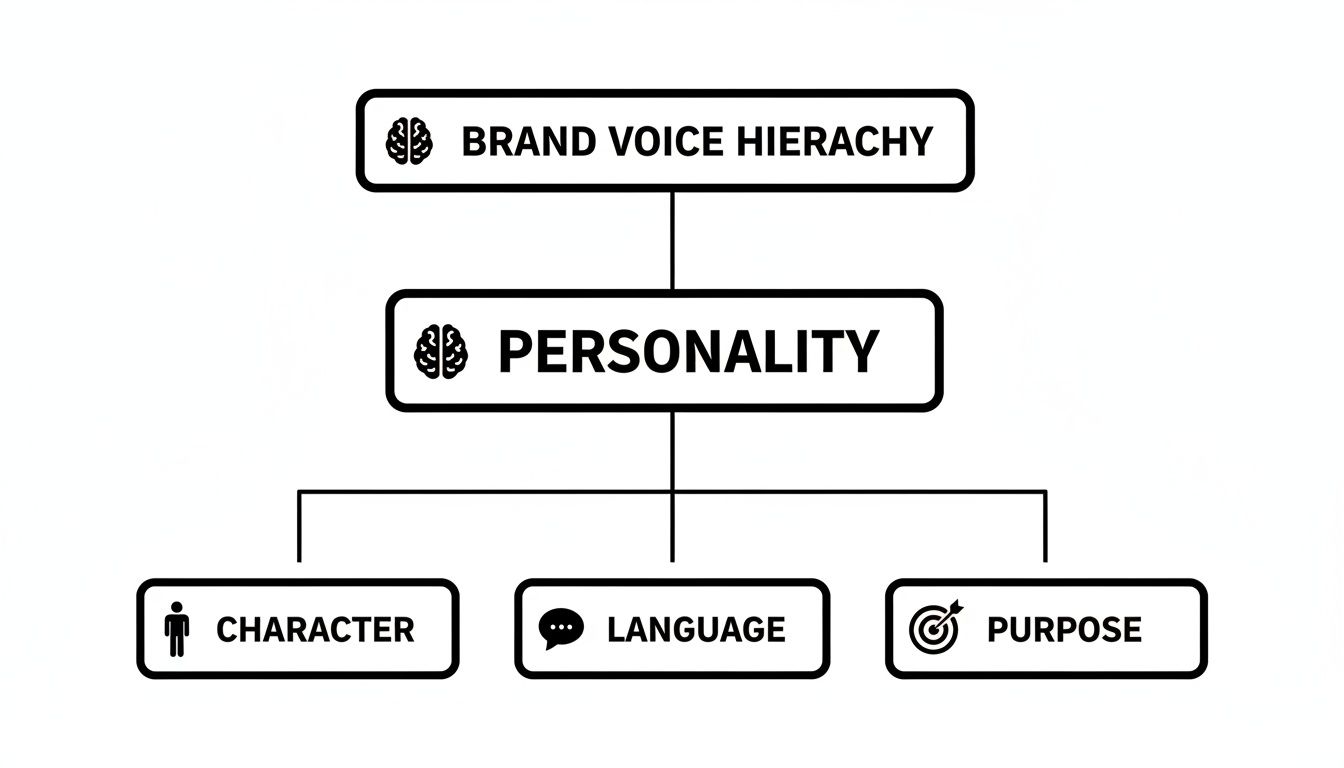
This hierarchy makes it clear: a memorable voice always starts with a well-defined personality. That personality then dictates every single communication choice you make, from the words you use to the purpose behind them.
Here's the hard truth: consistency is what turns a one-time interaction into a long-term relationship.
When your voice is predictable and authentic, customers learn to trust you. They know exactly what to expect, whether they're reading a blog post, opening an email, or scrolling past one of your social media updates.
This kind of reliability is the absolute bedrock of brand loyalty.
A brand voice is the purposeful, consistent expression of a brand through words and prose that engage and motivate. It's the art of communicating in a way that is true to who your brand is.
To make sure everyone on your team is on the same page, it's non-negotiable to create clear social media branding guidelines that everyone can follow. This is how you ensure everyone speaks with one unified voice, strengthening your brand identity at every single touchpoint.
In a market flooded with noise, a consistent brand voice is what makes you stand out. It’s the difference between being a memorable personality people connect with and just another face in the crowd.
When your voice is authentic and predictable, you build the kind of trust and familiarity that turns casual browsers into die-hard fans. It’s not just about sounding the same everywhere; it's about being reliable. Every interaction, from a social media post to a customer service email, should feel like it comes from the same person. This predictability creates a powerful sense of comfort.

Think about the brands you actually like. I bet their voice plays a huge part in that relationship. It’s what makes their content feel less like marketing and more like a real conversation.
But this isn’t just a feel-good thing. It has a direct, measurable impact on your bottom line.
The data doesn't lie. One report found that companies with a consistent brand voice across all their channels can see revenue jump by 23% to 33%. This proves a well-defined voice isn’t some creative luxury—it’s a core business strategy that prints money.
Why? Because consistency builds more than just recognition. It builds:
At the end of the day, your brand voice is the vehicle for your story. It’s how you share what you stand for, celebrate your wins, and talk about your mission in a way that actually connects with people.
Without a consistent voice, your story gets lost in a sea of mixed messages.
A consistent voice makes sure every piece of content works together to build a single, compelling narrative. It turns your brand from just another company into a character your audience knows, likes, and wants to support.
This narrative is what makes someone choose you over another option, even if the products are basically the same. They aren’t just buying what you sell; they’re buying into who you are.
If you want to go deeper on this, check out our guide on how to build a brand storytelling framework that wins hearts. When you invest time in defining and sticking to your voice, you’re not just making content—you’re building a lasting asset.
Let's clear something up right away. People often use "voice" and "tone" interchangeably, but they're two different things. Getting this distinction right is what separates brands that feel authentic from those that come off as inconsistent or even emotionally tone-deaf.
Think of it like this: your voice is your personality. It’s who you are at your core. It’s consistent. If your brand is a witty, sharp-tongued expert, that’s your voice. It doesn’t change whether you’re writing a blog post or a tweet.
Your tone, on the other hand, is your mood. It’s the emotional color you add to your voice to fit a specific situation. You wouldn’t talk to a friend who just got a promotion with the same mood you’d use if their dog just died, right? Your brand needs that same emotional intelligence.
Voice = Personality (It’s who you are, always.)
Tone = Mood (It’s how you feel in the moment.)
Your voice is the constant, the foundation. Your tone is the flexible, adaptive layer you apply on top.
So how does this play out in the real world?
Let’s say your brand voice is "The Mentor"—you're knowledgeable, reassuring, and you want to empower your audience. That’s your personality, your foundation. But your mood—your tone—has to shift based on what’s happening.
You’re still The Mentor, but your delivery changes.
See the pattern? The core personality never wavered. The Wise Mentor was always there. But the tone was carefully dialed in for each specific context.
This is what makes a brand feel human. You're not a robot spitting out the same lines over and over. You're maintaining a consistent identity while actually listening and responding to your audience's emotional state. That’s how you build real connections that last.
To really nail this down, let’s look at how The Mentor's voice adapts its tone across different channels and scenarios. It's the same core personality, just a different emotional flavor for each situation.
Notice how the underlying voice—knowledgeable, reassuring, and empowering—is always present. The tone is simply the tool used to make sure the message lands perfectly in every single interaction. That’s the secret sauce.
Figuring out your brand voice can feel a bit... fuzzy. But it's not about inventing a personality from scratch. It’s more like an excavation project.
Your authentic voice is already there, buried in your company’s values, your mission, and the way you already operate. The goal here is to dig it up and give it a clear, consistent way to express itself. Let's get our hands dirty with a few exercises to nail down the voice that is 100% yours.
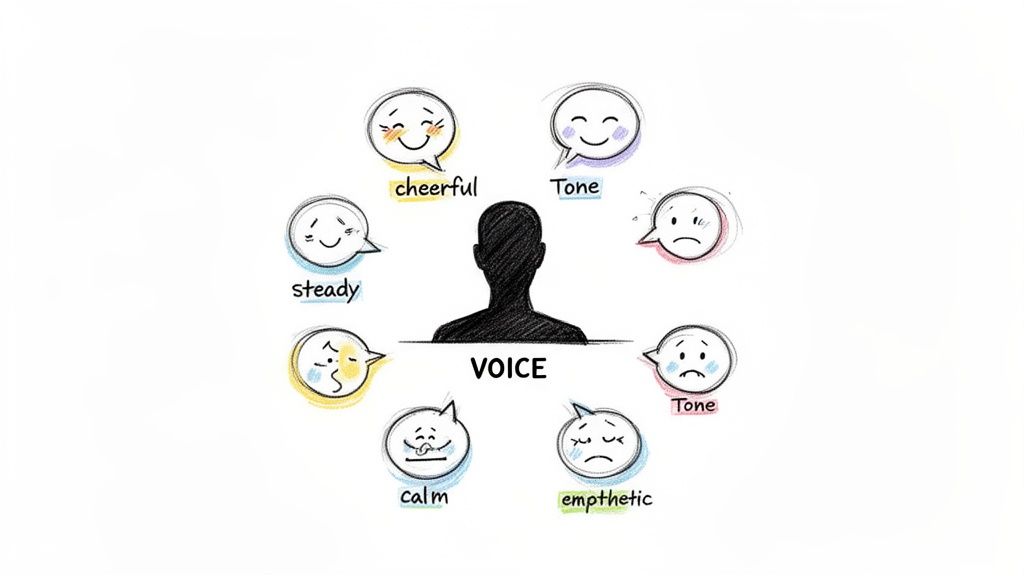
The simplest way to start is to boil your brand’s personality down to its absolute core. If you only had three words to describe your brand to someone new, what would they be? This isn't about what you sell; it's about who you are.
Try to push past the generic stuff like "professional" or "friendly." Dig a little deeper. Are you insightful, rebellious, and witty? Or are you more reassuring, methodical, and empowering?
Jot down a big list of adjectives, then force yourself to circle just three. These three words become your North Star. Every email, every post, every webpage should echo at least one of them.
Okay, now let's take those adjectives and give them a pulse. This is where you create a character sketch for your brand as if it were a real, living person. Trust me, this makes your voice tangible and way easier for your team to get on board with.
Ask yourself a few questions:
By turning your brand into a person, you’re moving from an abstract idea to a concrete character. This ensures you're building a voice that shows what is brand authenticity from the ground up, making everything you say feel more genuine.
This isn't just a fun creative exercise; it's a strategic move. When you have a well-defined persona, you can always gut-check your content by asking, "Would our brand person really say it like this?"
Finally, let’s look backward to move forward. Your existing content—blog posts, social media updates, old emails—is a goldmine. It shows you the voice you already have, whether you created it on purpose or not.
Pull together a handful of your best-performing pieces of content. For each one, figure out what made it click.
This little audit will show you what’s already resonating with your audience and what feels natural for you. Finding your authentic voice is all about understanding its personality, which you can express everywhere from a long-form article to a short bio. For some quick inspiration on that front, check out these creative Instagram bio ideas for cultivating your brand personality to see how others do it.
Combine these insights with your three adjectives and your brand persona, and you'll have a clear, actionable roadmap for your voice.
Look, defining your brand voice is a great first step. But a guide collecting dust in a Google Drive folder isn't going to build a connection with anyone. The real work starts when you actually bring that voice to life in the content people see every day.
This is where the rubber meets the road. Every single word you choose, every sentence you write, and even the rhythm of your paragraphs should feel like a direct expression of your brand’s personality. A strong, authentic voice can make even the driest topics feel human and engaging.
Think of your brand voice as the final filter for everything you create. Before you hit “publish” on a LinkedIn post, a newsletter, or that new 'About' page, ask yourself one simple question: "Does this actually sound like us?" This quick check is what separates brands that feel consistent and memorable from those that don't.
Your brand voice needs to be consistent, but that doesn't mean it's rigid. You have to be flexible enough to adapt it to different platforms without losing its core personality. The witty, punchy voice that kills it on social media might need to be toned down a bit for a formal white paper, but the essence should still be there.
Let's get practical. Here’s how this might look:
This adaptability is what makes a brand feel real and aware of its surroundings, no matter where someone stumbles upon it.
Applying your voice consistently does more than just make your content sound good—it makes you unforgettable. Think about it. Research from Qualtrics shows that 40% of consumers say memorable content is what makes a brand stand out on social media. And what's right behind it? 33% said it’s a distinct personality. A well-executed brand voice is the foundation for both.
The goal isn't just to broadcast information; it's to start a real conversation. When your content has a personality, people don't just consume it—they connect with it.
To make sure your entire team is on the same page, you need to document this stuff. For a complete walkthrough, check out our guide on how to create practical brand guidelines that your team will actually use. This becomes the single source of truth that ensures every piece of content strengthens your brand identity.
Once you start trying to pin down and actually use your brand voice, the real questions pop up. It’s one thing to get the concept, but making it stick across everything you do? That’s a whole different ballgame.
This section is your practical field guide. We’re going to tackle the tough questions head-on so you can build a brand that feels real and stays consistent.
When you've got a team, consistency lives and dies by one thing: a killer Brand Voice Guide. This can't just be a list of fluffy adjectives. It needs to be a practical, easy-to-use playbook for everyone, from sales to customer support.
To make your guide actually work, it has to include:
It also helps to name a "voice champion"—someone who can give feedback and keep everyone on track. Make the guide easy to find, train your team on it, and you'll get everyone speaking the same language.
Absolutely. And it should. Think about it—people change and grow, and so do brands. Your voice should be consistent, not stuck in cement.
As your business matures, your audience changes, or you expand into new markets, your voice will naturally need to adapt. The scrappy, energetic voice of a startup probably won't feel right for an established industry leader a decade later.
The trick is to make the evolution intentional and gradual. You can't wake up one day with a completely new personality. That’ll just confuse your audience and break the trust you’ve worked so hard to build.
It's a subtle refinement, not a total personality transplant. The core of who you are stays the same, but how you express it might become more confident, more focused, or more sophisticated. That's growth, not inconsistency.
The single biggest mistake is being a fake. It's so tempting to see what a cool, edgy brand is doing and think, "We should do that!" But if that persona doesn't line up with your company's actual values, your team, and your customers, it will always fall flat.
People can smell inauthenticity from a mile away. It kills trust faster than anything.
Your voice has to come from a real place—who you are, what you believe in, and who you're here to serve. Don't chase what's trendy. Find what's true to you and build from there. An authentic voice connects in a way a cool-but-hollow persona never could.
You’ll want to look at a mix of hard data and what people are actually saying.
At the end of the day, a successful brand voice doesn't just make you sound good. It builds a loyal community that helps your business grow.
Ready to build a personal brand that truly reflects your vision and connects with your audience? At Legacy Builder, we turn your unique story into powerful content that builds influence and leaves a lasting impact. Discover how we can build your legacy.


You could – but most in-house teams struggle with the nuance of growing on specific platforms.
We partner with in-house teams all the time to help them grow on X, LI, and Email.
Consider us the special forces unit you call in to get the job done without anyone knowing (for a fraction of what you would pay).
Short answer – yes.
Long answer – yes because of our process.
We start with an in-depth interview that gives us the opportunity to learn more about you, your stories, and your vision.
We take that and craft your content then we ship it to you. You are then able to give us the final sign-off (and any adjustments to nail it 100%) before we schedule for posting.
No problem.
We have helped clients for years or for just a season.
All the content we create is yours and yours alone.
If you want to take it over or work on transitioning we will help ensure you are set up for success.
We want this to be a living breathing brand. We will give you best practices for posting and make sure you are set up to win – so post away.
Subscribe to our newsletter and get insights on how to grow your personal brand.
