.svg)
Subscribe to our newsletter and get insights on how to grow your personal brand.
Thank you! Your submission has been received!
Oops! Something went wrong while submitting the form.
.svg)


Most startup content advice is wrong. It tells you to post more, be everywhere, and stay consistent as if volume alone creates demand.
It doesn’t.
Unstructured content is a tax on a small team. Founders burn hours writing posts that don’t move pipeline, marketers chase engagement that never turns into qualified conversations, and agencies ship polished filler that sounds nothing like the person who built the company. If you want a content strategy for startups that drives growth, stop thinking like a publisher and start thinking like an operator.
Content is not a side project. It’s a trust system. Done well, it shortens the distance between “who are you?” and “let’s talk.” Done badly, it creates noise, drains budget, and teaches your team to hate marketing.
The fix isn’t more content. The fix is a system that captures founder insight, turns it into useful assets, and distributes it without losing the voice that made people care in the first place.
Most startup content fails for a simple reason. It starts with output instead of strategy.
Founders hear that content compounds, so they publish random LinkedIn posts, half-finished blog articles, and product updates nobody asked for. Then they conclude content doesn’t work. What failed was the lack of direction.
A startup does not need more content. It needs fewer, sharper messages tied to buyer problems and business goals. If you want a useful primer on the broader mechanics, Feather has a practical resource on how to boost your brand with content marketing. Read it, then come back and build a system instead of a posting habit.
Your scarcest resource isn’t budget. It’s founder attention.
Every hour you spend writing reactive content is an hour you’re not selling, hiring, or improving the product. That trade-off only makes sense when content has a job. It should answer objections, build trust, create inbound interest, or support deals already in motion.
If a piece of content does none of those things, it’s marketing theater.
Practical rule: Don’t publish anything that can’t be tied to a specific audience question, objection, or buying trigger.
A lot of founders also make the opposite mistake. They outsource too early. The result is clean grammar, generic ideas, and a voice that sounds like a committee wrote it. Buyers can tell.
“Just stay consistent” is lazy advice.
Consistency matters only after positioning is clear. A bad message repeated every week doesn’t become effective. It becomes expensive. Startups need a repeatable content engine built on expertise, customer reality, and a founder point of view that the market can recognize.
That’s why authority and trust have to come first. If you need a sharper framework for that foundation, Legacy Builder’s article on developing a content strategy to build authority and trust is worth reviewing before you map your own system.
If your content goal is “grow awareness,” you don’t have a goal. You have a wish.
A real content strategy for startups starts with a North Star outcome. That outcome has to matter to the business. Qualified leads. Better sales conversations. Higher demo quality. Faster trust with buyers. Pick one primary result and build around it.

Research cited by SQ Magazine says the average ROI for content marketing in 2025 is $7.65 per $1 spent, and companies with a documented content strategy see 33% higher ROI. The same source says early-stage startups should allocate 5–15% of their marketing budget to content (content marketing statistics). The message is obvious. If you want returns, document the plan.
Don’t ask content to do everything.
If you’re early, your best North Star is usually one of these:
Put one of those at the top of the page. Everything else is secondary.
Then define what content should make the reader do next. Not “engage.” Not “be inspired.” A concrete next step. Reply. Book a call. Join the email list. Request a demo. Share internally with their team.
Most personas are useless because they stop at job title and industry.
You need to know what your buyer is dealing with when they open LinkedIn, search Google, or skim their inbox, perhaps when time is limited. You’re not writing for a demographic bucket. You’re writing for a person under pressure.
Use this filter:
| Question | What you need to know |
|---|---|
| What are they responsible for? | The outcomes they own and get judged on |
| What frustrates them weekly? | Repeated bottlenecks, missed targets, internal friction |
| What are they afraid of getting wrong? | Risks tied to budget, reputation, or team performance |
| What do they already believe? | Assumptions that shape how they evaluate solutions |
| What content do they trust? | Founder opinions, tactical breakdowns, product demos, peer stories |
That last row matters more than people think. Some audiences want polished explainers. Others trust rough founder takes because they feel real. If you’re trying to grow your YouTube channel strategy, for example, format and delivery matter more than most founders expect. The same is true across blog, email, and social.
Your audience profile should read like field notes from sales calls, not a slide from a branding workshop.
Audience and goal belong together.
A good audience profile tells you what problem the buyer is trying to solve. A good North Star tells you what business outcome you want. Strong content sits at the intersection. If you need help defining who that content should reach, this guide on how to find your target audience for a personal brand gives a useful lens for founders and operator-led brands.
Startups get stuck on topic selection because they treat content like a brainstorming exercise. It isn’t. It’s a packaging exercise.
You already have raw material. Customer questions. Sales objections. Product lessons. Contrarian opinions. Mistakes you’ve seen repeatedly. The job is to organize that material into content pillars your company can own.

A useful starting model comes from Blaze AI. Effective startup strategies often follow a structured pillar mix of 40% educational content, 25% product-focused content, 20% industry content, and 15% culture content (effective social media strategy for startups). That mix is strong because it forces balance. You teach, you sell, you interpret the market, and you show the people behind the work.
Before you pick formats, define what you know better than the market around you.
That usually sits at the intersection of three things:
If your startup sells workflow software for finance teams, your pillars probably shouldn’t be “entrepreneurship,” “innovation,” and “business tips.” That’s content wallpaper. Better pillars would be approval bottlenecks, reporting accuracy, and finance operations under resource pressure.
Founders often overproduce product content because it feels closest to revenue. It usually backfires.
Here’s the better split:
This is the workhorse. It solves immediate problems and earns trust. Think how-to articles, teardown posts, checklists, and tactical videos.
Good educational topics sound like this:
You connect your solution to real use. Not feature dumps. Not release notes with no context.
Show the problem, the before state, the decision criteria, and the result the buyer should care about. Product content works when it feels like applied expertise, not a brochure.
A short explainer can help if your team needs inspiration on structuring pillar content in multiple formats.
It is how strong founders separate themselves from bland brands.
Most companies repeat trends. You should interpret them. Explain what changed, why it matters, who should care, and what action a smart buyer should take. Industry content is where your point of view becomes visible.
This is the most neglected pillar, and it’s the one that protects authenticity as you scale.
Culture content doesn’t mean office photos and birthday posts. It means showing how your team thinks, what standards you hold, how decisions get made, and what kind of company you’re building. For founder-led brands, this pillar keeps the business human.
The market trusts expertise faster when people can see the operator behind it.
Once pillars are clear, topic generation gets easy.
Use these inputs every month:
| Source of ideas | What to pull from it |
|---|---|
| Sales calls | Objections, repeated questions, buying triggers |
| Customer onboarding | Confusion points, setup friction, early wins |
| Product roadmap | Shifts in category education and messaging |
| Founder opinions | Contrarian takes, lessons learned, strategic beliefs |
Then map each idea to one pillar. If it doesn’t fit a pillar, it probably doesn’t belong in your content system.
A content strategy for startups breaks down in operations, not ideas. Teams know what they should say. They just don’t have a system for getting it out without chaos.
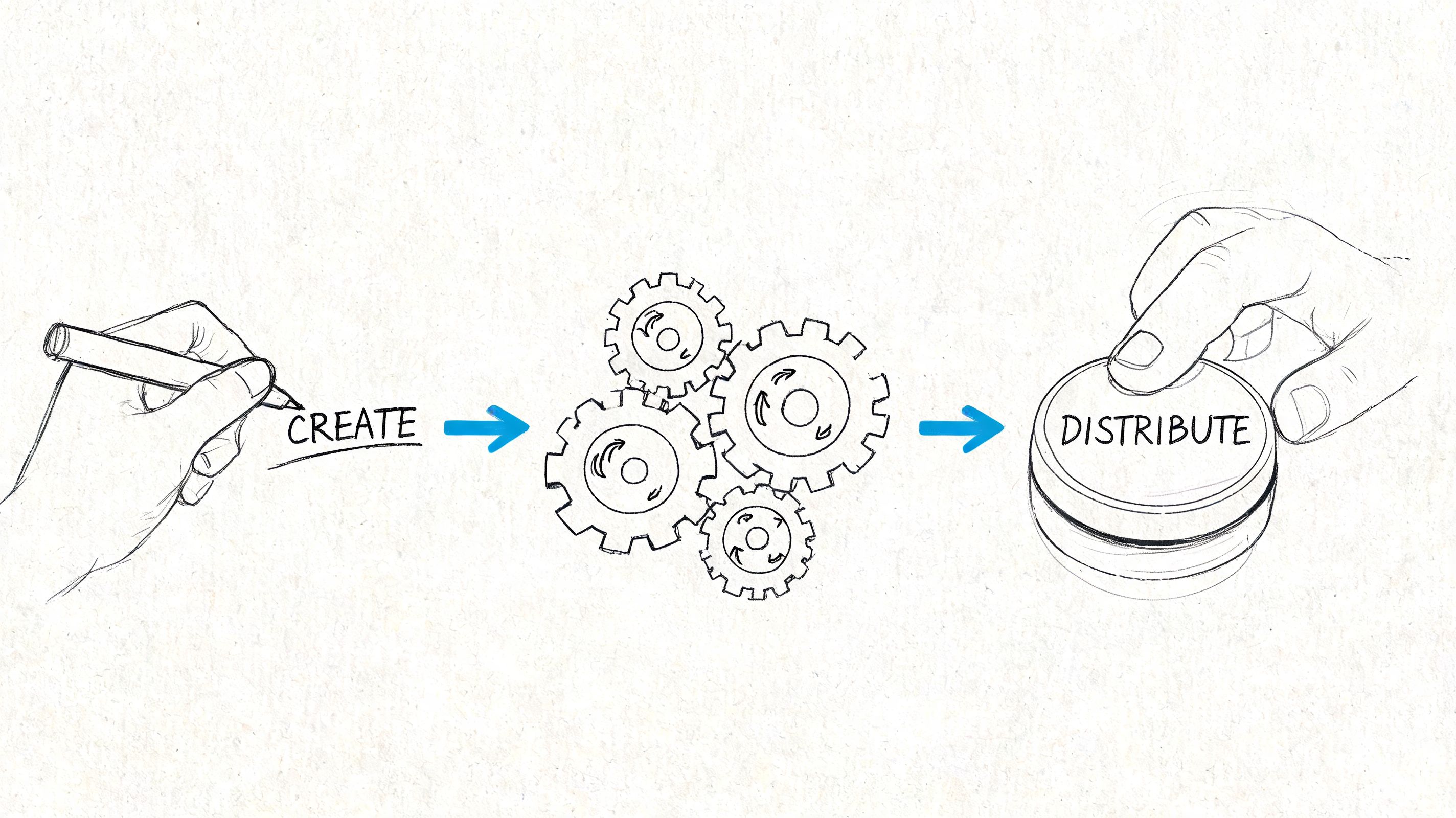
What you need is a Content Operating System. Not a complicated stack. Not a giant editorial machine. A simple workflow that turns expertise into finished assets and gets those assets in front of the right people repeatedly.
Stop creating every piece from scratch.
Each cycle should begin with one substantial asset. A founder memo, article, customer lesson, webinar, or recorded breakdown. That becomes the source material for everything else. From there, your team can carve it into smaller pieces for distribution.
A practical workflow looks like this:
That’s how small teams win. They don’t create more. They reuse better.
AI is useful, but only when you treat it like an assistant instead of a substitute for thinking.
Semrush reports that 67% of small business owners use AI for content marketing or SEO, 58% use it to write blog posts, and businesses using AI for content report an average 70% increase in ROI (content marketing statistics). That doesn’t mean you should hand your voice to a prompt and hope for the best. It means AI is good at acceleration.
Use tools like ChatGPT, Claude, Notion AI, Grammarly, or Descript for specific jobs:
Don’t use AI to invent your point of view. Buyers can smell that instantly.
Most startups spread too thin because every platform feels urgent.
Pick channels based on buyer behavior and team capacity. If your audience reads LinkedIn and email, start there. If they search for category terms and compare vendors through articles, prioritize blog and SEO. If they trust face-to-camera explanations, build a video habit. You do not need to win every channel.
Operator’s rule: One core channel, one support channel, one archive channel is enough for most early teams.
A simple system might look like this:
| Channel role | Example |
|---|---|
| Core channel | LinkedIn for founder-led distribution |
| Support channel | Email newsletter for direct reach |
| Archive channel | Blog for search, sales enablement, and asset storage |
If you want outside help building that operating layer without handing off your voice completely, options include freelance editors, in-house contractors, and services like Legacy Builder, which starts by interviewing founders, extracting their stories and perspectives, and turning them into structured content assets.
Most founders measure content like social media managers. Likes, impressions, followers, and vague “reach.” That’s how you end up protecting vanity metrics instead of building a revenue asset.
Measure content by what it changes in the business.

A strong content system should help you answer questions like these:
That’s the scoreboard. Not applause.
If you want a cleaner framework for evaluating the business side, LLMrefs has a useful article on boosting your content ROI. It’s worth using as a reference point when you build your review cadence.
This is the problem most advice ignores.
At first, the founder is the content engine. That works because the voice is real and the ideas are firsthand. Then the company grows. The founder gets busy. Content gets delegated. The voice disappears. Funded Club points out that most startup advice fails to address how founders transition from being the primary content creator to a delegated system without losing authenticity, even though that’s a critical challenge when bandwidth gets tight (content marketing strategy for startups).
You cannot scale founder-led content by hoping a writer will “just get it.” You need documentation.
Create a simple internal asset that teaches a team how you think.
Include these parts:
Then require every draft to start from founder material, not a blank page.
Authenticity at scale is not magic. It’s documented judgment plus a disciplined editing process.
If you want to tighten your review process, this article on how to measure content performance for your personal brand is helpful because it connects output to actual brand progress instead of surface metrics.
Don’t overbuild this. Your first job is to create momentum with discipline.
Make strategy concrete.
If you skip this phase, the next two months become guesswork.
Start publishing from a system, not from inspiration.
Use one core asset each cycle. Turn that into derivative pieces and distribute them consistently. Tighten the workflow until your team knows who owns capture, drafting, review, design, and publishing.
Your checklist:
Many startups panic at this stage and change direction too fast. Don’t. You’re building muscle memory.
Review what the market is telling you.
Look for useful patterns. Which topics create replies from the right people? Which posts help sales? Which assets get shared internally by prospects? Which formats your team can produce without friction? Keep those. Cut the rest.
Do three things before the end of this phase:
By the end of 90 days, you shouldn’t be asking, “What should we post?” You should have a working content system, a clearer market position, and early evidence of what your audience responds to.
If you want help turning founder insight into a repeatable content engine without sounding like an outsourced marketing department, Legacy Builder works with founders and professionals to capture their voice, shape their positioning, and turn it into structured content that builds authority over time.


You could – but most in-house teams struggle with the nuance of growing on specific platforms.
We partner with in-house teams all the time to help them grow on X, LI, and Email.
Consider us the special forces unit you call in to get the job done without anyone knowing (for a fraction of what you would pay).
Short answer – yes.
Long answer – yes because of our process.
We start with an in-depth interview that gives us the opportunity to learn more about you, your stories, and your vision.
We take that and craft your content then we ship it to you. You are then able to give us the final sign-off (and any adjustments to nail it 100%) before we schedule for posting.
No problem.
We have helped clients for years or for just a season.
All the content we create is yours and yours alone.
If you want to take it over or work on transitioning we will help ensure you are set up for success.
We want this to be a living breathing brand. We will give you best practices for posting and make sure you are set up to win – so post away.
Subscribe to our newsletter and get insights on how to grow your personal brand.
