.svg)
Subscribe to our newsletter and get insights on how to grow your personal brand.
Thank you! Your submission has been received!
Oops! Something went wrong while submitting the form.
.svg)



So, what exactly is a content strategy?
Think of it as the game plan that turns random posting into a systematic way of building your brand. It’s the blueprint that ensures every single piece of content you create—every post, every video, every article—has a clear purpose and pushes you closer to your goals. It’s about being intentional.
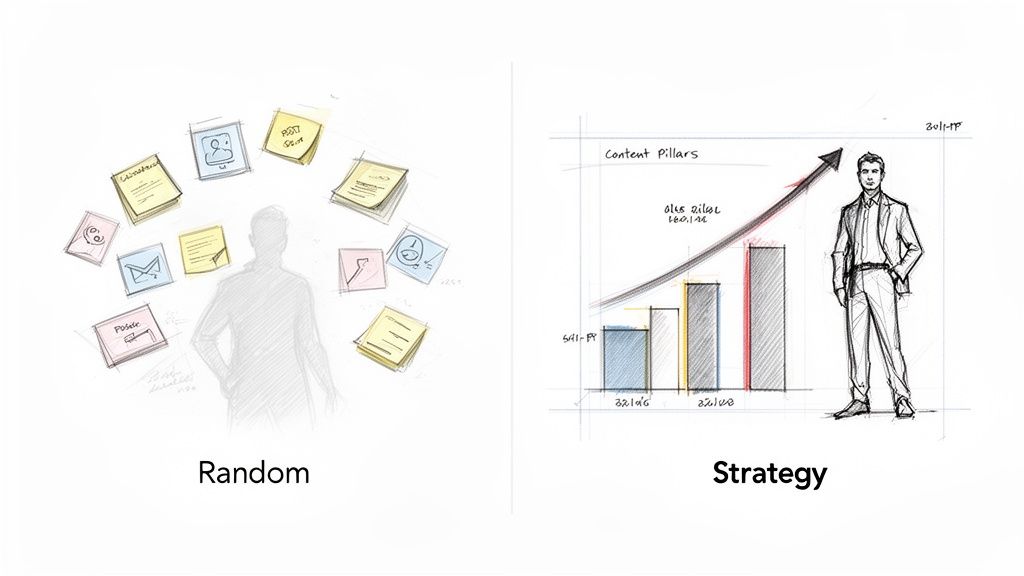
Let's be real: in a world this noisy, just showing up and tossing content into the void isn't enough to build real influence. Too many entrepreneurs and leaders fall into the trap of a tactical, post-by-post approach. I call it "random acts of content," and it's a surefire way to feel like you're spinning your wheels.
The result? A digital presence that feels generic and disconnected from who you actually are. You end up staring at a blank screen, wondering what to post next, or creating stuff that lands with a thud because it lacks a guiding purpose. This kind of inconsistency doesn't just confuse your audience—it actively undermines the authority you're trying to build.
Without a plan, you're just adding to the noise.
This is where you make the fundamental shift from just "doing content" to strategically building an authentic brand. A content strategy is the foundation for your entire digital presence. Think of it like the architectural plan for a house; without it, you're just nailing boards together and hoping it doesn’t fall down.
This strategy is the system that translates your unique vision, experience, and values into a consistent stream of high-impact content. It’s designed to:
A content strategy isn't about creating more content. It's about creating the right content, for the right people, at the right time. It ensures your efforts stack on top of each other, creating a powerful, cohesive personal brand over time.
Wingin' it comes with a steep price. When your content has no strategic backbone, you're not just wasting time and resources—you're actively damaging your credibility.
To move past this, understanding how to build a personal brand that works is non-negotiable. It’s the difference between being a memorable authority and just another forgotten voice in the digital crowd.
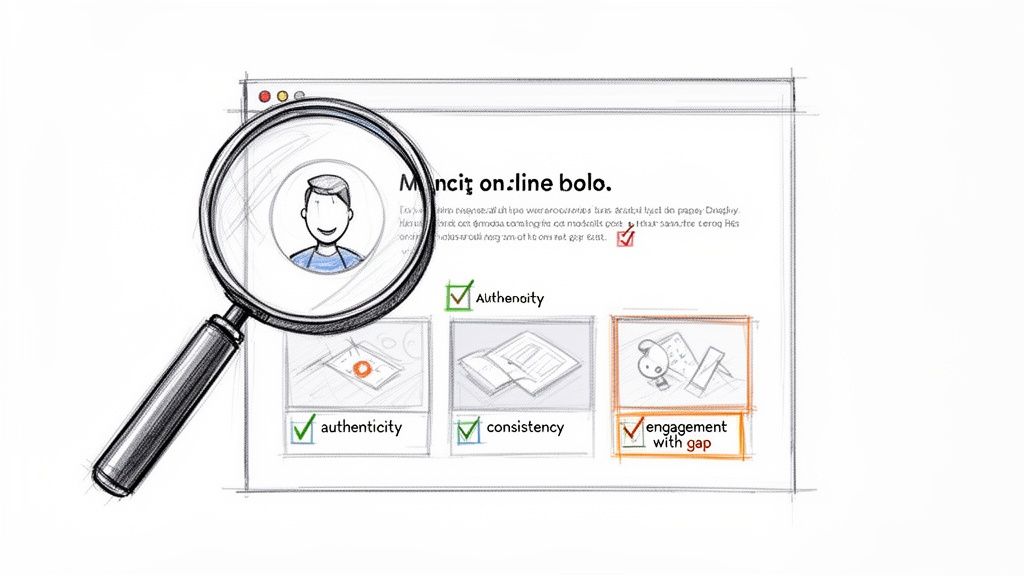
Before you can build a new content strategy that actually works, you have to get brutally honest about where you are right now.
Think of it less like a stuffy corporate audit and more like a reality check. You're mapping out your current digital footprint—all your posts, profiles, and random thoughts you’ve shared online—to see what's hitting the mark, what's falling flat, and where your real opportunities are hiding.
This means taking a hard look at your content on platforms like LinkedIn, X (formerly Twitter), and your personal blog. And if you haven't been posting? That’s an important piece of the puzzle, too. This isn’t just for seasoned creators; it’s for anyone who wants to stop guessing and start developing a content strategy that gets results.
The goal here is to dig deeper than just vanity metrics. We're looking for authenticity, consistency, and genuine connection.
First things first, open a simple doc and list every place you show up online professionally. Your LinkedIn profile, X account, personal site—get it all down in one place. This is your command center.
Now, go through each platform. You’re not just counting likes. You're trying to figure out what story your content is telling about you right now.
Ask yourself these questions:
Be ruthless here. This initial audit is your baseline—the "before" photo. Getting this right is what makes the "after" so damn impactful.
Look, having a documented plan is what separates the pros from the amateurs. While 97% of B2B marketers claim they have a content strategy, a wild 66.5% struggle with having the resources to actually pull it off. That stat shows a massive disconnect between planning and doing.
For founders and leaders, this is even more critical. The good news? 61% of marketers say their strategies got better over the past year, proving that constant tweaking works. You can dive into more of these content marketing stats to see why a real, documented approach wins every time.
Okay, you've done the initial scan. Now it's time to sort through what you found and turn those observations into action.
I like to think of this as sorting everything into three buckets: what to keep doing, what to stop doing, and what you need to start doing.
Here's a simple checklist to guide you through it.
Use this table to translate your audit findings into a clear, actionable plan. It forces you to move from just looking at your content to actually understanding what it's doing for your brand.
This process gives you the raw material you need to build the rest of your strategy. It’s not a guessing game. It’s a targeted plan based on where you are today and a clear vision of where you’re headed. Get this right, and you're setting yourself up for real growth and influence.
Alright, you’ve done the internal work and audited your content. Now it’s time to look outward.
A content strategy that actually connects with people boils down to two things: knowing exactly who you’re talking to and being crystal clear on what you’re going to talk about.
Nail these two, and every single post becomes a powerful asset.
Let's get one thing straight: you can't create content for "everyone." When you try, you end up with a watered-down message that resonates with absolutely no one. The goal is to build such a detailed picture of your ideal audience member that they feel like a real person you know.
And I’m not just talking about surface-level demographics like their age or job title. That stuff provides context, but the real magic happens when you understand what’s going on inside their head.
To truly connect, you have to dig into their psychology. What’s keeping them up at night? What are their biggest dreams, both in their career and in their personal life? What’s standing in their way?
When you can answer those questions, your content stops being a broadcast and starts feeling like a one-on-one conversation. You’re no longer talking at them; you’re talking with them about things they actually care about.
Here’s what I focus on when building a persona:
Building a detailed persona isn't just a box to check. It's the filter every single content idea should pass through. Before you hit publish, ask yourself: "Would [Persona's Name] find this genuinely helpful or interesting?"
If you want a more structured way to tackle this, check out our guide on how to find your target audience for a personal brand.
Once you have a sharp focus on your audience, you can build the architecture for your message: your content pillars. These are the 3-5 foundational themes where your expertise, your values, and your audience's biggest needs all intersect.
Think of them as the main sections in your personal brand's library. They aren’t specific post ideas, but the broad, recurring themes you want to be known for. This is so critical because it builds your authority on specific topics and makes your brand memorable.
For a fintech founder, the pillars might look like this:
For a marketing executive, they could be:
These pillars are the guardrails for your content. They keep you focused and ensure everything you create reinforces the same core message. Once you’ve locked these in, you can explore different formats that bring them to life, like these proven ideas for what to post on LinkedIn. It’s a simple way to guarantee your brand narrative stays cohesive and authoritative.
This kind of strategic clarity is more important than ever. We're in a weird spot where nearly 94% of marketers are jumping on AI to churn out content, but the most successful brands are doubling down on quality over quantity. And even with all the AI noise, 64% of buyers are still spending over an hour a week on thought leadership content—proving there's a huge appetite for real substance.
The takeaway for leaders is simple: use AI for efficiency, but build your strategy around human authenticity and genuine expertise. That's how you build a real connection. You can find more on these and other content marketing statistics on Typeface.ai.
You've nailed down your content pillars. Now the real work begins. It's time to shift from what you'll talk about to how and where you’ll actually show up and say it.
This is where your strategy becomes tangible. It's about turning those big ideas into real assets that people can watch, read, and share. And it's about making smart choices that play to your strengths while meeting your audience where they already hang out. You don’t have to do it all, but you have to do the right things well.
Look, the best content formats are always a mix of two things: what your audience loves and what you actually enjoy creating.
If you're a natural on camera and love storytelling, short-form video on LinkedIn or TikTok is your playground. If you're more of a deep, analytical thinker, you'll probably feel more at home writing long-form articles for LinkedIn or a dedicated newsletter.
Forcing yourself into a format you hate is the fastest way to burn out. Consistency is everything when you're developing a content strategy, so you have to pick a format you can sustain.
Here are a few popular formats to consider for your personal brand:
Your goal isn't to be everywhere. It's to be unmissable where it matters most. Pick one or two formats to master first. Once you've got momentum, then you can think about expanding.
This whole process can feel a bit abstract, so here’s a simple way to visualize how your pillars flow into formats, which then feed your repurposing engine.
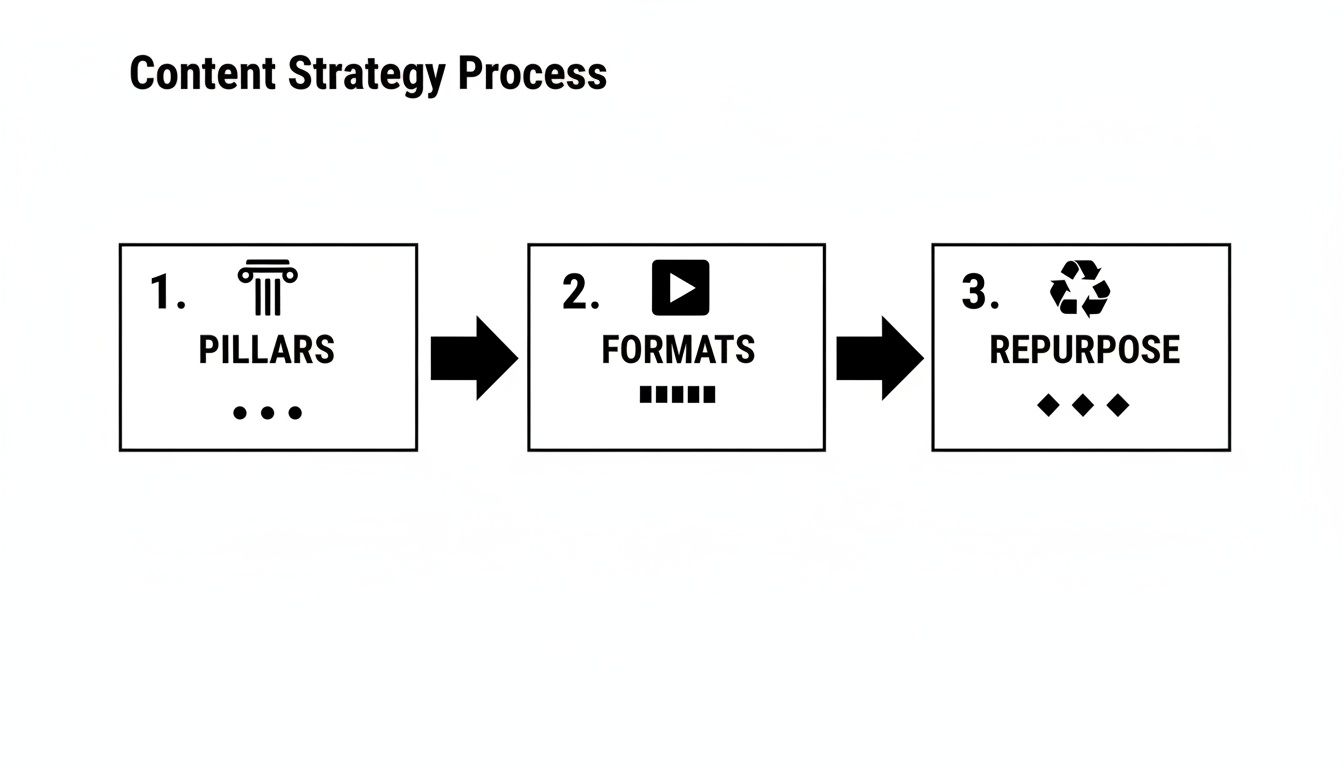
As you can see, it's a straightforward path. Your pillars dictate the formats, and those formats become the raw material for repurposing, which is how you get maximum reach.
Okay, you've picked your formats. Next up: creating a posting schedule you can actually stick to. Let me be clear—consistency beats intensity, every single time. Posting five times in one week and then going dark for a month is a great way to kill all your momentum.
A simple, repeatable schedule is your best friend here. It creates structure and takes the daily "what should I post?" guesswork out of the equation.
Here’s a sample weekly calendar for a CEO whose pillars are Leadership, Team Culture, and Industry Innovation. It's a great example of how to blend pillars and formats.
This schedule hits all three pillars using different formats, which keeps the content feeling fresh while hammering home the core brand message. It’s a manageable rhythm that keeps you visible without burning you out.
Want to know the secret to a high-impact, low-stress content strategy? It’s not about creating more content. It’s about getting more mileage out of the content you already have.
This is the art of repurposing.
One great idea—let's say an in-depth client case study—can be sliced and diced into a dozen different assets. You put in the hard work upfront on the core idea, and then you just create variations on that theme.
For instance, that one long-form article can become:
This is how you maximize your reach and hammer your message home across different platforms and formats. If you want to get really good at this, we've put together a full guide where you can learn more about how to repurpose content and multiply your reach.
It’s all about working smarter, not harder, to build a powerful content engine that fuels your brand's growth.
A brilliant content strategy is worthless if it just sits in a Google Doc. This is where the real work begins—turning that plan into a consistent rhythm of action, learning, and genuine influence.
Let’s be clear: execution doesn't have to be complicated. You don’t need a fancy, expensive software suite to make this happen. A shared calendar or a basic project management tool is often all it takes to keep your content pipeline organized, whether you're a solo founder or leading a small team.
The goal isn't to find the most feature-packed tool. It's to build a simple, repeatable workflow you can actually stick to. Consistency is what builds trust and authority over time, and a simple system is your best shot at maintaining it.
It's so easy to get hooked on the wrong things. Likes, views, and follower counts feel good, but they're often just vanity metrics that do nothing for your bottom line. When you’re building a personal brand with real business goals, you have to shift your focus.
Forget the fleeting validation. You need to track the signals that point to real connection and opportunity. These are the numbers that tell you if your content is actually working.
Here’s what you should be obsessed with instead:
A successful personal brand isn't measured by the size of its audience, but by the quality of its connections. Your goal is to attract the few who matter, not the many who just scroll past.
When you start tracking these metrics, you stop seeing content as a performance and start seeing it as a conversation starter. That shift in mindset is what separates noisy creators from influential leaders.
You don't need a complex analytics dashboard to monitor these signals. Seriously, a simple spreadsheet is all you need to get started.
Just take 15 minutes once a week to log the data that reflects actual influence.
Create a few columns for the KPIs that tie directly to your goals:
This simple habit completely changes how you view your content. It gives you clear, qualitative data on which topics and formats aren't just getting seen, but are actively driving the results you care about.
This isn't just my opinion; it's where the market is headed. The global revenue from content marketing is on track to shoot past $100 billion by 2026. That’s not happening because brands are just making more stuff. It’s because they're getting smarter about measuring real impact. With more than half of companies planning to increase their content budgets in 2024, the focus has shifted to proving a real return. For a leader building a personal brand, this just confirms the need to measure what actually builds influence. You can dig into more of these and other content marketing statistics from HeroicRankings.com.
The data you collect becomes your feedback loop. It's how you stop guessing and start knowing.
If you notice one of your content pillars consistently drives more DMs and high-quality connection requests, that's your signal to double down on that theme. If a certain format, like a text-only post, falls flat week after week, maybe it's time to experiment with something else.
This cycle—act, measure, refine—is the engine that powers a successful content strategy. It ensures your efforts aren’t just adding to the noise but are actively building your legacy and driving tangible results.
Even with the best roadmap, you’re going to hit a few bumps. This is where the strategy you’ve mapped out meets the real world.
Let's walk through some of the most common questions and roadblocks I see entrepreneurs and leaders run into when they start putting their personal brand strategy into play.
This is the big one. It's the number one objection I hear from busy founders and executives, and it's completely valid.
The solution isn't to magically create more hours in the day. It's to separate the thinking from the doing.
You don’t need to be in "strategy mode" every single day. Block off a couple of hours once a month—maybe a quiet Sunday evening—to map out your content pillars and brainstorm a list of topics. That's the high-leverage work.
Then, you can use content batching to knock out a week or two's worth of posts in a single afternoon. If that still feels like too much, that's when you bring in help. A dedicated service can handle the writing and posting, letting you focus only on providing the core ideas. Your strategy ensures every post is 100% authentic to you, solving the time problem without compromising your voice.
This is a point of confusion that can completely stall a content strategy before it even gets going. I like to use a simple analogy: think of your pillars as the major sections in a bookstore, and your topics as the individual books on the shelves.
Your content pillars are the 3-5 big, foundational themes you stand for. They are broad, consistent, and built to last.
For a founder, your pillars might be things like:
The content topics are the specific posts you create that live under each pillar.
Under the "Building a Remote Culture" pillar, you could have topics like:
Your pillars give you direction. Your topics give you variety. A solid set of pillars can spin off hundreds of topics, so you’ll never be staring at a blank screen wondering what to post.
Let me be blunt: building a personal brand is a marathon, not a sprint. The need for instant results is the single biggest killer of a great content strategy.
You'll likely see small signs of life within the first 30-60 days. But the real, game-changing results? Those take time.
Early wins to look for:
Give it a solid 90 days of consistent posting before you even think about changing your strategy. After six months of showing up every day, you should start seeing real traction. By the one-year mark, a well-played strategy will have cemented you as a voice in your space.
It's all about tracking the leading indicators (engagement, DMs, profile views) while you wait for the lagging ones (revenue, big opportunities) to catch up. Don't quit three feet from gold.
AI can be a phenomenal tool, but you have to use it the right way. For a personal brand that’s all about authenticity, AI needs to be your assistant, not your author.
If you just ask an AI to write a post for you, you'll get generic, soulless content that sounds like everyone else. It won't have your unique perspective or your hard-won experience.
Instead, use AI as a creative partner to speed things up.
Here’s how to do it right:
AI is brilliant for getting past writer's block and making you more efficient. But the final post must be filtered through your brain, infused with your stories, and stamped with your unique point of view. That's your differentiator. Never let a tool water it down.
At Legacy Builder, we get it. Building an authentic personal brand is a serious commitment. If you have the vision but not the time to execute daily, our team is here to step in. We turn your expertise into high-impact content that builds your influence and legacy, day after day.
Learn more about how we can build your legacy at LegacyBuilder.co


You could – but most in-house teams struggle with the nuance of growing on specific platforms.
We partner with in-house teams all the time to help them grow on X, LI, and Email.
Consider us the special forces unit you call in to get the job done without anyone knowing (for a fraction of what you would pay).
Short answer – yes.
Long answer – yes because of our process.
We start with an in-depth interview that gives us the opportunity to learn more about you, your stories, and your vision.
We take that and craft your content then we ship it to you. You are then able to give us the final sign-off (and any adjustments to nail it 100%) before we schedule for posting.
No problem.
We have helped clients for years or for just a season.
All the content we create is yours and yours alone.
If you want to take it over or work on transitioning we will help ensure you are set up for success.
We want this to be a living breathing brand. We will give you best practices for posting and make sure you are set up to win – so post away.
Subscribe to our newsletter and get insights on how to grow your personal brand.
