.svg)
Subscribe to our newsletter and get insights on how to grow your personal brand.
Thank you! Your submission has been received!
Oops! Something went wrong while submitting the form.
.svg)


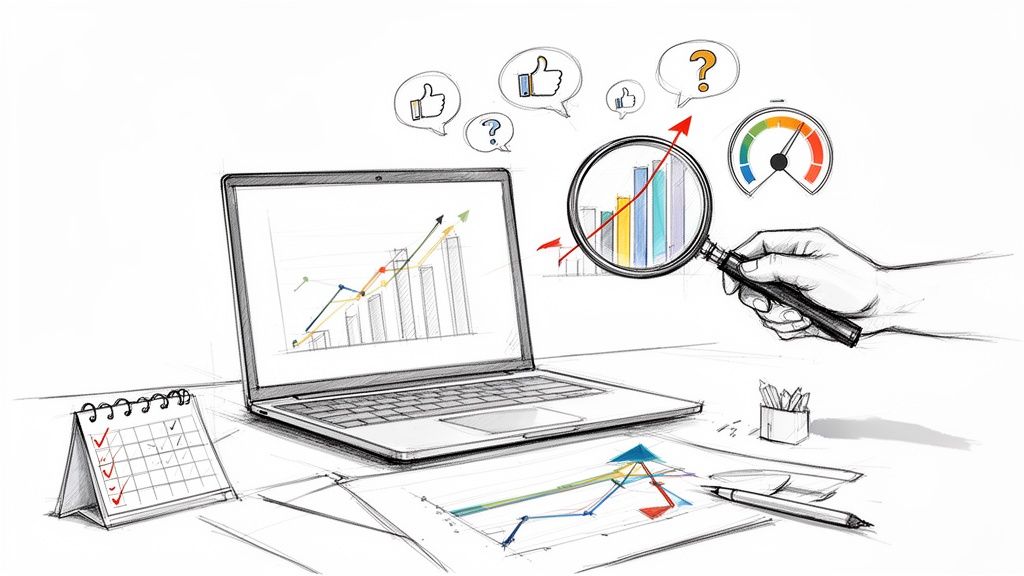
When you're trying to figure out if your brand awareness efforts are actually working, it boils down to two things: tracking the hard numbers (your quantitative reach) and understanding how people feel about you (the qualitative mindshare). A killer strategy needs both. You need the data to back up the gut feelings, giving you the full story of your brand's influence.

I see it all the time. Entrepreneurs and personal brands are in the trenches, creating content day in and day out. They’re posting on LinkedIn, recording podcasts, and dropping insightful articles. But when you ask them how it's all performing, the answer gets a little fuzzy.
"It's going well," they'll say, but there's no real data behind it. This is exactly where measurement changes the game.
Brand awareness isn't some fluffy, feel-good idea. It's a real asset that directly builds the trust and authority you need for long-term growth. When you know how to measure it, your content strategy stops being a guessing game and starts becoming a predictable system for building your influence.
Without measurement, you're flying blind. You have no idea which activities are actually building your reputation and which ones are just wasting your time. Tracking awareness is how you prove your content isn't just making noise—it's making a real impact.
Getting a handle on your brand's footprint means looking at it from different angles. Think of it like using both a telescope and a microscope. The telescope gives you that big-picture view of your reach, while the microscope zooms in on the nitty-gritty details of how your audience actually perceives you.
To get you started, we'll break down both sides of the coin in this guide:
Before we dive deep, here’s a quick overview of the methods we’ll be covering.
This table gives you a snapshot of the key quantitative and qualitative methods, helping you pick the right approach for your specific goals.
By mixing and matching these approaches, you get a complete, 360-degree view of your brand’s health and influence. This isn't just about validating your work; it’s about gaining the insights you need to consistently generate high-quality leads.
Gut feelings are great, but hard numbers don't lie. When you’re trying to figure out if your brand-building efforts are actually working, you need proof.
Quantitative metrics give you that proof. They show you, in black and white, just how big your digital footprint is. These are the numbers you’ll use to set a baseline today and measure your growth against it down the road.
One of the most powerful—and most overlooked—metrics is direct website traffic. This is pure gold. It counts the people who didn’t just stumble upon you; they typed your URL directly into their browser or used a bookmark. A steady climb in direct traffic is a dead giveaway that your brand recall is growing. People know you by name.
Let's make this real. Say you were just a guest on a popular industry podcast. You check your analytics a week later and see your direct traffic jumped by 30%. That’s not a fluke. It's a straight line connecting your appearance to people who heard your name, remembered it, and came looking for you. That’s brand awareness in action.
Then there’s organic search traffic, which tells a different but equally important story. While direct traffic proves recall, organic shows discovery.
When this number goes up—especially for non-branded keywords tied to your expertise—it means your content is hitting the mark. You’re becoming an authority. People aren’t just looking for you; they’re finding you because you’re a key voice in the conversation. You have to watch both to get the full picture.
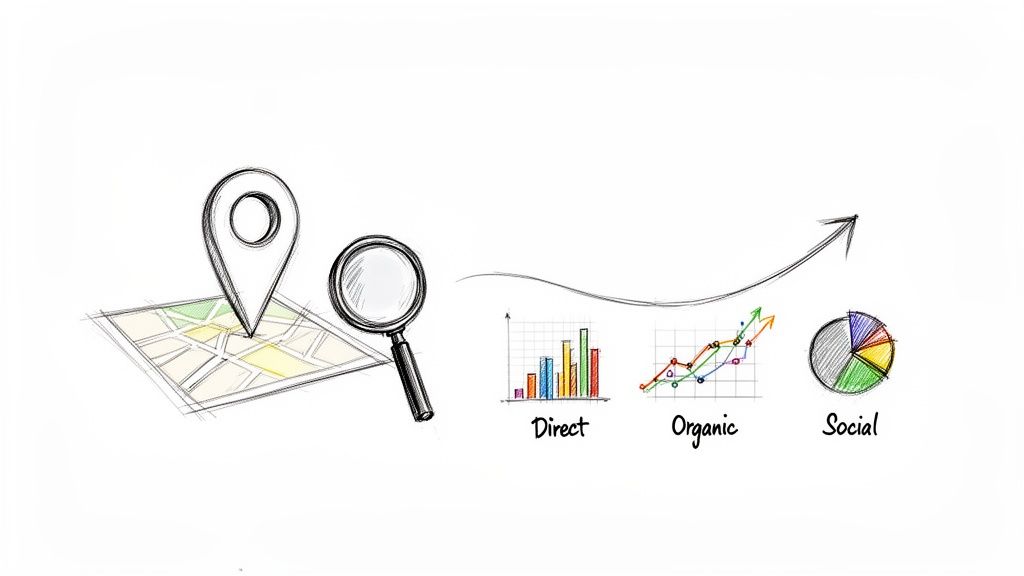
Your analytics platform is a goldmine. Stop just glancing at the total traffic. Dig into the sources—direct, organic, social, referral—and figure out how people are finding you. Each one tells a different part of your brand’s story.
Social media platforms hand you a ton of quantitative data on a silver platter. The two you absolutely need to be watching are reach and impressions.
These metrics are your first signal that your message is cutting through the noise. Track them consistently. You'll quickly see what kind of content resonates and which platforms are actually growing your influence.
As you start getting serious about this, check out Legacy Builder's approach to strategic content. It’s designed to turn those impressions into real, meaningful engagement.
Okay, now it’s time to look outside your own bubble. To really understand where you stand, you need to measure your Share of Voice (SOV).
Put simply, SOV tells you how much of the conversation in your niche is about your brand versus your competitors.
For a personal brand, you don’t need fancy software. You can start by manually tracking mentions of your name against a few key competitors on LinkedIn or X (formerly Twitter) over a set period.
If you want to go deeper, check out a modern guide to Share of Voice calculation. It’s a great way to get a clear benchmark of your visibility and authority in the market.
The quantitative stuff—reach, impressions, all that—tells you how many people saw your brand. But it can't tell you if a single one of them actually remembers who you are.
That's a huge gap.
To really know if your message is sticking, you need to measure mindshare. And for that, you have to go qualitative. We’re moving beyond just numbers to figure out who knows you and, more importantly, why they know you.
For a lot of founders, the word "survey" sounds expensive and complicated, like something only a Fortune 500 company with a research department can pull off. But that’s a myth. Simple, consistent surveys are one of the most powerful tools you have in your arsenal.
They’re your direct line into understanding two critical types of awareness, and you can get started pretty easily with things like dedicated brand awareness survey templates.
You have to get this distinction right. Aided and unaided recall each tell a completely different story about where your brand lives in your audience's head.
Unaided Recall: This is the holy grail. It’s when someone can name you without any prompting at all. Think about the classic question: "When you think of experts in personal branding, who are the first three names that come to mind?" If your name shows up in that list, you’ve hit top-of-mind status. You own real estate in their brain.
Aided Recall: This is more about brand recognition. You give them a little nudge to jog their memory. For instance, you might ask, "Have you heard of Clifton Sellers before?" It’s a great way to measure general familiarity, even if you aren’t the first name they think of.
Unaided recall is the real litmus test for your top-of-mind presence. It's no surprise that it typically takes 5-7 impressions for someone to even remember a brand—consistency is everything.
In fact, brand recall drives a whopping 38.7% of brand lift, making it the single biggest factor in ad effectiveness. And when you consider that 59% of shoppers would rather buy from brands they already know, you can see why this matters so much.
Look, you don't need a massive budget or some complicated software to get this done. The secret ingredient here is consistency. Asking the same questions to a similar audience over time is how you see the needle move.
Here are a few dead-simple, low-cost ways to run these surveys:
The goal isn't to get thousands of responses overnight. It's about establishing a baseline and then measuring against it every quarter. Seeing your unaided recall score slowly climb from 2% to 10% over a year is the tangible proof that your content strategy is actually working.
When you consistently ask these questions, you turn an abstract idea like "mindshare" into a hard metric.
You can finally draw a straight line from your efforts—like that guest podcast tour or a series of viral posts—to a measurable jump in people who know your name. This is how you prove your brand isn't just being seen; it's becoming unforgettable.
Numbers tell you how many people saw your content. They don't tell you how people feel about it.
That's where social listening comes in. It’s your secret weapon for bridging that gap. This isn't just about counting mentions; it’s about digging into the context, tone, and overall vibe of the conversations happening around your brand online.
Think of it as digital eavesdropping, but for a good reason. You’re tuning in to what real people are saying about you, your competitors, and your industry on platforms like LinkedIn, X, and even Reddit. This is how you figure out if your brand-building efforts are creating positive momentum or just adding to the noise.
You don't need to drop a ton of cash on fancy software to get started. In fact, some of the most effective tools for keeping a pulse on the conversation are completely free. The goal is to build a simple system that pings you whenever your brand or key topics are in the spotlight.
Here’s how you can get rolling today:
Let's say you just dropped a pillar article about a new industry trend. With these alerts in place, you’ll see if other experts start citing your work in their own posts or if it’s sparking a debate on a Reddit thread. That's raw, unfiltered feedback on your content's real-world impact.
Collecting mentions is just the start. The real magic is in the analysis. You’re not just hunting for volume; you’re looking for meaning.
Social listening helps you understand the why behind the numbers. A sudden spike in mentions could be a huge win or a looming crisis. If you're not analyzing the sentiment, you're flying blind with only half the story.
As you review these conversations, zero in on a few key things:
These insights are non-negotiable. Social media listening and share of voice (SOV) are powerful ways to track brand awareness by seeing how your mentions and engagement stack up against your competitors. By 2025, with 92% of businesses using AI in marketing, analyzing this data will be more precise than ever. And considering that 77% of consumers buy from brands they follow on social, these conversations are directly linked to your bottom line.
Learning to "read the room" online is a core skill for any modern B2B marketer. For a deeper dive into making this happen, check out our guide on building a modern B2B social media strategy that works. When you consistently listen, you can adapt your strategy, engage in more meaningful ways, and make sure your brand is truly resonating with the right people.
All this data is great, but it’s completely useless if it’s scattered across a dozen different platforms. The real magic happens when you bring your key metrics together into a single, actionable dashboard.
And no, you don't need to shell out for some complex enterprise software. You can build an incredibly effective dashboard with a simple spreadsheet or a free tool like Google Data Studio.
The whole point is to create a clear, at-a-glance story of your brand's health. When you centralize your information, you stop chasing random numbers and start building a continuous strategic process. This dashboard becomes your single source of truth—the place you go to validate your efforts and spot new opportunities.
To keep things focused and avoid getting lost in vanity metrics, I always recommend structuring your dashboard around three core pillars. This framework makes sure you're tracking both how far your message is reaching and how deeply it's connecting with your audience. It’s the perfect mix of numbers and nuance.
Organize your dashboard into these essential sections:
Aided recall surveys, which use cues like your logo or tagline to jog someone's memory, are a practical place to start. And don’t underestimate the power of social media here—with 77% of consumers preferring to buy from brands they follow, these platforms are your front line for building recognition.
People are 50% more likely to buy from a brand they recognize, yet only 32% of marketers are actually tracking their efforts across all their channels. If you want to dive deeper, you can find more brand awareness stats in various industry reports.
The graphic below shows a simple way to think about gathering the social data you need for this part of your dashboard.

It’s a straightforward flow: set up alerts for your brand name, track the conversations, and analyze the sentiment. That sentiment score plugs right into your dashboard.
Look, a dashboard without context is just a bunch of numbers on a screen. The real value gets unlocked when you start benchmarking.
The most important comparison you can make is against yourself. Your goal isn't just to have good numbers; it's to have numbers that are getting better every single month.
Set up your dashboard to compare this month’s data against last month’s. It’s that simple. This month-over-month view will immediately show you if what you’re doing is actually working.
Did that podcast interview cause a spike in direct traffic? Did your latest content series improve your social sentiment score? Benchmarking is what turns your data from a static report into a clear story of your progress.
Alright, even with a solid framework, I know that diving into the world of brand measurement can feel a little intimidating. It’s one thing to know the theory, but another thing entirely to put it into practice.
Let's break down some of the most common questions and roadblocks I see entrepreneurs hit when they start tracking brand awareness.
For most founders and personal brands, a quarterly check-in is the sweet spot.
This rhythm is frequent enough to see if what you're doing is actually working, but it also gives your content and marketing efforts enough time to breathe and make a real impact. You won't get caught up in the noise of daily ups and downs.
Now, that doesn't mean you ignore everything in between. You should absolutely keep an eye on your quantitative metrics—things like website traffic and social reach—on a monthly basis. This is great for spotting quick trends or seeing the immediate results of a specific campaign.
But save the deeper, more involved qualitative stuff, like running brand recall surveys, for that quarterly review. This keeps you focused on long-term growth instead of overreacting to every little spike or dip in the data.
You absolutely do not need a big budget to get this right. In fact, you can build a powerful measurement system without spending a dime. It's perfect for entrepreneurs who are still building momentum.
Here’s a simple, free, and surprisingly effective tech stack to get you started:
You can build a robust measurement system with zero financial investment. The most important resource you need is consistency—committing to tracking these metrics over time is what will ultimately yield the most valuable insights.
Hitting a plateau is frustrating, but it’s almost always a sign that one of three things is off. If your numbers are flat, don't panic. Instead, use this as a diagnostic tool.
First, look at consistency. This is the number one killer of momentum. Are you truly showing up on a regular, predictable schedule? Sporadic effort here and there is never going to build lasting awareness. You have to be relentless.
Next, take a hard look at your content's relevance. Is what you're creating genuinely solving a problem for your audience, or is it too focused on you? Use your social listening tools to figure out what conversations are actually happening in your niche and join them.
Finally, audit your distribution. Hitting "publish" is not a strategy. Are you actively engaging in conversations, collaborating with other people in your space, and promoting your content beyond your own followers? Great content without a distribution plan is like a billboard in the desert.
At Legacy Builder, we help you smash through these roadblocks. We turn your expertise into a consistent flow of high-impact content, making sure your brand doesn't just get seen—it gets remembered. Build your legacy with us at https://www.legacybuilder.co.


You could – but most in-house teams struggle with the nuance of growing on specific platforms.
We partner with in-house teams all the time to help them grow on X, LI, and Email.
Consider us the special forces unit you call in to get the job done without anyone knowing (for a fraction of what you would pay).
Short answer – yes.
Long answer – yes because of our process.
We start with an in-depth interview that gives us the opportunity to learn more about you, your stories, and your vision.
We take that and craft your content then we ship it to you. You are then able to give us the final sign-off (and any adjustments to nail it 100%) before we schedule for posting.
No problem.
We have helped clients for years or for just a season.
All the content we create is yours and yours alone.
If you want to take it over or work on transitioning we will help ensure you are set up for success.
We want this to be a living breathing brand. We will give you best practices for posting and make sure you are set up to win – so post away.
Subscribe to our newsletter and get insights on how to grow your personal brand.
