.svg)
Subscribe to our newsletter and get insights on how to grow your personal brand.
Thank you! Your submission has been received!
Oops! Something went wrong while submitting the form.
.svg)



An online marketing strategy is the coordinated plan for using digital channels to attract the right audience, build trust, and convert that attention into measurable business outcomes. In 2025, global marketers were projected to spend approximately $1.16 trillion on advertising, with digital channels expected to represent 74.4% of worldwide advertising expenditure.
The popular advice is simple: post more, publish everywhere, run ads, and keep chasing attention. That advice keeps founders busy, but it doesn't necessarily build demand, authority, or revenue.
A real strategy does something harder. It decides where your attention belongs, what trust looks like, how people move toward a decision, and which results deserve credit. Channels matter, but they're only the delivery system. Your strategy is the logic connecting audience, message, content, distribution, conversion, and measurement.
Confusing an online marketing strategy with a list of activities is a common mistake. They say they need SEO, LinkedIn posts, email campaigns, paid ads, or short-form video. Those are tactics. A strategy explains why you're using them, who they serve, what job each channel performs, and how the activity supports a business outcome.
An online marketing strategy is the coordinated use of internet-based channels, including search engines, social media, websites, email, online video, and digital advertising, to attract audiences, build relationships, generate leads, and convert demand into measurable results. The definition is practical because it forces you to connect communication with action.
A founder might use an insight-led article to attract people searching for a solution. That article can lead readers to a service page, an email signup, or a consultation. A social post can introduce the founder's point of view, while an email can deepen the relationship. Each asset has a role, and the roles reinforce one another.
Practical rule: If you can't explain what a piece of content is supposed to change, it isn't part of a strategy yet.
Start with the outcome, not the platform. You may want qualified conversations, consultation bookings, product purchases, referrals, or a permission-based audience you can reach without relying entirely on an algorithm.
Then define the audience problem. “Executives” or “small businesses” isn't enough. Specify the situation, pressure, or decision that makes your expertise relevant. A founder serving professional-services firms might focus on leaders who have strong experience but lack a consistent way to communicate it online.
Next, assign each channel a job. Search can capture existing intent. Social media can create discovery and interaction. A website can clarify value. Email can nurture permission-based relationships. Measurement can show whether attention is becoming action.
Without this structure, every platform becomes a separate obligation. You publish because the calendar says so, boost a post because reach is weak, and change topics whenever engagement falls. That creates activity without a clear path to demand.
With a strategy, your personal brand becomes an asset. Your experience supplies the raw material, your perspective gives it shape, and your distribution system puts it in front of relevant people. The result isn't guaranteed by publishing frequency. It comes from consistent alignment between audience need, recognizable expertise, and a measurable next step.
Online marketing dominates because attention has moved into environments where people search, compare, follow, and form opinions every day. Global marketers were projected to spend approximately $1.16 trillion on advertising in 2025, an increase of 6.5% from 2024, according to the Digital 2026 Global Overview Report.
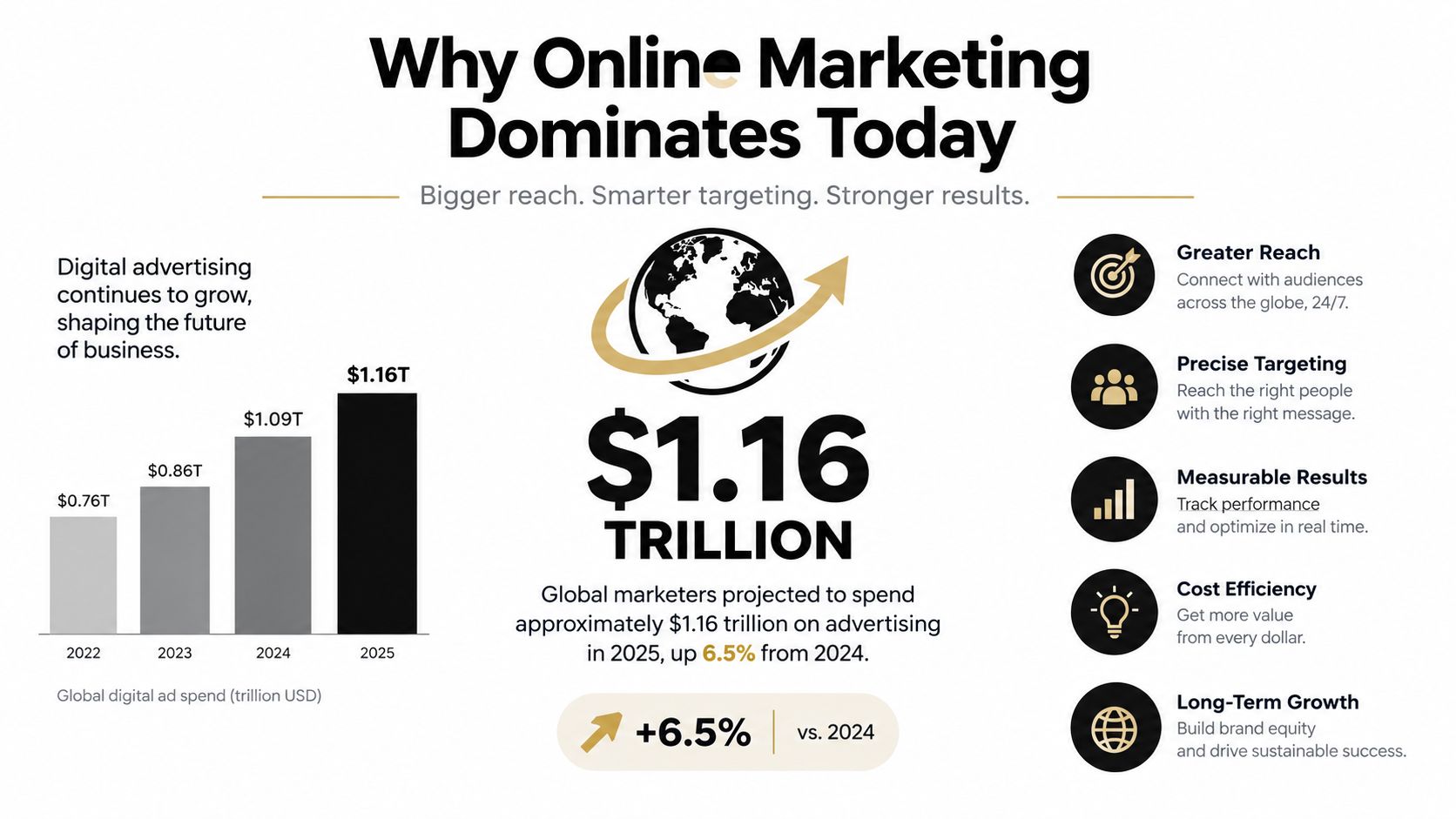
Digital channels were expected to account for 74.4% of total worldwide advertising expenditure in 2025, compared with 72.7% in 2024, based on the same report. This growth reflects a change in how organizations earn attention, build trust, and track what people do after seeing a message.
Traditional mass media usually sends one message to a broad audience. Digital environments let marketers tailor communication by interest, behavior, location, device, or search intent. Someone actively searching for leadership support is in a different decision state from someone who encounters a founder's story while browsing social media. A credible strategy assigns those situations different jobs.
Search advertising alone was projected to reach $352 billion in 2025, while social-media advertising was expected to represent 32.1% of all digital advertising spending, according to the same report. These channels support different forms of attention.
Search meets an existing question. Social media creates familiarity before someone has a defined buying need. A website turns interest into understanding, while email continues the conversation after the initial visit. Publishing the same message everywhere wastes the strengths of each channel.
The useful shift is from one-way exposure to ongoing, measurable interaction. Marketers can observe responses, segment audiences, test creative, adjust budgets, and improve the path from exposure to action. Reach, impressions, and clicks remain visibility indicators. They matter only when they help produce owned results such as qualified inquiries, bookings, purchases, or permission to continue the relationship.
That distinction should shape the strategy. A large audience can create visibility without creating demand. A smaller, well-matched audience can produce stronger trust and clearer commercial outcomes.
Ignoring digital channels leaves search results, feeds, inboxes, and buyer conversations open to competing voices. Prospects will still form opinions. They will form them from whoever shows up consistently.
Build a focused system around a specific audience and a credible perspective instead of imitating every company with a large content operation. Your advantage may come from lived experience, a clear point of view, useful education, or a direct explanation of a problem buyers struggle to solve. Use each channel to earn the kind of attention it handles best, then judge performance by the action that attention creates.
A strategy needs six connected components. Think of them as a hierarchy, not a shopping list. Audience definition comes first because every later decision depends on whom you're trying to help.
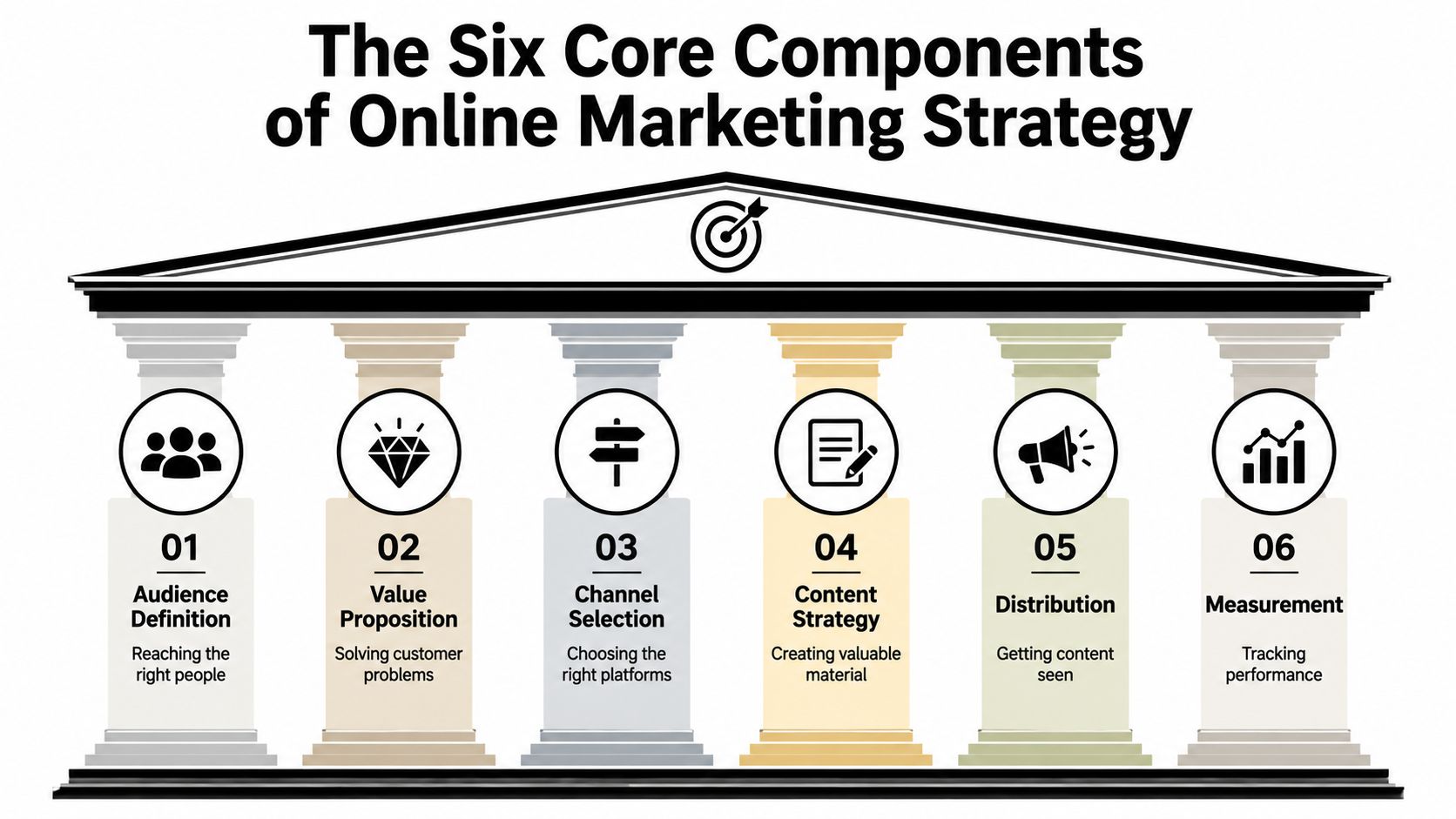
Audience definition identifies the people, problems, context, and decision triggers that matter. Don't define an audience only by job title. Define what has changed in their situation and what they're trying to accomplish.
Value proposition states the useful outcome you help create and the reason your perspective deserves attention. For a personal brand, this isn't a slogan. It's the intersection of your experience, your audience's need, and the problem you can address credibly.
Channel selection matches the message to the environment. Search, LinkedIn, Instagram, YouTube, email, and paid advertising each support different behaviors. Choose channels you can sustain and where your audience can realistically encounter you.
Content strategy turns expertise into assets for different stages of the journey. Discovery content may explain a problem. Trust content may show how you think or what you've learned. Conversion content should make the next step clear.
Distribution determines how useful material reaches the right people. Distribution can include organic search, social publishing, newsletters, partnerships, direct outreach, and paid promotion. Creating a strong asset doesn't guarantee that anyone relevant will see it.
Measurement connects activity to outcomes. Track the signals that matter for the stage, from qualified organic sessions and profile visits to email signups, conversations, bookings, and sales.
For practical guidance on improving discoverability without a large budget, this low-cost SEO guide offers a useful starting point. Structured data can also provide standardized information about a page and may support richer search result features, but Google recommends validation and before-and-after comparisons rather than assuming markup will automatically produce traffic. Its structured data documentation explains the implementation and evaluation principles.
For a deeper look at how content supports authority over time, see this content marketing strategy blueprint. The important point is connection. Audience insight should shape the message, the message should shape the content, distribution should create access, and measurement should influence the next decision.
Confusing strategy with tactics is how founders end up working hard without building momentum.
A tactic is a discrete action. You publish a LinkedIn post, optimize a page, send a newsletter, record a YouTube video, or launch a Google Ads campaign. A campaign groups tactics around a defined, time-bound objective, such as promoting a new service or filling a workshop.
A strategy is the system that decides which campaigns and tactics deserve attention. It sets priorities, defines the audience, establishes the message, maps the customer journey, and determines how performance will be judged.
| Question | Tactic | Campaign | Strategy |
|---|---|---|---|
| Main concern | What action should we take? | What result should this coordinated effort produce? | Which system will create business value? |
| Time frame | Immediate or recurring | Defined period | Ongoing direction |
| Example | Publish a founder insight | Promote a new advisory offer | Build authority with a specific buyer group |
| Success signal | Post engagement or clicks | Qualified responses or bookings | Consistent movement from attention to revenue |
A founder who asks, “What should I post today?” is thinking tactically. A founder who asks, “What does my ideal client need to understand before they trust me with this problem?” is thinking strategically.
Tactics still matter. They produce feedback. A post may reveal a recurring question. A search page may attract visitors with a clear problem. An email reply may expose language your audience uses to describe a buying concern.
Use that feedback to refine the system, not to chase every spike in engagement. A tactic deserves continued investment when it supports the chosen audience, reinforces your position, and advances a meaningful conversion path.
A campaign can create short-term focus, but it shouldn't become your entire marketing system. If you only communicate during launches, prospects have little opportunity to learn how you think before a buying moment arrives.
Keep evergreen authority content, relationship-building communication, and conversion assets running alongside campaigns. That combination gives your business a durable presence instead of forcing every piece of content to sell immediately.
Build the strategy around your business, not around whatever a competitor published yesterday. A personal brand needs a system that reflects its expertise, capacity, voice, and commercial priorities.
Write one primary business outcome for the next planning cycle. It might be more qualified consultation requests, stronger demand for a particular service, or a reliable flow of subscribers interested in your expertise.
Then describe the audience narrowly. Identify the role, situation, problem, desired result, and objections. “Founders who need marketing” is too broad to guide content. “Service-business founders who have referrals but lack a repeatable way to demonstrate expertise online” gives you a usable starting point.
Your messaging framework should answer three questions:
That framework becomes the filter for every topic. If an idea doesn't reinforce your relevance to the chosen audience, discard it.
Choose the channel where discovery happens, the destination where understanding develops, and the owned environment where the relationship continues. For one founder, that might mean search-led articles, LinkedIn distribution, and an email list. For another, video may be the primary discovery format.
Avoid spreading yourself across every platform before you can maintain a coherent message. A smaller system that you can operate consistently beats a broad presence that produces thin, disconnected activity.
Create content for three jobs:
Your organic search traffic playbook for founders can support the discovery side, but search visibility isn't the whole strategy. Each asset needs a destination and a measurable action.
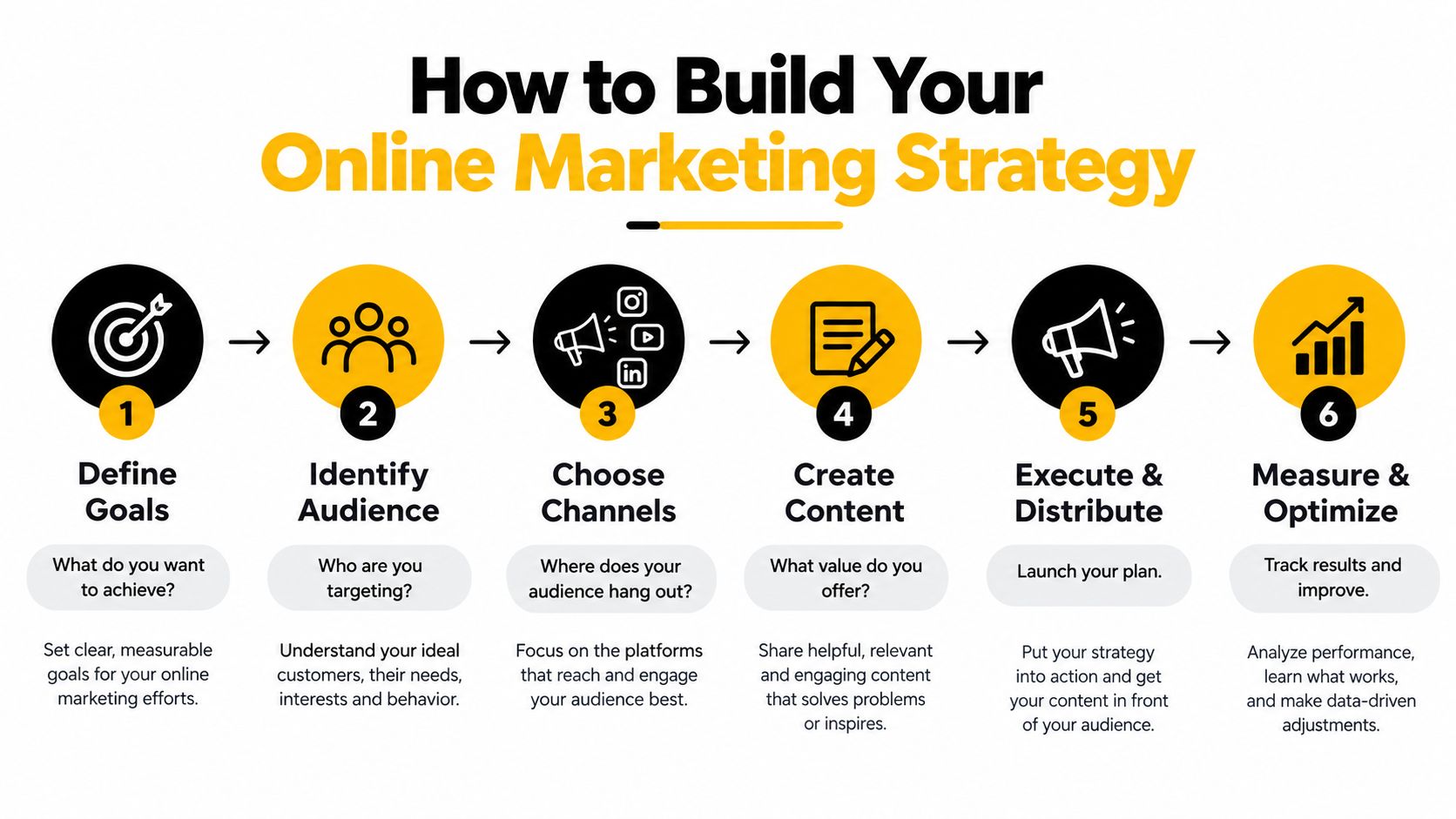
A workable operating rhythm includes regular review. Look for content that attracts the right people, prompts meaningful replies, generates subscribers, or contributes to qualified conversations. Keep, improve, or retire assets based on evidence rather than habit.
This video offers another perspective on turning expertise into a more deliberate content system:
More content isn't automatically better. More channels can make performance worse when they dilute your position, divide your attention, and create activity you can't connect to a business result.
Likes and impressions have a legitimate use. They can indicate whether a message is being seen or whether a format is earning attention. But they're visibility indicators, not proof that your marketing is producing commercial value.
Separate the scorecard into two groups:
Visibility helps you understand whether your ideas are entering the market. Owned results show whether people are taking actions your business can continue to reach, nurture, and evaluate. You need both, but you shouldn't confuse them.
Choose one important action for each stage of the journey. An educational article might aim for a relevant email signup. A trust-building profile might aim for a qualified conversation. A service page might aim for a consultation booking.
Use consistent campaign parameters for source, medium, campaign, and content theme. Without naming discipline, your reports become a collection of partial clues. You won't know whether a result came from a search page, a social post, a referral, or a later branded interaction.
Google Analytics defines attribution as assigning credit for an important user action to the ads, clicks, and other factors involved in the customer journey. Its cross-channel attribution guidance describes how reporting can connect paid advertising, organic activity, brand campaigns, and website or app behavior.
A final conversion often receives the visible credit, even though earlier content created familiarity or answered the buyer's first question. Compare first-touch, last-touch, and data-driven views where available, then use the differences to form hypotheses.
Don't claim that a channel caused demand because it appeared before a sale. Test the assumption by changing one meaningful condition while keeping other factors stable. Your marketing ROI guide can help you connect measurement to better decisions rather than vanity reporting.
Execution is where many good strategies fail. The founder has clear positioning, useful ideas, and a defined audience, but content production keeps getting postponed by sales calls, client work, and operational demands.
Ongoing content services can solve the execution problem when they operate from a real strategic brief. They can support content creation, publishing, profile optimization, audience interaction, newsletters, distribution, and conversion workflows. They shouldn't replace the strategic decisions that make the content worth producing.
An outside partner can't manufacture your authority. You need to provide the experiences, opinions, lessons, customer language, and boundaries that make the work sound like you.
A useful onboarding process should clarify:
The partner then turns those inputs into a repeatable system. That might include a content calendar, drafted posts, long-form articles, newsletters, videos, distribution across selected platforms, audience engagement, and reporting against agreed outcomes.

Avoid providers that promise volume without asking about your audience, offer, point of view, and conversion path. A large publishing schedule can increase noise if the underlying message is weak.
Look for operational clarity instead. You should know who develops the ideas, how your expertise enters the work, where content will be distributed, how feedback is handled, and which indicators will be reviewed. The right service makes your strategy easier to execute while keeping your voice and judgment at the center.
Legacy Builder offers content strategy and execution for authentic personal brands, including content creation, publishing, profile optimization, strategic distribution, newsletters, audience engagement, and lead-generation systems. If your strategy is sound but execution keeps slipping, visit Legacy Builder to discuss a practical content system built around your expertise.


You could – but most in-house teams struggle with the nuance of growing on specific platforms.
We partner with in-house teams all the time to help them grow on X, LI, and Email.
Consider us the special forces unit you call in to get the job done without anyone knowing (for a fraction of what you would pay).
Short answer – yes.
Long answer – yes because of our process.
We start with an in-depth interview that gives us the opportunity to learn more about you, your stories, and your vision.
We take that and craft your content then we ship it to you. You are then able to give us the final sign-off (and any adjustments to nail it 100%) before we schedule for posting.
No problem.
We have helped clients for years or for just a season.
All the content we create is yours and yours alone.
If you want to take it over or work on transitioning we will help ensure you are set up for success.
We want this to be a living breathing brand. We will give you best practices for posting and make sure you are set up to win – so post away.
Subscribe to our newsletter and get insights on how to grow your personal brand.
