.svg)
Subscribe to our newsletter and get insights on how to grow your personal brand.
Thank you! Your submission has been received!
Oops! Something went wrong while submitting the form.
.svg)


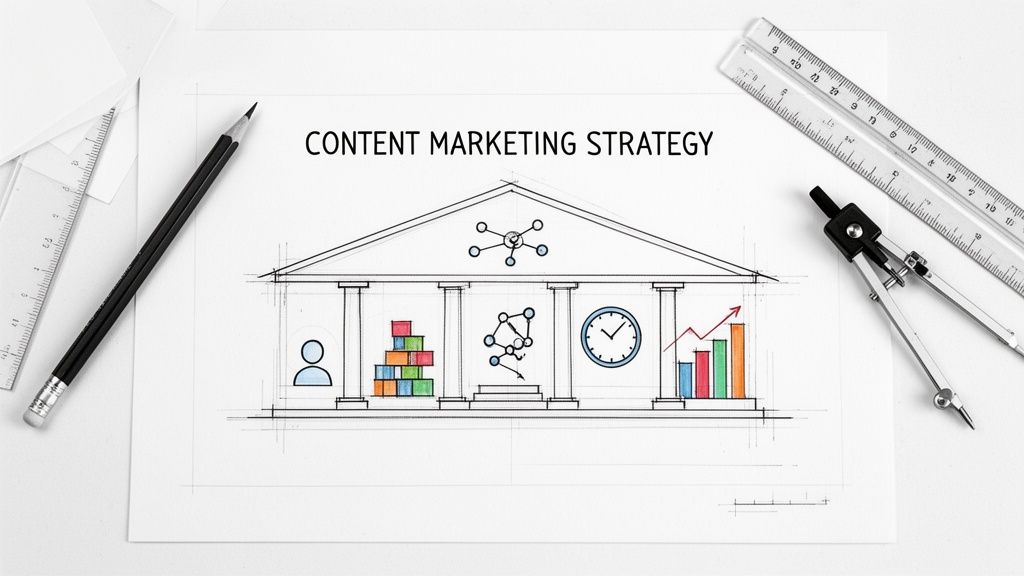
A content marketing strategy is your playbook.
It’s the documented plan for how you’ll use valuable, relevant content to pull in a specific audience and hit your business goals. Think of it as the essential blueprint that gives every single article, video, and social post a real purpose.
This plan is what separates random acts of content creation from a deliberate system for building authority and influence.
Imagine an architect trying to build a skyscraper without a blueprint. They could be the best in the world at laying bricks and pouring concrete, but the result would be a chaotic, unstable mess. It would go nowhere.
Creating content without a strategy is the digital version of that. You might be posting daily, but without a plan, your efforts are just noise. They lack the structure needed to build something that lasts.
So, what is a content marketing strategy in real terms? It’s your roadmap that clearly outlines:
This isn't just about what you post; it's about the "why" behind every single piece. Each element should act as a structural beam, guided by your blueprint to construct a powerful, recognizable personal brand.
For founders and professionals, this distinction is everything. Randomly sharing articles or thoughts might get you a few likes, but it rarely builds a legacy. A documented strategy forces consistency, focus, and alignment with your long-term goals.
It turns your online presence from a passive portfolio into an active engine for attracting clients, partnerships, and high-value opportunities. To really get a handle on the power behind this, it's essential to first grasp the principles outlined in What Is Content Marketing Strategy and How to Build One.
The difference between creating content and having a content strategy is night and day. One is busywork; the other is building an asset.
Let’s break it down.
See the difference? One is a short-term game of chasing engagement, while the other is a long-term play to build a real asset for your business.
The market data confirms this need for a plan. The global content marketing industry is projected to hit an incredible $107 billion by 2026. And while 82% of businesses are creating content, only 47% of B2B marketers have a documented strategy.
That gap is a massive opportunity for anyone willing to be deliberate.
A strategy doesn't just organize your content; it multiplies its impact. It ensures every word you write and every video you record contributes directly to the brand you are methodically building.
Without this strategic foundation, even the most brilliant content can fail to connect or convert. You're left with a collection of impressive pieces that don't add up to anything meaningful.
Building a powerful personal brand doesn't happen by accident. You can't just throw content at the wall and hope something sticks. It requires a solid foundation—a strategy.
Think of it like building a house. You wouldn't start hammering without a blueprint, right? Your content strategy is that blueprint. It relies on four essential pillars to stand firm and actually get you the results you're after. If you skip one, the whole thing gets wobbly.
These pillars give structure to every single thing you create. They're what turn "just posting online" into a deliberate system for building authority and driving business.
This visual breaks down how your big-picture strategy is held up by your goals, your audience, and the influence you want to build.
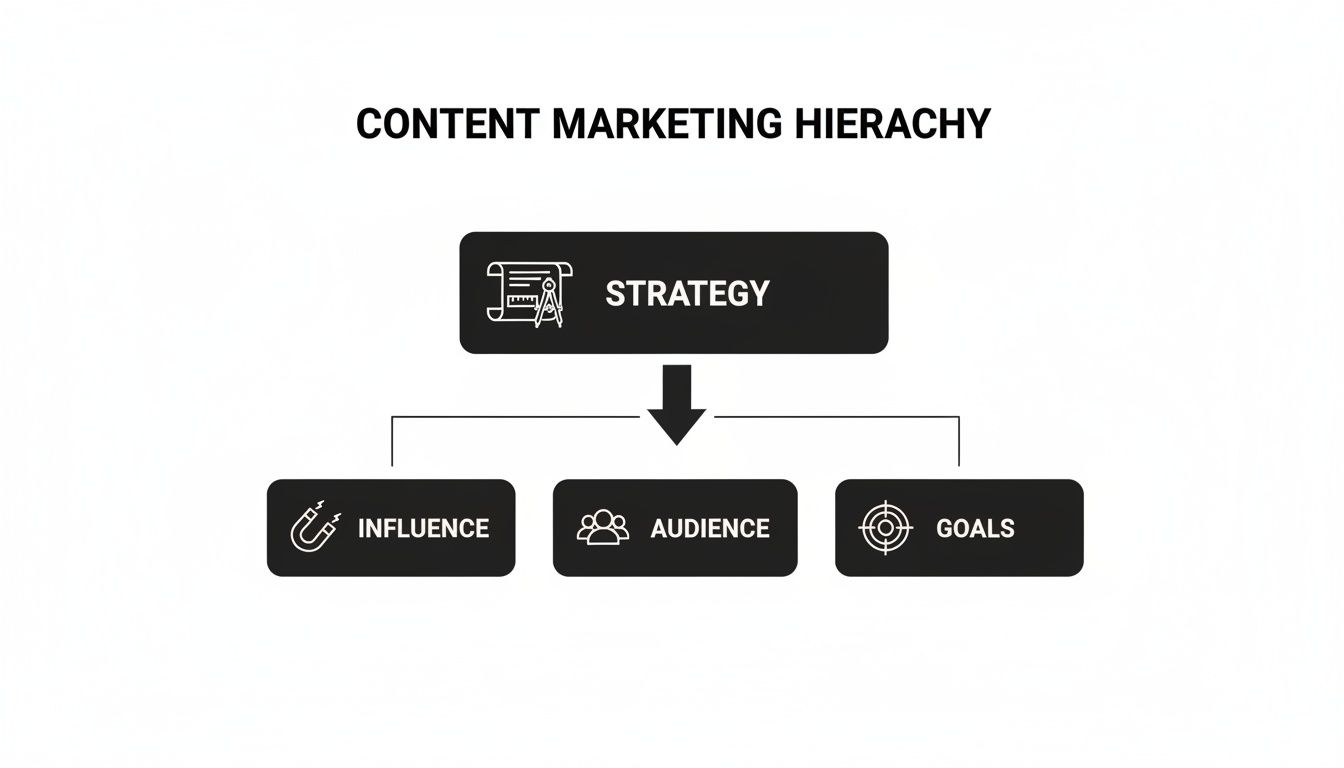
As you can see, everything flows from the top. Your tactical decisions about who you're talking to and what you want to achieve have to line up with your overarching strategy.
First things first: you have to know exactly who you’re talking to and what you’re trying to accomplish. Without this, your content is a shot in the dark. A real strategy demands precision.
Start by getting crystal clear on your ideal audience. Forget basic demographics. What are their job titles? What challenges keep them up at night? What are they trying to achieve in their careers?
Once you know your who, you need to define your why. What's the main goal of your content?
Your purpose shapes the tone, the format, and the call to action of every piece of content. It ensures you're not just sharing information, but actively moving your audience toward a specific outcome.
With your audience and purpose locked in, the next pillar is identifying your core content themes. These are the 3-5 key topics that will become the backbone of everything you publish.
Think of them as the signature subjects you want to own—the sweet spot where your expertise, your audience's needs, and your business goals all meet.
These themes aren't random. They're the intersection of what you know and what your audience needs to know. For instance, a CFO who advises tech startups might focus on themes like:
Sticking to these themes keeps your content focused and constantly reinforces your authority. It stops you from wandering into irrelevant topics that dilute your message. Every post, video, or article should tie back to one of these themes, building a cohesive library of work that screams "expert." This approach is also crucial for guide to maximizing your content's impact.
Your brilliant content is totally useless if the right people never see it. This brings us to the third pillar: strategic channel selection. The goal isn't to be on every platform. It's to be where your audience actually hangs out.
Trying to master every social media channel at once is a surefire recipe for burnout and mediocre results.
Instead, pick a primary channel where you'll focus most of your energy—this is your home base. Then, choose one or two secondary channels to support and amplify what you’re doing on your main platform.
Your primary channel is where you build community and go deep. Your secondary channels are for amplifying that message and reaching new people.
A B2B consultant might choose LinkedIn as their primary channel for publishing in-depth articles, then use X (formerly Twitter) as a secondary channel to share quick hits and drive traffic back to their LinkedIn profile. The trick is to pick platforms that match both your content style and your audience's habits.
The fourth and final pillar is what keeps everything honest: a measurement framework. A strategy without metrics is just wishful thinking. You have to define your Key Performance Indicators (KPIs) from day one to know if what you're doing is actually working.
But don't fall into the trap of chasing "vanity metrics" like follower counts or likes. You need to focus on data that signals real progress toward your goals.
Your measurement framework should track metrics that matter:
Look at these KPIs every month. This regular check-in lets you see what's working, what's not, and where you need to pivot. It’s a data-driven approach that ensures your strategy gets smarter over time.
Let’s be honest. For any founder or professional today, your personal brand is your single most valuable career asset. Hands down. And a content marketing strategy? That's the engine that actually makes it grow, turning you from just another expert in the crowd into a recognized authority in your field.
It’s the fundamental difference between occasionally posting and deliberately building something meaningful. Throwing random content out there is like shouting into the wind—sure, you're making noise, but the right people probably aren't hearing you. A real strategy is more like a finely tuned broadcast signal, beaming a clear, consistent message directly to your ideal audience.
This deliberate approach is what builds trust and credibility at scale. When you consistently show up with valuable insights on your core topics, you’re not just sharing information. You're proving your expertise, over and over again.
Look, anyone can have an online presence. A LinkedIn profile and a few posts a year? That’s a presence. But a presence doesn't automatically equal influence. Not even close.
Influence is something you earn when your audience starts seeing you as a reliable, go-to source for wisdom and guidance. A strategy makes this happen methodically, not by accident.
Think about two consultants in the same space. One posts whenever inspiration strikes—a great article one week, then radio silence for a month, followed by a random personal update. The other has a plan. They consistently publish a weekly LinkedIn post about a core theme, like "financial modeling for SaaS startups."
Which one builds a rock-solid reputation as the go-to expert? The second one, every single time. Their strategy ensures every piece of content reinforces their core message, building a powerful, cohesive brand that people remember.
A strong personal brand doesn’t just get you noticed; it gets you sought after. It’s the magnet that pulls high-value opportunities—clients, partnerships, speaking gigs—directly to you.
This is how you shift from just being a participant in your industry to being a leader. Your content plan is the roadmap that gets you there.
At the end of the day, a personal brand is really about connection. A documented strategy transforms your content into a powerful networking tool that works for you 24/7. It attracts the right people and starts the right conversations, even while you sleep.
It works by focusing your energy on the things that actually move the needle:
Your content stops being a task on your to-do list and becomes a genuine asset that builds its own momentum. Instead of you chasing opportunities, a well-executed strategy brings those opportunities right to your doorstep.
It's the most effective way to scale your reputation and impact. For a deeper dive, check out our guide on creating a thought leadership content strategy for personal brands. This is how you stop being just another practitioner and start becoming an industry pillar.
Theory is great, but seeing a content strategy actually work is where the real lessons are. All the planning in the world doesn't mean a thing if it doesn’t translate into real-world authority and, ultimately, business growth.
So, let's move beyond the blueprint. We're going to break down how real founders are building serious influence with smart, focused content. These mini-stories show what a winning strategy looks like when the rubber meets the road.
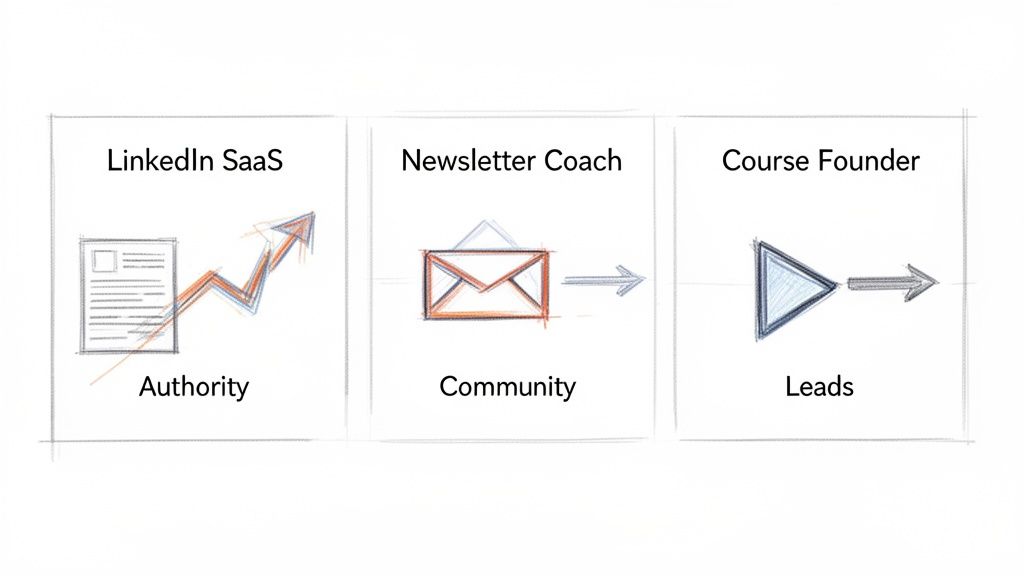
These examples prove that a solid plan isn't some "nice-to-have." It's the engine that drives measurable success.
Picture this: a B2B SaaS founder is launching a new tool for enterprise finance teams. The market is packed, and her budget is next to nothing. Instead of trying to be everywhere at once, she went all-in on a laser-focused strategy to become the only person to talk to about one specific thing.
Her game plan was simple but deadly effective:
She stuck to it, posting four times a week without ever straying from her core theme. This wasn't fluffy, generic advice. She was in the trenches, giving deep, tactical analysis of the exact problems her ideal clients were losing sleep over. She shared detailed breakdowns of financial models, untangled complex revenue recognition rules, and even gave away templates.
The results? They speak for themselves.
This wasn't luck. It was the direct result of a strategy that chose depth over breadth and value over volume. She didn't talk about everything; she talked about one thing better than anyone else.
A winning content strategy often comes down to becoming the undisputed expert on a narrow topic. You build real authority by solving a specific problem for a specific audience—something generic content can never do.
That razor-sharp focus turned her LinkedIn profile into a lead generation machine. It's proof that a targeted content strategy is one of the most powerful tools a bootstrapped founder has.
Now, let's look at a business coach for creative freelancers. Her goal wasn't just to get leads; she wanted to build a loyal community that would be the bedrock of her business for years. She knew her audience felt alone and overwhelmed, so her entire strategy was built on connection and trust.
Her strategic pillars were crystal clear:
She used channels like Instagram, but not as her main stage. They were simply on-ramps to get people onto her newsletter. This is a critical move. While everyone else was chasing likes, she was busy building an asset she actually owned: her email list.
Every week, her newsletter delivered insane value. It was never just a sales pitch. She shared raw, personal stories of her own struggles as a freelancer, handed out templates for client proposals, and gave practical advice on pricing and project management.
This consistent, high-value approach created an incredible sense of community.
Both of these examples show that a real discussion of what is content marketing strategy goes way beyond SEO tricks or social media hacks. It's about knowing your audience so deeply that you can create content that builds trust, solves problems, and drives the exact business outcomes you're gunning for.
Alright, we’ve covered the "what" and the "why" of a content strategy. Now it's time to roll up our sleeves and get to work. Let's move from theory to action and build your blueprint—a simple, step-by-step plan you can put into play today to start building real authority.
This isn’t about creating some massive, 50-page document that collects dust. It's about making a few smart decisions that will guide every single thing you post, making sure it all has a purpose.

Stick with me, and by the end of this, you’ll have a clear plan ready to go.
Before you write a single word, you need a North Star. Your Legacy Statement is just that—a simple, one-sentence declaration that anchors everything you do. Think of it as the mission statement for your personal brand.
It forces you to answer three critical questions:
The formula is simple: "I help [Your Audience] achieve [The Outcome] by [Your Unique Expertise]."
Let’s say you’re a marketing consultant. Your statement might be: "I help B2B SaaS founders achieve predictable revenue growth by implementing a scalable demand generation engine." Bam. Suddenly, every piece of content has a filter. Does it help SaaS founders? Does it relate to demand gen? If not, you don't post it.
With your Legacy Statement locked in, the next move is to break your expertise down into 3-5 core content pillars. These are the big themes you'll talk about over and over again. They're the main chapters in the book of your expertise.
Your pillars should flow directly from your Legacy Statement. For our marketing consultant, those pillars might look like this:
Sticking to these pillars is what keeps your content focused. It stops you from chasing shiny objects and getting distracted by random trends. Your audience quickly learns what you're about and why you're the one they should be listening to.
Look, you can't be everywhere at once. Trying to is the fastest way to burn out. The founders and execs who win at this game focus their energy. You need to pick one primary channel and one secondary channel. That’s it.
The key here is to go where your audience already is. A consultant trying to reach enterprise CEOs isn't going to find them on TikTok. Be strategic. This is a business decision, not a random guess.
Consistency is the name of the game. One brilliant post a month doesn't move the needle. A couple of solid posts every week? That builds momentum. You need to lock in a content cadence—a realistic posting schedule you can actually stick with for the long haul.
For a busy founder, a great place to start is two posts per week on your primary channel. It's manageable, but it’s frequent enough to stay top-of-mind. The goal is to build a habit, not create a chore you dread. To keep it all straight, you need a system. If you want to go deeper on this, our guide on how to create a content calendar that actually works is a game-changer.
A sustainable cadence is more powerful than short bursts of high-intensity effort. It’s the compounding effect of showing up consistently that builds true authority.
To help you get started, here’s a simple template for a weekly posting rhythm.
Use this simple schedule as a starting point. The goal isn't to be rigid, but to build the muscle of showing up consistently with valuable content that aligns with your pillars.
After a few weeks, this becomes second nature, and you can start experimenting with different formats and days. But first, just get the reps in.
So, how do you know if any of this is actually working? You need a simple way to measure what matters. Forget vanity metrics like follower count—they don't pay the bills.
Instead, focus on these three key performance indicators (KPIs):
Check these metrics once a month. This quick check-in will tell you everything you need to know about what’s working so you can double down on it. This blueprint gives you the road map. To get even more granular, this guide on how to create a content strategy is a fantastic resource for diving deeper.
Even with the best plan in the world, you're going to have questions. You're going to hit roadblocks. It's just part of the process of building something meaningful.
Let's tackle the most common questions I hear from founders head-on. No fluff, just direct answers to give you the clarity you need to push forward.
This is the number one question for a reason. But the answer isn't about finding more hours in the day or having more willpower. It's about building a system.
Consistency comes from making your content process ruthlessly efficient, not from trying harder.
First, stop trying to be everywhere at once. Don't try to conquer five platforms out of the gate. Pick one primary channel and own it. Commit to something manageable, like posting two times a week.
Here’s a simple system that works:
This system turns content from a daily chore you dread into a repeatable habit. And once you build that momentum, everything else gets easier.
It's easy to get these mixed up, but they play two totally different roles. Let's go back to our architect analogy.
Your content strategy is the architect's blueprint. It's the high-level vision. It defines the 'why' (your goals), the 'who' (your audience), and the 'what' (your content pillars). The content calendar is the construction schedule—the down-and-dirty tactical plan that says exactly when each post goes live and on which platform.
Basically, your strategy is the thinking behind the work. Your calendar is the tool you use to execute that work day in and day out.
A good content calendar is always a direct result of a solid strategy. You can't have one without the other.
Let's be real: content marketing is a long game. You're planting a tree, not flipping a switch. You're building an asset that compounds in value over time, not looking for a quick hack.
You’ll start seeing early signs of life—like more engagement and profile views—within the first 1-3 months of consistent posting. Those are great signals that you're on the right track and your message is starting to hit.
But the real-deal results—the steady stream of inbound leads, the speaking invites, the partnership opportunities—those typically start showing up after 6-12 months of putting in the work.
The key is sticking with it. The magic is in the compounding effect of showing up with value, day after day.
You can't improve what you don't measure. A real strategy has Key Performance Indicators (KPIs) baked in from day one. This is how you stop guessing and start making data-driven decisions.
For founders building a personal brand, you have to ignore vanity metrics like follower count. They don't pay the bills. Instead, focus on the numbers that signal real business impact.
Here’s what you should be tracking every single month:
Looking at this data gives you a direct feedback loop from the market. It tells you what's working so you can double down on it, and what's not so you can cut it loose.
Ready to stop guessing and start building a personal brand that attracts real opportunities? At Legacy Builder, we turn your expertise into a powerful content engine. We handle the strategy, creation, and distribution so you can focus on what you do best. Book a call with us today and let's start building your legacy.


You could – but most in-house teams struggle with the nuance of growing on specific platforms.
We partner with in-house teams all the time to help them grow on X, LI, and Email.
Consider us the special forces unit you call in to get the job done without anyone knowing (for a fraction of what you would pay).
Short answer – yes.
Long answer – yes because of our process.
We start with an in-depth interview that gives us the opportunity to learn more about you, your stories, and your vision.
We take that and craft your content then we ship it to you. You are then able to give us the final sign-off (and any adjustments to nail it 100%) before we schedule for posting.
No problem.
We have helped clients for years or for just a season.
All the content we create is yours and yours alone.
If you want to take it over or work on transitioning we will help ensure you are set up for success.
We want this to be a living breathing brand. We will give you best practices for posting and make sure you are set up to win – so post away.
Subscribe to our newsletter and get insights on how to grow your personal brand.
