.svg)
Subscribe to our newsletter and get insights on how to grow your personal brand.
Thank you! Your submission has been received!
Oops! Something went wrong while submitting the form.
.svg)



You publish consistently, share thoughtful posts, and keep improving your website. Yet when you open your analytics, organic visits look almost unchanged. That experience is common for founders because search growth rarely follows the emotional rhythm of content creation. A post can take time to be indexed, earn visibility, attract references, and become associated with your name.
The bigger mistake is treating every search impression as if it should produce a click. In an AI-heavy results page, organic search traffic growth now includes more than sessions. It also includes branded demand, repeated visibility, citations in answer surfaces, and discovery that brings people back when they're ready to act.
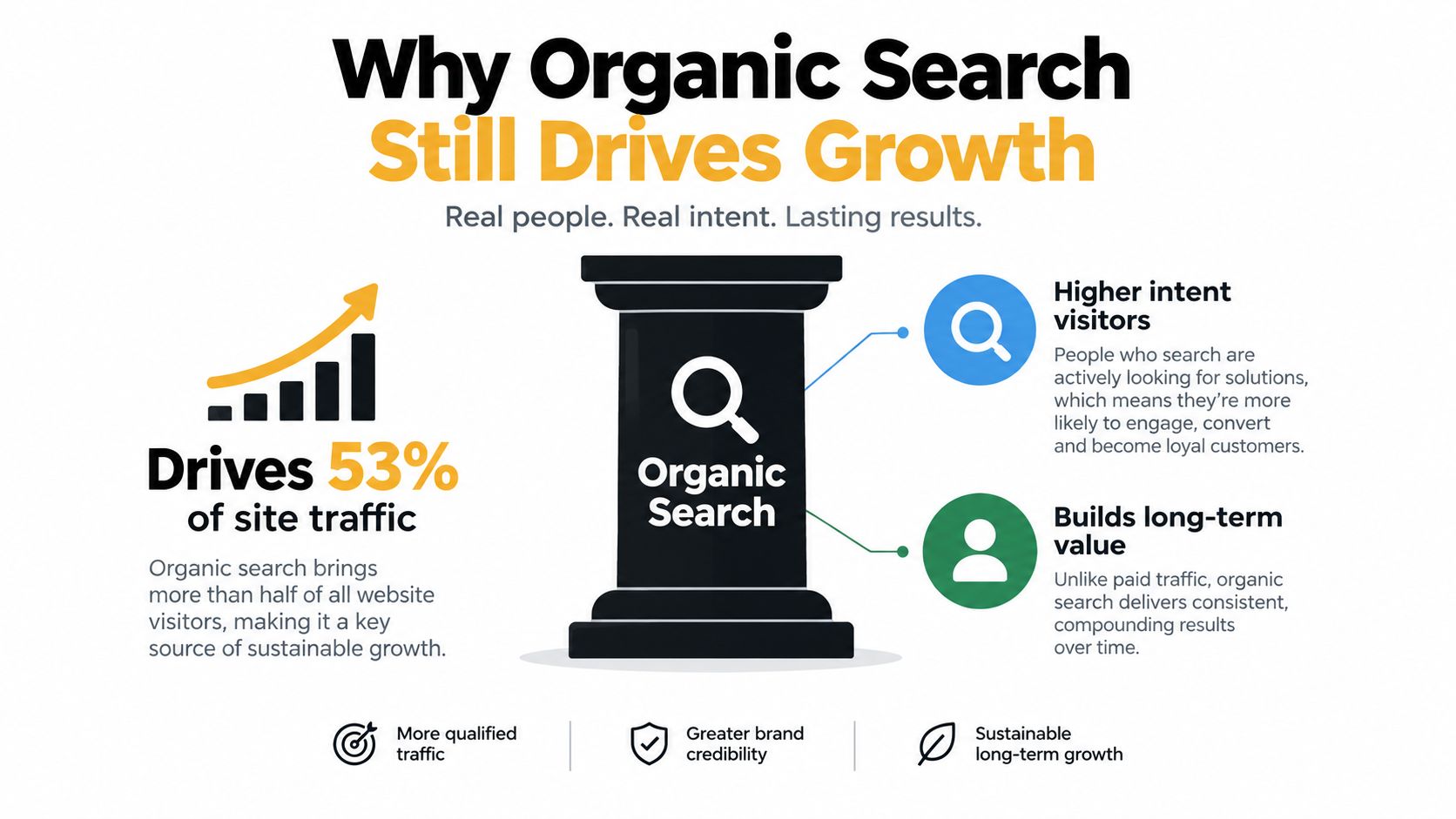
A founder can publish useful work for months while generic search clicks flatten. That does not mean search stopped creating demand. People still use it to solve problems, compare options, validate recommendations, and find a trusted voice. BrightEdge-based research found organic search represented 51% of trackable website traffic in 2014 and 53% in 2019, a two percentage-point increase that kept it as the leading discovery source across the domains studied, as summarized by BrightEdge-based organic traffic research.
The implication for personal brands is practical. Search does not need to win every informational click to remain valuable. It can create repeated exposure, branded searches, direct visits, and entry points through pages where the reader has a clearer reason to act.
A personal brand has an asset that a generic content site often lacks: a recognizable source of experience. Your operating principles, mistakes, decisions, frameworks, and point of view give a page a reason to exist beyond matching a keyword.
That lived experience changes how search content works. A founder writing about hiring, product strategy, or audience building can connect a broad question to choices made in practice. Readers may remember the perspective, search for the founder by name later, or enter the ecosystem through a high-intent page. Authority content can therefore compound even as some informational answers appear directly in search results.
Zero-click behavior makes the measurement harder. Independent 2026 coverage reported that 68.01% of U.S. Google searches ended without a click in the first four months of the year, compared with 60.45% in 2024, as described in analysis of the 2026 zero-click search findings. The same analysis cited a study in which AI Overviews were associated with organic click-through rates falling from 1.76% to 0.61%, a 61% drop, on affected informational queries.
That shift changes what a founder should monitor. Track non-branded clicks, then add name searches, returning visitors, direct traffic, branded conversions, and assisted conversions from authority pages. A page that answers the initial question without a click can still make the author the person a prospect remembers.
Practical rule: Don't judge a personal brand's search strategy only by non-branded clicks. Track whether more people search for your name, return directly, recognize your ideas, and enter your ecosystem through high-intent pages.
Search is mature, not irrelevant. Separate reporting found U.S. organic traffic down only 2.5% year over year in 2026, while recent organic search traffic reporting also discussed the scale and continuing reach of the channel.
The operating model stays focused: publish authority content, make it clear, distribute it where the audience already spends time, and connect related pages so one useful idea supports the next. Resources on content and community growth for founders show how search publishing can work alongside audience development rather than sit apart from it.
A founder publishes consistently, rankings begin to move, and total website traffic still looks flat because a product launch or social post changed the mix. The reverse also happens. Organic sessions rise while their share falls after another channel has an unusually strong month. A useful forecast starts by separating these effects.
Track absolute organic sessions first. Record the current monthly total in your analytics platform, then segment it by landing page, branded versus non-branded query, country, device, and conversion action. Keep the baseline definition stable. Changing tracking rules halfway through the year can make a genuine trend look like measurement noise.
A practical benchmark for growing companies is 5% to 15% month-over-month growth, while mature programs often settle into 5% to 10% monthly gains, according to the organic traffic growth benchmark guide. The same guide frames strong first-year performance at roughly 20% to 40% quarterly growth after the initial ramp-up.
Treat these ranges as planning references, not promises. A new site with a clear niche may have more room to grow than an established domain competing with strong publishers. Set targets around current authority, publishing capacity, technical condition, and the demand available in the market.
Use a planning sequence that connects search activity to business results:
The first one to three months often center on indexing and early rankings. The four to twelve-month period provides a better window for evaluating compounding, based on organic traffic benchmarks by industry. That delay changes the review cadence. Check impressions, indexed pages, ranking movement, and new referring domains weekly. Review sessions and conversions monthly and quarterly.
Search goals also need to reflect the zero-click, AI Overview era. Informational pages may earn fewer visits while still building recognition, branded searches, returning visitors, and later high-intent demand. Report those signals separately from click growth, especially for a personal brand whose authority content may influence a conversion without producing the first visit.
Industry benchmarks vary sharply. One benchmark set reported annual organic traffic growth of 41% for B2B SaaS, 38% for eCommerce, 67% for entertainment, 84% for addiction treatment, 92% for industrial IoT, 99% for construction, and 108% for biotech after one to two years of campaigns, as documented in the organic traffic benchmarks by industry.
Those figures are comparison points, not universal targets. Compare businesses with similar sales cycles, query sets, competitive pressure, and content resources. A founder selling a high-consideration service should not copy the traffic target of a high-volume publisher.
Forecasting error usually comes from expecting a straight line. Organic growth behaves more like a portfolio of assets, with some pages declining, some gaining, and new pages entering the compounding cycle.
Avoid three mistakes. Do not demand traffic increases immediately after publication. Do not measure share instead of absolute visitors. Do not publish more content until existing pages can be crawled, understood, internally linked, and improved.
Keyword research becomes useful when it explains why someone searched, not merely what phrase they typed. A founder-led site usually needs four distinct intent groups.
Informational queries ask for education or a process. They may support authority, but they're increasingly exposed to AI-generated answers and zero-click behavior. Branded queries include your name, company, framework, or signature idea. They often signal recognition and should lead to clear, credible destinations.
Discovery queries connect with timely interests, fresh perspectives, and formats that can spread through Google Discover or similar surfaces. High-intent queries indicate that someone is evaluating a service, solution, consultant, or next step. Those pages need evidence, positioning, and a direct path to action.
The content format should follow the intent:
| Search Intent | Best Content Format | Growth Play |
|---|---|---|
| Informational | Definitive guide, glossary, tutorial, or expert explanation | Answer directly, organize the page into extractable sections, and add first-hand insight |
| Branded | Founder profile, point-of-view page, framework, or interview | Strengthen recognition and connect related ideas through internal links |
| Discovery | Timely commentary, trend analysis, visual story, or newsletter-led article | Respond quickly to fresh interest and distribute through existing communities |
| High intent | Service page, comparison, process page, or decision guide | Address objections, show fit, and make the next action obvious |
Choose a central subject where your experience is credible, then create supporting pages that answer narrower questions. A founder focused on audience growth might build a central strategy page supported by articles about positioning, distribution, content operations, and measurement.
That structure creates a better editorial system than chasing unrelated keywords. Each page has a role, and internal links help readers move from education toward a relevant decision. A practical example is Legacy Builder's founder action plan for content strategy, which connects strategic thinking with the mechanics of publishing online.
Prioritize topics using three filters:
Use keyword placement naturally. Month17's guide to keyword placement is useful for checking titles, headings, introductory copy, internal anchors, and page elements without turning the writing into repetition.
Create new content when the intent is missing from your site. Update an existing page when it already has impressions, links, or a useful foundation. Repurpose when the central idea is strong but your audience needs to encounter it in another format.
A founder's content plan should therefore contain fewer disconnected posts and more connected arguments. Informational content can establish the problem. Branded content can make the viewpoint memorable. Discovery content can create fresh exposure. High-intent pages can convert the attention into a relationship.
Great ideas don't produce organic visibility if search engines can't reliably access, interpret, or prioritize the pages. Personal brand sites often lose opportunities through simple issues: an important article sits several clicks from the homepage, author pages contain almost no useful information, or multiple URLs repeat the same insight with minor changes.
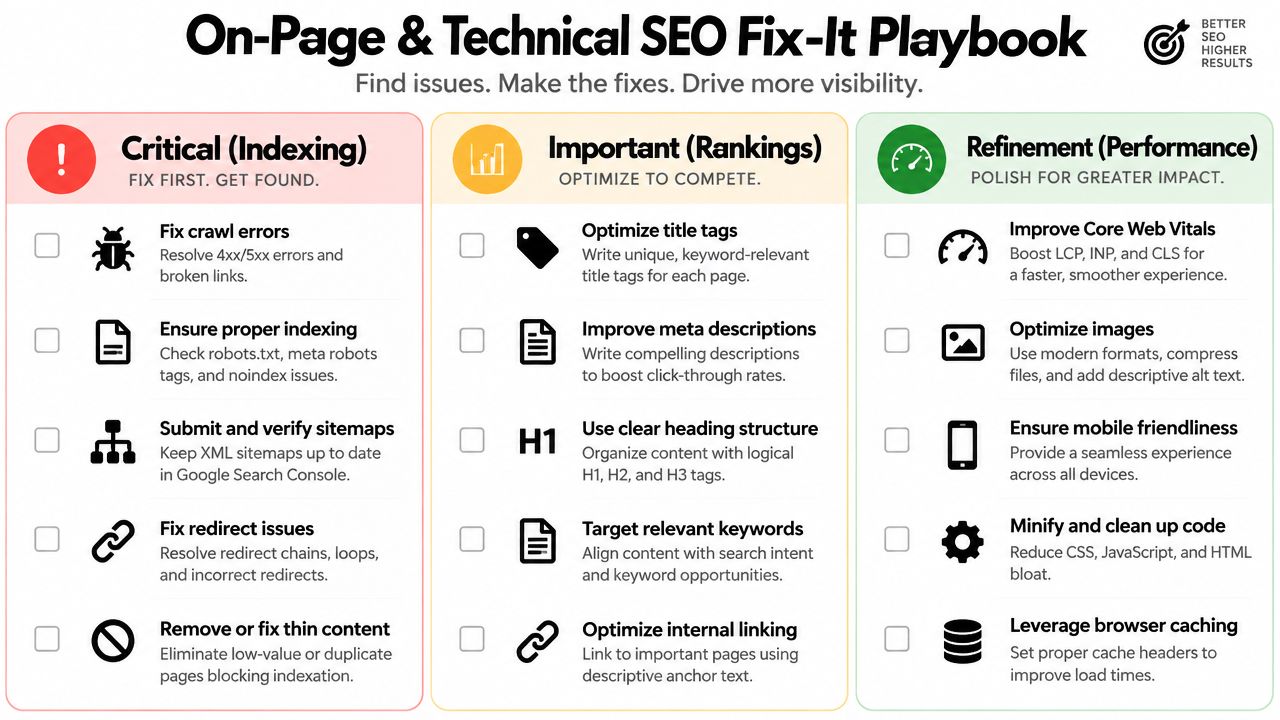
Start with crawlability and indexability. Review the XML sitemap, robots directives, canonical signals, redirect chains, broken internal links, and status codes in Google Search Console or a crawler such as Screaming Frog. If a valuable page isn't indexed, rewriting its introduction won't solve the primary problem.
Next, improve page clarity:
Avoid thin author bios that say little beyond a job title. A personal brand site should make the author's perspective visible across the profile, article, and supporting pages. It should also avoid publishing several short pages that compete for the same intent.
Performance refinement comes after access and relevance. Check mobile layouts, image weight, script behavior, page stability, and Core Web Vitals. Structured data can help search engines interpret suitable page types, but it won't compensate for unclear or unhelpful content.
Priority order: Make the page accessible, make the subject unmistakable, make the experience usable, then improve presentation.
A content management system also affects how easily a team can manage redirects, metadata, templates, and internal links. This comparison of content management systems offers a useful reference when the publishing workflow itself is creating SEO friction.
The expected lag still matters. Technical cleanup can remove blockers quickly, but rankings and traffic may take time to reflect the changes because crawlers must revisit pages and search systems must reassess them.
Use the video below as a practical supplement while reviewing your site's technical foundation.
Publishing is not distribution. A strong article can sit unnoticed if nobody in your network, market, or community encounters it. For personal brands, promotion should build relationships and recognition, not just generate a list of prospects for generic outreach.

Cold outreach fatigue usually begins with an interchangeable asset. If the article could have been written by any company in the category, a request for a link gives the recipient little reason to care. A founder's advantage is specificity. Operating stories, original frameworks, strong opinions, and clear explanations give other people something worth referencing.
Start with the people already adjacent to the topic. Mention a relevant practitioner in a thoughtful post, invite a specialist to discuss a narrow question, or turn a podcast conversation into a useful written resource. The objective isn't to manufacture praise. It's to create a legitimate reason for another person to share, cite, or contribute.
A sustainable weekly rhythm might include:
Dream 100 engagement works when it stays human. Select a manageable group of important peers, customers, creators, and publishers. Read their work, respond with substance, and look for collaboration opportunities that make sense without forcing a backlink.
Podcast appearances can also produce more than a temporary referral. Extract a focused article from the conversation, link to related pages, share the episode with your audience, and give the host a reason to reference the written version. Over time, these connected assets can support both links and branded searches.
Avoid buying links, sending mass requests, or treating every mention as a transaction. A link from an irrelevant page may do little for authority, while a relationship with a respected publisher can lead to repeated exposure across articles, interviews, and community discussions.
A useful link-building question is not “Who can I persuade to link to this?” It's “Who would naturally need this resource to make their own work clearer?”
Promotion also supports search indirectly. People who repeatedly encounter a founder's ideas are more likely to remember the name, search for it, and return through a branded result. That demand is harder for a generic competitor to copy because it comes from accumulated familiarity.
Measurement should tell you what to do next. A dashboard full of rankings and sessions is not useful if it can't distinguish a ranking loss from a click decline caused by an answer feature.
Start with a simple loop: publish, distribute, measure, refine. Give each stage a clear owner and a defined review point. The purpose isn't to restart your strategy every time a page underperforms. It's to identify which part of the system needs adjustment.
Review these signals on different schedules:
Segment performance before making a decision. If informational clicks decline while branded searches and discovery exposure expand, rewriting every article may destroy assets that are still building authority. If impressions and rankings fall together, investigate relevance, competition, technical access, and content freshness. If impressions remain stable but clicks decline, inspect the results page for AI Overviews, featured answers, or other elements that may satisfy the query without a visit.
Search Engine Land summarized a 2026 Define Media Group analysis reporting search clicks down 42% since AI Overviews expanded in one portfolio, while also noting opportunities in breaking news and Google Discover, as discussed in coverage of AI Overviews and search click changes. The practical lesson is that content performance is becoming more query-specific. Informational pages may face different pressure from branded, timely, or discovery-led content.
Rewrite a page when the intent is still valuable and the content no longer satisfies it. Strengthen a page when it earns impressions but lacks depth, proof, or a clear next step. Consolidate pages when several URLs address the same question. Create discovery content when fresh interest offers a credible way to reach people before they search for a solution.
Tie reporting to commercial reality with a clear model for qualified actions. Legacy Builder's guide to calculating marketing ROI can help connect traffic metrics with outcomes that matter to an operating business.
For the next ninety days, select a focused topic cluster, repair the technical blockers, publish a small set of useful pages, distribute each one through relevant relationships, and review performance by intent. The compounding effect comes from repeating that loop with better decisions, not from chasing every algorithm conversation.
Legacy Builder helps founders turn their stories, expertise, and operating insights into consistent content, strategic distribution, and stronger search visibility. If you want a personal brand system that connects authority content with audience engagement and organic demand, visit Legacy Builder to explore the process.


You could – but most in-house teams struggle with the nuance of growing on specific platforms.
We partner with in-house teams all the time to help them grow on X, LI, and Email.
Consider us the special forces unit you call in to get the job done without anyone knowing (for a fraction of what you would pay).
Short answer – yes.
Long answer – yes because of our process.
We start with an in-depth interview that gives us the opportunity to learn more about you, your stories, and your vision.
We take that and craft your content then we ship it to you. You are then able to give us the final sign-off (and any adjustments to nail it 100%) before we schedule for posting.
No problem.
We have helped clients for years or for just a season.
All the content we create is yours and yours alone.
If you want to take it over or work on transitioning we will help ensure you are set up for success.
We want this to be a living breathing brand. We will give you best practices for posting and make sure you are set up to win – so post away.
Subscribe to our newsletter and get insights on how to grow your personal brand.
