.svg)
Subscribe to our newsletter and get insights on how to grow your personal brand.
Thank you! Your submission has been received!
Oops! Something went wrong while submitting the form.
.svg)


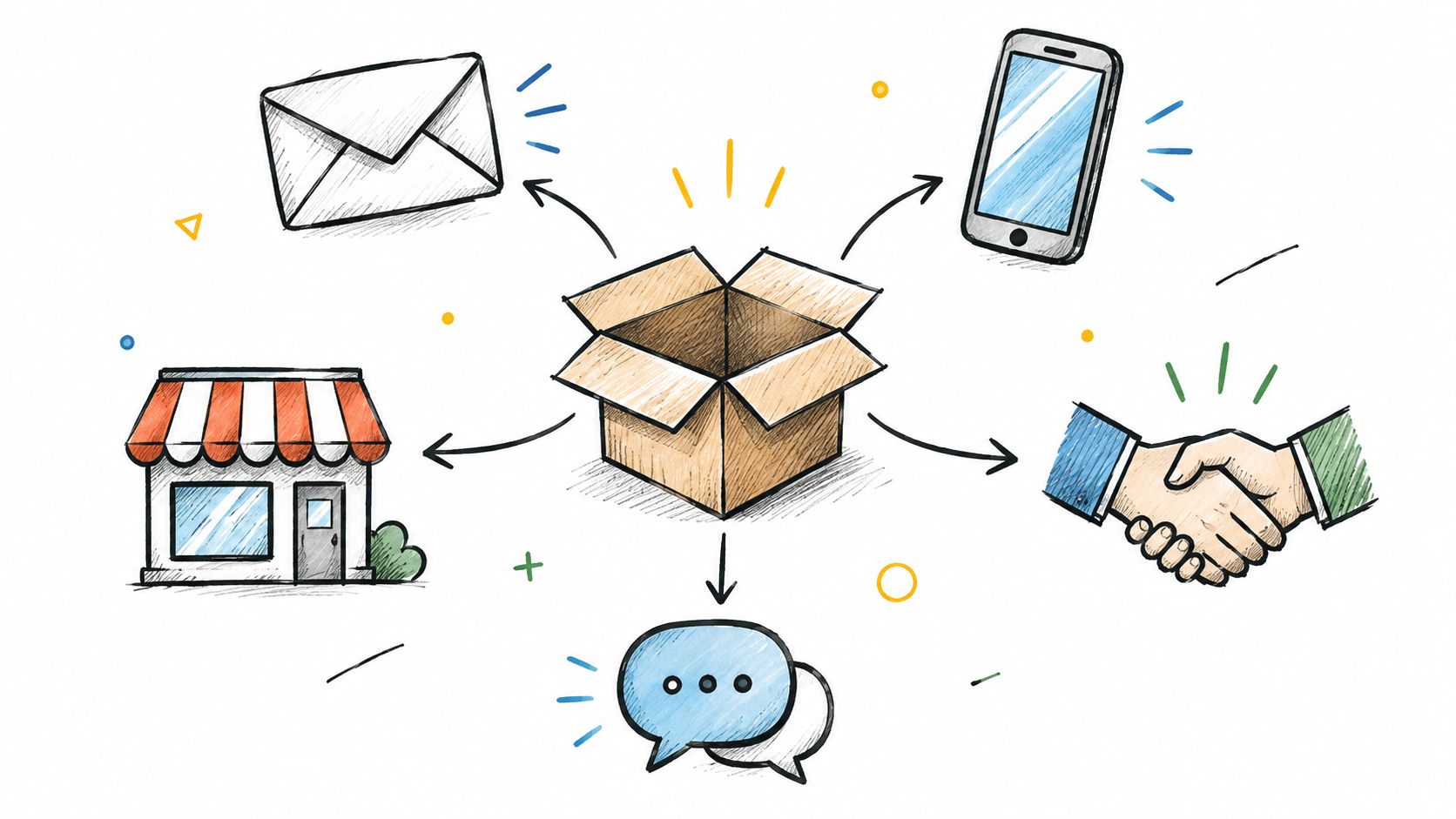
Most advice about distribution strategy starts with a channel list: publish on LinkedIn, send an email, appear in search, perhaps add video. That advice misses the decision that matters most. Are you building an audience you can reach again, or renting access to people a platform may stop showing you tomorrow?
A distribution strategy determines how an idea, product, or message reaches the people it's meant to serve. For a founder, it also determines who controls the relationship after that first interaction. A post can create discovery, but an email subscriber, direct conversation, or community member creates a more durable connection.
That distinction changes how you choose channels, repurpose content, measure performance, and protect a personal brand. It also gives you a practical way to build authority with content marketing without confusing visibility with ownership.
Many founders think they're choosing distribution channels. In practice, they often inherit a default from the first platform that gave them attention. A LinkedIn post becomes the strategy, or a newsletter becomes the entire system, even when the audience behaves differently across discovery, trust, and retention.
That's risky because third-party platforms control visibility. Their algorithms decide which followers see a post, while their policies determine what you can publish and how you can contact people. Research from UCL on Patreon earnings across major social platforms describes a strong “rich-get-richer” pattern, with attention and earnings concentrated among a smaller group of creators and algorithmic recommendations increasingly replacing user-filtered social graphs. The finding matters for founders because a growing following doesn't automatically mean growing access.
A useful distribution model gives each channel a job.
The same idea might appear as a LinkedIn post, lead to a practical article, and then invite a reader to join a newsletter. Each step moves the relationship from rented reach toward an audience you can contact again.
Practical rule: Every discovery channel should have a clear migration path to a retention channel.
This doesn't mean abandoning social platforms. It means refusing to let them become the only place your reputation exists. For a practical approach to audience growth and channel movement, see Legacy Builder's audience growth strategies.
Ask the sharper question before your next post: am I increasing reach I own, or reach I rent?
A distribution strategy is the deliberate plan for moving an offering from its creator to its intended customer through suitable routes, intermediaries, platforms, and processes. It covers more than publication or promotion. It determines access, operating cost, brand control, delivery speed, customer experience, and retained customer data.
Distribution works like a delivery system. Wholesalers, distributors, retailers, mail-order companies, and company-owned stores once carried products toward buyers. Digital commerce added marketplaces, direct-to-consumer websites, email, social platforms, and other online touchpoints. These options did not eliminate channel decisions. They gave businesses more routes to combine, with different levels of control and dependence.
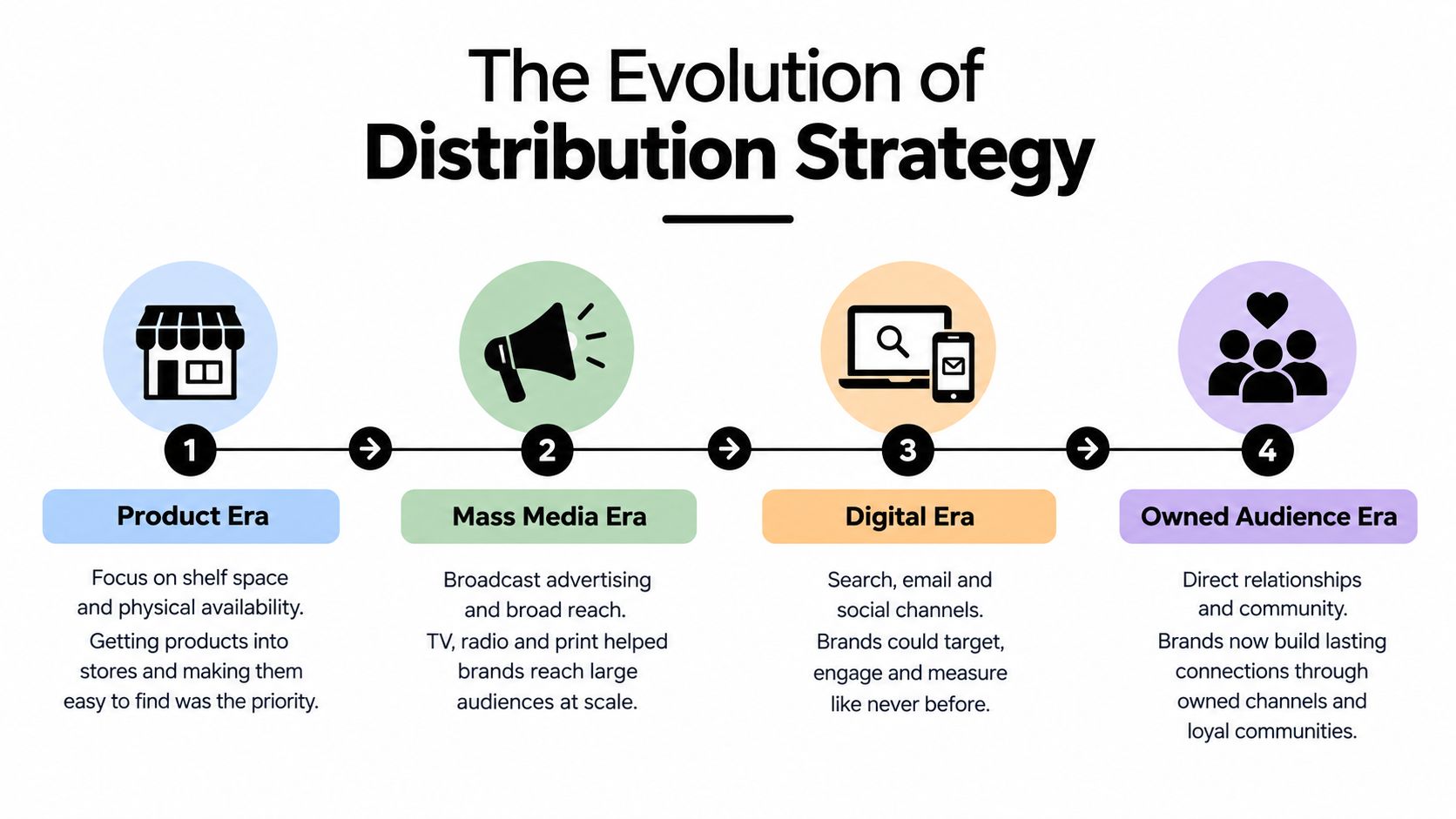
U.S. Census Bureau data show the scale of online retail's expansion. E-commerce sales grew from $5.0 billion in 1998 to $571.2 billion in 2019, then reached $815.4 billion in 2020, an increase of $244.2 billion, or 43%, in one year (U.S. Census Bureau data on e-commerce's pandemic-era growth).
The share of seasonally adjusted e-commerce also rose from 0.6% of total U.S. retail sales in the fourth quarter of 1999 to 16.1% in the second quarter of 2020, according to the same Census data. Physical retail remained relevant as stores reopened. The practical lesson is to coordinate routes around customer behavior and economics, rather than assume one channel will replace another.
Content follows the same pattern. A website and email list provide greater control and durable access. Social platforms and professional networks can create discovery and conversation, while also leaving reach subject to platform rules. A sound strategy connects these roles without treating any route as universally superior. For wider context, explore the history of content marketing from print to AI.
Channel categories become easier to understand when you ask what each route gives you and what it takes away.
Owned channels include your website, blog, email list, podcast feed, and private community. You control the publishing environment, messaging, and audience records more directly. You still need to earn attention, maintain quality, and manage consent, but a platform change won't define the entire relationship.
Discovery platforms include LinkedIn, YouTube, Facebook, and other social networks. They can place your ideas in front of people outside your existing audience. The trade-off is dependency. Visibility, distribution rules, and access to followers remain controlled by someone else.
Marketplaces and indirect routes put products in front of established customer groups. They can provide reach, fulfillment, merchandising, or credibility that would be costly to build alone. They also introduce margin sharing, coordination requirements, and dependence on partner performance.
Partner and community channels include referrals, guest appearances, industry groups, and organic mentions. These routes can transfer trust from an existing relationship, but they require useful participation and careful audience fit. A promotional message rarely works as well as a contribution that solves a real problem.
Content distribution and product distribution use the same underlying principle: match the route to customer behavior and channel economics. A physical product may need a retailer for access and fulfillment. An expert article may need LinkedIn for discovery, a website for depth, and email for continued contact. Resources on how to boost content reach and results can help teams think through those combinations.
| Criterion | Direct Channel | Indirect Channel |
|---|---|---|
| Customer relationship | Greater control over the relationship | Shared with an intermediary or platform |
| Audience data | More first-party data retained | Data access may be limited |
| Reach | Requires internal acquisition and delivery | Partner can extend reach or coverage |
| Economics | More operational responsibility, potentially stronger control over margins | Margin sharing and partner costs |
| Brand experience | Designed by your business | Influenced by the partner's environment |
| Flexibility | Changes can be made directly | Changes require coordination |
A balanced mix usually assigns different jobs to different routes. Your website can hold the complete argument, a LinkedIn post can create discovery, a partner can lend credibility, and an email sequence can support the next decision. For a practical implementation model, see Legacy Builder's multi-platform content distribution guide.
“Be everywhere” sounds ambitious, but it usually creates shallow execution. A founder with limited time needs a way to compare channels by fit and business value, not by the size of a platform's user base.
Start with a simple matrix. List the channels you use now and the channels you're considering. Score each one on a consistent scale, such as low, medium, or high, for five criteria:
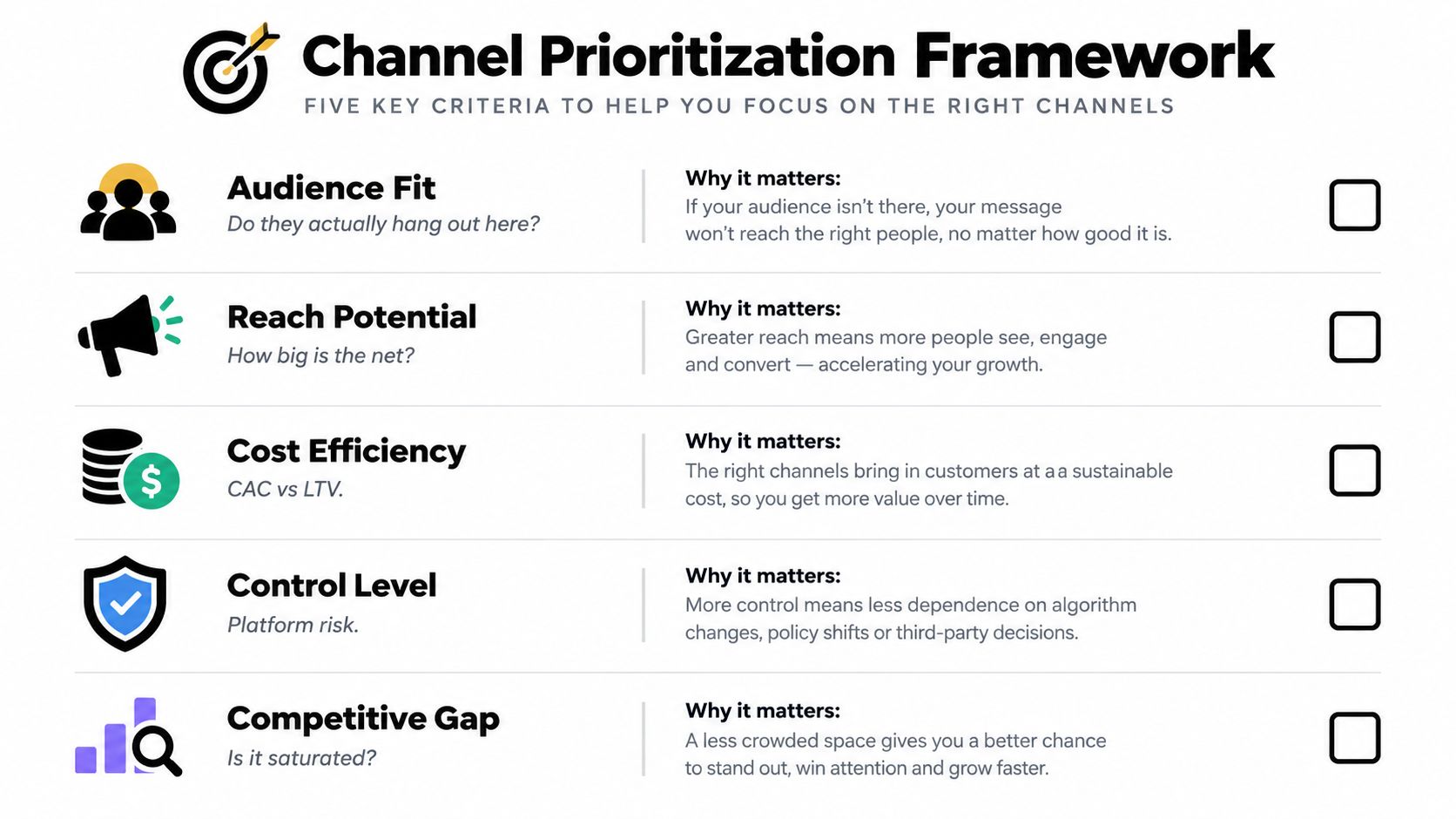
Not every criterion deserves equal importance. A founder who needs immediate discovery may give reach and audience fit more weight. A founder with an established following may prioritize control and retention. Write down the weights before reviewing results so the loudest recent post doesn't determine the strategy.
Then rate each channel against those weights. A smaller professional network may beat a larger entertainment platform if the first produces better conversations with the people you serve. A newsletter may score lower for discovery but higher for control and retention. The purpose isn't mathematical precision. It's disciplined comparison.
The highest-reach channel is rarely the highest-value channel by default.
Review the matrix alongside actual evidence from your work: qualified conversations, subscriber movement, responses, and conversions. Keep one or two discovery routes, at least one strong retention route, and a realistic production workflow. A channel that looks attractive but consumes all your time may weaken the entire system.
Consider two coaches with similar expertise. The first publishes consistently on one social platform and receives encouraging reactions. Her posts generate visibility, but she hasn't created a reliable path to an email list, private community, or direct conversation. If the platform reduces distribution, she has no dependable way to reconnect with most of the people who appeared interested.
The second founder treats social content as the opening of a journey. He publishes a short LinkedIn explanation for discovery, answers comments to build trust, and directs interested readers to a newsletter or a relevant conversation. His long-form article gives the idea a stable home, while email allows him to develop the subject without depending on a feed.
The first coach treats reach as the outcome. The second treats reach as an input.
| Founder habit | Discovery role | Retention role | Main weakness |
|---|---|---|---|
| Social-only posting | Strong if the platform recommends the content | Weak, because access remains platform-controlled | High dependency |
| Social plus newsletter | Social introduces the idea | Email develops the relationship | Requires a clear signup path |
| Social, website, and conversation | Social creates attention | Website and direct contact support trust | Needs coordinated execution |
For a personal brand, this structure prevents content from becoming a stream of disconnected posts. A single insight can become a social viewpoint, a detailed article, a newsletter lesson, and a conversation prompt. The founder doesn't need to create unrelated material for every channel. They need to give each version a distinct job.
Single-channel dependence appears first when the founder can't answer a simple question: how would I contact the people who engaged with me if this platform stopped distributing my posts? If the answer is unclear, retention needs attention.
Likes and impressions answer one question: did people see or react to something? They don't tell you whether the right people noticed, whether trust increased, or whether anyone took a commercially meaningful next step.
Measure distribution as a sequence. Discovery metrics show whether a channel creates visibility. Relationship metrics show whether people choose to continue. Business metrics show whether that continued attention supports qualified conversations, subscribers, referrals, or revenue.
A social post may be doing its job when it attracts thoughtful comments from relevant people, even if it doesn't produce immediate revenue. An email newsletter should be judged more heavily on continued readership, replies, clicks, and movement toward a defined next step. Your website may support both discovery and conversion, so its measurement needs to connect traffic with actions.
Track a small set of indicators:
Email requires its own operational discipline. Subject-line relevance, list quality, consent, segmentation, and timing all affect the relationship. For practical guidance on improving newsletter performance, review these email marketing tips.
HubSpot's 2025 survey of more than 400 professionals found that 52% of creators used LinkedIn, 50% used Facebook, and 42% used traditional email to distribute newsletter content (HubSpot's 2025 newsletter survey). Those figures describe usage, not effectiveness. Your scorecard still needs to show which channel creates the strongest relationship and business outcome for your audience.
More channels don't automatically create more reach. They create more production demands. If every version is rushed, your message becomes inconsistent and your audience receives repeated links rather than useful, platform-appropriate ideas. Choose fewer routes and execute their jobs clearly.
A follower count isn't an ownership metric. A large following can remain inaccessible if an algorithm limits visibility or a platform changes its rules. Pair rented discovery with a permission-based retention channel and make the transition easy.
Distribution isn't a posting schedule. A calendar tells you when something appears. A strategy explains who should see it, why that channel fits, what action follows, and how you'll evaluate the result.
UCL research on Patreon earnings across major platforms points to a concentrated rich-get-richer dynamic, where recommendation systems can disadvantage creators in the middle. That makes platform diversification sensible, but diversification doesn't mean copying every post everywhere. It means protecting the relationship while using discovery platforms deliberately.
AI can support drafting, segmentation, scheduling, and routine email operations. It shouldn't remove human review from claims, tone, consent, or audience context. Validity's 2025 email report found that 70% of marketers expected up to half of email operations to be AI-driven by 2026, while privacy compliance was reported as a challenge by 23% of organizations with larger email budgets (Validity's 2025 email report).
The correction is straightforward: document permissions, review automated messages, protect data quality, and keep a human accountable for editorial decisions. Efficient distribution without governance can damage trust faster than slow distribution.
Use this checklist to turn the ownership principle into an operating decision:
A healthy distribution strategy doesn't eliminate rented reach. It makes sure rented reach consistently helps build an audience you can serve again.
Legacy Builder helps professionals and founders turn their stories, insights, and goals into authentic content distributed across channels such as LinkedIn, X, Instagram, YouTube, and newsletters. If you want a structured system for content creation, channel planning, and audience engagement, visit Legacy Builder and explore how its team can support your distribution strategy.


You could – but most in-house teams struggle with the nuance of growing on specific platforms.
We partner with in-house teams all the time to help them grow on X, LI, and Email.
Consider us the special forces unit you call in to get the job done without anyone knowing (for a fraction of what you would pay).
Short answer – yes.
Long answer – yes because of our process.
We start with an in-depth interview that gives us the opportunity to learn more about you, your stories, and your vision.
We take that and craft your content then we ship it to you. You are then able to give us the final sign-off (and any adjustments to nail it 100%) before we schedule for posting.
No problem.
We have helped clients for years or for just a season.
All the content we create is yours and yours alone.
If you want to take it over or work on transitioning we will help ensure you are set up for success.
We want this to be a living breathing brand. We will give you best practices for posting and make sure you are set up to win – so post away.
Subscribe to our newsletter and get insights on how to grow your personal brand.
