.svg)
Subscribe to our newsletter and get insights on how to grow your personal brand.
Thank you! Your submission has been received!
Oops! Something went wrong while submitting the form.
.svg)


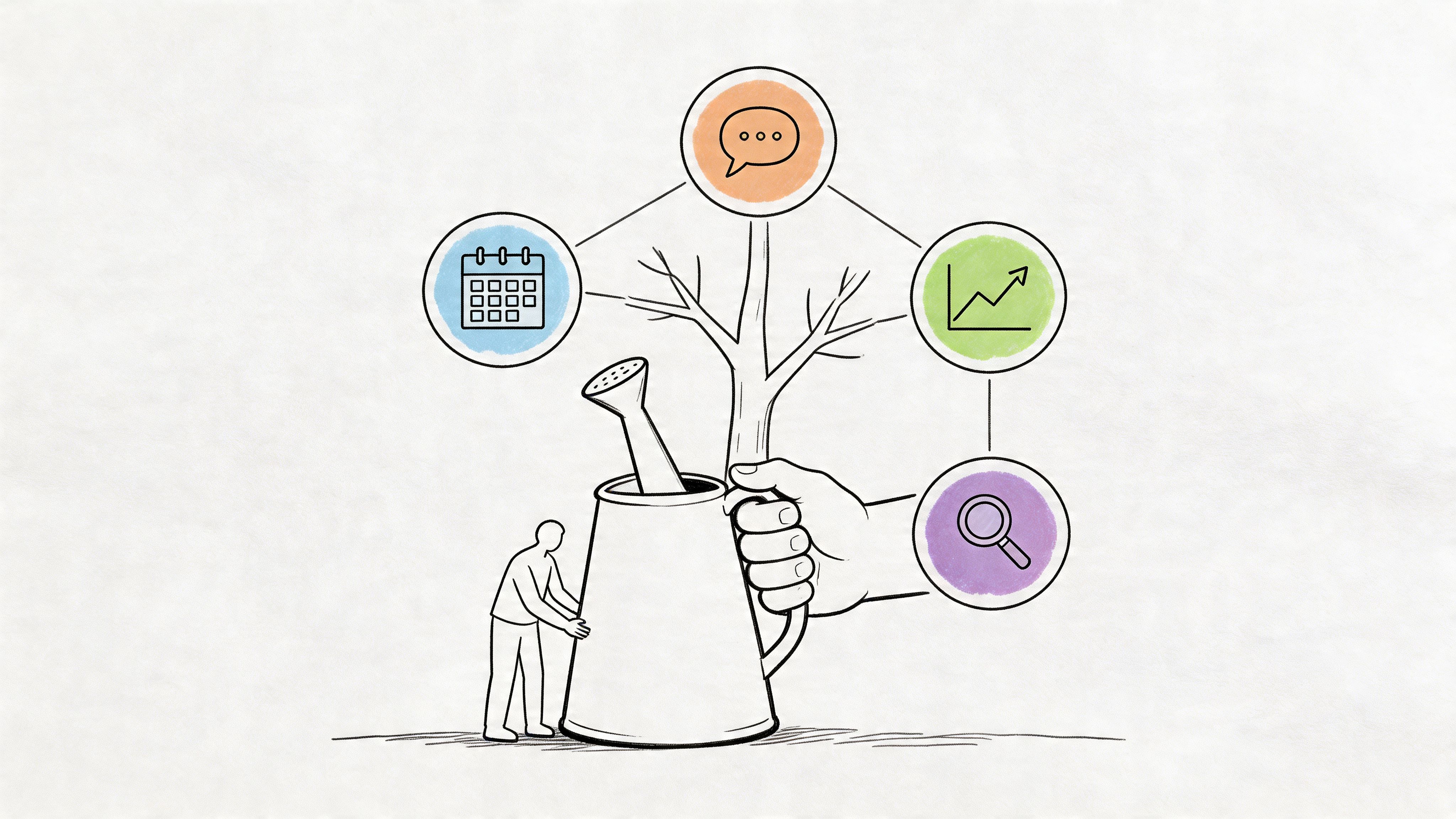
Most advice about how to grow your audience is built for aspiring influencers, not serious professionals.
It tells founders to post constantly, chase trends, and treat attention like the end goal. That's backward. If you're a CEO, consultant, operator, or creator with an actual business, audience growth should serve revenue, reputation, recruiting, partnerships, and deal flow. Not your ego.
You do not need a massive following. You need the right people to know who you are, what you stand for, and why your perspective matters. That means building trust at scale, then converting that trust into business outcomes.
The strongest audiences aren't random. They're shaped. They come from clear positioning, disciplined content, repeat visibility, and smart follow-up. If you want a practical model for social growth that stays aligned with substance, this guide on grow on LinkedIn without selling your soul is worth reading because it respects the fact that professionals need credibility more than cheap reach.
Follower count is a terrible primary KPI for professionals.
It looks clean on a dashboard, but it hides the only question that matters. Are you attracting people who can become customers, advocates, collaborators, hires, or introducers? If the answer is no, your audience isn't growing. It's just accumulating.
If you're building a business, your audience is an asset. You should judge it the same way you judge any asset. By output.
That means asking better questions:
A founder with a modest but concentrated audience often outperforms someone with broad visibility and weak trust. I’ve seen professionals waste months posting for applause from peers who were never going to buy, refer, or partner. Attention from the wrong audience is a distraction with good branding.
Build for relevance first. Reach follows. Revenue follows faster.
A lot of professionals quit because they think audience growth requires becoming a full-time creator.
It doesn't. It requires becoming a clear communicator with a repeatable system. That's different. You don't need to comment on every trend or publish on every platform. You need a focused message, a few durable channels, and content that keeps answering the same high-value problems from fresh angles.
How to grow your audience isn't a game of volume alone. It's a game of strategic repetition. The market rewards people who become known for something specific, then deliver that perspective consistently enough that buyers remember them when timing changes.
If you don't know what your audience is supposed to do, you're going to create a lot of content that feels productive and produces nothing.
Start with business intent. Then build your profile around that intent.

Generic growth plans fail because they're generic. According to Omeda's breakdown of top-of-funnel audience growth, 70-80% of generic top-funnel efforts fail because they lack nurturing and specific benchmarks. The same source recommends SMART goals, including examples like a 10% increase in newsletter subscribers over 12 months, and notes that repeat visitors with 3+ visits in a week can be up to 5x hotter than first-time visitors.
Those numbers matter because they force you to stop posting blindly.
A strong audience goal sounds like this:
Weak goal: “Grow my brand.”
Strong goal: “Turn my LinkedIn profile and content into a repeatable source of newsletter subscribers and qualified inbound conversations.”
Your audience can't do ten things at once.
Choose the single most important next step you want the right person to take after discovering you. For most professionals, it's one of these:
Everything on your profile should support that one action. If your bio points in one direction, your banner in another, and your featured section in a third, you're leaking trust.
Practical rule: Your profile should answer three questions in under ten seconds. Who are you, who do you help, and what should someone do next?
Most profiles read like resumes. That's a mistake.
Your profile is not a career archive. It's a conversion asset. Every element should reduce confusion and increase qualified action.
Use this checklist:
If your audience is founders, speak to founder problems. If your audience is operators, speak to operational pain. Broad profiles attract broad attention. Broad attention rarely converts.
For a more detailed walkthrough, this guide on LinkedIn profile optimization for standing out is a useful reference because it treats profile strategy as positioning, not decoration.
The earlier data about repeat visitors being hotter should change how you think about your presence.
You don't just want someone to land on your profile once. You want them to come back. That means your profile should reward a second and third visit with depth. Add strong featured content. Pin content that represents your thinking. Keep your call to action current. Make it obvious that you publish consistently and have a point of view worth returning to.
A good profile doesn't try to impress everyone. It filters casual traffic and pulls the right people deeper.
Many individuals don't struggle with content creation. They struggle with content selection.
They sit down to post and ask, “What should I say today?” That question kills consistency because it forces reinvention. You need pillars. Once you have them, your content engine gets simpler, sharper, and easier to sustain.
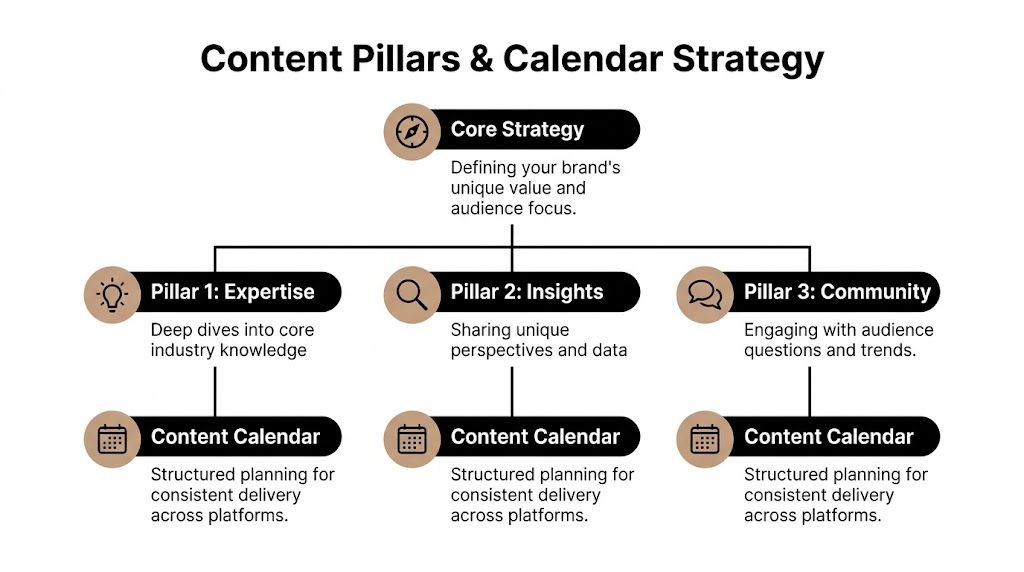
Your content pillars should sit at the intersection of three things. What you know well, what your audience needs urgently, and what supports your business model.
For most founders and professionals, three to five pillars is enough. More than that and you dilute recognition.
A clean setup looks like this:
This is how to grow your audience without becoming repetitive. You're not posting random ideas. You're exploring the same strategic territory from different angles.
If you're still building your content plan around text alone, you're making the job harder than it needs to be.
According to digital marketing statistics compiled by Web and Crafts, video accounts for 82.5% of global internet traffic, the average user spends 88% more time on websites that feature video, and 91% of businesses now use video as a primary marketing tool. That isn't a passing trend. It's the format your audience already expects.
Video works because it compresses trust. People hear your voice, see your pace, and judge your confidence faster than they can from text alone.
That doesn't mean you need cinematic production. It means you need a repeatable system for simple, clear video content:
One strong idea in multiple native formats beats five disconnected posts every time.
Your calendar doesn't need to be complicated. It needs to be usable.
A lot of founders overbuild content systems, then abandon them because they require too much maintenance. Keep the structure light. Assign each day a purpose. Then batch your ideas ahead of time.
Here’s a workable example.
| Day | Pillar Focus | Format | Example Post Concept |
|---|---|---|---|
| Monday | Expertise | Text post | A framework for diagnosing why your sales content isn't converting |
| Tuesday | Insights | Short video | One unpopular opinion about personal branding for B2B founders |
| Wednesday | Community | Carousel | Answering three audience questions about consistency and visibility |
| Thursday | Proof | Story post | A behind-the-scenes lesson from refining your positioning |
| Friday | Offer-adjacent education | Newsletter or article | What buyers need to understand before hiring for brand-led growth |
Notice what's missing. No trend-chasing. No empty motivational fluff. No “just staying active” posts.
The easiest way to stay consistent is to create one substantial anchor piece each week, then derive the rest from it.
That anchor can be:
If you want a practical framework for planning this without turning it into another abandoned spreadsheet, review this guide on how to create a content calendar that actually works.
The point of your calendar is not to fill slots. It's to create a reliable pattern of useful visibility. When your audience can predict the kind of value they'll get from you, trust compounds.
Publishing isn't distribution. A post that sits on one platform and dies there is not a growth strategy.
If you want your audience to grow, you need a distribution habit and an engagement habit. Often, one habit is executed poorly, and the other is neglected entirely.
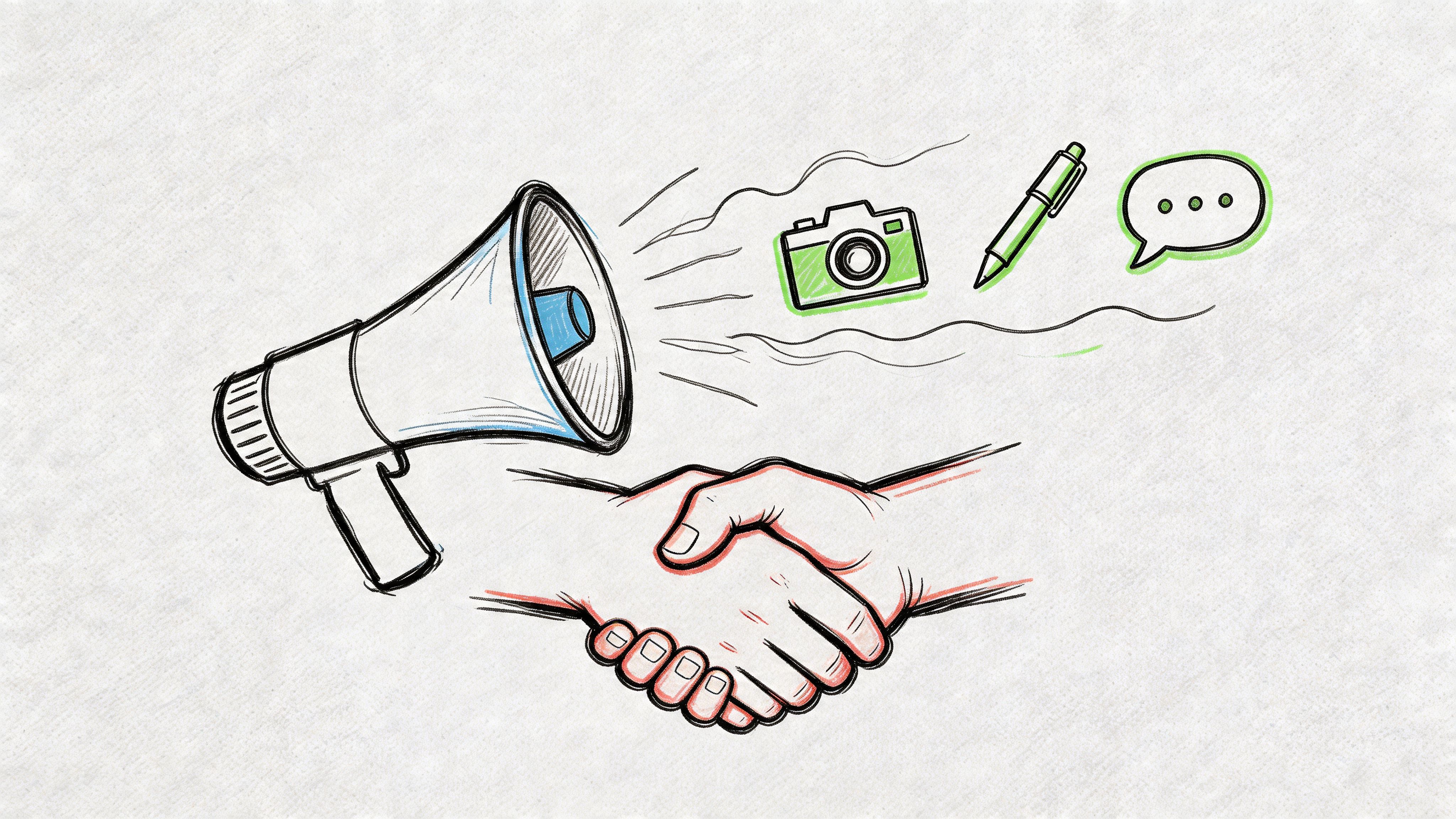
Copy-pasting the same post across platforms is lazy distribution. It ignores audience behavior and platform mechanics.
A better move is content atomization. Start with one pillar piece, then rebuild it natively for each channel.
For example, if you publish a long-form post or video about founder positioning:
That approach respects context. It also multiplies the surface area of your ideas without multiplying your workload.
Platform choice isn't a branding preference. It's a resource allocation decision.
According to 321 Web Marketing's audience growth guidance, LinkedIn yields 3x the ROI of platforms like Instagram for B2B leaders, consistency boosts audience retention by 35%, and achieving a response rate over 80% in comments can double audience loyalty. This is the essential lesson. Not that every founder should abandon every other channel, but that serious professionals should put their energy where buyer intent and conversation quality are strongest.
If your market lives on LinkedIn, act accordingly. Build there first. Use other channels to support that position, not to distract from it.
Don't spread your effort evenly. Concentrate it where trust converts fastest.
A lot of smart people treat engagement like cleanup after posting.
That's a major error. Engagement is where your audience stops being an audience and starts becoming a network.
Three habits matter:
People often trust your comments before they trust your posts. Comments reveal how you think in real time.
If video is part of your channel mix, study retention and watch behavior instead of only views. This resource on strategies to increase YouTube watch time is useful because it pushes you to think beyond upload volume and focus on what keeps attention.
A quick example helps. Use this as a reference for how native distribution can support engagement across channels.
Founders love the idea of networking with bigger voices. They usually do it badly by asking too early.
Make a list of people who influence your market. Buyers, creators, operators, podcasters, newsletter writers, investors, category experts. Then engage in a way that creates familiarity before contact.
That means:
This takes longer than cold outreach spam. It also works better because it creates recognition before the ask.
Once your core system is working, stop treating growth levers like big, scary bets.
Treat them like experiments. Small budget. Clear hypothesis. Tight timeline. Real review.

Most collaboration pitches are weak because they center on exposure. Nobody serious cares about “getting in front of each other's audiences” unless the overlap is obvious and useful.
Pitch collaborations around shared buyer problems.
Good examples:
Keep the ask narrow. Name the audience overlap. Explain the topic. Make it easy to say yes.
Don't put ad spend behind weak content and hope the algorithm fixes your strategy.
Use paid distribution only after a piece of content has already shown signs of resonance. If a post starts strong organically, that gives you something worth testing. Then target tightly. Specific roles. Specific industries. Specific problems.
A service like Legacy Builder can fit for professionals who want help turning expertise into consistent brand content and distribution. It's one option alongside freelancers, in-house support, or your own lean internal process.
The point isn't to spend more. It's to learn faster. A small ad test can tell you whether a message resonates outside your immediate network.
Spend to validate a message, not to rescue a bad one.
Social platforms rent you access. Email gives you direct reach.
According to Sage Island's digital marketing statistics, email marketing delivers an average ROI of $36-$40 for every $1 spent, produces a median ROI of 122%, and is nearly 40 times more effective at acquiring new customers than social channels. That's why smart audience builders push social attention toward an owned list as early as possible.
Use email for more than a newsletter recap.
Try these experiments:
If you're serious about how to grow your audience in a way that survives platform shifts, email isn't optional. It's where trust matures into action.
Most professionals check the wrong dashboard.
They obsess over impressions, likes, and follower increases because those numbers are visible and easy to compare. But vanity metrics don't tell you where business value is building. They tell you where attention flickered.
Look for indicators tied to movement, not applause.
Useful metrics include:
If you need a stronger measurement framework, this guide on measuring content performance for your personal brand is a practical reference because it pushes beyond surface engagement.
A common belief is that audience growth means reaching outward forever.
Not always. One of the sharpest moves is to look inward and find the subsegments inside your current audience that you're under-serving. According to Caroline Leon's analysis of audience growth gaps, a frequently overlooked strategy is identifying underserved subsegments within your existing audience rather than chasing broad new follower growth. By comparing engaged segments against broader benchmarks, you can find “higher fruit” opportunities you're currently missing. The same source argues that warming specific subsegments first can grow both audience size and revenue without entering new markets.
That idea is stronger than most generic growth advice because it's efficient. You're not starting from zero. You're identifying groups that already have some relationship to your work and giving them more reasons to engage.
Start with behavior and pattern recognition.
Review who consistently interacts with your content, opens your emails, or replies to your posts. Then look for clusters:
Once you find a cluster, create content specifically for that group. Not forever. For a short run. Test whether depth beats breadth.
For example, if your broad audience includes SaaS founders in regulated industries, and they repeatedly engage with content about trust and category education, lean in. Publish directly to their operating reality. Mention the constraints they face. Build examples that sound like their world.
The easiest audience to grow is often the one that's already half-convinced.
That shift changes everything. You're no longer asking, “How do I reach everyone?” You're asking, “Where is trust already forming, and how do I deepen it?”
Audience growth gets easier when you stop treating it like performance art.
You do not need to become louder. You need to become clearer, more consistent, and more useful to the right people. That means defining a sharp goal, tightening your profile, building durable content pillars, distributing with intent, running measured experiments, and using data to deepen traction where it already exists.
Use this for your first month:
Then repeat this review every month:
Build an audience this way and you're not just growing visibility. You're building reputation, influence, and a body of work that compounds beyond any one platform.
If you want help turning your expertise into a focused personal brand system, Legacy Builder works with professionals to turn their story, insights, and vision into consistent content, profile strategy, and audience growth assets that support real business goals.


You could – but most in-house teams struggle with the nuance of growing on specific platforms.
We partner with in-house teams all the time to help them grow on X, LI, and Email.
Consider us the special forces unit you call in to get the job done without anyone knowing (for a fraction of what you would pay).
Short answer – yes.
Long answer – yes because of our process.
We start with an in-depth interview that gives us the opportunity to learn more about you, your stories, and your vision.
We take that and craft your content then we ship it to you. You are then able to give us the final sign-off (and any adjustments to nail it 100%) before we schedule for posting.
No problem.
We have helped clients for years or for just a season.
All the content we create is yours and yours alone.
If you want to take it over or work on transitioning we will help ensure you are set up for success.
We want this to be a living breathing brand. We will give you best practices for posting and make sure you are set up to win – so post away.
Subscribe to our newsletter and get insights on how to grow your personal brand.
