.svg)
Subscribe to our newsletter and get insights on how to grow your personal brand.
Thank you! Your submission has been received!
Oops! Something went wrong while submitting the form.
.svg)


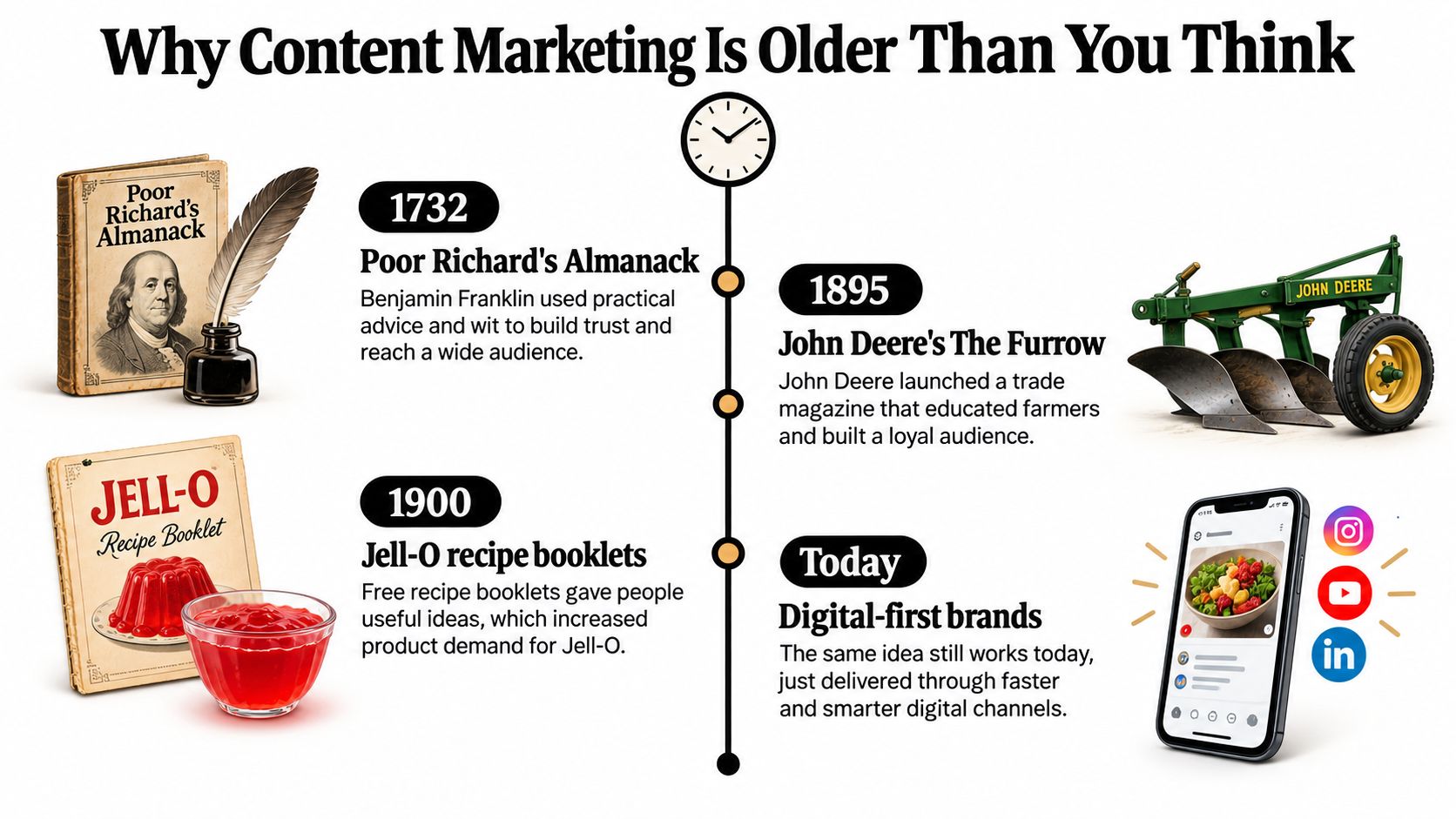
Content marketing didn't begin with blogs, search engines, or social media. Its underlying idea is much older: teach people something useful, earn their attention, and let trust create a path toward demand. John Deere used that model in 1895 with The Furrow, a publication that became one of the earliest widely cited examples of brand publishing and still circulates today, reaching 1.5 million readers across 40 countries in 12 languages according to this history of content marketing reference.
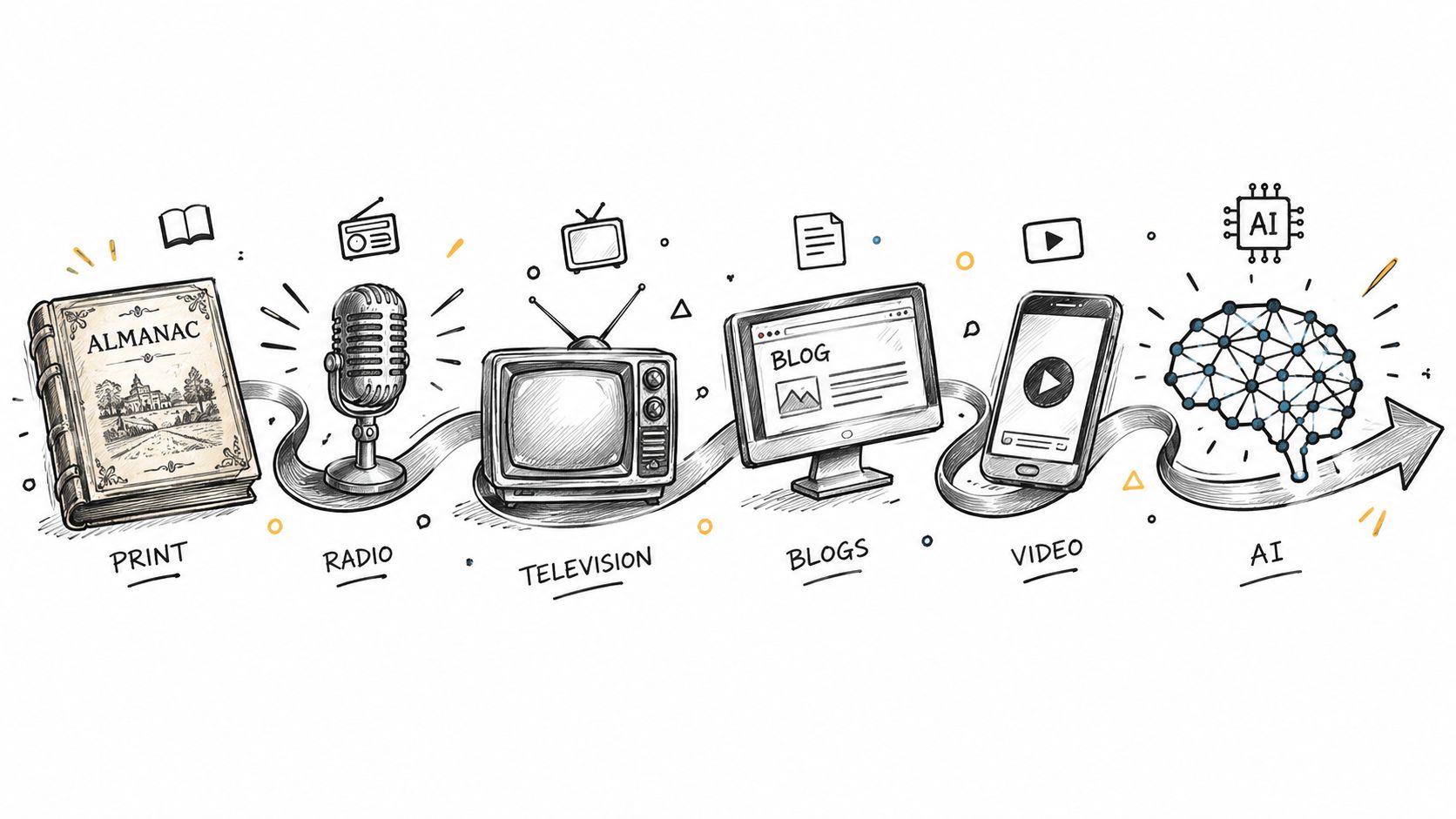
The channel keeps changing, but the mechanism stays familiar. Print publications became radio and television, then websites, blogs, newsletters, social platforms, video, communities, and AI-assisted workflows. The history of content marketing is therefore less a straight line than a series of reinventions, each one teaching modern personal-brand builders how to turn useful ideas into durable audience relationships.
The common story starts with the corporate blog. That story is convenient, but it's wrong. Blogs made publishing faster and search made discovery more scalable, yet neither invented the central discipline. Long before a founder could publish an article from a laptop, publishers were already using practical information and editorial consistency to create demand.
The key distinction is between content marketing as a label and content marketing as a practice. The label is relatively modern. The practice appeared whenever a person or company created material that an audience valued in its own right, then connected that attention to a commercial identity.
Benjamin Franklin's Poor Richard's Almanack, first published in 1732, illustrates the principle. It used useful information and editorial material to attract readers before asking them to think about a product. John Deere's The Furrow, launched in 1895, applied a similar logic to agriculture. Instead of interrupting farmers with a narrow sales message, it created a publication built around the subjects farmers needed to understand.
Across these early examples, four elements keep appearing:
That pattern still describes a strong newsletter, educational podcast, founder-led LinkedIn presence, or video channel. The modern creator may use a smartphone instead of a printing press, but the strategic job remains similar.
Personal-brand builders often mistake novelty for strategy. They assume a new platform requires a new philosophy. In practice, a platform changes the way people discover, consume, and share content. It doesn't remove the need to be useful, credible, and consistent.
Practical rule: Treat every new channel as a new delivery system for an old promise, not as a replacement for the promise itself.
The history of content marketing begins, then, with a simple lesson. Audiences don't become valuable because a brand publishes frequently. They become valuable when a brand repeatedly helps them make better decisions.
Content marketing did not begin with the internet, social media, or even modern advertising departments. It evolved whenever an organization treated information as a way to earn attention over time. Benjamin Franklin and John Deere illustrate the early pattern, but other publishers reveal how widely the idea traveled across industries.
The Boy Scouts of America founded Scouting magazine in 1910. Its purpose was closely tied to the organization's wider mission: helping members develop skills, values, and a sense of participation. The magazine was more than a noticeboard for the group. It gave readers guidance and stories connected to the identity they were building.
Coca-Cola used another version of the model through early employee publications. Internal magazines helped the company communicate with its workforce, reinforce shared standards, and give employees a common understanding of the brand. The audience was inside the organization, yet the publishing logic was familiar: regular information shaped a relationship that could support the wider business.
These examples add an important dimension to the history. Brand publishing was not limited to companies selling specialist products to customers. It could serve members, employees, professionals, or communities. The publisher chose a group, identified information that mattered to it, and created a recurring editorial reason to pay attention.
| Setting | Primary audience | Typical editorial territory | Strategic lesson |
|---|---|---|---|
| Membership organizations | Members and participants | Skills, values, activities, and shared identity | Publish around the identity people want to strengthen |
| Consumer brands | Customers and interested readers | Advice, stories, culture, and product-related interests | Build a subject area larger than the product itself |
| Industrial businesses | Professionals and business buyers | Work practices, operating knowledge, and industry conditions | Teach the decisions surrounding the purchase |
| Internal company publications | Employees and colleagues | Standards, updates, recognition, and organizational purpose | Publishing can align the people who deliver the brand promise |
The format depended on the audience. A membership magazine created belonging. An employee publication created alignment. An industrial journal helped buyers understand their working environment before they evaluated a product. The channel changed, but the publisher's task remained recognizable: become useful in a defined information space.
That distinction helps modern personal-brand builders choose a better starting point. A founder does not need to publish about every subject connected to their expertise. They can select one audience and one recurring concern, then build a body of work that helps people understand it.
A cybersecurity founder might focus on operational risk. A leadership consultant might examine difficult executive decisions. A product designer might explain how research shapes customer experiences. Each topic leaves room for education, examples, and informed opinion before a commercial conversation begins.
The lesson from the pre-digital era is practical. Publishing works when it gives a community a reason to return and makes the publisher recognizable within that community. Today's creators use feeds, newsletters, podcasts, and video instead of magazines, yet the same choice still determines whether content becomes a durable asset or a stack of unrelated pieces.
The 20th century turned brands into publishers. Printed materials, radio, television, and other media formats gave companies ways to build recurring relationships with audiences. The major change was organizational: a company had to create and manage its own publishing operation rather than just place messages inside someone else's.
That required a clear audience, a production process, an editorial voice, and a distribution plan. A brand publishing regularly needed to behave more like a media organization, with repeatable standards for what it made and how people received it.
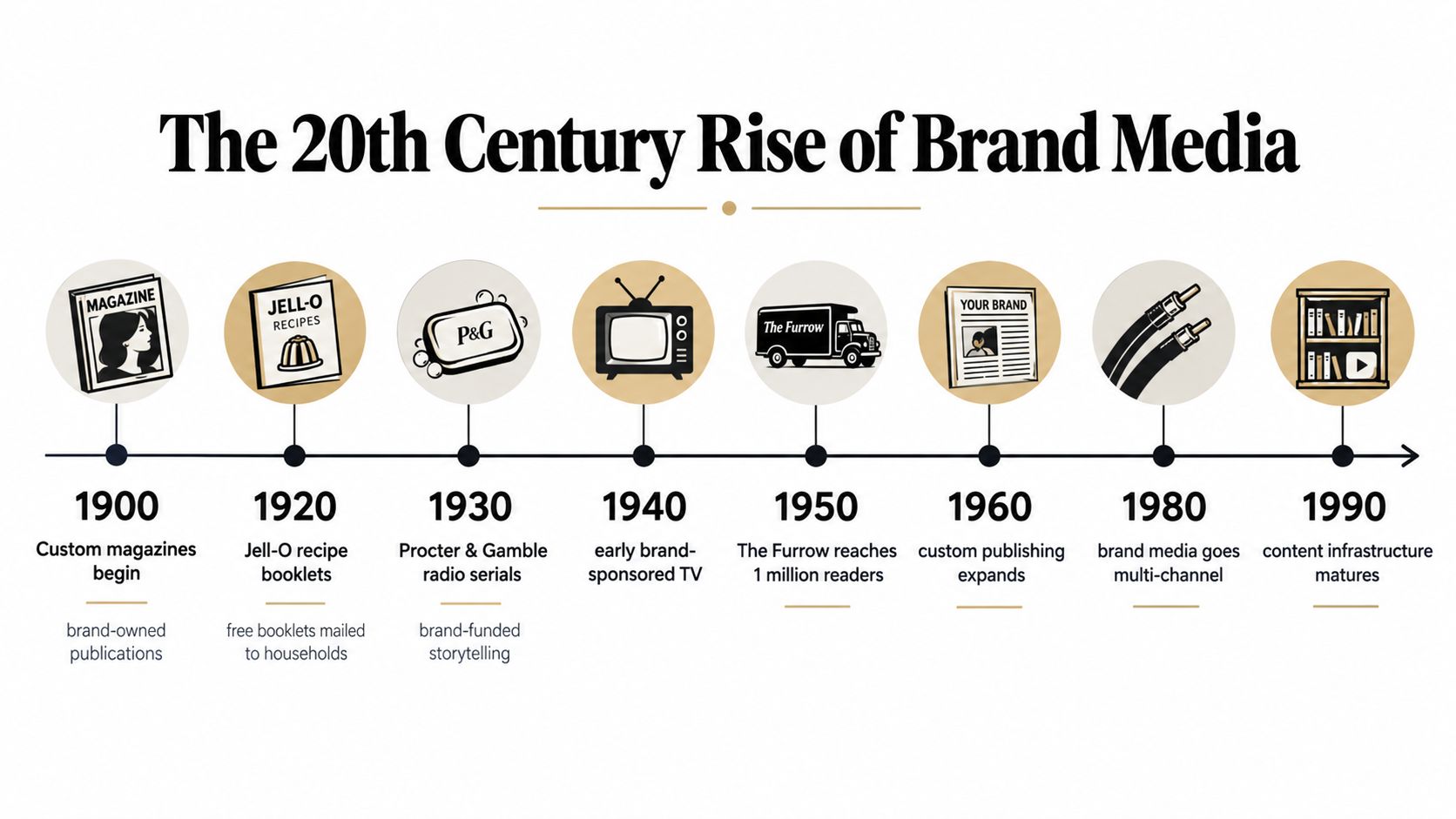
Printed brand materials provided the first durable template. Recipe booklets, customer magazines, and specialist publications offered information people could use, keep, and share. Radio extended that relationship through scheduled programs and serialized storytelling. Television added sound and visual performance, giving brands another way to create programs audiences might return to.
Each format imposed a different editorial discipline. Print required editorial planning, because publishers had to choose themes and prepare material before distribution. Radio required continuity, with recurring topics, characters, and a dependable schedule. Television added visual storytelling, so brands had to design experiences that worked through both sound and image. Multichannel publishing increased coordination, because one idea could be adapted for different audience contexts.
Together, these media created a direct relationship with an audience that can develop over time. A brand was building a publishing environment associated with its own identity, rather than renting every moment of attention from an external publisher.
The formats also supplied working models for later digital channels. A blog follows the editorial rhythm of a magazine. A podcast draws on serialized audio programming. A video channel adapts television while allowing direct audience feedback. An email newsletter turns recurring publication into a personal delivery channel.
Founders comparing older and newer methods can use this guide to traditional marketing versus digital marketing and ROI for context. Digital media did not invent audience relationships or make older media incapable of measurement. It made publishing cheaper, faster, and easier to connect with audience response.
That is the lasting lesson of the century's brand media wave: consistent publishing can give a company a recognizable voice, a repeatable format, and an audience relationship. Modern personal-brand builders can apply the same principle across blogs, newsletters, podcasts, and video, adapting the channel while keeping the publishing discipline.
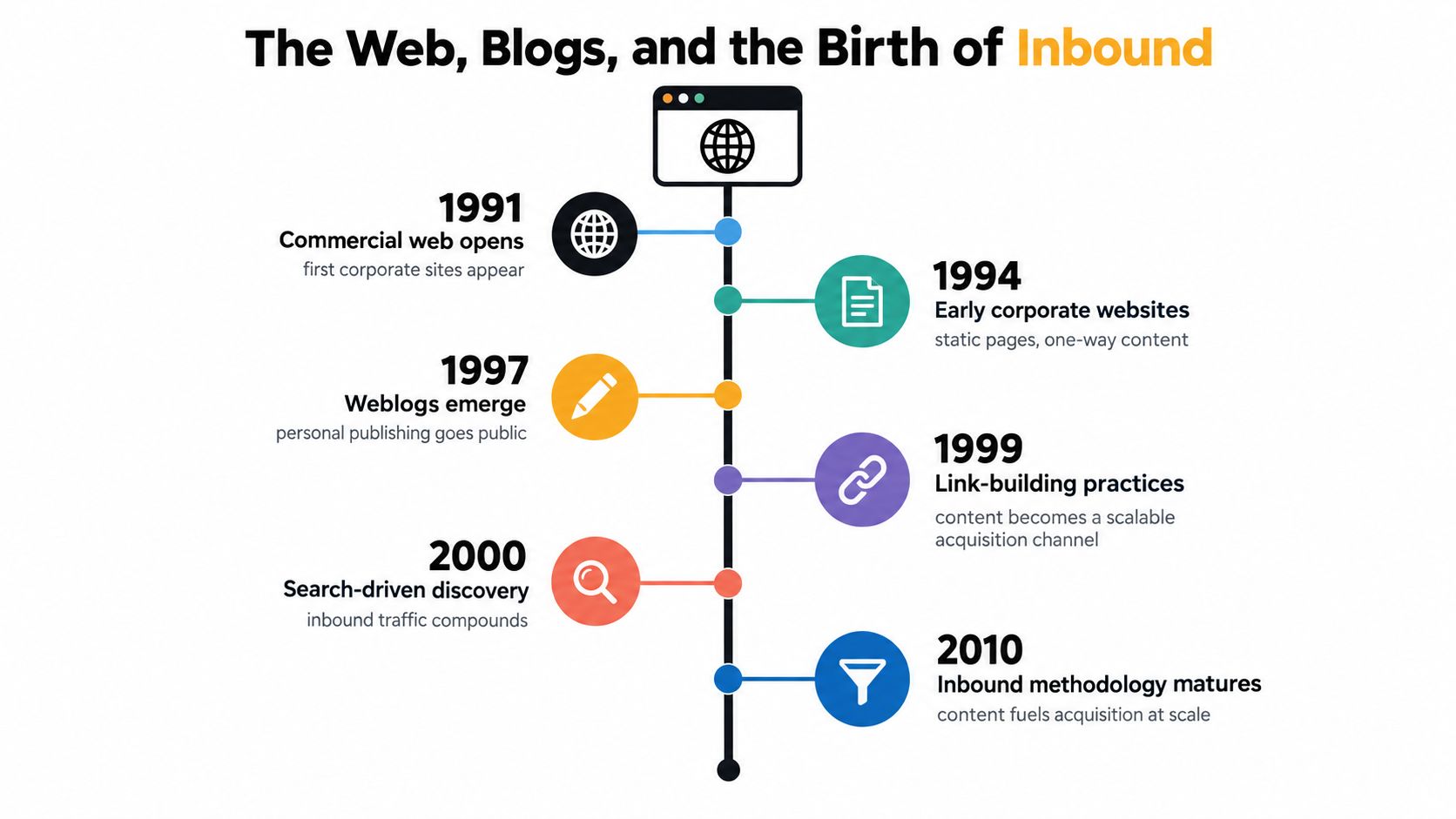
The web reinvented content marketing by changing who could publish, how quickly they could publish, and how audiences could find the result. A company no longer needed a large print operation or broadcast infrastructure to distribute useful material. One website could bring together explanations, resources, product information, and editorial content in a searchable environment.
Early corporate websites often behaved like online brochures: static, promotional, and organized around the company's own message. Weblogs introduced a different rhythm. Frequent, chronological publishing made a business feel more present, while search gave each useful article a chance to reach someone with a specific question.
Traditional advertising starts with a message and interrupts an audience to deliver it. Inbound content starts with a problem, question, or interest that already exists. That reversal changed the marketer's job from finding attention to earning discovery.
A team might identify a recurring customer question, publish a useful answer, make it visible through search, and offer a relevant next step such as an email, guide, tool, or consultation. Reader behavior then supplied feedback for improving the next piece. Editorial planning and SEO became connected parts of the same process.
Keyword research helped marketers understand the language buyers used. Resource hubs grouped related answers, while lead magnets gave readers a practical reason to continue the relationship. Search also rewarded depth and originality in a practical sense. A page that merely repeated a phrase did little for the reader. A well-developed guide could clarify several related choices and remain useful after its publication.
The web didn't eliminate brand publishing. It gave brand publishing a searchable memory.
For a founder, that memory changed the value of an explanation. An insight shared in a conversation or at an event could become an article, a newsletter issue, a social post, or a sales enablement asset. One underlying idea could reach people at different moments instead of disappearing after the original interaction.
Consistency therefore became a system requirement. Search visibility, subscriber growth, and audience trust usually develop through a connected body of work, not one isolated article. Founders planning that system can use this content marketing strategy blueprint as a reference.
The web-era lesson still applies as AI and video reshape production: useful answers, discoverability, and a clear next step give content a durable structure. The tools and formats will keep changing, but modern personal-brand builders can still treat each new wave as a publishing advantage, not a completely new discipline.
Content marketing has been reinvented in waves. Blogs shaped the web era, while video, multimedia, and community now shape how many creators earn attention and build trust. In 2025, short-form video was used by 60% of marketers, and video formats ranked among the leading ROI drivers, according to HubSpot's 2025 marketing benchmark data. The same source reports that in 2026, 52% of content marketers planned to shift more spending toward video or multimedia content, while more than half of marketers reported using AI to create personalized content.
This shift changes the creator's role. Text can explain an idea, but video can show judgment, tone, process, and personality at the same time. A founder might explain a customer problem, demonstrate a product decision, answer a misconception, or document an experiment. The audience receives information while observing how the creator reaches a conclusion.
That is the lesson of this wave: each new medium adds a way to make expertise visible.
Short-form video platforms, podcasts, livestreams, and user-generated content create faster feedback loops than traditional publishing. One strong idea can become a short clip, a longer explanation, a podcast conversation, and a question for the community. Replies and comments then expose which questions deserve a fuller answer.
A founder can treat the process like a workshop. The first public explanation tests the topic. Audience reactions reveal confusion or demand. A longer resource addresses the strongest questions, while a newsletter or community discussion keeps the conversation active.
Community supplies continuity. A public post can introduce an idea, while a newsletter, private group, or member discussion gives interested people a place to return. The system has two connected functions:
Each format serves a different job. Video can create initial interest, while a written guide can provide the detail a prospect needs before making a decision. A community can add peer discussion, and a newsletter can deliver the founder's point of view directly.
Format selection works best as a sequence rather than a popularity contest. Start with the audience action you want to support, then choose the medium that makes that action easier.
Use short-form video for discovery, demonstrations, reactions, and visible personality. Use long-form written content for comparison, explanation, searchability, and careful reasoning. Use newsletters for repeated contact and a consistent point of view. Use communities when members can learn from one another, not only from the founder.
A video may attract someone who has never encountered the brand. A detailed article can answer that person's practical questions. A newsletter can bring the reader back, while a community can reveal new objections, examples, and use cases. Together, these formats form a content loop rather than a collection of disconnected posts.
AI changes the production layer of this system. It can help adapt one idea into several formats or personalize content for different audience needs. Human judgment still determines which ideas deserve attention, what evidence supports them, and which channel fits the audience's next question.
Modern personal-brand builders can apply the same lesson at every stage: follow the audience's need, assign each format a clear role, and let feedback shape the next piece. The medium will keep changing. The discipline remains a cycle of useful ideas, visible expertise, audience response, and deeper trust.
Content marketing became a business system when publishing teams had to explain what their work produced. Stories and polished formats still attract attention, but business leaders now ask a harder question: how does content contribute to demand, pipeline, retention, and revenue?
The gap between activity and impact appears in current B2B research. 97% of B2B marketers say they have a content strategy, while 13% say that strategy significantly improved results, according to the Content Marketing Institute's B2B research. A documented strategy is only a plan on paper. An effective operating system connects audience needs, commercial priorities, publishing choices, and evidence of progress.
Earlier publishing models could focus on readership and reputation. Digital channels added behavioral signals, giving teams more ways to examine what happens after someone encounters a piece of content. They can compare which topics attract qualified visitors, which resources start conversations, and which distribution paths bring people back.
A useful measurement system links four layers:
Consider a founder-led buying journey. A prospect may discover the founder through a short video, read an article later, join a newsletter, and speak with the company after receiving a practical guide. Giving all credit to the final interaction hides the earlier work. Giving every interaction sole credit creates a different error.
Measurement principle: Use attribution to improve decisions, not to pretend that complex buying journeys have one perfect answer.
The operating system around content has expanded as well. It may include editorial calendars tied to revenue goals, content scoring models, AI-assisted briefs, audience research, CRM integration, and performance dashboards. AI can accelerate planning, personalization, production, and analysis. Human judgment still decides whether an idea is useful, whether the evidence supports it, and whether the result sounds like the brand.
Investment in AI-powered marketing tools is also rising, with 45% of marketers planning to increase investment in 2026, as reported in the same Content Marketing Institute research. The practical lesson is not to automate every decision. Teams can use AI to identify themes, adapt existing material, and support production while keeping a clear point of view.
Video deserves its own measurement question. For founders evaluating it as an acquisition channel, video-led acquisition ROI provides a useful perspective on connecting attention to business results. Audience growth may show that a channel is gaining momentum, while qualified conversations and revenue indicate whether it serves the company.
A practical guide to audience engagement metrics can help teams choose signals that reflect relationship quality instead of collecting every available platform number. Content marketing has therefore moved through repeated reinventions: print created trust through useful stories, digital channels made behavior visible, and AI now speeds the system's operation. The enduring lesson for personal-brand builders is to measure what helps them make better editorial and business decisions.
Content marketing has been reinvented in waves, not invented once. Franklin used useful information to earn attention, Deere connected practical guidance with a product, brand publishers built trust through recurring media, blogs made expertise searchable, and video and AI have changed how ideas are produced and distributed. The tools differ, but the underlying lesson remains: content works when it helps a specific audience make progress.
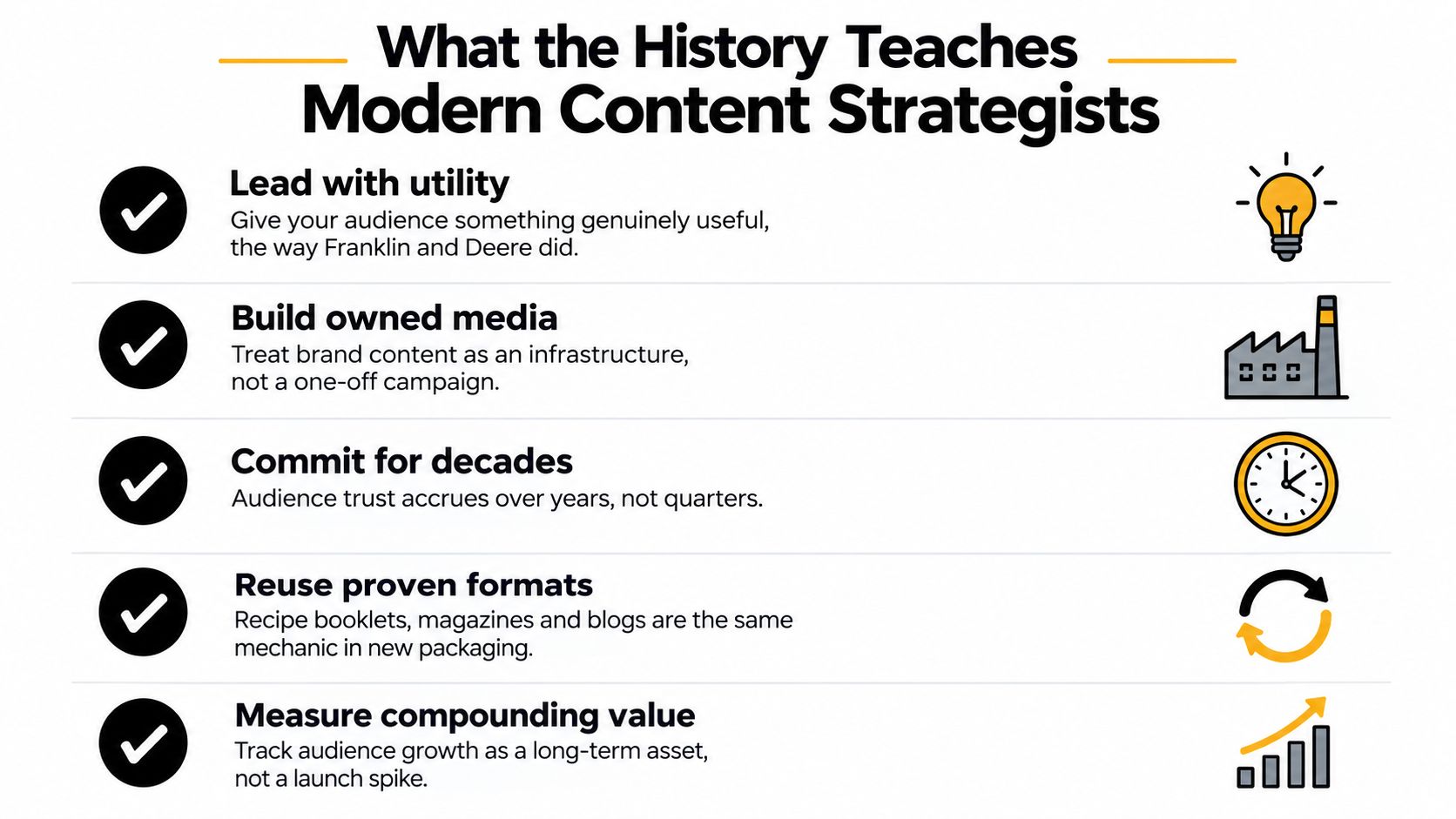
Useful content earns permission to continue the relationship. Start with the decision your audience is trying to make, then remove confusion, risk, or unnecessary effort from that decision. A founder who publishes a clear explanation of a difficult customer problem can build trust before discussing an offer.
Within a week, list recurring questions from prospects, customers, or peers. Choose one and create a complete answer in the format your audience already prefers. The answer should remain useful even if the reader never buys from you.
Platforms can create discovery, but direct access creates resilience. A newsletter, website, podcast feed, or community gives you a place to develop a relationship beyond a changing recommendation system.
Choose one owned channel and define its publishing promise. A founder might send one practical operating lesson each week. Write the welcome message and outline the next three topics. Then identify where interested people can continue the relationship without depending on a platform feed.
The medium should match the communication job. Short video can demonstrate a process or express a strong point of view. A detailed article can explain a complex decision. A newsletter can create rhythm, while a community discussion can reveal shared problems and unanswered questions.
Create one idea in three forms this week: a short video, a written explanation, and a discussion prompt. Compare the quality of responses, not only reach. The strongest format is the one that helps the audience understand, trust, or act.
Sporadic inspiration rarely creates a durable publishing asset. A documented strategy gives a founder a repeatable way to choose topics, assign formats, distribute work, and review results. 97% of B2B marketers report having a content strategy, according to Content Marketing Institute research. The figure makes execution more important, because a plan matters only when it shapes weekly behavior.
Write a one-page operating brief covering your audience, editorial territory, core formats, publishing rhythm, and review criteria. Schedule the first production block before the planning energy fades. A useful system should keep publishing even when motivation is low.
AI can organize research, suggest outlines, repurpose material, draft variations, and support repetitive production. Human judgment still determines what the brand believes, which evidence matters, and whether the result sounds distinctive.
Use AI for one production task, then verify every factual claim and revise generic passages yourself. For founders seeking a structured approach to founder-led content, Legacy Builder offers strategy, writing, and distribution support for personal brands.
These lessons also provide a practical way to measure content marketing impact. Track whether content helps people discover your work, understand your expertise, return for more, start a conversation, and move toward a relevant offer. That discipline connects print-era usefulness with the speed of AI and the reach of video.
Legacy Builder helps founders and professionals turn their stories, expertise, and ideas into consistent content across social posts, newsletters, carousels, threads, and other formats. If you want to build a personal brand with the long-term discipline that has defined content marketing from print to AI, visit Legacy Builder and explore its support for your publishing system.


You could – but most in-house teams struggle with the nuance of growing on specific platforms.
We partner with in-house teams all the time to help them grow on X, LI, and Email.
Consider us the special forces unit you call in to get the job done without anyone knowing (for a fraction of what you would pay).
Short answer – yes.
Long answer – yes because of our process.
We start with an in-depth interview that gives us the opportunity to learn more about you, your stories, and your vision.
We take that and craft your content then we ship it to you. You are then able to give us the final sign-off (and any adjustments to nail it 100%) before we schedule for posting.
No problem.
We have helped clients for years or for just a season.
All the content we create is yours and yours alone.
If you want to take it over or work on transitioning we will help ensure you are set up for success.
We want this to be a living breathing brand. We will give you best practices for posting and make sure you are set up to win – so post away.
Subscribe to our newsletter and get insights on how to grow your personal brand.
