.svg)
Subscribe to our newsletter and get insights on how to grow your personal brand.
Thank you! Your submission has been received!
Oops! Something went wrong while submitting the form.
.svg)


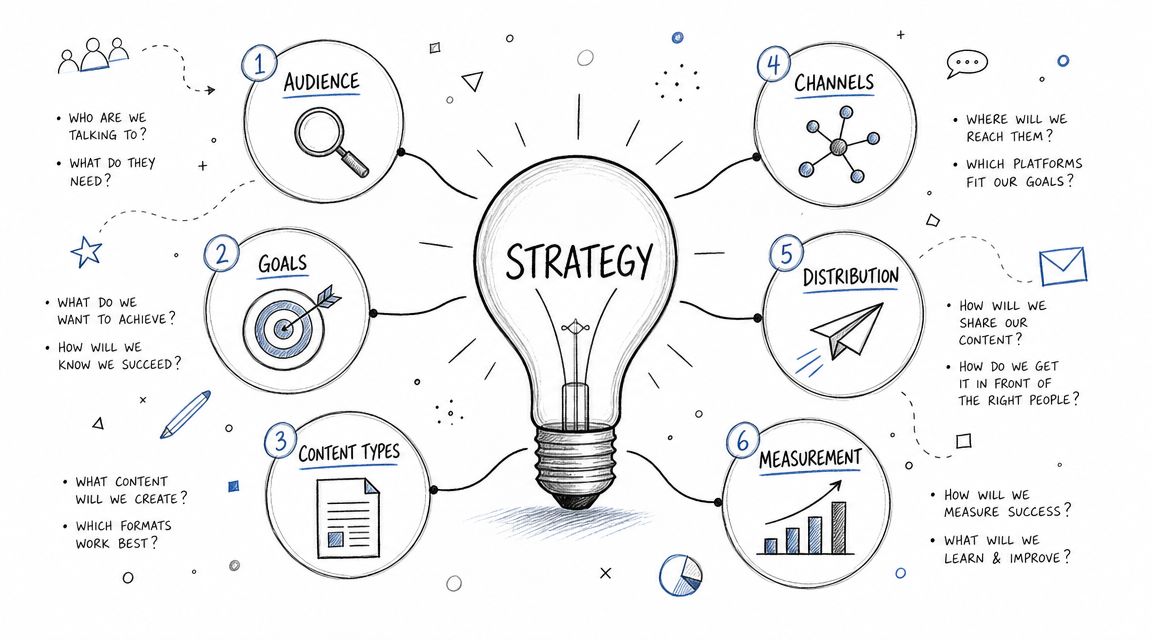
Digital content strategy is the system that turns content into business execution, not just publishing, and 90% of organizations now have a content marketing strategy while 47% of thriving companies emphasize audience research and 46% prioritize SEO. If you're asking what digital content strategy is, the blunt answer is this: it's the operating plan for deciding why you create content, who it's for, where it lives, how it gets distributed, and how you'll measure whether it moves the business.
The worst advice on the internet is still “just post consistently.”
That advice sounds practical because it removes the hard part. It lets people avoid choices. No positioning. No audience clarity. No business goal. No measurement. Just activity dressed up as progress.
Founders fall for this all the time. They hire someone to cut clips, hand off a few rough thoughts, post on LinkedIn, maybe start a newsletter, and call that a strategy. It isn't. It's a production habit. Sometimes useful. Usually scattered.
If you want to build a personal brand that creates opportunities for years, not just likes for a week, you need a system. Your content has to do more than fill feeds. It has to sharpen your positioning, attract the right people, reinforce your reputation, and create a body of work that compounds.
Digital content strategy isn't your posting schedule. It's the logic behind the schedule.
Hygraph puts it clearly in its guide to digital content strategy. It's the operational layer that turns broad content planning into measurable business execution. That means defining what content supports the business, choosing channels, setting KPIs, auditing what already exists, building a calendar, then measuring and improving over time.
That's a very different thing from “post three times a week.”
A founder can be highly visible and still be strategically invisible.
If your content doesn't connect to a real outcome, such as lead flow, authority, trust, partnerships, speaking opportunities, or recruiter interest, you're producing noise. A full calendar doesn't fix that. More volume doesn't fix that. Better design doesn't fix that either.
Practical rule: If you can't explain why a piece of content exists before you publish it, you don't have a strategy. You have a content habit.
Here's the distinction that matters:
For most personal brands, this also means narrowing scope. You don't need to dominate every channel. You need to choose the channels that fit your audience and your strengths. If social is part of the mix, this guide on how to create an effective social media strategy is useful because it pushes the same discipline often overlooked. Match the platform to the outcome instead of copying someone else's playbook.
A serious digital content strategy does two jobs at once. It generates current opportunities, and it archives your thinking in public.
The significance of that second part is frequently overlooked. Your podcast appearances, articles, essays, clips, and interviews become proof of how you think. Over time, they become the record people use to decide whether you're credible. That's why random posting is such a waste. It produces fragments. Strategy produces a body of work.
A real strategy works like a building. If one support fails, the structure weakens. If two fail, the whole thing starts to collapse. The six pillars below are what keep your content from becoming a pile of disconnected assets.
Recent data gathered in these content marketing statistics shows 90% of organizations now have a content marketing strategy. It also shows 47% of thriving companies emphasize audience research and 46% prioritize SEO. That tells you something important. Mature content systems aren't built on creativity alone. They're built on discoverability and audience understanding.
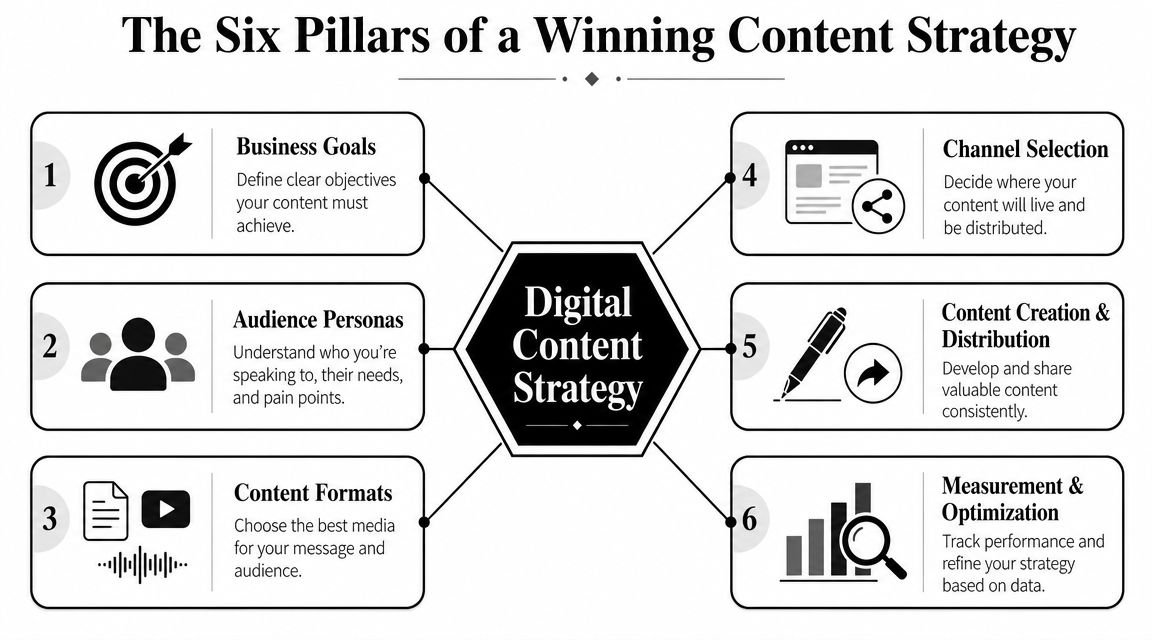
The first two pillars determine whether the rest of your work has any chance of compounding.
Business goals
Content needs a job. For a founder, that might mean attracting clients, building authority in a niche, supporting fundraising visibility, recruiting talent, or opening doors to partnerships. If the goal is fuzzy, every content decision downstream gets sloppy.
Audience personas
When defining audience personas, many tend to stay too broad. “Founders” is not an audience. “Bootstrapped B2B SaaS founders trying to create authority without sounding like marketers” is closer. Strong strategy feels personal because it's aimed at a specific person with a specific problem.
The fastest way to make your content forgettable is to write for everyone who might possibly care.
These pillars decide how your ideas travel.
| Pillar | What it decides | Founder-level recommendation |
|---|---|---|
| Content formats | Whether your ideas work best as articles, video, podcast clips, carousels, emails, or short-form posts | Pick formats you can sustain and that preserve your thinking, not just trends |
| Channel selection | Where the content lives and how audiences find it | Choose fewer channels and go deeper instead of spreading thin |
A founder with strong spoken communication might win with video, interviews, and repurposed clips. A founder with sharp written thinking might win with essays, newsletters, and LinkedIn posts. The right format is the one that captures your strongest mode of communication without turning content into a weekly burden.
The final pillars turn ideas into a system.
Content creation and distribution
Great ideas die in draft folders when there's no workflow. You need a calendar, publishing rhythm, ownership, and distribution plan. A piece that gets published once and never reused is underperforming before it starts.
Measurement and optimization
If you don't track outcomes, your strategy becomes taste-based. Hygraph recommends keeping KPI selection simple at first, typically 1 or 2 KPIs per goal, so you can establish baseline measurements and compare performance over time, as outlined in its guide to building digital content strategy. That's smart advice. Complexity is not sophistication. It's often avoidance.
A useful companion read is this article on top tips for developing a content strategy and building authority and trust. It aligns with the same idea. Strategy works when each pillar supports the others instead of fighting for attention.
Most founders don't have a content problem. They have a category error.
They confuse tactics with strategy.
Posting on LinkedIn is a tactic. Recording a founder Q&A is a tactic. Publishing a blog every week is a tactic. Repurposing one podcast into ten clips is a tactic. None of those are a strategy on their own.
Use a military analogy if you want the cleanest distinction. Strategy is the campaign plan. Tactics are the individual moves inside it. A general decides where to fight, why the battle matters, and what winning looks like. A soldier executes a specific order in service of that plan.
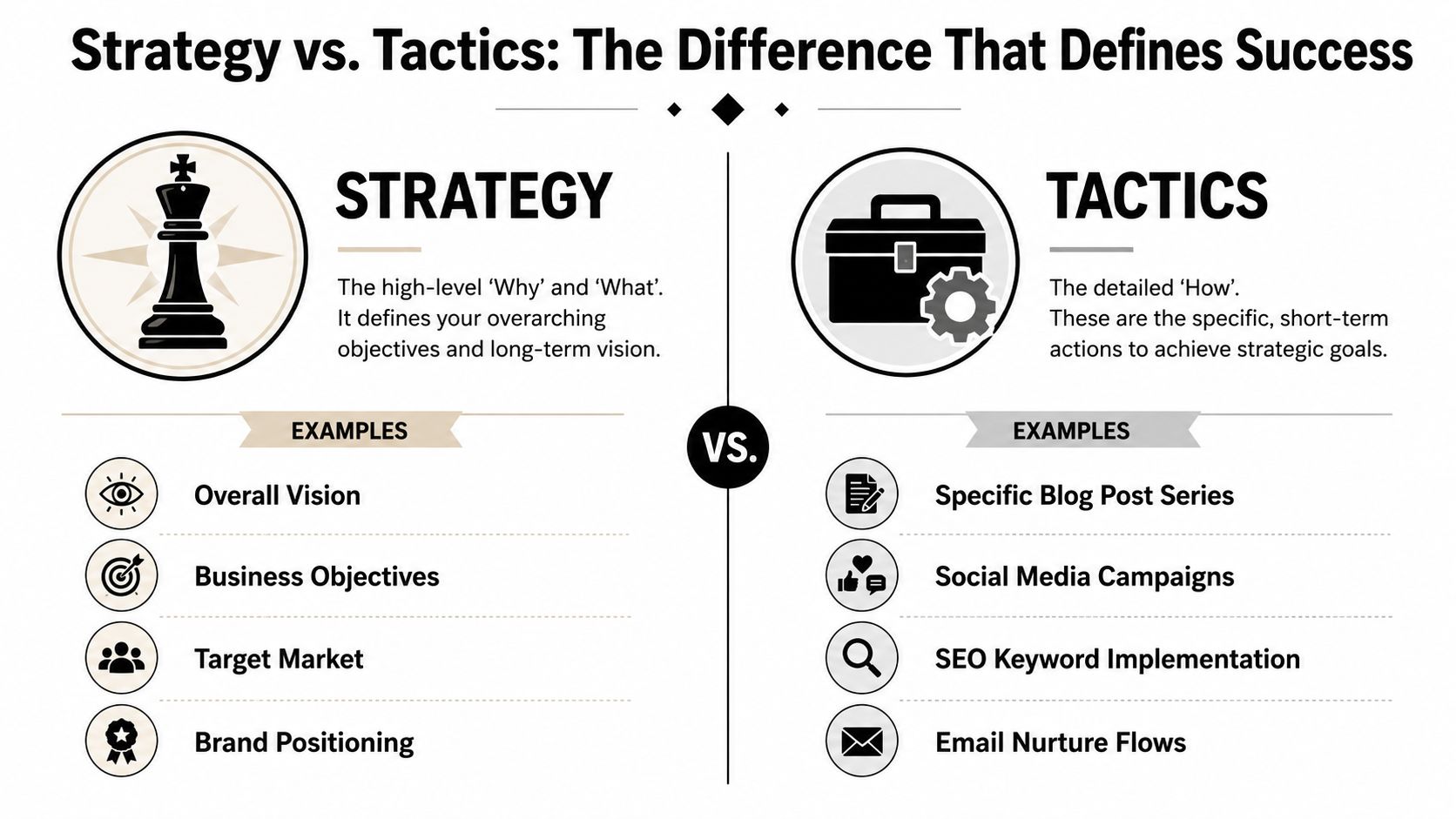
Strategy answers the big questions first.
Once those answers are clear, tactics become easier to choose. You stop copying creators with different business models, audiences, and goals.
Tactics answer the smaller execution questions.
This video gives a helpful visual way to think about that split:
If your team debates post formats before it agrees on positioning, it's working backward.
Founders who live only at the tactical layer burn out fast. Every week starts from zero. Every content idea feels isolated. Every result feels random. A strategy fixes that because it creates continuity. One article supports a larger theme. One video reinforces a viewpoint. One interview contributes to a broader reputation.
That's the ultimate win. Tactics generate outputs. Strategy creates momentum.
Founders do not need a bigger content calendar. They need a system that turns their ideas, decisions, and hard-won lessons into assets that keep building reputation while they run the business.
Use a flywheel, not a media company cosplay. Keep it tight. Keep it repeatable. Keep it tied to the name you want to own five years from now.
Personal brand content works best when it answers one question clearly: what should people trust you for?
Hinge Marketing makes a strong point in its guide to digital content strategy for professional services firms. Strong strategy starts by owning a small set of issues and using keyword research to connect positioning with discoverability. That applies to founders just as much as firms.
If your content jumps between random topics, your audience gets fragments instead of a clear body of work. Influence does not come from volume. It comes from repetition with substance.
Pick a narrow set of issues you want attached to your name. Good categories usually fall into three buckets:
A founder who commits to a few issues gets remembered. A founder who comments on everything gets scrolled past.
Your best content should start as something substantial. An article. A solo video. A podcast interview. A keynote. A sharp founder memo.
From there, break it into smaller assets that fit the channels you use. One interview can become a long-form article, a newsletter topic, short clips, quote cards, a thread, and talking points for future appearances. Starting from zero every time is wasteful. It also weakens your message because each post comes out disconnected from the last.
Use this workflow:
That last step matters more than founders think. Old content shapes your reputation too. If it no longer reflects your current thinking, it undermines your authority.
If you want a sharper model for this process, read your personal brand content strategy that works in 2026.
A good framework respects the fact that you are building a company, not trying to win a posting contest.
That means your raw material should come from places where you already think out loud. Sales calls. Team meetings. Voice notes. Interviews. Investor updates. Founder memos. Customer objections. Those moments contain essential substance. Content strategy turns them into durable IP.
This is how personal brands become legacy assets instead of vanity projects. You are not filling feeds. You are documenting judgment, sharpening your point of view, and making your name mean something specific in the market.
Legacy Builder is one example of a strategy-led service built around extracting a founder's positioning, voice, and content pillars, then turning those inputs into ongoing content. That can help when the problem is not a lack of ideas, but a lack of time and consistency.
Most personal brands don't fail because the founder lacks expertise. They fail because the system around that expertise is weak.
The pattern is predictable. Someone starts strong, posts for a few weeks, copies a few trending formats, gets uneven results, then either chases volume or disappears. Neither path builds trust.
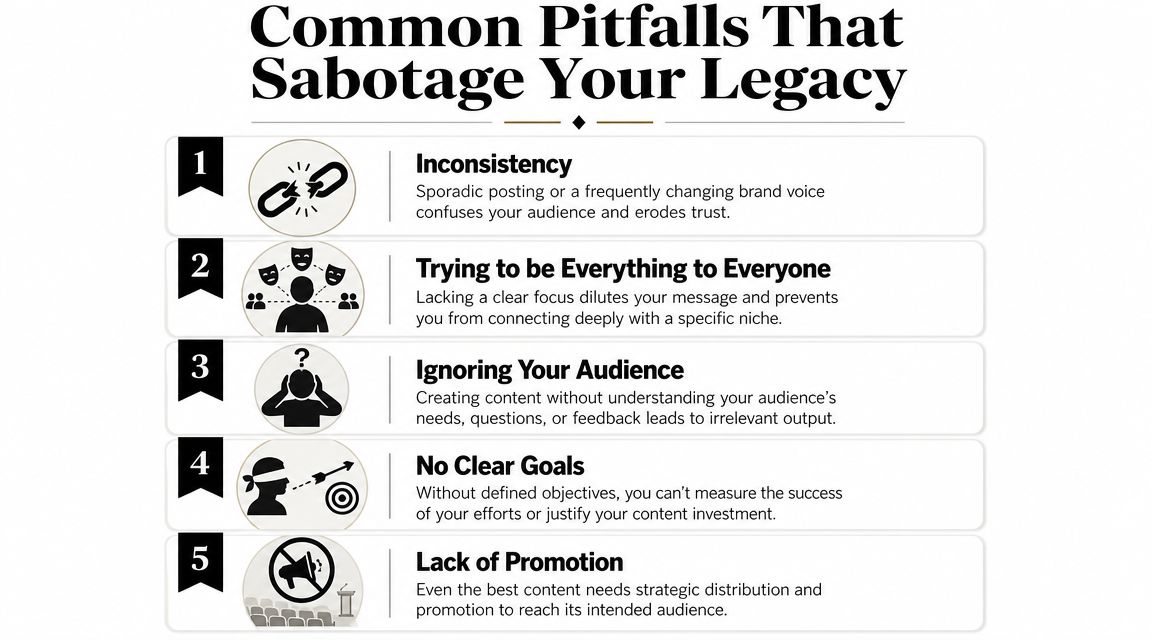
Inconsistency
Sporadic publishing trains your audience not to expect anything from you. The bigger issue is reputational. People start to experience your brand as unfinished.
Trying to be everything to everyone
This usually shows up as random topic drift. One day leadership. Next day growth hacks. Then a product rant. Then a personal story with no connection to your positioning.
Ignoring audience reality
Founders often publish what they want to say, not what the audience needs help understanding. Good strategy sits at the intersection of your expertise and the market's recurring questions.
No clear goals
If you don't know whether content should drive authority, leads, partnerships, recruiting, or speaking opportunities, you can't evaluate it properly.
Weak promotion
Publishing is not distribution. A strong article buried on a quiet blog doesn't become influential just because it exists.
Strong content with no distribution plan is a draft you happened to publish.
Here, older content advice breaks down.
Contentful notes that Google's AI Overviews are reaching over 1.5 billion users monthly in its article on how to build a digital content strategy. It also highlights the practical consequence. When AI summaries appear, traditional organic click-through rates can decline. That means a founder can be increasingly visible in search ecosystems while getting fewer clicks than older dashboards would suggest.
So stop acting like pageviews are the whole game.
A modern personal brand should also ask:
That's the shift. You're no longer optimizing only for visits. You're optimizing for citation-worthiness, memory, and downstream action.
Most founders look at metrics the way amateurs look at casino lights. They notice whatever flashes.
Likes. Impressions. Follower bumps. Those numbers can be useful, but they're weak if they don't connect to business intent. A personal brand isn't a fan club. It's a reputation system tied to opportunity.
Don't build a giant dashboard on day one. Pick one business objective for this quarter and attach a small set of KPIs to it.
Here's a simple approach:
| Goal | Useful KPIs | Weak substitutes |
|---|---|---|
| Authority building | Inbound podcast invites, speaking inquiries, partnership conversations | Raw likes |
| Lead generation | Qualified DMs, contact form submissions, booked calls | Generic reach |
| Audience growth | Email replies, newsletter signups, repeat engagement from the right people | Follower count alone |
| Trust and market feedback | Sales-call mentions, client objections addressed by content, comments from ideal buyers | Broad impressions |
Use a lightweight review process every month.
A good companion resource is this guide on how to measure content performance for your personal brand.
Metrics should help you make decisions. If your reporting doesn't change what you do next month, it's decoration.
The biggest trap here is false precision. Don't pretend a pile of weak signals equals traction. If your content gets attention from the wrong audience, that's not growth. It's drift.
You don't need a perfect strategy to start. You need a usable one.
The goal of the first month is simple. Build enough structure that your content stops depending on mood, spare time, or last-minute inspiration.
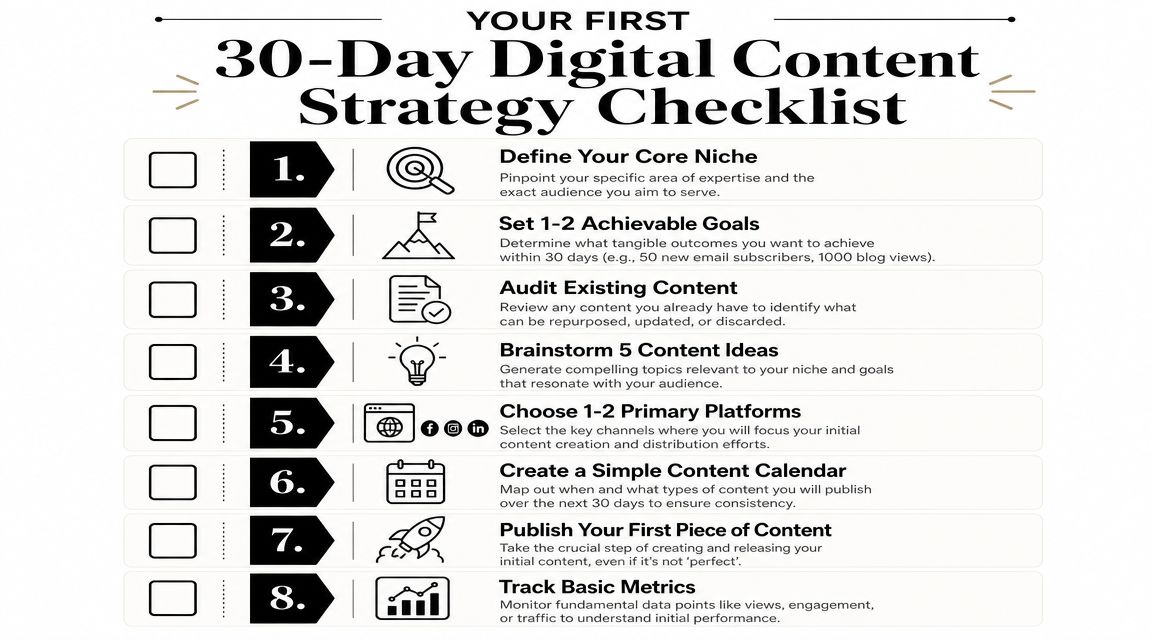
Define your niche
Write one sentence that describes who you help, what problem you solve, and what angle makes your perspective different.
Set 1 or 2 goals
Keep it tight. If your goal is authority, your content should look different than if your goal is pipeline.
Audit existing content
Pull up old posts, interviews, articles, webinars, slide decks, and email sequences. Keep what still reflects your thinking. Cut what doesn't.
Choose 3 core content pillars
These should come from your expertise, your market's recurring questions, and the themes you want associated with your name.
Pick 1 or 2 primary platforms
Stop trying to win everywhere. A focused channel mix beats scattered presence.
Create one pillar asset
Start with one article, video, or interview that captures a meaningful idea in depth.
Build a simple calendar
Map the next few weeks. Topic, format, channel, publish date, CTA. If video is part of the plan, Framesurfer's video planning tool is a practical resource for organizing shots, sequences, and production tasks before you hit record.
Track early signals
Don't obsess over scale yet. Watch for relevance. Are the right people engaging? Are conversations starting? Are you getting clearer on what your audience wants from you?
Month one is not about becoming prolific. It's about becoming coherent.
If you finish the month with a clear niche, a few strong themes, one source asset, a repeatable posting rhythm, and a simple measurement habit, you're ahead of most founders already. That foundation matters because it gives you something to refine instead of something to constantly reinvent.
If you want help turning your expertise into a structured personal brand system, Legacy Builder helps founders and professionals turn their ideas, positioning, and lived experience into consistent content with a clear strategic direction.


You could – but most in-house teams struggle with the nuance of growing on specific platforms.
We partner with in-house teams all the time to help them grow on X, LI, and Email.
Consider us the special forces unit you call in to get the job done without anyone knowing (for a fraction of what you would pay).
Short answer – yes.
Long answer – yes because of our process.
We start with an in-depth interview that gives us the opportunity to learn more about you, your stories, and your vision.
We take that and craft your content then we ship it to you. You are then able to give us the final sign-off (and any adjustments to nail it 100%) before we schedule for posting.
No problem.
We have helped clients for years or for just a season.
All the content we create is yours and yours alone.
If you want to take it over or work on transitioning we will help ensure you are set up for success.
We want this to be a living breathing brand. We will give you best practices for posting and make sure you are set up to win – so post away.
Subscribe to our newsletter and get insights on how to grow your personal brand.
