.svg)
Subscribe to our newsletter and get insights on how to grow your personal brand.
Thank you! Your submission has been received!
Oops! Something went wrong while submitting the form.
.svg)


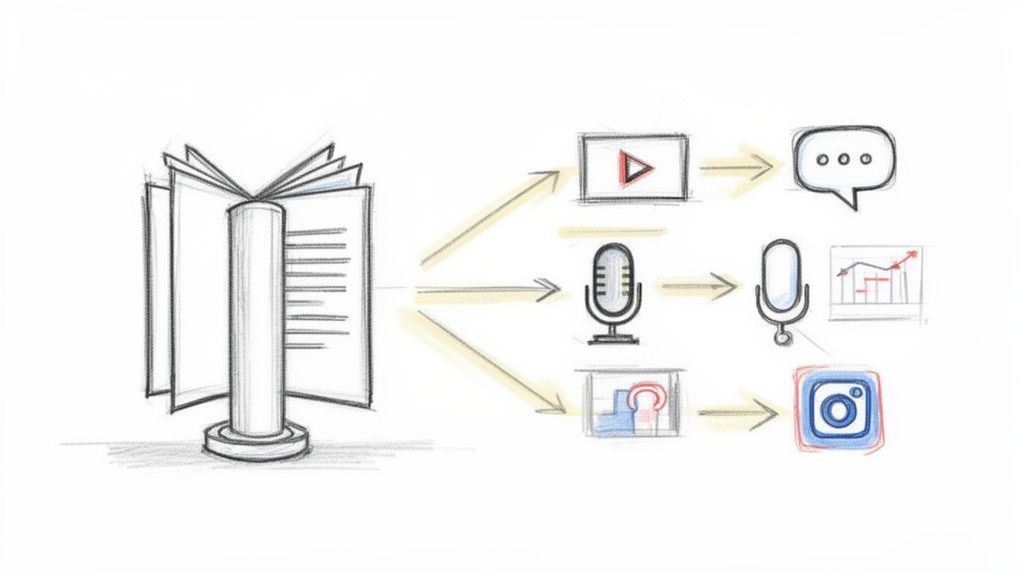
Ever feel like you're stuck on a content treadmill, constantly chasing the next new idea? There’s a smarter way to work, and it’s called content repurposing.
It's the simple practice of taking one powerhouse piece of content and strategically slicing it into multiple new formats. Think of it as working smarter, not harder, by turning a single asset—like a webinar or an in-depth blog post—into dozens of smaller pieces perfect for different platforms.
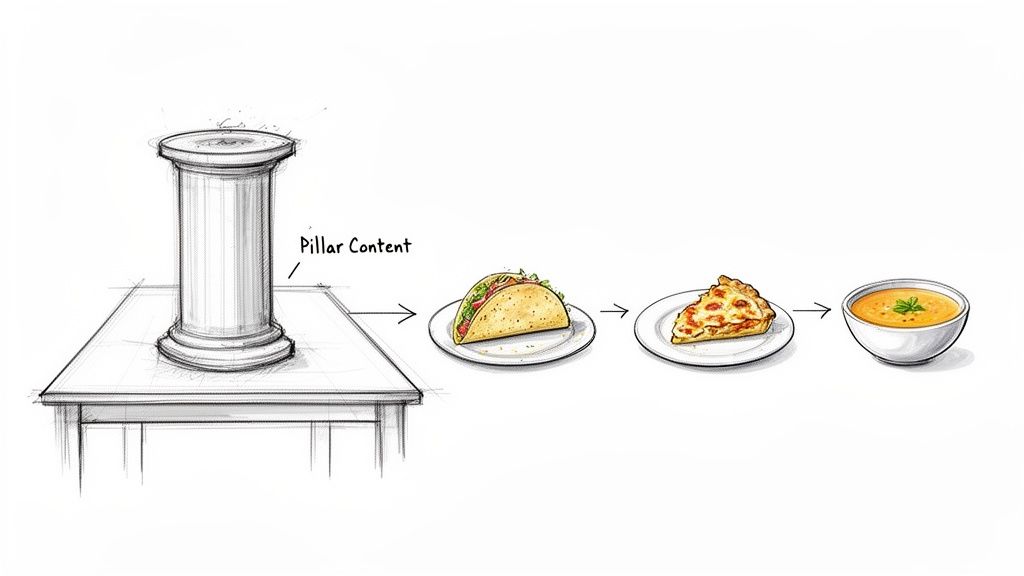
Let's use an analogy. Imagine you spend hours cooking a fantastic brisket. You wouldn't just serve it for one meal and toss the rest, right? Of course not. You'd use the leftovers for sandwiches, tacos, or a hash the next day.
That’s exactly what content repurposing is. You take that one foundational idea—your 'pillar' content—and re-shape it for different channels and audiences. It’s how you finally get off the exhausting "create-once, publish-once" hamster wheel.
The old-school content model demanded a never-ending stream of brand-new ideas. It was a fast track to burnout. The modern approach, however, is all about squeezing every last drop of value from your best work. This isn't about lazy copy-pasting; it's a strategic adaptation.
To see this shift in action, let's compare the two mindsets.
This table really shows the difference. One is a sprint, the other is a marathon you can actually sustain.
So how does this transformation work in practice? It boils down to a few key principles:
This isn’t some fringe tactic anymore; it’s a core marketing function. A recent ReferralRock survey found that a staggering 94% of marketers already repurpose their content. On top of that, data shows 42% of marketers see updating and repurposing as a top driver of campaign success—right up there with creating new assets from scratch.
Repurposing isn't about being lazy; it's about being ruthlessly efficient. It ensures your most powerful ideas reach the widest possible audience by meeting them where they are, in the format they prefer.
The traditional approach often feels like shouting into the void and just hoping someone hears you. The repurposing model is different. It’s a deliberate, sustainable system for building real authority and a commanding presence.
By focusing on a 'repurpose-first' mindset, you're not just creating posts; you're building a content ecosystem where every single piece works together to amplify your core message.
Ready to dive deeper? You can explore additional content repurposing strategies to get more ideas on how to build a more robust and effective content engine for your brand.
For any busy founder or leader, time is the one resource you can never get back. This is what makes content repurposing more than just a smart marketing trick—it’s a strategic lifeline for building a killer personal brand without completely burning out.
Think of it as the engine that turns your limited time into daily, high-impact visibility.
Instead of constantly chasing the next new idea, you can pour your energy into just a few high-value concepts and then multiply their impact across the board. This approach ensures your core message actually gets seen by the right people, in the format they prefer, on the platforms they’re already using. You’re essentially creating an echo chamber for your expertise.
A strong personal brand is built on a clear, consistent message. Repurposing is hands-down the best way to hammer that message home again and again without sounding like a broken record.
By framing your core ideas in different formats, you’re not just repeating yourself; you’re giving your audience new ways to understand your perspective. Each new format is a fresh doorway into your world. A deep-dive blog post will grab your analytical thinkers, while a snappy 60-second video clip will catch the fast-scrollers. This multi-format strategy makes your point of view impossible to ignore.
The goal isn't just to be present on multiple platforms; it's to be powerfully consistent. Repurposing turns one great idea into a unified brand story told across your entire digital footprint.
This consistency is what builds trust and recognition. When your audience sees the same core ideas showing up in articles, videos, and graphics, your message sinks in and solidifies your authority. It’s a foundational piece of building a modern brand, something we cover in detail in our complete guide on a modern playbook for personal branding for leaders.
Your best insights—the gold from a keynote speech, a great webinar, or a deep-dive interview—are incredibly valuable assets. Leaving them locked in a single format is like striking gold and only keeping one nugget. Content repurposing is how you extract every last ounce of value from that initial effort.
Let's look at the return on investment (ROI) from just one hour of your time:
This approach massively cuts down the cost and effort of creating each piece of content. You invest your time and energy once into a high-quality "pillar" piece, then you reap the rewards for weeks, sometimes even months. For a leader trying to maintain a strong presence without dropping the ball on their real job, that efficiency is everything.
In today's noisy world, authority isn't built with one viral post. It’s forged by consistently showing up with valuable insights. Repurposing is the system that makes this happen.
When people keep bumping into your ideas in different places, it signals deep expertise. Seeing a concept from your keynote pop up again in a detailed LinkedIn article, and then again as a quick tip in a video, creates a powerful perception of mastery.
This is what content repurposing is all about: a system for making you the go-to expert in your field. To really get a feel for the strategic possibilities, you can explore various top content repurposing strategies that break down how to turn your expertise into real-world authority and influence.
Ultimately, this is how you turn your knowledge into a legacy.
Knowing what content repurposing is and why it matters is one thing. Actually doing it is a completely different ballgame. To get this off the ground, you need a system—a repeatable workflow that turns your best ideas into a steady stream of content without all the guesswork.
This five-step process is the exact framework we use. It’s practical, it’s actionable, and it breaks down the entire cycle from finding your hidden gems to measuring what actually works.
Think of it this way: one great idea gets amplified, building your authority and influence piece by piece. That's the end goal.
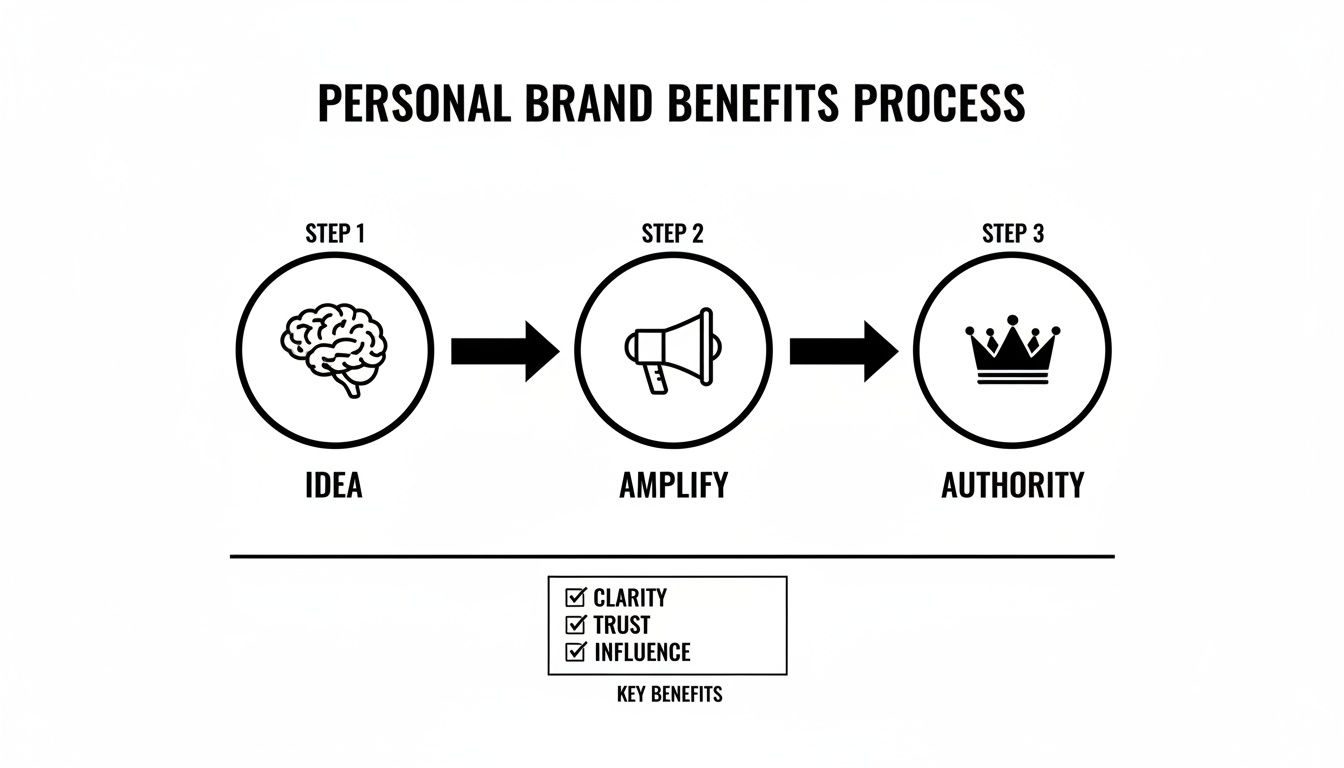
This is what a real content machine looks like in action. Let's break down how to build yours.
First things first, you need to go on a treasure hunt. This is your content audit. You’re digging through everything you’ve already created to find your "pillar" assets—those big, beefy, high-value pieces that can be the foundation for dozens of smaller content spinoffs.
So, what are you looking for?
You’re not trying to boil the ocean here. The goal is to find the top 20% of your content that holds the most weight. These are your gold mines.
Once you’ve found your pillar assets, it's time to decide where to start. Your time is your most valuable resource, so you need to put your effort where it will deliver the biggest punch.
Use these two filters to pick your winners:
By combining hard data with your business goals, you stop repurposing content just for the sake of it. You’re strategically amplifying the ideas most likely to move the needle for your brand.
This data-driven approach takes the emotion out of it and puts all your energy behind proven content.
This is where the real work—and the magic—happens. You're going to adapt and transform that pillar content into new formats for different platforms. This isn’t about copying and pasting; it’s about translating your core message for a new audience and a new context.
Take a 45-minute webinar, for example. You can slice and dice it into:
Each new piece should feel like it was made for that platform, all while reinforcing the same big idea.
You've created an awesome library of repurposed assets. Great. But that's only half the battle. If nobody sees it, it doesn't exist. Strategic distribution is how you make sure your content gets in front of the right eyeballs.
This means you need a plan for when and where each piece of content goes live.
A well-organized distribution plan is the key to staying consistent without getting overwhelmed. A simple calendar can be a game-changer for scheduling everything out. We show you exactly how to set one up in our guide to building a content calendar template for social media that actually works.
Your plan should map out which asset goes to which channel, and on what day. This creates that steady drumbeat of value that keeps you top-of-mind.
The final step is closing the loop. You have to measure your results. A good repurposing workflow isn't set in stone; it’s a living system that you constantly refine based on what the data tells you.
Keep an eye on these key metrics for your repurposed content:
Use these insights to sharpen your strategy for the next round. Double down on what works, and ditch what doesn't. This is how you turn a simple content strategy into a predictable engine for growing your brand.
Theory is great, but let's get down to brass tacks. Seeing content repurposing in action is where the lightbulb really goes on. To get it, you need to see how one high-value piece of content can fuel an entire campaign.
Think of it like this: you spend a ton of energy creating one amazing piece of content—a keynote, a webinar, a deep-dive interview. Instead of it being a one-and-done deal, you treat it like the sun in a solar system, with smaller, powerful pieces of content orbiting around it.
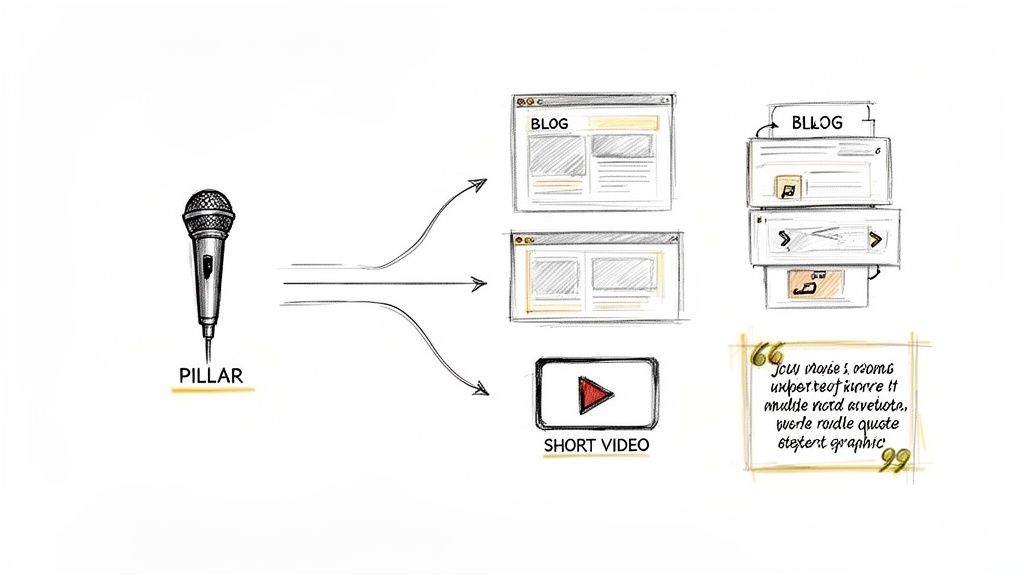
This isn't just about saving time; it’s about strategic amplification. You’re meeting your audience where they are, on the platforms they prefer. This isn’t some fringe tactic, either. A recent HubSpot report found that 48% of social media marketers already share repurposed content with only minor tweaks. It just makes sense.
Let’s walk through a few “recipes” to show you exactly how this works.
Picture this: you've just walked off stage after delivering a killer 45-minute keynote. That recording is a goldmine of your best ideas, stories, and expertise. Instead of letting it collect digital dust on a hard drive, here’s how we turn that single performance into a month’s worth of high-impact content.
Just like that, one speaking gig becomes an entire content engine. You’re not just re-posting the same thing; you’re translating your core message for different platforms and different consumption habits, massively expanding its reach and impact.
Here's another classic scenario for entrepreneurs and leaders: you're a guest on an industry podcast. That 60-minute conversation is packed with authentic, unscripted moments that are pure gold for building your personal brand.
Once you have the audio and video files, you have everything you need to kick off another wave of content.
Here's the game plan:
1x "Key Moments" Blog Post: Don't just dump the transcript. Write a post that pulls out the top five most powerful takeaways from the interview. This curates the best stuff for your audience and adds your own spin.
2x Audiograms (60 seconds): Snag the best audio clips—a killer story or a contrarian take—and turn them into audiograms with animated captions. These are incredibly effective for teasing the full episode on LinkedIn and Instagram.
3x "Myth vs. Fact" Text Posts: Did you bust a few industry myths during the chat? Turn those into a series of punchy text posts for LinkedIn or X. It positions you as a clear-thinking authority who isn't afraid to challenge the status quo.
1x Email Newsletter: Send an email to your list sharing a personal reflection on the interview. Embed one of the best video clips and link out to the full episode to drive listens and deepen the connection with your subscribers.
By following these recipes, you’re not just creating content—you’re building an ecosystem. Every keynote, interview, or webinar becomes a renewable resource that consistently builds your authority and keeps you top-of-mind.
So you've built a system to repurpose your content. That’s a huge win. But here’s the million-dollar question: is it actually working?
The real power of repurposing isn't just about saving a few hours. It’s about getting better, more meaningful results from the work you’re already doing. To see if you’re pulling that off, you have to look past vanity metrics like likes and shares. You need to focus on the KPIs that prove your content is delivering a real, tangible return.
It's not about tracking every single number you can find. It’s about asking the right questions. Is this repurposed tweet driving real action? Is this video clip actually growing my authority? Is any of this helping me hit my business goals?
To get a clear picture, you need to zero in on a few specific areas. These are the metrics that cut through the noise and tell you what’s hitting the mark with your audience and what’s falling completely flat. Think of this data as your feedback loop—it’s what helps you sharpen your entire strategy.
Here are the essential KPIs you should be tracking:
Engagement Rate: This is your best pulse check for audience interest. Don't just glance at the raw like count. Calculate the actual engagement rate (likes + comments + shares / followers) for every single repurposed asset. If a LinkedIn carousel gets a much higher rate than a video clip on the same topic, that’s a massive clue about what format your audience prefers.
Website Traffic and Referrals: A huge goal of repurposing is to pull your audience back to your home base—your website. Jump into your analytics and see which repurposed pieces are sending the most referral traffic. Are the blog posts you spun from your podcast driving more clicks than the audiograms you posted on social?
Lead Generation: This one is non-negotiable. If you're using repurposed content to push gated assets like ebooks or webinars, you need to track conversion rates. How many people who saw that series of short video clips actually went on to download the full guide? This metric directly connects your content to real business growth.
Here's a hard truth: not all content formats are created equal. Different platforms are built for different behaviors. Your audience on TikTok wants quick, punchy value, while the people reading your blog are there for a deep dive. Comparing performance across these channels is how you start optimizing like a pro.
Get started with a simple tracking system. A basic spreadsheet is all you need. For each piece of pillar content, list out every single repurposed asset you created from it. Then, after a set amount of time—say, 30 days—log the key metrics for each one.
This isn't just about crowning a "winner." It's about understanding the specific job each format does. Your short-form videos might be amazing for brand awareness (high reach, low clicks), while your blog post version is a lead-gen machine (lower reach, but sky-high conversions).
Once you have this data, the real work begins. The goal is to create a continuous improvement cycle where the insights from one round of repurposing directly inform the next.
Look for the patterns. Do repurposed assets about a specific topic always knock it out of the park, no matter the format? That tells you exactly what your audience is hungry for. Are carousels consistently your top performer on LinkedIn? Great—double down on them.
This data-driven approach takes all the guesswork out of your content strategy. It ensures that with every cycle, your content gets sharper, your message gets clearer, and the ROI of your repurposing efforts becomes impossible to ignore.
Even with a solid plan, jumping into a new strategy always brings up questions. It's totally normal. Getting these sorted out upfront is the key to ditching the guesswork and feeling confident you're on the right track.
Let’s tackle some of the most common things leaders ask when they first start repurposing their content.
This is the big one. Content repurposing saves a massive amount of time, but not in the way most people think. It's about shifting your effort from the constant hamster wheel of "what do I post today?" to front-loading that creative energy into one high-value "pillar" piece.
Once that's done, the rest is just execution—which is a whole lot faster. For a busy founder, this means a single 60-minute podcast interview can fuel an entire month of social media content. We're talking about saving dozens of hours you'd otherwise spend brainstorming and creating from scratch.
This is a valid fear, but it almost never happens when you do it right. Good repurposing isn't just copying and pasting the same sentence everywhere. It's about translating your core message for different platforms and the people who use them.
Someone who wants to go deep will read your full blog post. The person scrolling Instagram on their lunch break will catch the 30-second video clip on the same topic. Because people consume content in different ways—and let’s be real, the algorithms don't show all your posts to all your followers—repurposing actually makes it more likely your message will land, without ever feeling repetitive.
You want to start with your "pillar" content. Think of these as the big, foundational pieces that are packed with your best ideas, stories, and unique insights. They're the gold mines.
The best pillar content usually comes from things like:
- Keynote speeches or presentations
- Podcast interviews (yours or ones you've been a guest on)
- In-depth webinars
- Long-form, cornerstone blog posts
- Detailed case studies that tell a story
These are loaded with raw material you can slice and dice into dozens of smaller, bite-sized assets for all your other channels.
Absolutely. In fact, it’s a killer SEO strategy. You can take a video that's getting great engagement and turn it into a keyword-optimized blog post that starts ranking on Google. Or, you can bundle a few related articles into a "definitive guide" that other sites will want to link to.
When you create a bunch of different assets all centered around a core topic, you’re basically telling search engines that you're an authority on that subject. This helps you rank higher for your key terms across text, video, and even image searches.
Ready to get off the content treadmill and start building a personal brand that actually works for you? Legacy Builder turns your expertise into a steady stream of high-impact content, so you can get back to leading. Find out how we can build your legacy.


You could – but most in-house teams struggle with the nuance of growing on specific platforms.
We partner with in-house teams all the time to help them grow on X, LI, and Email.
Consider us the special forces unit you call in to get the job done without anyone knowing (for a fraction of what you would pay).
Short answer – yes.
Long answer – yes because of our process.
We start with an in-depth interview that gives us the opportunity to learn more about you, your stories, and your vision.
We take that and craft your content then we ship it to you. You are then able to give us the final sign-off (and any adjustments to nail it 100%) before we schedule for posting.
No problem.
We have helped clients for years or for just a season.
All the content we create is yours and yours alone.
If you want to take it over or work on transitioning we will help ensure you are set up for success.
We want this to be a living breathing brand. We will give you best practices for posting and make sure you are set up to win – so post away.
Subscribe to our newsletter and get insights on how to grow your personal brand.
