.svg)
Subscribe to our newsletter and get insights on how to grow your personal brand.
Thank you! Your submission has been received!
Oops! Something went wrong while submitting the form.
.svg)



Let’s be honest. Content governance sounds like something only a massive corporation would need. But strip away the corporate-speak, and it’s simply your brand’s playbook. It's the set of rules that dictates how you create, publish, and manage every single piece of content.
This playbook is what ensures every blog post, social media update, and video you put out tells one consistent, powerful story—instead of a dozen conflicting ones.

Have you ever seen a brand that feels all over the place? One day they’re posting professional, polished videos, and the next, it’s a blurry photo with a caption that completely misses the mark. That’s what happens when you’re just creating "random acts of content."
It’s like a ship with no rudder. Without a clear plan, your teams are just guessing. They waste time and money on content that’s off-brand, outdated, or even a legal liability. This doesn't just confuse your audience; it actively erodes the trust you’re working so hard to build.
Content governance flips the script. It turns that chaos into a well-oiled machine, giving you the clarity and control to build a real digital legacy. Every piece of content becomes a strategic asset, not just another post.
Look, the idea of having rules for content isn’t new. The term really started gaining traction in the early 2010s when businesses were drowning in digital content. Back in 2015, a survey found that a staggering 70% of B2B marketers didn't have a documented content strategy. The result? Total chaos.
Fast forward to today, and the stakes are much higher. By 2026, projections show companies that get governance right see up to 3.5 times higher content marketing ROI. They also slash production mistakes by as much as 40%. You can dig deeper into content governance's impact if you're curious.
The message is clear: as the pace of content creation speeds up, the cost of being disorganized is just too high. The reward for getting it right, on the other hand, is massive.
To really get what content governance is and why it matters, you have to see the difference between having a plan and just winging it. The contrast hits everything from how people see your brand to your actual bottom line.
Here’s a straightforward look at the two realities.
At the end of the day, content governance isn't about bureaucracy or making things harder. It’s about building a system that empowers your brand to communicate with purpose, clarity, and consistency, no matter how fast you grow. It's the move that turns your content from a business expense into your most powerful growth engine.
A strong content governance framework isn’t some abstract idea—it’s a practical blueprint built on five core pillars. Get these right, and you’ll create order from the chaos.
Think of it as your operating system for content. Each part has a job, and they all have to work together. Miss one, and the whole system starts to lag.
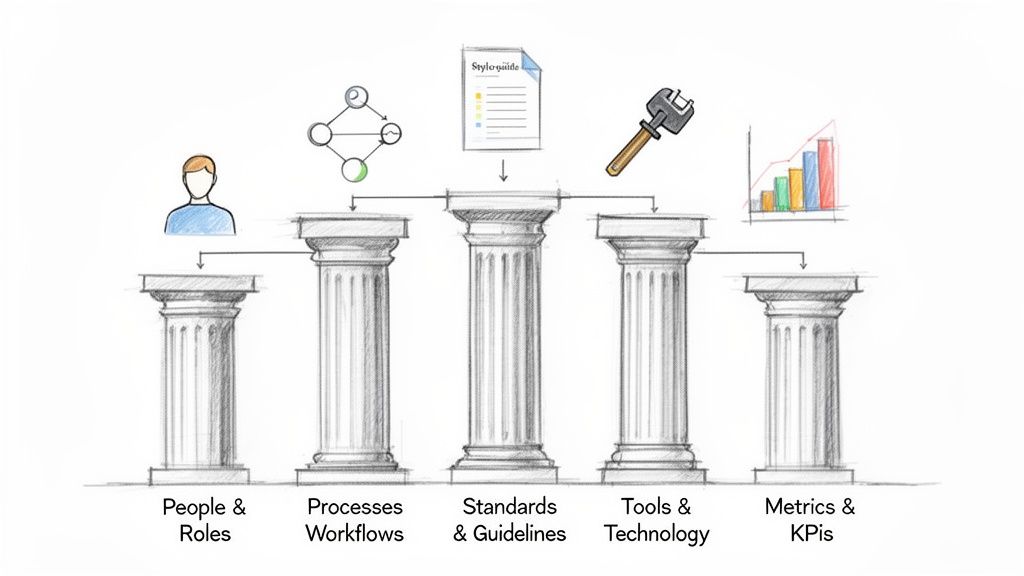
Let's break down exactly what these pillars are and how they bring clarity and control to your content.
Before a single word gets written, you have to answer one simple question: who owns what?
This is all about assigning clear roles and accountability. Without it, tasks get dropped, approvals turn into endless bottlenecks, and everyone assumes someone else is handling it.
It’s like a pro sports team. The quarterback has a job, the coach has a job, and they don't try to do each other's. Content is no different.
You need to define who is responsible for what. Key roles often include:
If roles define who, processes and workflows define how.
This pillar maps out the entire journey for a piece of content, from a raw idea to a published asset and, eventually, to being archived or updated. A documented workflow is your content assembly line—it builds consistency and efficiency right into the system.
A documented workflow removes all the guesswork. It’s the single source of truth that tells your team exactly what to do next, who to pass it to, and when. This is how you stop wasting time and prevent costly missteps.
This workflow should cover every stage: ideation, drafting, editing, SEO review, design, legal approval, publishing, and promotion. Each step needs a clear owner and a defined handoff to the next person.
This pillar answers the most important question for your brand: What makes our content ours?
It’s the rulebook for your brand’s unique voice, style, and look. These standards are the guardrails that keep your content consistent and recognizable, no matter who creates it.
The key documents you’ll need here are:
Your tools and tech stack are the infrastructure that makes all the other pillars work. They help automate workflows, store your assets, and make it easier for everyone to collaborate.
The right tech doesn't just support your governance—it enforces it. Common tools include a Content Management System (CMS), a Digital Asset Management (DAM) system for your creative files, and project management software to keep everything on track.
So, how do you know if any of this is actually working? You measure it.
This final pillar is all about defining your Key Performance Indicators (KPIs) to track how effective your content is and prove its value. These numbers move you beyond vanity metrics and tie your content directly to business results.
Good KPIs help you understand content performance, brand consistency, and how efficiently your team is operating.
Moving from content chaos to a system that actually works isn't some big, mystical project. It’s a step-by-step build. Think of it like building a house: you wouldn't just start throwing up walls without a plan. You survey the land, draw up the blueprints, and then you start building.
This is exactly how you bring order to your content. Let's walk through it, phase by phase.
Before you build anything, you need to know exactly what you're working with. A content audit is you walking the property line, mapping out every single asset you own. This is where you find out what’s working, what’s broken, and where your biggest opportunities are hiding.
Start by making a master list of all your content. I mean everything.
Once you have the list, run through it with a simple checklist for each piece. Is it accurate? Does it sound like your brand? Is it actually doing anything for you? This gives you a clear picture of the mess and proves why you need a plan in the first place.
Now that you know what you have, it's time to design the rules of the road. Your governance blueprint defines the roles, workflows, and standards that will guide your content from here on out.
This isn't about creating red tape. It's about creating clarity. When people know the rules of the game, they can stop worrying about approvals and focus on being creative and getting results.
Your blueprint needs to cover a few key things. Use this as your guide:
Skipping this step is where the real money gets lost. A recent report found that major companies lose a staggering $12.5 billion every year because of inconsistent messaging and compliance mistakes. The data also showed that 65% of organizations battle with poor content quality because they have no clear rules, which can tank conversion rates by as much as 30%.
With a solid blueprint in your hands, you’re ready to build. The secret to a successful rollout is to go slow. Don't try to change everything overnight—you'll just create chaos.
Start with a small pilot program. Introduce the new model to just one team or for a single content type, like your blog. This lets you test your new workflows in the real world, get feedback, and fix what’s not working before you go all-in.
As you expand, make training and communication your top priority. Run workshops to walk your team through the new rules and tools. Make sure all your new guidelines are saved in one central place where everyone can find them. A slow, steady rollout gets everyone on board and makes sure your new system actually sticks.
If you want more practical tips on managing your content effectively, our guide on content management best practices for building a personal brand is a great next step.
All this talk about systems is great, but what does it actually look like when it works? It’s one thing to build a framework; it’s another to see it turn into real growth and authority.
Let’s look at the proof. These stories from a SaaS founder and an entrepreneur show how even a simple, focused governance plan can deliver massive returns.
I know a SaaS founder who was shouting into the void on LinkedIn. Their posts were all over the place—one day a technical deep dive, the next a personal story, then some generic industry news. The visuals were a mess, and there was no clear call to action. It was a classic case of "random acts of content."
So, they got serious and put a dead-simple governance plan in place, focusing on just two things: standardized messaging and visual consistency.
The results were insane. By getting their messaging and visuals in order, the founder’s LinkedIn follower count exploded by 180% in just six months, jumping from 5,000 to 14,000. Better yet, that consistency built real authority, leading to a huge spike in qualified demo requests.
This isn't just a one-off story. By 2026, 80% of enterprises are expected to use governance dashboards to track their results, a massive jump from just 35% in 2023. It’s becoming critical for avoiding the 45% content decay that happens when assets get old and irrelevant. You can get more details on these governance trends on Contentful.
This simple flow chart shows the exact process they used to get there.
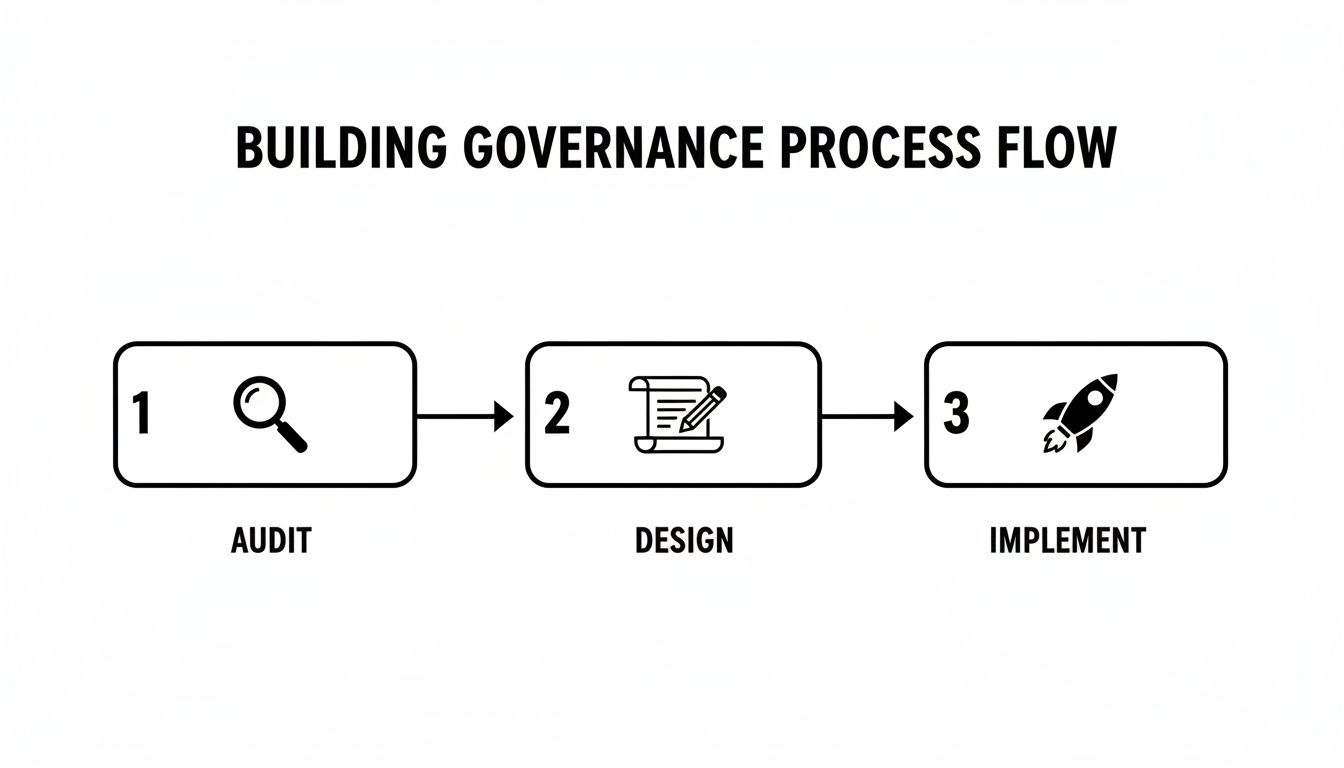
The takeaway is simple: you have to audit what you’ve got, design a clear plan, and then execute without getting distracted.
Another entrepreneur was running a blog, a newsletter, and a bunch of social accounts. They were creating a ton of stuff, but it all felt disconnected. The blog post never made it to the newsletter, and social media felt like it was on a different planet. Unsurprisingly, engagement was flat, and their subscriber list had hit a wall.
Their fix was a straightforward content workflow to tie everything together.
The new rule was simple: No piece of content lives in a vacuum. Every core piece of content must be repurposed and distributed across at least two other channels.
For example, every time a new long-form blog post went live, it automatically triggered two more tasks:
This simple workflow created a powerful echo chamber for their ideas. The results? A 55% jump in overall engagement and a newsletter list that doubled in just three months. By building a system for content reuse, they squeezed every drop of value out of each idea and built a brand that felt cohesive and authoritative.
Let’s be honest. A new content rulebook is useless if it doesn’t deliver real results. After you’ve put in the work to build a governance model, how do you prove it’s actually winning the game for you? This is where we stop chasing vanity metrics and start talking about a tangible return on investment (ROI).
Measuring the impact of your governance isn't about counting likes or followers. It’s about tracking the real-world operational shifts that lead to business growth. When you know which numbers to watch, you can confidently show anyone that a structured content system isn't just an expense—it's a profit driver.
If you want to measure success, you need to focus on Key Performance Indicators (KPIs) that directly show the efficiency and consistency your new framework creates. These numbers give you the hard data you need to prove your point.
Here are three of the most important metrics to start tracking immediately:
The goal here is simple: connect your content operations directly to business outcomes. When you can show that faster content velocity led to more leads, or that a higher reuse rate slashed your budget, you've successfully proven your ROI.
The best part? You don’t need expensive or complicated tools to track these KPIs. You can get started with simple spreadsheets and calendars to establish a baseline. From there, just watch how the numbers improve as your governance model really takes hold.
We're seeing a massive shift in the industry. By 2026, projections show 75% of leaders will be tracking governance KPIs like content velocity through AI dashboards, a huge jump from just 28% in 2023. We already know from historical data that a solid governance plan can boost content reuse by 60% and cut creation costs by 35%—all while demands are getting higher.
If you want to get really granular on the financial impact, learning how to measure content marketing ROI is a must. This will help you tie all your operational improvements directly back to revenue.
To help you get started, I’ve put together a simple table outlining the most important metrics. Don't overcomplicate it—just pick a few, track them consistently, and let the data tell the story.
Start here. These metrics are more than just numbers on a page; they're the proof that your hard work is paying off and that a well-governed content strategy is one of the smartest investments you can make.
Let’s be real. “Content governance” sounds like a corporate buzzword that has no place in a personal brand or a growing business.
But it’s not about adding red tape. It’s about creating freedom.
When you stop the random acts of content and get a real system in place, you’re not building a cage—you’re building a launchpad. You give yourself and your team the clarity to be more creative and authentic, not less. It’s how you make sure every single post, video, and article builds your legacy, not just fills a slot on the calendar.
Getting started is the hardest part. Most people get stuck trying to create a perfect 100-page rulebook from day one.
Forget that. It’s not about boiling the ocean. It’s about creating momentum.
The goal is progress, not perfection. Each small, intentional step you take builds the foundation for a more powerful, consistent, and influential brand presence. Don't let the scale of the "perfect" plan stop you from taking immediate action.
Ready to take control? Pick one of these and get it done this week. You’ll be shocked at the clarity it creates.
Define Your Three Core Content Pillars
What are the three main topics your brand will own? Write them down. From this point forward, every piece of content must map back to one of these pillars. This simple rule forces focus into your strategy instantly.
Create a One-Page "Voice and Tone" Guide
Open a doc. If your brand were a person, what three adjectives would describe them? What words do you always use? What words do you never use? This one-pager is now the North Star for your brand’s personality.
Map Your Simplest Content Workflow
Draw out the five most basic steps your content follows from “idea” to “published.” It could be as simple as: Idea -> Draft -> Review -> Final Approval -> Publish. Assign one person to own each step. You just built your first workflow.
Taking these steps moves content governance from a vague idea to a real tool you can use.
To keep that momentum going, you need to get it organized on a schedule. For a great starting point, check out our guide on creating a content calendar template for social media that actually works.
You now have the knowledge—and the first steps—to stop creating random content and start building a real legacy.
Let's cut through the noise. The term "content governance" sounds complicated and corporate, but it's not. It’s just a system to keep your brand consistent and save you from chaos.
Here are the questions I get all the time from founders and entrepreneurs, with no-fluff answers.
No. That's a myth. Governance isn't about a hundred-page binder of rules. For a personal brand or a small team, it's about simple, smart guardrails.
Think of it like this:
This isn't about adding bureaucracy. It's about building a machine for efficiency, whether your team is one person or a hundred. Starting with a simple system now is how you prepare for growth without the headaches later.
This is a classic case of spending a little time now to save a ton of time later. The initial setup is an investment that pays you back by killing rework, ending confusion, and speeding up your content game.
For a personal brand or small business, you can knock out a solid first version in a weekend. Focus on the essentials: your voice, your core message, and a basic workflow.
Don't aim for a perfect plan on day one. A "good enough" framework that you actually use is a thousand times better than a perfect plan that never gets finished. Start small and let it evolve.
Yes, and you should. AI is a massive help in executing the rules you set. For example, tools like Grammarly Business or Writer.com can act like a brand cop, automatically enforcing your style and tone across everything your team writes.
AI can also help automate your workflows in project management tools or audit your old content for anything that's outdated or off-brand. Just remember—AI is the tool, not the strategist. You still have to define the "why" and the authentic voice that makes your brand yours.
I hear this fear a lot, but the truth is the exact opposite. Good governance doesn't kill creativity; it unleashes it.
When you give your team a clear framework—the mission, the audience, and the brand standards—you free them up. They stop worrying about approvals, formatting, and whether they're "on brand." All that mental energy can go toward what actually matters: coming up with killer ideas that hit the mark, every single time.
It’s the difference between telling someone to "go paint something" and giving them a canvas with a clear mission.
Building a brand that lasts requires a system. At Legacy Builder, we specialize in turning your story into a consistent, high-impact content strategy that builds real authority. If you're ready to stop posting randomly and start building a true legacy, we can help.


You could – but most in-house teams struggle with the nuance of growing on specific platforms.
We partner with in-house teams all the time to help them grow on X, LI, and Email.
Consider us the special forces unit you call in to get the job done without anyone knowing (for a fraction of what you would pay).
Short answer – yes.
Long answer – yes because of our process.
We start with an in-depth interview that gives us the opportunity to learn more about you, your stories, and your vision.
We take that and craft your content then we ship it to you. You are then able to give us the final sign-off (and any adjustments to nail it 100%) before we schedule for posting.
No problem.
We have helped clients for years or for just a season.
All the content we create is yours and yours alone.
If you want to take it over or work on transitioning we will help ensure you are set up for success.
We want this to be a living breathing brand. We will give you best practices for posting and make sure you are set up to win – so post away.
Subscribe to our newsletter and get insights on how to grow your personal brand.
