.svg)
Subscribe to our newsletter and get insights on how to grow your personal brand.
Thank you! Your submission has been received!
Oops! Something went wrong while submitting the form.
.svg)


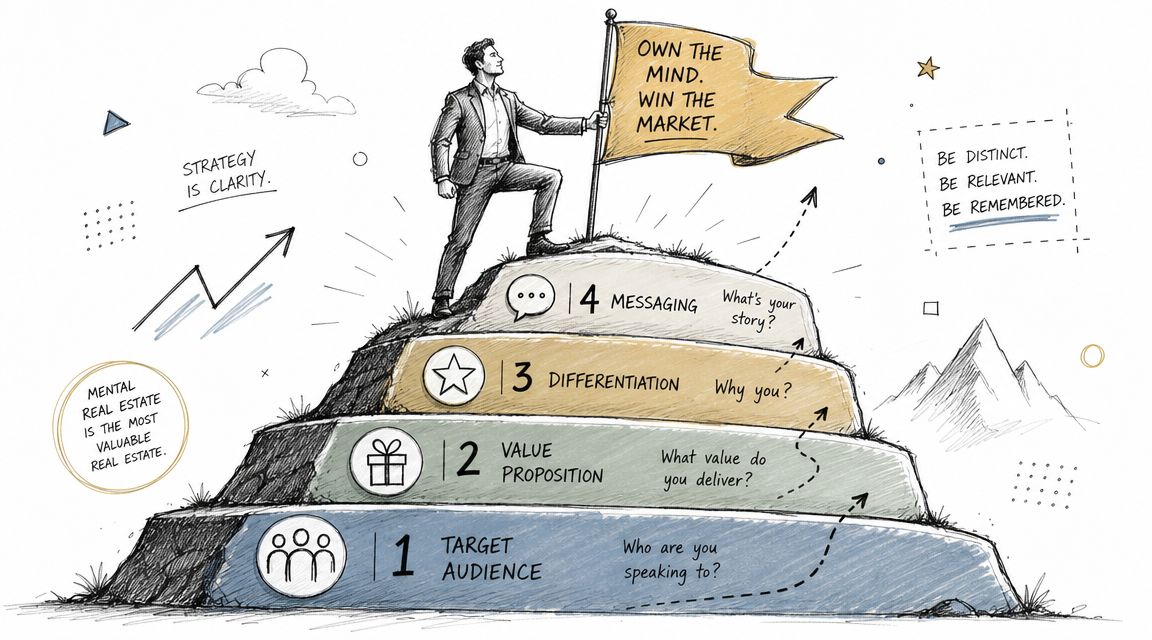
Most advice about brand positioning is useless for founders because it starts with the wrong question. It asks, “What do you want your brand to say?” I think that's backwards. Instead, the question is, “What do you want people to remember and repeat about you when you're not in the room?”
That's what is brand positioning strategy really about. Not logos. Not taglines. Not clever bios. Not a vague promise to “help businesses grow.”
If you're a founder, consultant, operator, or creator, your problem usually isn't capability. It's clarity. You know your craft. Your audience just doesn't instantly understand why you're the right choice. When that happens, people reduce you to a generic label. “Marketing consultant.” “SaaS founder.” “Leadership coach.” “Content person.” Once the market files you into a generic category, you become easy to ignore and hard to refer.
Good positioning fixes that. It gives people a sharp mental shortcut for your value. It turns scattered credibility into a coherent advantage. It also makes every downstream decision easier, from your offers to your content to your sales conversations.
The biggest myth in branding is that positioning is a luxury for big companies with giant ad budgets. It isn't. It matters more when you're a personal brand because you have fewer chances to make the right impression.
A company can hide behind distribution, paid media, or brand recognition. You can't. When someone lands on your LinkedIn profile, watches a clip, reads your website, or gets referred to you, they make a fast judgment about what lane you own. If you haven't defined that lane, they'll define it for you. Usually badly.
A lot of founders chase visibility first. More posts. More podcast appearances. More networking. More content volume. That sounds productive, but if your message is fuzzy, more visibility just spreads confusion faster.
You don't need everyone to know your name. You need the right people to know what you're known for.
According to NIQ's summary on brand positioning, 87% of customers said they choose brands that align with their personal values, while 71% actively avoid brands that do not. That matters because buyers don't choose based on competence alone. They choose based on fit, trust, and identity. For personal brands, that's even more obvious. People aren't only buying a service. They're buying your judgment, your standards, and your way of seeing the problem.
Practical rule: If your market can't quickly tell what you believe, who you help, and why your approach is different, you don't have a positioning strategy. You have content activity.
Strong positioning also changes how people price you in their heads.
When your positioning is weak, prospects compare you on surface-level factors. Price. speed. availability. General experience. When your positioning is strong, they compare you on relevance. That's where authority lives.
Here's what I tell founders who say, “My work speaks for itself.” No, it doesn't. Your work needs interpretation. Buyers are busy. They won't study your body of work and uncover your genius. You have to frame it for them.
That's why brand positioning is one of your most valuable assets. It shapes referrals, inbound quality, sales friction, collaboration opportunities, and the kind of audience you attract. A weak position makes you replaceable. A clear one makes you referable.
Brand positioning is the specific place you occupy in your ideal client's mind relative to alternatives. That's the definition that matters in practice.
Harvard Business School describes it as staking out “mental real estate” through a differentiated customer value proposition. I like that phrase because it's concrete. You are claiming a small but valuable piece of land in someone's head. If you don't claim it deliberately, someone else will.
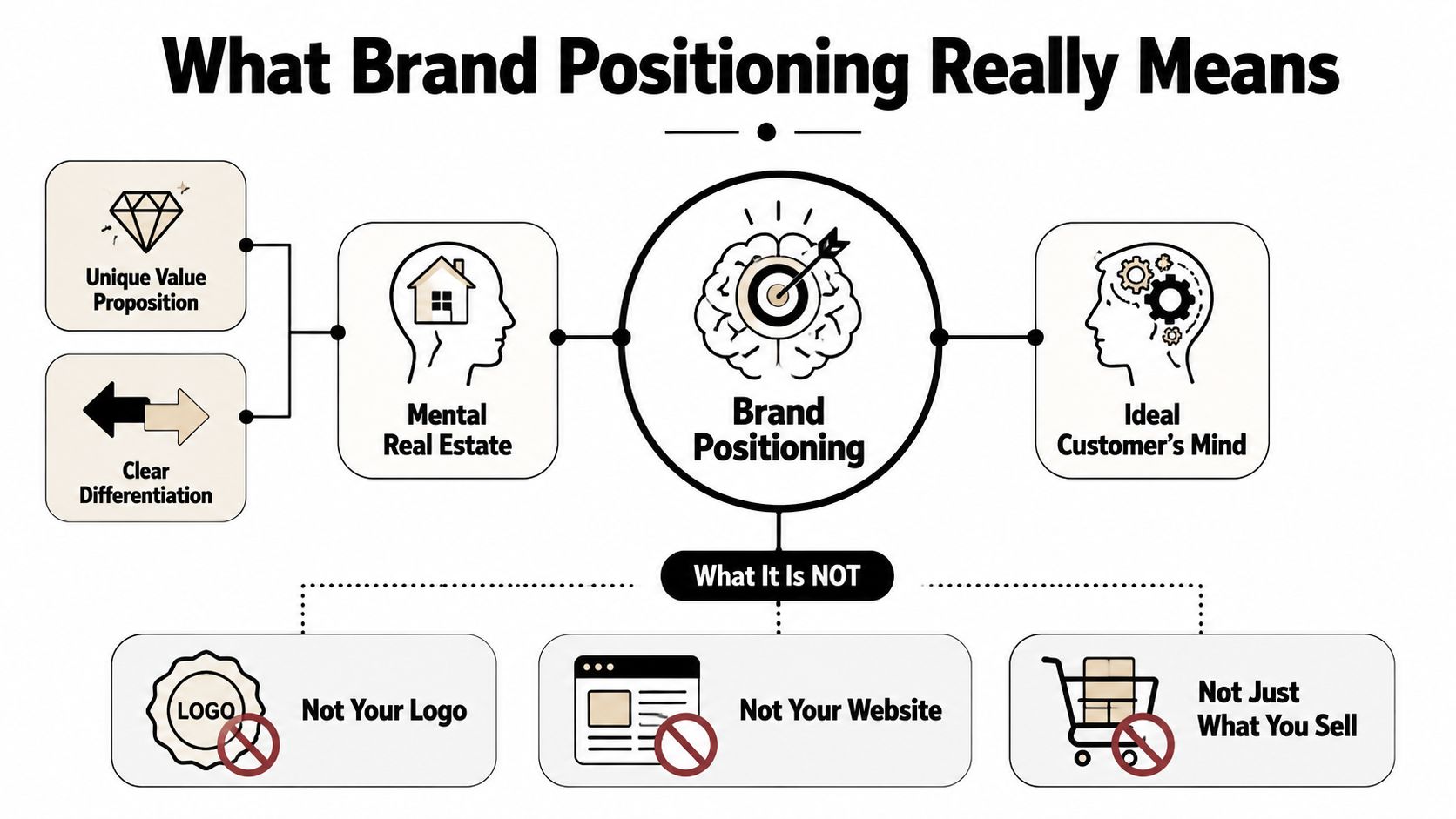
A clean visual identity helps. A polished website helps. A sharp headshot helps. None of those things are your position.
Your position is the belief people hold about your value.
That's why two professionals can offer similar services and get wildly different reactions. One looks interchangeable. The other feels obvious. Same category. Different mental ownership.
If you want a useful companion read, Carlos Alba Media offers expert insights on brand identity that pair well with this distinction between how a brand looks and what it owns in the audience's mind.
A lot of people confuse a tagline with a position. They're not the same thing.
A tagline is a line of copy. A position is the strategic logic underneath it.
Here's the difference:
Good positioning creates recognition before it creates admiration.
That's why positioning should guide your offers, your content themes, your sales calls, your profile copy, and even the stories you tell about your work. It isn't a decoration you add at the end. It's the filter you use before you publish, pitch, or launch anything.
Ask yourself this:
If your audience can answer those questions after spending a few minutes with your brand, your positioning is probably working. If they can't, your message may sound polished but still be strategically weak.
Most weak positioning falls apart because one core piece is missing. The founder knows their craft, but they haven't connected the dots between audience, value, difference, and communication.
That's why I treat positioning like a structure. If one pillar is soft, the whole thing feels unstable.
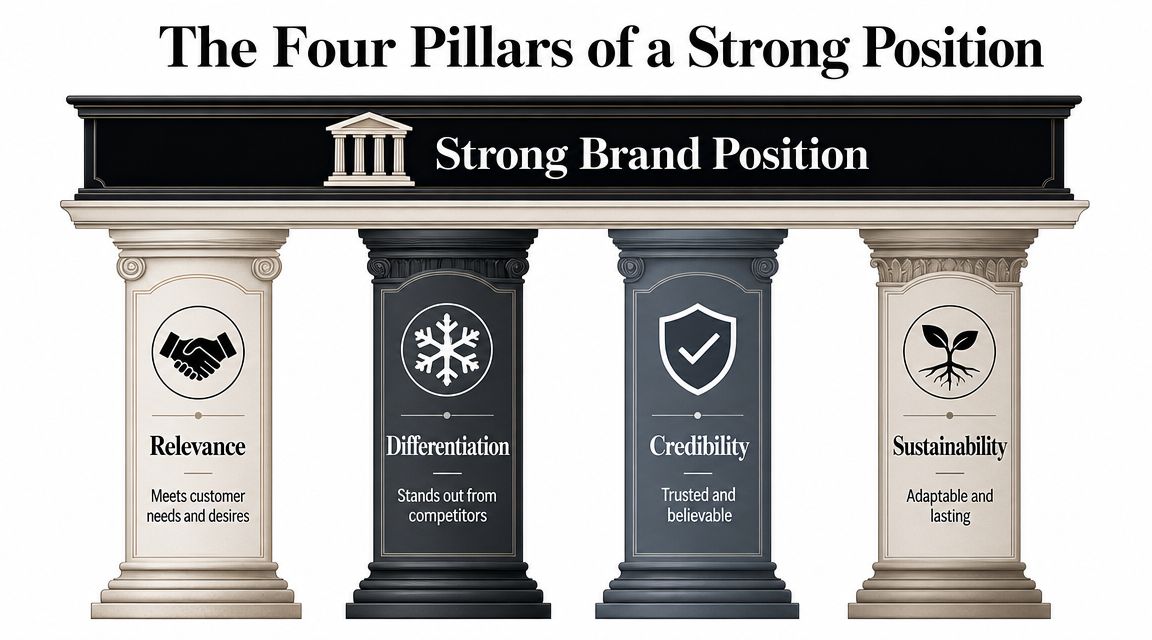
You can't build a sharp position around “founders,” “business owners,” or “professionals.” Those labels are too broad to produce useful messaging.
A real audience definition includes context. Stage. urgency. ambition. frustration. language. buying trigger.
For example, “B2B founders” is weak. “Bootstrapped SaaS founders with traction but no clear category narrative” is usable. That level of specificity changes your content, your offer design, and your examples.
Ask better questions:
Your value proposition is not your service menu. It's the clear business result or transformation you help create.
Too many professionals describe what they do in process language. “I provide consulting.” “I build content systems.” “I offer executive coaching.” Buyers care less about the container and more about the outcome.
A stronger value proposition sounds more like this:
The point isn't to sound dramatic. The point is to connect your work to an outcome people already want.
Too often, many get lazy. They say things like “personalized service,” “data-driven approach,” or “authentic storytelling.” That's not differentiation. That's category wallpaper.
Real differentiation usually comes from one of these sources:
| Source of difference | What it looks like |
|---|---|
| Perspective | You see the problem differently from others in your space |
| Method | You solve it through a distinct process or system |
| Specialization | You focus on a narrow type of client or problem |
| Credibility | Your background gives you unusual authority on the issue |
If your differentiator can be copied into a competitor's homepage without sounding strange, it isn't a differentiator.
The best differentiator isn't always flashy. It's often the clearest reason the right buyer says, “That's exactly who I need.”
Messaging is the visible expression of the other three pillars. It translates your position into words people can understand, remember, and repeat.
Bad messaging sounds inflated. Good messaging sounds specific. It names a buyer, a problem, a point of view, and a practical promise.
Your content should reinforce the same underlying position across formats. LinkedIn posts, podcast interviews, your website headline, your sales deck, and your intro at events should all point to the same core idea. If they don't, people get fragments instead of clarity.
Most founders don't need a branding workshop. They need a disciplined way to stop sounding generic.
I use a simple framework for personal brands. It's practical, repeatable, and grounded in reality. Not wishful thinking.
Start with the visual model below, then work through each step with ruthless honesty.
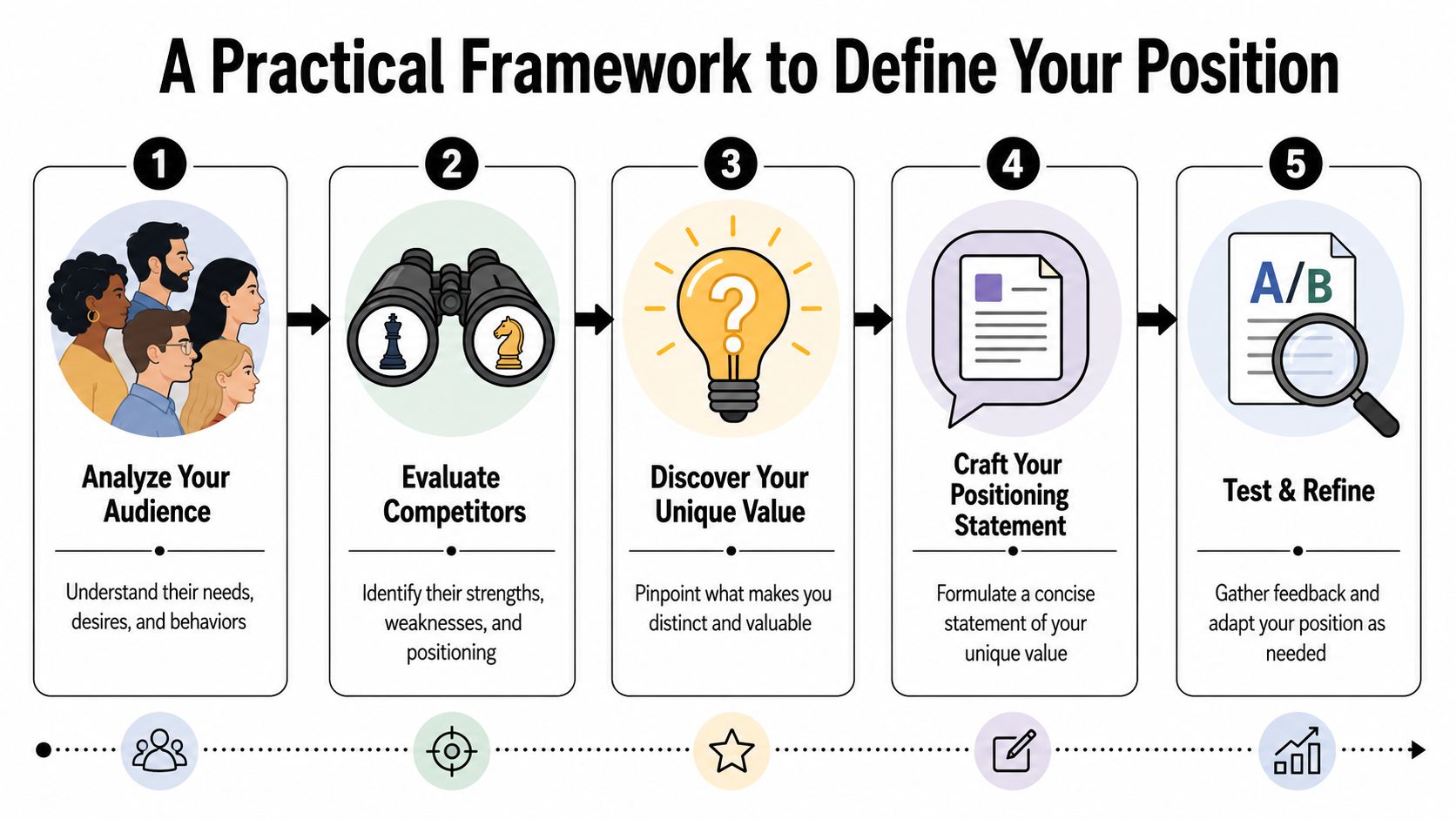
First, study your audience. Not in a vague persona-document way. Look at real signals. Sales calls. DMs. comments. objections. reviews. referral language. The words people already use are usually more valuable than the copy you invent in isolation.
Then study the competitive field. Not to copy it, but to identify sameness. Open ten profiles in your category. Read ten websites. Watch how people describe themselves in bios and video intros. You'll usually find the same recycled promises repeated everywhere.
Adobe reports that 64% of consumers say personalized experiences influence their purchasing decisions in its brand positioning guide. For a founder building a personal brand, that means generic positioning is even more dangerous now. If your audience is drowning in cheap, AI-assisted content, your position has to feel recognizably human and customized.
A related skill here is showing your thinking on camera. If you want help with that, Unfloppable has useful video strategies for founders that can strengthen how your position shows up in public.
Later in this process, many founders also need to narrow their lane before they can articulate it well. This guide on finding your niche with authenticity and profit in mind is a useful companion because positioning gets easier once your niche stops being vague.
Next, define your unique value. I don't mean your dream identity. I mean the intersection of three things:
You should now get brutally practical. What do clients repeatedly praise? Where do you create fast clarity? What part of your process changes the decision for buyers? What pattern do you spot that others miss?
Then turn that into a positioning statement. Keep it plain. A useful version often sounds like this:
I help [specific audience] achieve [specific result] by [distinct approach], especially when [context or pain point].
That's not your public slogan. It's your internal compass.
Positioning should be tested, not worshipped.
Say the statement in sales calls. Put a version in your profile headline. Build a short landing page around it. Share content that reflects it. Then pay attention to what people echo back.
If you run this process with support, use real operators, not vague brand theatre. That can include a strategist, a messaging consultant, a peer advisory group, or a service like Legacy Builder, which offers a strategy conversation to extract a founder's positioning, voice, and content pillars before shaping content around them.
What matters is simple. Your positioning must be true, useful, and repeatable. If it sounds impressive but you can't deliver it consistently, scrap it.
The fastest way to understand positioning is to compare weak statements with strong ones. Generic positioning isn't always wrong. It's just forgettable. The sharper version usually doesn't say more. It says it with clearer stakes.
A freelance consultant often starts with this:
“I help businesses with marketing strategy.”
That tells me almost nothing. Here's a stronger position:
“I help founder-led B2B companies clarify their message so sales calls stop starting with basic education.”
The first describes a service. The second claims a specific problem and a practical business effect.
A SaaS founder might say:
“We build software for team productivity.”
That's broad and crowded. A more useful position could be:
“We help remote product teams reduce decision chaos by turning scattered feedback into one clear operating view.”
Now the buyer can place it.
An industry thought leader might say:
“I talk about leadership and growth.”
That's content-category language. It isn't a position. A sharper version sounds like:
“I help new executives earn trust fast by teaching the communication habits that make teams follow them willingly.”
That gives the audience a role, a challenge, and a reason to care.
Use this canvas to draft your own.
| Element | Prompt | Your Answer |
|---|---|---|
| Audience | Who exactly do you help, and in what situation are they when they need you? | |
| Problem | What painful, expensive, or frustrating issue are they trying to solve? | |
| Outcome | What result do they want that your work helps create? | |
| Difference | What do you do differently from others in your category? | |
| Proof | What experience, method, or evidence makes your claim believable? |
If you want extra inspiration, these brand positioning statement examples and templates can help you move from a rough draft to a tighter statement.
One warning. Don't copy a template word for word and call it strategy. Use the structure to discover your angle, not to flatten it.
Most positioning problems don't come from a lack of talent. They come from bad assumptions. Founders assume sounding broad makes them more marketable. They assume listing services creates clarity. They assume polished copy can cover strategic confusion. It can't.
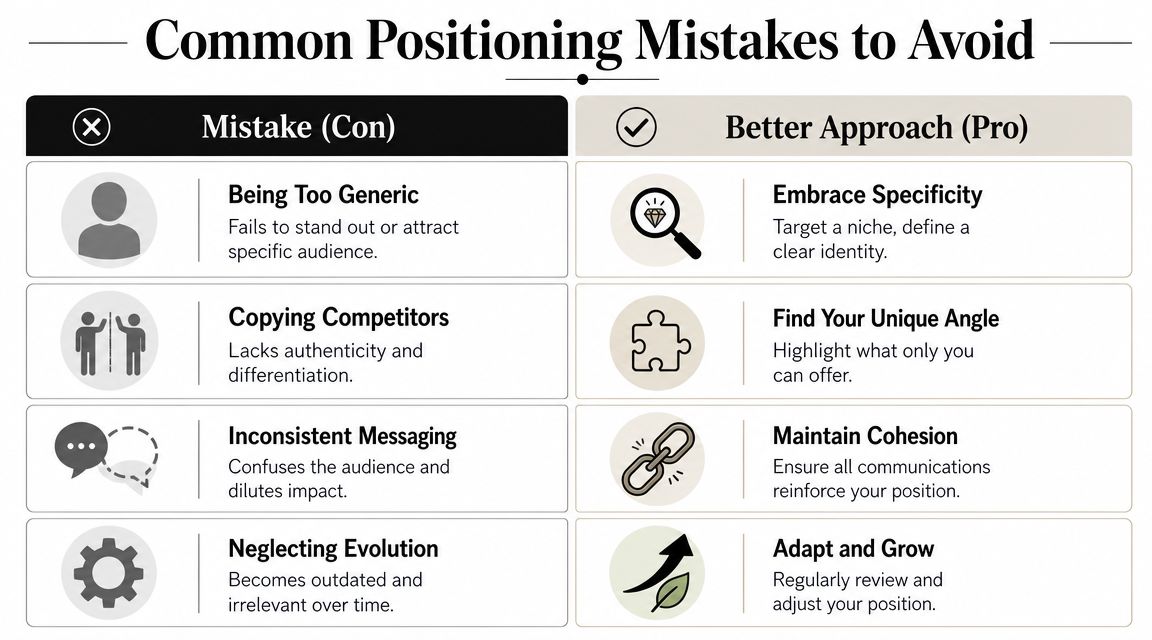
If your message tries to attract everyone, it won't feel urgent to anyone. Broad positioning feels safe because it avoids exclusion. In reality, it kills relevance.
The fix is to narrow your language around a situation, not just a demographic. Speak to a real moment of need. Buyers respond when they feel recognized.
A lot of professionals claim differences that buyers don't value. “White-glove service.” “Custom process.” “Passion.” “Years of experience.” None of those are persuasive on their own.
Use this quick filter:
If the answer falls apart, your differentiator is weak.
Stop trying to sound different. Start trying to be easy to choose.
This mistake is expensive because it destroys trust. You position yourself as strategic, premium, selective, or insight-driven, but the actual client experience feels rushed, generic, or inconsistent.
That gap teaches the market not to believe you.
Correct it by aligning delivery with promise. If your position is built on clarity, your onboarding should feel clear. If your position is built on premium judgment, your process should reflect discernment. Positioning isn't copy first. It's operational truth expressed clearly.
Some founders sound one way on LinkedIn, another on their website, and another in live conversations. That fragmentation weakens memorability.
Your fix is not robotic repetition. It's message cohesion. Define a few core phrases, proof points, and themes that show up across channels. People should encounter the same underlying position whether they read a post, hear you on a podcast, or get introduced over email.
A positioning statement is not a sacred artifact. It's a working hypothesis. You put it into the market, then you watch what comes back.
That mindset matters because a lot of founders either change too fast or never change at all. Both are mistakes. If you pivot every week, your audience never learns you. If you never refine your position, you miss what the market is telling you.
Attest and Adobe recommend validating positioning with research and then refining it through engagement and feedback in this positioning strategy overview. I agree with that completely. If people can't articulate what makes you distinct, your positioning has failed at the perception layer.
The best signals are often qualitative before they're quantitative.
Watch for things like:
Then pair that with business signals from your own funnel. Landing page conversions, consultation quality, content engagement by topic, reply quality, and close rates all help you see whether the market understands your position.
If you want a cleaner way to track visibility signals, this guide on how to measure brand awareness and fuel your growth is worth reading.
Don't rewrite your position just because one post flopped. That's insecurity, not strategy.
Refine when you notice a pattern. Maybe people love your insights but still misunderstand your offer. Maybe you're attracting too broad an audience. Maybe your best clients keep describing your value in a way that's stronger than your own messaging. Those are useful signals.
A practical review rhythm looks like this:
| Signal | What it may mean |
|---|---|
| People are confused | Your wording is too abstract or too broad |
| People are interested but not qualified | Your audience definition is too loose |
| People engage deeply with one topic | Your strongest position may be narrower than you thought |
| Clients describe your value better than you do | Your market language is stronger than your internal copy |
The right move is usually refinement, not reinvention. Keep the core truth. Sharpen the edges.
No. Personal brands need it even more because people often buy the person before they buy the offer. Your credibility, judgment, and reputation sit much closer to the transaction.
It's the deliberate process of defining the distinctive place you want to occupy in the mind of a specific audience.
No. Positioning is the strategy. Messaging is how you express that strategy in copy, conversation, content, and sales material.
More specific than feels comfortable, but not so narrow that it becomes fake. You want a position that makes the right people feel seen and the wrong people self-select out.
Start with the buyer's problem and desired result. Then bring in your personal angle, method, and credibility. A personal brand works best when your identity supports the value instead of replacing it.
Short enough that you can say it naturally. Clear enough that another person can repeat it accurately. If it needs a paragraph of explanation, it isn't sharp yet.
Change it when your audience, offer, proof, or market reality has shifted enough that your current position no longer reflects how you create value. Don't change it because you got bored.
If your brand still feels scattered, Legacy Builder can help you turn your expertise into a clear position people understand and remember. Visit Legacy Builder if you want structured support shaping your voice, content pillars, and online presence around a sharper personal brand.


You could – but most in-house teams struggle with the nuance of growing on specific platforms.
We partner with in-house teams all the time to help them grow on X, LI, and Email.
Consider us the special forces unit you call in to get the job done without anyone knowing (for a fraction of what you would pay).
Short answer – yes.
Long answer – yes because of our process.
We start with an in-depth interview that gives us the opportunity to learn more about you, your stories, and your vision.
We take that and craft your content then we ship it to you. You are then able to give us the final sign-off (and any adjustments to nail it 100%) before we schedule for posting.
No problem.
We have helped clients for years or for just a season.
All the content we create is yours and yours alone.
If you want to take it over or work on transitioning we will help ensure you are set up for success.
We want this to be a living breathing brand. We will give you best practices for posting and make sure you are set up to win – so post away.
Subscribe to our newsletter and get insights on how to grow your personal brand.
