.svg)
Subscribe to our newsletter and get insights on how to grow your personal brand.
Thank you! Your submission has been received!
Oops! Something went wrong while submitting the form.
.svg)


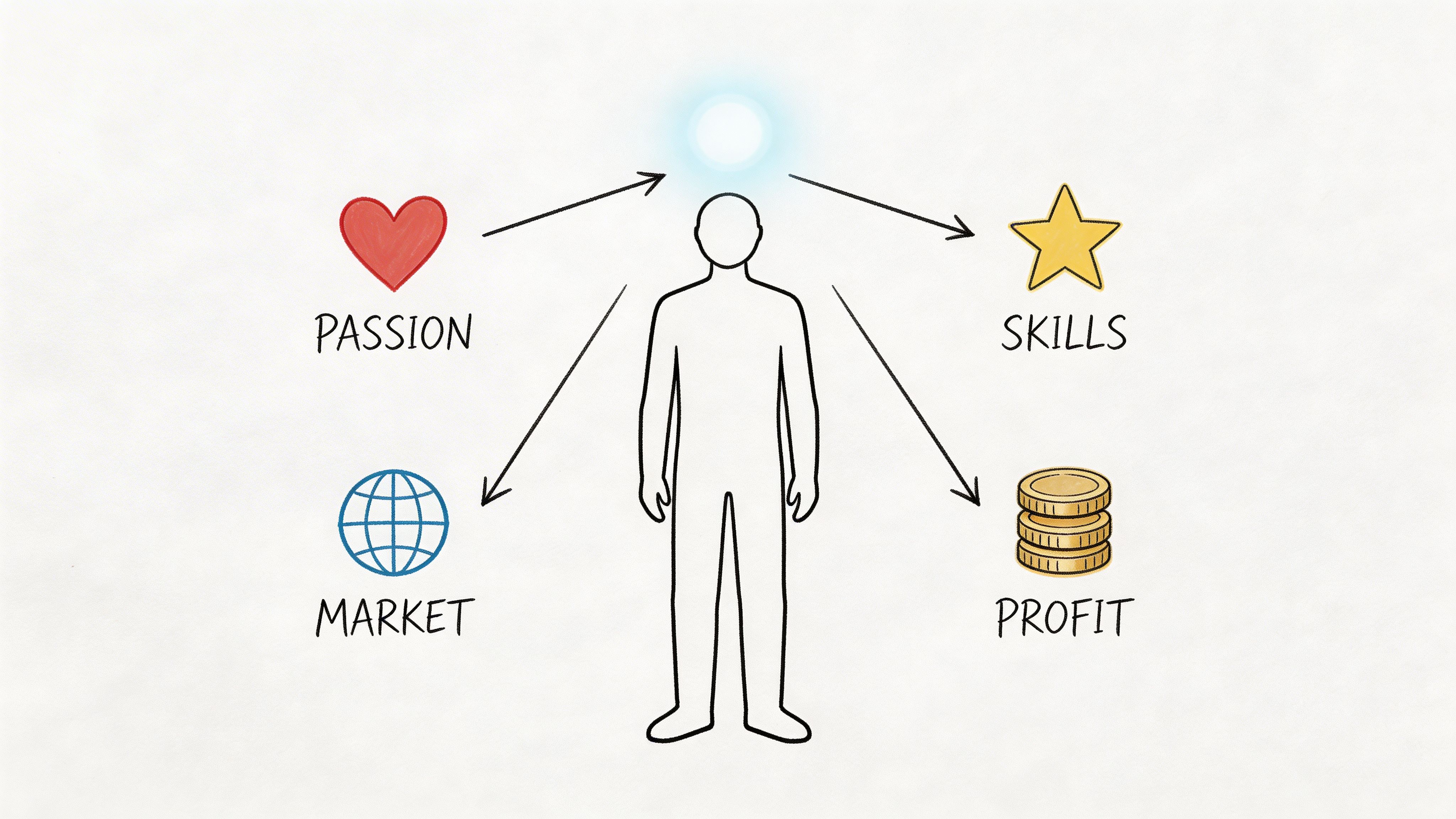
Advice on how to find your niche is often wrong in one of two ways.
The first camp tells you to follow your passion and trust that money will sort itself out. It often doesn’t. Passion without demand gives you a personal hobby with a logo.
The second camp tells you to chase whatever looks profitable. That often fails too. You might force yourself into a market you can sell to, but you’ll hate the work, sound generic, and quit the moment results slow down.
A strong niche sits at the intersection of identity and demand. It should feel true enough that you can talk about it for years, and specific enough that other people instantly know why they should care.
That is the true work. Not picking a trendy label. Not inventing a personal brand persona. Not trying to be “for everyone.” You need a niche that comes from your lived experience, your strengths, and clear market evidence that people want help, insight, or leadership in that area.
If you skip the authenticity piece, you become interchangeable. If you skip validation, you waste time making polished content for an audience that never shows up.
The perfect niche isn’t hiding somewhere, waiting for you to discover it like buried treasure. You build it.
That matters because too many smart people waste months trying to “figure out their one thing” before they publish a single post, offer a single service, or talk to a single buyer. They think clarity comes first. It often doesn’t. Clarity comes from structured reflection, then testing.
The bigger myth is that your niche must be either very personal or commercially smart. That’s lazy advice. A niche that lasts does both.
You need three things working together:
Many individuals fail because they only pick one of those.
Someone says, “I help entrepreneurs grow online.” That’s too broad to mean anything. Another says, “I only help former architects who now run vegan productivity startups.” That’s so narrow it can become impossible to sustain. Someone else picks a hot topic because it looks profitable, but they have no real conviction, no original viewpoint, and no stamina.
You don't find your niche by choosing a label. You find it by identifying a pattern where your story, your skill, and a real problem overlap.
If you want a niche that compounds, stop asking, “What should I call myself?”
Ask better questions:
A durable niche starts here.
Before you touch keyword tools, you need a personal inventory.
Many people skip this because it feels less productive than market research. That’s a mistake. If you don’t know what you bring to the table, you’ll borrow someone else’s positioning and wonder why your content feels flat.
Validating niches emotionally, not just through data, is critical. Professionals often fail because generic, keyword-driven niches don’t align with personal stories, leading to burnout. Niches with strong emotional fit for overlooked demographics yield higher retention, as noted in this piece on untapped niche markets and emotional validation.

Your niche rarely comes from your title alone. It comes from the combination of roles, scars, obsessions, and repeated wins.
Make four lists. Don’t overthink them.
Skills people already trust you for
These are things others ask your help with. Writing. Sales calls. Positioning. Team leadership. Product thinking. Client communication.
Experiences that changed how you think
Career pivots, business failures, recoveries, reinventions, unusual industries, hard-earned lessons.
Topics you return to without effort
The ideas you talk about in meetings, posts, DMs, and conversations without needing motivation.
Problems you hate seeing people struggle with
Your future niche often starts with this. Frustration is a clue.
You’re looking for patterns, not perfection.
Here’s a simple filter I use with clients. Circle anything that hits all three of these:
That last one matters. A lot of people can speak on something they survived, but they don’t want to build a body of work around it. Don’t force it.
A good niche topic often comes from one of these sources:
| Source | What it looks like |
|---|---|
| Past struggle | You solved a problem and can now guide others through it |
| Professional edge | You built specialized skill through repeated work |
| Contrarian belief | You disagree with the standard advice and can defend your view |
| Audience empathy | You understand a group because you’re one of them |
If your list feels messy, good. Raw material tends to be.
Ask yourself three blunt questions:
Your niche shouldn’t just reflect the past. It should pull your future in the right direction.
That’s where a lot of professionals get stuck. They think their niche must mirror their résumé exactly. It doesn’t. It should be grounded in credibility, but aimed at the work and identity you want to build next.
Practical rule: Don't choose a niche that only describes what you've done. Choose one that also supports what you want to become known for.
Forget clever branding for now. Write simple statements.
Examples:
These statements are more useful than catchy taglines. They give you substance.
If you need a sharper lens for this process, study what makes a brand feel real in the first place. This guide on brand authenticity and why it matters is worth reading because it forces the right question. Not “what sounds good?” but “what is true?”
This part is underrated.
Write down what you do not want your niche to become.
Maybe you don’t want to be the “hustle” person. Maybe you don’t want beginner clients. Maybe you don’t want to create shallow motivational content. Maybe you never want your work reduced to cheap hacks and templates.
That list protects your positioning before you go to market. It keeps you from saying yes to an audience you’ll resent.
By the end of this exercise, you should have:
That’s enough. You don’t need a final niche yet. You need the raw ingredients.
Raw ingredients are useless until you force them into a decision.
Some people stay in brainstorming mode because it feels safe. They keep collecting ideas, notes, and possibilities. None of that matters until you shape it into a working niche hypothesis.
Use a four-part filter. Not the fluffy version. The practical version.
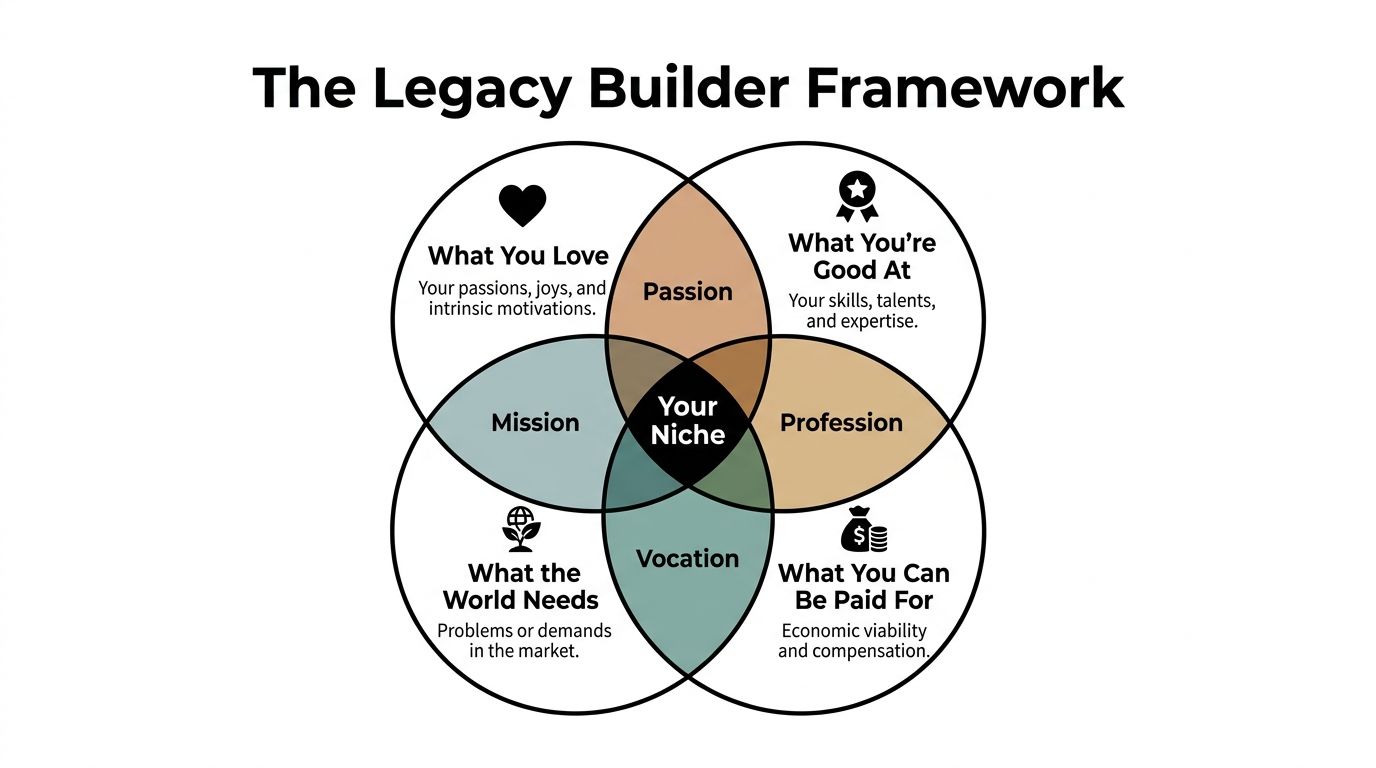
Think of your niche as the intersection of these four forces:
| Circle | Question |
|---|---|
| What you love | What keeps your attention over time? |
| What you're good at | Where do you have real ability or earned expertise? |
| What the world needs | What problem exists, and for whom? |
| What you can be paid for | What creates clear economic value? |
The common labels help, but don’t stop there.
The center is your niche.
Take your topic zones from the previous section and run each one through these questions.
Does this topic have a real problem attached to it?
If not, it’s probably content fluff.
Can I speak on this from experience or strong competence?
If not, you’ll sound borrowed.
Would people pay to solve this problem or gain this outcome?
If not, it may work as content but not as a business niche.
Do I want to be associated with this topic long term?
If not, don’t build around it.
This isn’t about being restrictive. It’s about refusing weak bets.
Let’s say your raw materials include:
That does not mean your niche is “personal branding.”
That’s a category, not a niche.
A sharper niche concept would be something like:
Those are not final claims. They are working hypotheses.
Your niche should describe who you help, what problem you solve, and the lens you bring. If one of those is missing, it's still too vague.
You need a single sentence. Not a paragraph. Not a manifesto.
Use this structure:
I help [specific audience] solve [specific problem] through [specific method or perspective].
Examples:
Good niche statements do four jobs:
A niche hypothesis is good if it passes these checks:
If your sentence sounds smart but says nothing, rewrite it.
If it could apply to twenty thousand creators, rewrite it.
If it feels forced because it ignores your real story, rewrite it.
You’re not looking for a slogan. You’re building a strategic identity.
Your niche is the territory. Your offers, content angles, and examples can evolve inside it.
That’s the mistake people make when they panic and “pivot” every few weeks. They confuse experimentation with drift. A strong niche gives you a base camp. You can test hooks, formats, and services without changing the mountain.
Your job now is simple. Pick the best sentence. Not the perfect one. The strongest one.
Then test it against the market.
A niche idea has no value until strangers respond to it.
That is where people waste months. They either crown a niche based on personal excitement, or they hide inside research and call it strategy. Both moves are expensive. Your job is simpler than that. Put the idea in front of real demand and watch what happens.

Start with visible proof that the problem exists. Search volume matters. Repeated discussion matters. Buying behavior matters. If people are actively searching, complaining, comparing options, or paying for related solutions, you have something worth testing.
A practical benchmark is keyword demand. Aim for topics with at least 1,000 global monthly searches, and prefer ideas closer to 2,000 if the competition is still reasonable. That threshold does not choose your niche for you. It tells you whether the market is awake.
Use tools such as:
If the problem has no search activity, no discussion, and no spending around it, stop calling it a niche. It is a private interest.
Beginners treat competition like a warning sign. Professionals read it as proof that money already changes hands in that category.
Analysts at Founderos report that successful niches often come from specific pains surfaced in communities such as Reddit and Quora, and they note that customer feedback often exposes dissatisfaction with current options that creates room for a sharper offer (Founderos on how to find your niche).
Your goal is not to be the only person in the market. Your goal is to become the clearest choice for a specific buyer.
That requires better observation. Review competing newsletters, YouTube channels, service pages, podcasts, and LinkedIn posts. Then answer these questions:
Gaps often show up in four places. Tone. Method. Audience. Point of view.
If everyone sounds polished and interchangeable, bring a stronger personal story and a clearer stance. If everyone teaches theory, show implementation. If everyone targets beginners, speak to experienced operators. This is how you fuse authenticity with market proof instead of choosing one and neglecting the other.
For a useful external read on digital-first niche selection, this guide on how to find a profitable niche is worth skimming because it pushes you to think in terms of audience demand and repeatable content angles, not vague self-expression.
Social listening is research with a filter. You are collecting buying signals, not scrolling for inspiration.
Create a document with three columns:
| Signal | What to capture | Why it matters |
|---|---|---|
| Questions | Repeated asks on Reddit, Quora, communities | Reveals demand in the audience’s own words |
| Complaints | Frustrations with current tools, creators, agencies, advice | Reveals gaps you can position against |
| Desired outcomes | What people say they want to become, fix, or achieve | Helps shape messaging and offers |
Then collect exact phrases.
Do not polish them. Do not translate them into brand jargon. If your audience says, “I know my stuff but I can’t turn it into content consistently,” keep that phrasing. That sentence contains the pain, the self-image, and the stalled outcome.
Buyers respond to problems they already know they have.
You do not need a website rebuild, a logo, or a polished brand system. You need evidence.
Run a small test and watch for response quality. Attention is nice. Specific replies are better. Direct messages, discovery calls, email signups, and repeated questions tell you far more than likes.
Try one or two of these:
Use what comes back to sharpen the niche. If people engage with your story but ignore the offer, your positioning is still too soft. If they respond to the problem but not your framing, adjust the angle. If nobody reacts at all, stop protecting the idea and change it.
If you want a tighter validation process before you sink time into content and offers, this guide on how to validate a business idea gives a clean checklist for testing demand without overbuilding.
A short visual walkthrough can also help if you think better with examples than text:
Validation is not glamorous. It saves you from building around a fantasy, and that is enough.
Validation gives you permission to stop tinkering.
Now you need a market position people can remember, repeat, and associate with your name. A niche is not claimed because you picked a category. It is claimed because your audience can explain who you help, what you help them do, and why your angle is different.
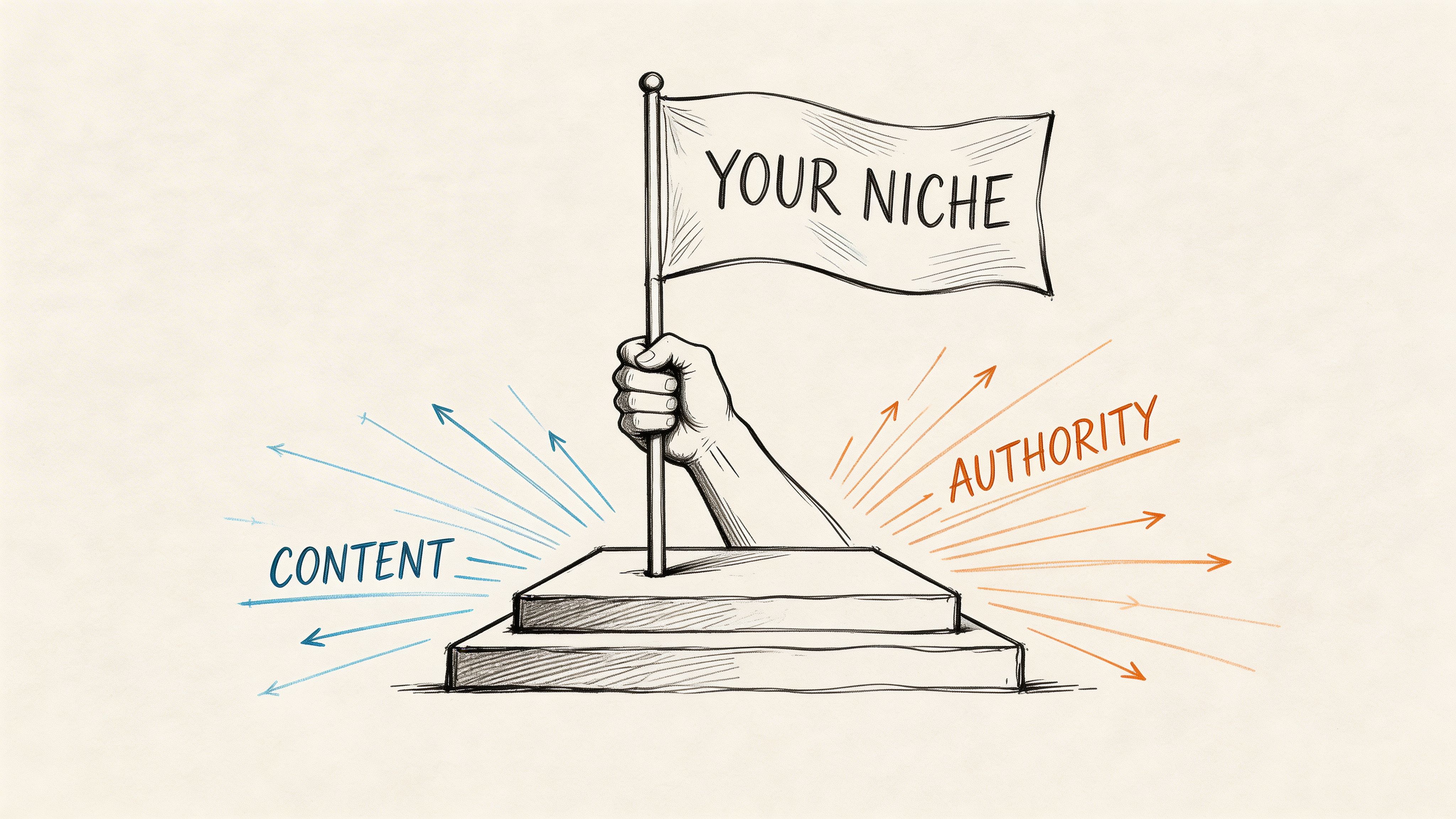
If people need a paragraph to describe what you do, your positioning is weak.
Use this structure:
I help [audience] achieve [outcome] without [common frustration] by using [your approach].
That format works because it fuses meaning with demand. It anchors your story in a real problem the market already cares about, instead of forcing you to choose between being authentic and being profitable.
Examples:
Good positioning travels. A client should be able to repeat it. A referral partner should be able to repeat it. Your audience should hear it once and know whether it fits them.
Content pillars should come from three inputs:
That third piece is where a lot of niche advice fails. Generic content gets attention for a day. Distinct content builds authority because it reflects both market demand and your lived point of view.
For a niche around executive visibility, your pillars could look like this:
Authority building
How credibility is built online and why expertise alone does not create trust.
Message clarity
How to turn complex thinking into language buyers, peers, and media contacts understand.
Consistency systems
How to publish regularly without turning content into a second full-time job.
Audience growth
How visibility creates opportunities, partnerships, and inbound demand.
Personal perspective
Stories, standards, and contrarian beliefs that give the brand a clear voice.
One or two pillars will carry most of the weight. That is normal. You do not need perfect balance. You need repeated association.
Keyword research is not there to dictate your brand. It is there to show you how your market describes the problems you solve.
Look for phrases in three buckets:
Problem-aware searches
People searching for the pain directly
Solution-aware searches
People comparing approaches, tools, or providers
Identity-based searches
People searching based on role, ambition, or stage
Examples:
Then match the search intent to the asset.
| Keyword type | Best content format |
|---|---|
| Direct question | Blog post or FAQ article |
| Comparison intent | Opinion post or breakdown |
| Strategic topic | Long-form article, video, or carousel |
| Narrative topic | Personal post with lesson and takeaway |
Use search demand as a filter, not a personality transplant. Your job is to say something true in language the market already uses.
Strong positioning gets wasted when every post starts from zero.
One core idea should become:
That is how authority compounds. Repetition with range beats random originality.
If you want to turn validated ideas into short-form visual content faster, a tool like ShortGenius AI video generator can help repurpose concepts into video assets without rebuilding the message from scratch every time.
Positioning check: If your content pillars could fit almost any consultant, coach, or creator in your space, they are too generic to build authority.
If your edge still feels blurry, read this guide on strategic positioning and finding your market edge.
Authority comes from consistency.
Your audience should keep seeing the same audience, same problem, and same point of view expressed through different stories, examples, and formats. That is how you train the market to associate your name with a specific result.
People do not remember variety. They remember clarity backed by repetition.
Niche failure usually starts with bad positioning choices, not lack of ability.
The biggest mistake is treating niche selection like a branding exercise instead of a market decision. A strong niche comes from two inputs working together. Your lived experience gives the message weight. Market validation proves people will pay attention.
“I help businesses grow” is not flexible. It is lazy positioning.
A vague niche makes everything harder. Your content gets generic. Your offers attract poor-fit buyers. Your audience cannot tell whether you are for them, so they move on.
Tighten the niche by choosing one clear audience, one painful problem, or one distinct lens.
Bad:
Better:
That kind of specificity does not limit you. It makes you memorable.
Plenty of smart people overshoot specificity in an attempt to sound knowledgeable. That move kills traction.
Shopify’s niche selection framework notes that 60% of tiny niches with fewer than 500 monthly searches collapse due to insufficient lead flow, and that highly competitive niches with more than 500,000 Google results are associated with 70 to 80% failure rates for new entrants (Shopify on smarter niche selection).
Use that as a filter, not a formula.
Do not chase the smallest niche possible. Choose a niche with a real buyer, a costly problem, and a story only you can credibly tell.
Research feels productive because it delays exposure.
You can spend months refining labels, reviewing competitors, and rewriting your niche statement without learning anything useful. The market does not reward private thinking. It rewards clear offers tested in public.
Pick a niche you can explain in one sentence. Publish around it. Sell against it. Then improve it based on actual response.
A borrowed niche rarely survives contact with real work.
You can copy someone’s topic. You cannot copy their earned perspective, pattern recognition, or proof. If your niche depends on mimicking another creator’s voice, you built a costume, not a position.
Use the right parts of what you see:
The market does not need another diluted version of a popular expert. It responds to a clear point of view backed by experience and validated by demand.
That’s normal. Many capable people do.
Don’t build your niche around every interest. Build it around the overlap that creates the strongest market position. Your interests can still show up in stories, examples, and adjacent content.
Long enough to gather real signal. That means publishing consistently, having audience conversations, and testing your message in public.
Don’t pivot because you got bored. Pivot because the audience response, sales conversations, or positioning friction shows a real mismatch.
Crowded often means there’s demand.
Your job isn’t to find an empty market. Your job is to bring a sharper point of view, a clearer audience focus, or a better method. The combination of lived experience and precise messaging is often enough to separate you.
You can. You probably shouldn’t at the start.
Multiple audiences create muddy messaging. Pick the audience you understand best and can help most credibly. Expand later if the market pulls you there.
Qualification is not the same as fame.
If you have real experience, a clear lens, and the ability to solve a specific problem, you’re qualified to build a niche. You do not need to be the most famous person in the category. You need to be useful and specific.
Yes, but passion alone is weak strategy.
Use passion as fuel, not as your filter. The better question is whether your passion sits inside a problem people care about enough to seek help with.
If you're ready to turn your experience into a niche people remember, Legacy Builder helps professionals, founders, and operators turn authentic ideas into consistent authority-building content. If you've got the substance but not the time, structure, or messaging clarity, they're built for that.


You could – but most in-house teams struggle with the nuance of growing on specific platforms.
We partner with in-house teams all the time to help them grow on X, LI, and Email.
Consider us the special forces unit you call in to get the job done without anyone knowing (for a fraction of what you would pay).
Short answer – yes.
Long answer – yes because of our process.
We start with an in-depth interview that gives us the opportunity to learn more about you, your stories, and your vision.
We take that and craft your content then we ship it to you. You are then able to give us the final sign-off (and any adjustments to nail it 100%) before we schedule for posting.
No problem.
We have helped clients for years or for just a season.
All the content we create is yours and yours alone.
If you want to take it over or work on transitioning we will help ensure you are set up for success.
We want this to be a living breathing brand. We will give you best practices for posting and make sure you are set up to win – so post away.
Subscribe to our newsletter and get insights on how to grow your personal brand.
