.svg)
Subscribe to our newsletter and get insights on how to grow your personal brand.
Thank you! Your submission has been received!
Oops! Something went wrong while submitting the form.
.svg)


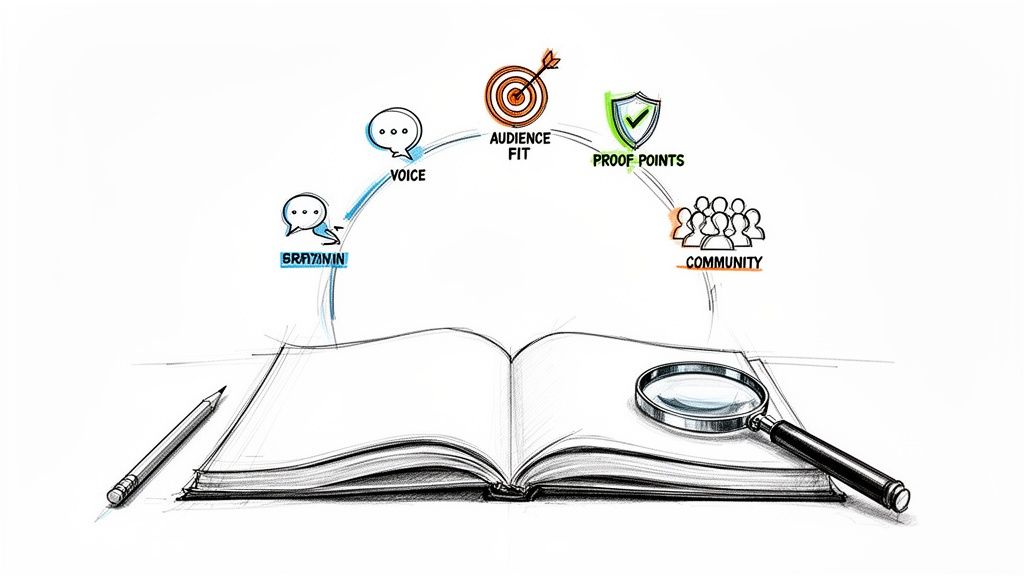
So, what exactly is a brand narrative?
Think of it as the big-picture story that ties everything your brand does together—your past, your present, and where you're headed. This isn't just your "About Us" page or a mission statement. It’s the emotional core of your brand, the reason anyone should care about what you do in the first place. It's your foundational "why."
Your brand narrative is like the plot of a good movie. It has a main character (your audience), a problem they're facing, a guide who helps them (that’s you), and a successful outcome. This simple shift in framing turns your brand from just another service provider into a vital part of your customer's journey.
It’s the difference between listing features and forging a genuine, emotional connection that builds real loyalty and trust.
A well-crafted narrative acts as your brand’s North Star. It guides every single piece of content, every social media post, and every client interaction, making sure everything feels consistent and authentic. This isn't just about looking good; it's about building a reliable identity that immediately sets you apart. Without a narrative, your marketing is just a series of disconnected tactics. With one, every action becomes a chapter in a much larger, more compelling story.
If you want to go deeper on this, we break it down further in our guide on how storytelling drives business growth.
Let's be honest—people are more skeptical than ever. In this environment, a transparent and authentic story isn't just a nice-to-have; it's your most valuable asset. The alignment between the story you tell and the experience you actually deliver has a direct impact on your bottom line.
A strong brand story isn’t just good for marketing—it's good for business. It unifies your team, attracts the right talent, and, most importantly, turns passive consumers into advocates who believe in your mission.
This alignment is a massive growth lever. Companies that nail the connection between their brand promise and the customer experience see up to 3.5x more revenue growth. Why? Because when the story you tell matches the reality people experience, trust skyrockets.
And today, trust is everything. Recent research shows that 40% of consumers spend more time digging into a brand's claims than they did five years ago, proving just how much authenticity matters.
So, what is a brand narrative? It’s the strategic thread that weaves every part of your business together, creating something memorable and meaningful. It answers the one question that matters most: "Why should I care?" It gives people a real reason to connect with you beyond a simple transaction.
Every story that's ever stuck with you, from childhood fables to the last movie you binged, follows a familiar pattern. A great brand narrative is no different. It’s not just a timeline of your company's history; it’s a deliberately crafted story with a few key ingredients that pull people in and make them actually care.
Think of these elements as the essential framework for your brand's story. Without them, you’re just another voice shouting into the void. Once you nail these down, you stop just existing and start building a narrative that connects, persuades, and gets people to act.
These core components are the why, what, and how of your brand, all wrapped up in a story that resonates.
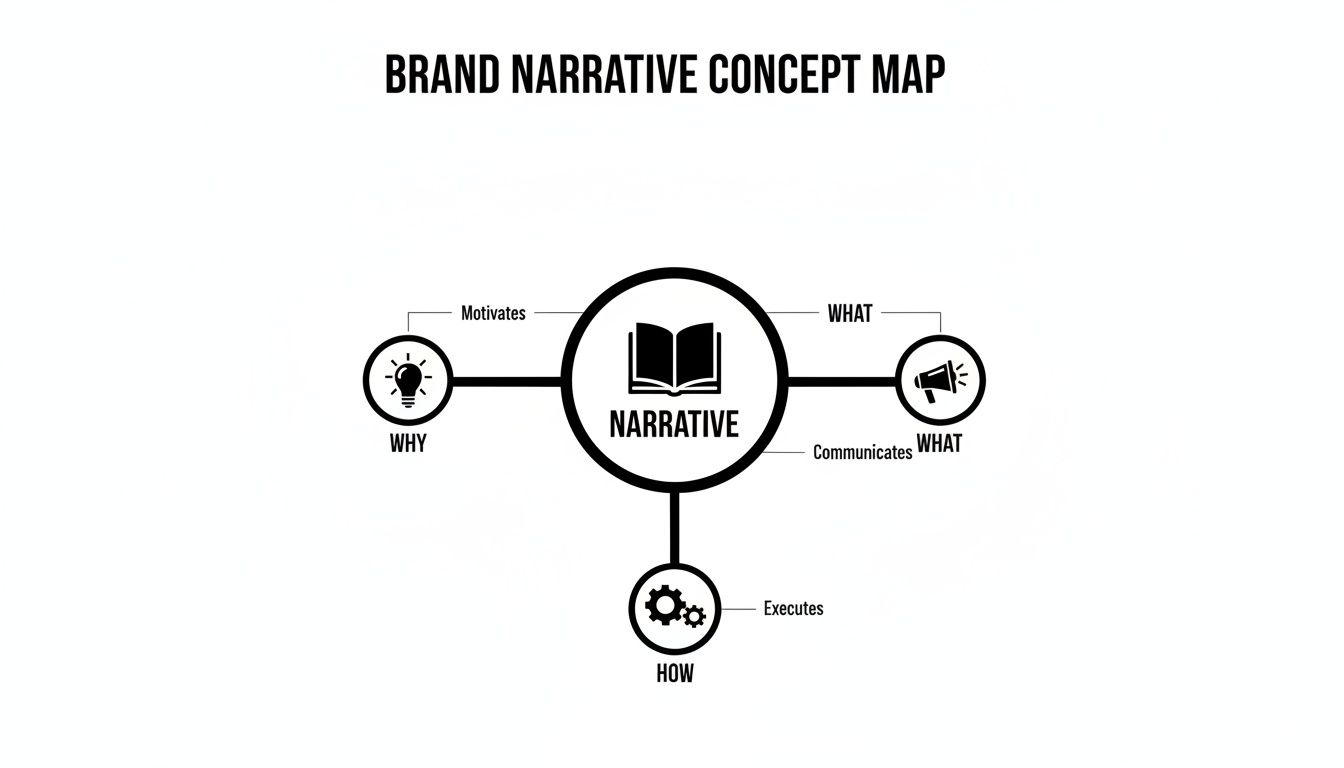
This map shows you how the central story powers everything. Your narrative is the engine for your mission (the why), it shapes your messaging (the what), and it dictates your actions (the how). When they all work together, your brand becomes impossible to ignore.
Here’s the number one mistake I see brands make: they cast themselves as the hero of the story. Wrong. In a powerful brand narrative, your audience is the protagonist. They are the ones on a mission, facing down challenges, and fighting for a better future.
Your job is to get inside their head and understand what they truly want. Is your audience a founder trying to break through the noise? A professional gunning for that next promotion? You have to start your story with their goal, not your own.
Let's be honest, a story with no conflict is just plain boring. And a brand without a clear problem to solve is completely irrelevant. The conflict is the wall standing between your audience (the protagonist) and what they want.
"A good brand story doesn’t just state dry facts. Much like your favorite book, it has a protagonist and a dramatic conflict, recounts the struggles the main character...overcomes, and how they shape your vision and mission."
This isn't some minor inconvenience. It’s a real, nagging pain point holding them back—maybe it's a lack of time, overwhelming complexity, or the fear of being left behind. When you define this problem clearly, you show your audience you don't just see them as a sale. You get their struggle.
Once you’ve set up the hero and their challenge, a guide enters the picture. This is you. This is your brand. You aren't the hero slaying the dragon; you're the mentor who hands the hero the sword, the map, and the confidence to win on their own.
To be a guide people trust, you need two things:
This plan is your product, your service, your framework. It’s the step-by-step path you offer to get them from where they are to where they want to be. If you want to dive deeper into this, Milo Ai's Builder Storytelling Playbook is a fantastic resource.
Every great story needs a satisfying ending. This is where you paint a crystal-clear picture of what success looks like for your audience after they follow your plan and conquer their problem. This isn't about listing features; it’s about showing them the transformation.
Make the stakes clear. What happens if they do nothing, and what amazing future awaits if they take action?
When you frame the outcome this way, you're no longer just selling a product. You're selling a better version of them. And that’s what a killer brand narrative is all about.
You've got the core pieces of your story—the hero, the struggle, and the breakthrough. Now, you have to decide what that story sounds like.
This is your brand voice, and it’s the personality that comes through in every single word you write and speak. It's what makes your brand feel human and, most importantly, authentic.
Authenticity isn't just a buzzword; it's the foundation of trust. We're all drowning in generic corporate-speak, so a genuine voice is what makes people stop scrolling and actually listen. It’s the difference between talking at your audience and building a real connection with them.
Think of it this way: your brand voice is your core personality. It doesn’t change day-to-day. If your brand is direct and witty, it stays that way.
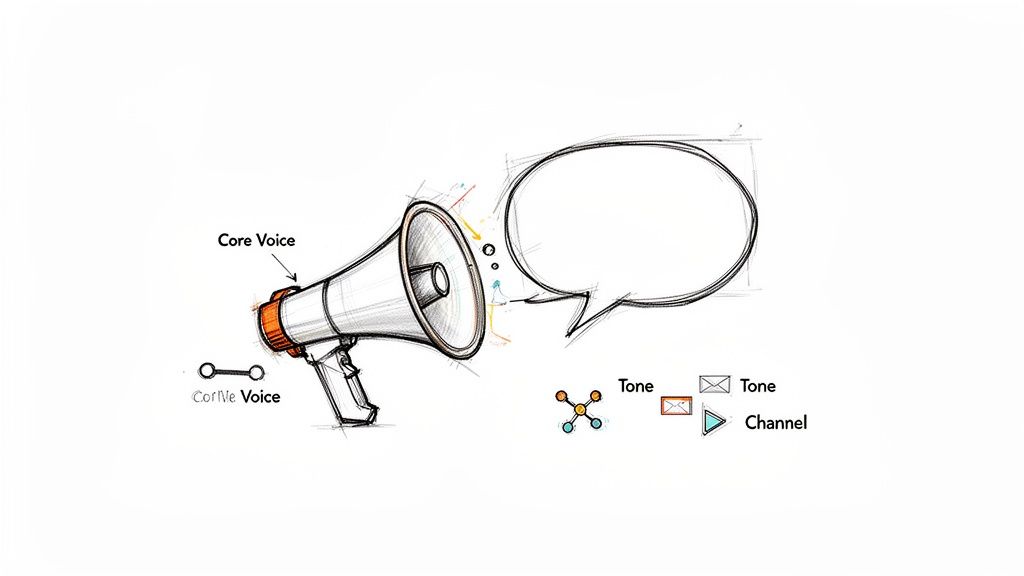
Here's where people get tripped up. While your voice is your fixed personality, your tone is the emotional inflection you use in different situations.
You wouldn't talk to your best friend the same way you’d speak in a boardroom presentation, right? Your brand has to adapt its tone for different contexts, too. Your voice stays the same, but your tone flexes.
Getting this distinction right is everything. A consistent voice builds recognition, while an adaptable tone makes sure your message lands perfectly, whether it’s a professional LinkedIn article or a casual email.
To go deeper, check out our complete guide on how to build a brand voice that connects.
Finding your voice isn't about inventing a persona out of thin air. It’s about digging in and articulating the personality that's already there. The goal is to be consistently you, everywhere.
Start by asking a few simple questions.
If your brand was a person, who would it be? Think of a celebrity, a historical figure, or even a character from a show. What qualities do they have that you want your brand to have? This makes it tangible.
What three adjectives describe your brand's personality? You only get three. Are you helpful, direct, and witty? Or maybe authoritative, sophisticated, and calm? This forces you to get clear.
What adjectives does your brand not embody? Knowing what you aren't is just as powerful as knowing what you are. For example, you might be confident but not arrogant. You could be playful but not silly.
Answering these gives you a rock-solid starting point for building out a more detailed voice and tone guide.
Your brand voice shouldn't be an aspiration; it should be an amplification of who you already are. The most powerful voices are born from authenticity, not imitation. They feel real because they are.
To keep everyone on the same page, a simple voice and tone chart is one of the most effective tools you can create. It becomes the go-to guide for anyone creating content for you.
Here’s a simple structure you can steal:
This chart turns abstract ideas into concrete do's and don'ts, making it dead simple for anyone—from a copywriter to a social media manager—to stay on-brand. When you define your voice and its different tones, every piece of communication works together to strengthen your story.
Having a killer story and an authentic voice is a huge first step. But even the most powerful narrative on earth falls flat if it doesn't land with the right people. This is where the magic happens—the moment your story clicks perfectly with your audience's world.
And let’s be clear: true alignment goes way beyond basic demographics like age or location.
To build a narrative that actually sticks, you have to dig into the why behind what your audience does. What gets them out of bed in the morning? What are their biggest dreams and their most nagging fears? This is the critical difference between knowing who they are and truly understanding what makes them tick.
Your goal here is to make your audience the undisputed hero of the story you're telling. Once you nail this, your brand stops being just another service provider and becomes their trusted guide—the one who helps them along a journey they already want to take.
Demographics give you the skeleton, but psychographics? That's the heart and soul of your audience. This is where you uncover the beliefs, values, and psychological triggers that actually drive their decisions.
Think of it like this:
One is a data point; the other is the start of a story. A powerful brand narrative speaks directly to that second person, tapping into their internal struggle and showing them a clear way forward.
When your narrative reflects your audience's inner world back to them, they don't just hear you—they feel seen. This is the bedrock of genuine loyalty.
Getting these insights means you have to listen way more than you talk. Dive into reviews of similar products. Lurk in Reddit or Quora threads where your ideal clients are asking for help. Better yet, get on the phone for some one-on-one interviews. You want to capture their exact words and feelings. Our guide on finding your target audience for a personal brand gives you a solid framework for this.
People move fast. They make snap decisions driven by emotion and what they see others doing. To connect, you need what the pros call 360° consumer insights, which just means blending two types of data to see the full picture.
Combine both, and you can build a narrative that feels like it was written just for them. You’re no longer guessing what they want; you’re building your story around what their actions and words are screaming that they need.
The data backs this up, too. Recent research shows that as attention spans shrink, people are relying more on emotions and community stories to make choices. It’s no surprise that strategies built on strong narratives are crushing it. For instance, Retail Media Networks that use powerful stories deliver 1.8x better results than standard digital ads and get almost 3x higher purchase intent. That's why 35% of marketers are planning to pump more money into these story-driven approaches.
Here’s the single most important mindset shift you can make: stop talking about yourself and start telling your audience's story. In this narrative, you are not the hero. You are the guide, the mentor—the one who hands them the map and the tools they need to win.
Every single piece of content you create should drive this home.
When you consistently put them at the center of the story, you build a brand that feels less like a business and more like a partner. That connection is what separates fleeting interest from die-hard advocates. Your audience stops being just a passive consumer and becomes an active participant in the story you're building together.
So you’ve crafted a brilliant brand narrative. That’s great, but it’s completely useless if it just sits in a Google Doc or on a forgotten "About Us" page.
To build real trust and a genuine connection, your story has to be the lifeblood of everything you put out there. Every email, every LinkedIn post, every presentation. It all needs to feel like it’s coming from the same place.
This is about moving away from random, one-off campaigns and embracing integrated storytelling. Every piece of content, no matter how small, should feel like a chapter in your bigger story. This is how you turn passive followers into a loyal community that actually believes in what you’re doing.
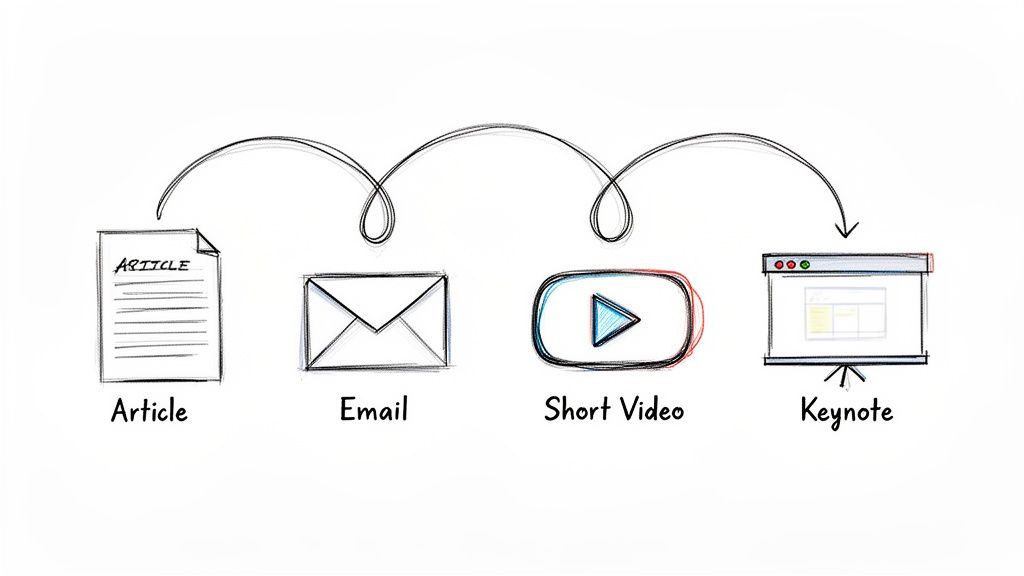
First things first: distill your core narrative down into a few key themes, or what we call content pillars. These are the big ideas you're going to own.
If your whole narrative is about helping founders cut through the noise, your pillars might be things like "Radical Simplification," "Growth without Burnout," and "Building a Legacy."
These pillars become your content roadmap. They make sure every article or video you create reinforces the core story you’re telling. Instead of staring at a blank screen wondering what to post, you just ask, "Which pillar does this idea support?"
Your core story never changes, but how you tell it absolutely must adapt to the platform you’re on. The tone, the format, the length—it all needs to match what people expect to see there.
Once you have your core content, you need to get it in front of people. Learning how to repurpose your blog content for social media is a non-negotiable skill that saves you time and keeps your message consistent everywhere.
The key to making this work long-term is to build storytelling into your process so it becomes a reflex, not an afterthought. You need a system.
A major trend for 2026 is this very shift away from isolated campaigns and toward cohesive, integrated storytelling. And while 61% of marketers are talking about AI, real people are getting tired of robotic, soulless content. They crave human authenticity. Your consistent narrative cuts right through that noise and builds real emotional trust.
Your brand narrative isn't a script you memorize. It's the lens through which you see and talk about the world. When you create from that place, authenticity is automatic.
Here’s a simple framework to make this practical:
When you weave your narrative into the very fabric of your content, you’re doing more than just selling a service. You’re inviting your audience into a story they can see themselves in—a story where they’re the hero, and you’re the guide who helps them win.
Putting together a killer brand narrative is a great start, but it’s only half the battle. How do you know if the story you’re telling is actually connecting with people? A strong narrative shouldn't just feel good—it needs to drive real, tangible results for you and your business.
It’s time to move past vanity metrics like likes and follows. Those don't tell the full story.
The real goal is to draw a straight line from your storytelling to your business outcomes. The question isn't "How many people saw my content?" but rather, "How did my content change the way people think, feel, and act?" This is how you prove your narrative is more than just fluff and gather the insights you need to make it even more powerful.
To really get a read on your narrative's impact, you need to look at a mix of indicators—some you can count, and some you have to feel out. This combo gives you the complete picture of whether your story is truly hitting home. Instead of drowning in data, just focus on the few things that actually matter.
Here’s what to watch for:
A successful brand narrative doesn't just get seen; it gets absorbed and repeated by the community you're building. When your audience starts telling your story for you, you've won.
At the end of the day, your story has to support your business goals. You can connect the dots directly from your narrative to your revenue by tracking a few key metrics that show how your story is influencing actual behavior.
Throw together a simple dashboard to keep an eye on how your story-driven content is performing against these goals:
Even with the best game plan, a few questions always pop up. It's only natural when you're building something as important as your personal story. Let's tackle the most common ones I hear from founders and professionals so you can move forward and start building.
I get this one a lot. Here’s the simplest way to think about it: your mission statement is the "what" and "why" boiled down to a single sentence. It’s a declaration.
Your brand narrative is the entire book that gives that mission emotion, context, and a pulse. It’s the story that explains the problem you’re obsessed with solving, takes your audience on a journey, and makes your mission feel real and urgent. One is a headline; the other is the full story.
It absolutely should. In fact, if your narrative isn't evolving, you might have a bigger problem. As you grow, as your industry shifts, and as your customers' needs change, your story has to adapt right along with them.
The core of who you are—your values, your purpose—that stays solid. But the specific challenges you address and the way you tell your story have to stay relevant.
An evolving narrative isn't a sign of inconsistency; it's a sign that you're paying attention. Sticking to a story that no longer fits the world is far more dangerous than adapting it.
There's no magic word count. The full, detailed version might just be for you and your team, living in an internal document. The real power is in its flexibility.
You need to be able to distill its core message into a single, punchy sentence—your classic elevator pitch. From there, you should be able to expand it on demand:
The goal isn't a specific length. It's having a story so ingrained in you that you can tell it compellingly in 30 seconds or 30 minutes, whatever the situation calls for.
At Legacy Builder, we turn your expertise and personal journey into a brand narrative that actually connects with people and drives results. If you’re ready to build a story that makes you stand out, let's connect and start building your legacy.


You could – but most in-house teams struggle with the nuance of growing on specific platforms.
We partner with in-house teams all the time to help them grow on X, LI, and Email.
Consider us the special forces unit you call in to get the job done without anyone knowing (for a fraction of what you would pay).
Short answer – yes.
Long answer – yes because of our process.
We start with an in-depth interview that gives us the opportunity to learn more about you, your stories, and your vision.
We take that and craft your content then we ship it to you. You are then able to give us the final sign-off (and any adjustments to nail it 100%) before we schedule for posting.
No problem.
We have helped clients for years or for just a season.
All the content we create is yours and yours alone.
If you want to take it over or work on transitioning we will help ensure you are set up for success.
We want this to be a living breathing brand. We will give you best practices for posting and make sure you are set up to win – so post away.
Subscribe to our newsletter and get insights on how to grow your personal brand.
