.svg)
Subscribe to our newsletter and get insights on how to grow your personal brand.
Thank you! Your submission has been received!
Oops! Something went wrong while submitting the form.
.svg)



Let's cut through the noise. What exactly is business storytelling?
Think of a business without a story like a person without a personality. They might be functional, but you'll forget them the second you walk away.
At its core, business storytelling is about ditching the corporate-speak and the dry lists of features. Instead, it’s about weaving your mission, your values, and your purpose into a narrative that actually connects with people. It makes them feel seen, understood, and part of something bigger than just a transaction.
It’s the difference between saying, “We sell high-quality accounting software,” and sharing the story of a small business owner who was drowning in financial chaos, used your software to finally get control, and was able to take their family on a vacation for the first time in years.
One is a bland statement. The other is a journey.

A great business story isn't just thrown together; it follows a proven structure. Once you understand this framework, you can start crafting narratives that stick.
Here are the essential ingredients:
This simple shift in perspective is incredibly powerful because it puts your customer at the absolute center of everything. You’re no longer just a vendor; you’re a trusted partner in their success.
By framing your customer as the hero on a journey, you stop selling a product and start offering a path to transformation. This fundamental shift is what builds lasting brand loyalty.
The numbers don't lie. The digital brand storytelling market is on track to hit $260 billion by 2033—this isn’t some fluffy trend; it’s a core business strategy.
Why? Because research shows people are 22 times more likely to remember a fact when it’s wrapped in a story. In a marketplace full of noise, that’s how you get remembered. Plus, over 42% of businesses already rely on storytelling, which can boost sales by 30% and engagement by an insane 300%. (You can check out more stats on the brand storytelling market here).
When you focus on this hero-guide dynamic, you create a bond that goes way beyond features and price. You build a brand that people don't just buy from—they believe in. That’s the foundation for real growth and a powerful legacy.
In business, we get so focused on the numbers—revenue, profit margins, customer acquisition costs. We obsess over the things we can neatly fit into a spreadsheet. But what if your most powerful, most defensible asset is something you can't quantify that easily?
A great story isn't just fluffy marketing. It’s a strategic weapon that hits your bottom line by building real trust, setting you apart from the noise, and getting people to actually do something.
When we hear a story we can connect with, our brains literally release oxytocin, the "trust hormone." It’s a chemical reaction that creates a genuine emotional bond, turning your company from a faceless logo into a trusted partner. It's the reason we instinctively root for the underdog or connect with brands that aren’t afraid to show they're human.
This is the bedrock of real brand loyalty. When you share your origin story—the struggles, the breakthroughs, the why behind it all—you stop being just another vendor. You become a character in your customer's life, someone they get and believe in.
Trust is the only currency that matters today. We're all drowning in ads and slick marketing promises, and frankly, people are skeptical. A real story cuts through that clutter by showing your authenticity instead of just talking about it.
When you share stories about challenges you've overcome or even failures you've learned from, you’re doing something profoundly human. That kind of transparency shows you get your customer's struggles because you've been there, too. It’s a powerful way to build authority by proving your expertise through lived experience, not just a polished sales pitch. You can dive deeper into establishing your personal brand as a leading authority in our detailed guide here: https://www.legacybuilder.co/authority
When you stop telling people what you do and start sharing why you do it, you invite them into your world. This invitation is the first step toward building a community, not just a customer base.
And this isn't just feel-good talk; it pays off. The data shows businesses that lean into emotional storytelling can see a 44% higher ROI than companies sticking to dry, rational content. Why? Because emotional connections stick. They build memories and loyalty in a way that feature lists and price points never will. If you want to really get this, explore the key advantages of content marketing and see how it all ties back to trust and growth.
Let’s be honest: what happens when your competitors can copy your product, match your price, or even hijack your marketing playbook?
Your story. That's the one thing they can never, ever steal. It’s your unique fingerprint in the market, the ultimate defense against becoming just another commodity.
While everyone else is shouting about features, your narrative gives you an identity built on purpose. Think about it:
Their stories are so baked into their brands that the products almost become souvenirs of that bigger idea. The purchase is less about the item and more about what it stands for. Customers aren't just buying a product; they're buying into an identity.
At the end of the day, a story has to move people to act. In business, that means driving sales. A great narrative frames your product not as a line item on an invoice, but as the tool your customer needs to achieve their own transformation.
The numbers don't lie. A staggering 92% of people want brands to make ads that feel more like stories. And there's a good reason for that—story-driven marketing leads to a 30% increase in conversion rates.
It works because it provides context. You’re showing—not just telling—how your solution helps the hero (your customer) win their battle. When you do that, buying from you becomes the most logical and emotionally satisfying ending to their story.
Knowing you need a story is one thing. Actually building one that hooks people in and gets them to act? That’s a whole different ball game.
So, how do you go from a vague idea to a real, concrete narrative that actually works? The good news is you don’t have to start from a blank page.
Tons of successful brands lean on proven storytelling frameworks. Think of these less as rigid formulas and more as blueprints. You wouldn't build a house without a solid structure, right? Same idea here. These frameworks give your story shape, clarity, and the emotional punch it needs to land.
Let's walk through three of the most effective ones you can start using today.
This is the big one. Popularized by mythologist Joseph Campbell, the Hero's Journey is the backbone of basically every blockbuster movie and epic legend you’ve ever loved. Why? Because it taps into a universal human truth: we’re all trying to overcome challenges.
Here’s the secret for using it in business: your customer is the hero, not your brand. Your job is to be the wise guide—the Yoda or Gandalf who gives the hero the plan and the tool they need to win.
It breaks down like this:
This framework is a powerhouse for big-picture brand storytelling because it builds genuine empathy. You're not just a seller; you're a partner in their success.
If the Hero’s Journey is the epic film, the Problem-Agitate-Solve (PAS) formula is the hard-hitting, persuasive short story. It’s direct, emotional, and killer for things like marketing copy, landing pages, and social media posts.
The structure is dead simple but wildly effective:
PAS works because it follows a natural psychological trigger. It hooks into a real need, makes the desire for a fix urgent, and then positions your offer as the perfect relief.
The Before-After-Bridge (BAB) model is all about transformation. It paints a crystal-clear picture of what’s possible, which makes it perfect for case studies, testimonials, and any content focused on results. It shows your value by creating a stark contrast between life before you and life after.
Here’s the flow:
This model is so powerful because it sells the destination, not the airplane. It keeps the focus squarely on the outcome your customer is chasing, making your solution the only logical way to get there.
And to really bring these stories to life, mastering different visual storytelling techniques is non-negotiable for creating social media content that actually stops the scroll.
This is how it all connects—a central story isn't just fluffy marketing; it's what builds trust, drives growth, and creates a real connection.
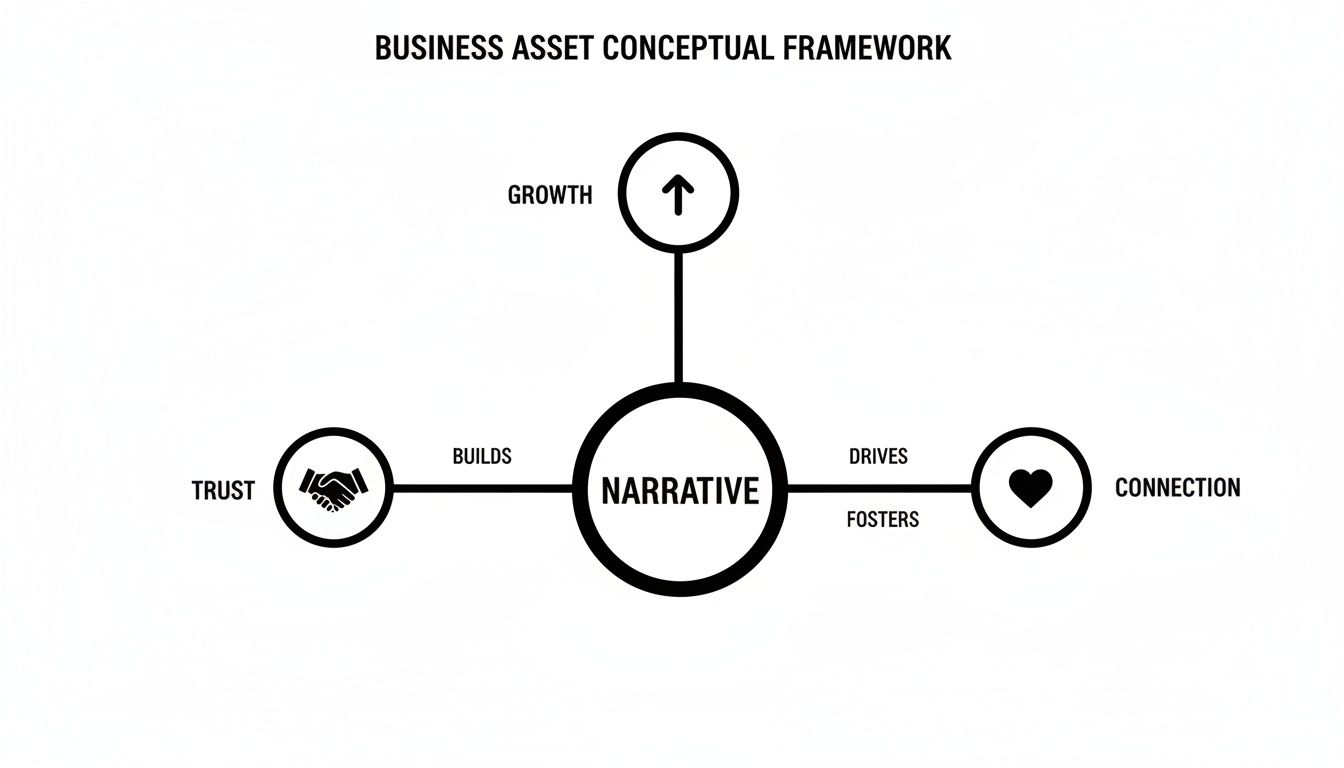
As you can see, a strong story is the engine. It’s the operational core that feeds every other part of your business. Pick the right framework, and you’ll build a narrative that doesn’t just tell people what you do—it makes them care.
Theory is one thing, but seeing storytelling in action is where the real lessons are.
The best way to really get the power of a great narrative is to deconstruct how master brands weave it into their DNA. This isn't just about admiring a clever ad; it’s about pulling back the curtain to see the tactical moves you can borrow for your own strategy.
Let’s dive into a few killer examples—a mission-driven B2C giant, a B2B leader that changed the game, and a scrappy small business—to see how they turn stories into their most valuable asset. Each one gives you a different blueprint for connecting with people on a human level.
Patagonia doesn’t just sell jackets; it sells a philosophy.
Their real story isn't about the quality of their gear—that’s just table stakes. Their story is about protecting the planet we all love to explore. This narrative is so ingrained that their customers feel more like activists than consumers.
This screenshot from Patagonia's Wikipedia page shows just how deep their history of environmental activism runs. It's not a tactic; it's who they are.
The biggest takeaway here is that their story isn't a marketing campaign. It’s a core operational principle that dictates everything they do, from the materials they use to the political stands they take.
Here's their playbook:
This level of commitment to an authentic story builds unshakable loyalty. You don't just buy a Patagonia jacket; you buy into the mission.
So, how does a B2B software company make its story engaging? Slack absolutely nailed it by zeroing in on a universal enemy: chaotic email threads and pointless meetings.
Their story isn't about features; it's about transformation.
Slack’s narrative frames them as the guide that helps teams (the heroes) conquer the villain of workplace chaos. They sell a vision of a more organized, collaborative, and honestly, a more pleasant way to work.
By focusing on the feeling of a streamlined workflow instead of the technical specs, Slack turned a simple utility into an aspirational brand. They sell the "after" picture—a less stressful, more productive workday.
This is a powerful move for any business, especially when you're building out a modern B2B social media strategy that works. It shifts the conversation from what your product is to what it helps the customer become. Their marketing rarely talks about code; it tells stories of teams crushing their goals together, faster.
You don't need a billion-dollar budget to be a master storyteller. Not even close.
Think about a local coffee shop that tells the story of its bean suppliers by name, sharing photos of their farms and families on Instagram. Or the solo consultant who builds their brand around their personal journey of overcoming the exact same challenges their clients are facing right now.
These smaller players win by being deeply human. Their stories are built on:
The market is rewarding this approach in a big way. The global Digital Storytelling Market, valued at USD 10 billion in 2024, is expected to skyrocket to USD 30 billion by 2032. This explosive growth is powered by proven results—data shows that a good story can boost sales by 30% and engagement by a massive 300%. This trend makes it clear: your story isn't a "nice-to-have," it's your competitive edge.
Alright, you get the frameworks and you've seen how the pros do it. So, how do you actually make it happen? How do you take that core story of yours and weave it into every single blog post, email, and social media update you publish?
This is the part where your brand story stops being a fuzzy, high-level idea and becomes your day-to-day playbook. It’s the filter for every content decision you make, making sure everything you put out there hammers home the same message and builds a brand people can actually connect with.

Look, this isn't about just repeating your origin story on a loop. It’s about translating that narrative into a practical content plan that pulls in the right people, keeps them hooked, and gets them to take action.
Your content pillars are the 2-4 core themes your brand is going to own. Period. Think of them as the main chapters in your brand's book. These are the topics you'll hit again and again because they directly support your core story and solve your audience's biggest problems.
For example, if your story is all about helping small businesses escape financial chaos, your pillars might be:
These pillars give your content focus and stop you from just posting randomly. Every single piece you create should fall under one of these themes. This way, you’re always talking about what your audience cares about while proving you’re the one to help them.
Your content pillars are the strategic bridge between your big-picture brand story and the tangible value you deliver to your audience every single day. They make your narrative actionable.
Not all content is created equal. Different parts of your story land better in different formats. A one-size-fits-all approach just waters down your message and guarantees you won't connect with anyone. You have to be strategic and match the format to the goal.
1. For Deep Dives and Building Authority (Blog Posts & Case Studies):
When you need to unpack complex ideas, share detailed case studies, or really flex your expertise, long-form content is your best friend. This is where you can walk someone through a "Before-After-Bridge" framework from start to finish.
2. For Emotional Connection and Engagement (Social Media Videos & Stories):
Short-form video is pure gold for sharing personal stories, behind-the-scenes glimpses, and quick, relatable advice. Use Instagram Stories or TikTok to tell those small, human stories that build a real community.
3. For Nurturing Relationships (Email Sequences):
Email is perfect for telling a story over time. You can guide subscribers through a multi-part narrative, dropping insights piece by piece and building up to your solution—just like a mini-Hero’s Journey.
4. For Demonstrating Results (Testimonials & Social Proof):
Let your happy customers tell your story for you. A killer quote or a short video testimonial is the perfect final chapter to a story about solving a problem.
Using a mix of formats keeps your story from getting stale and meets people where they already are. This is a core part of what we do at Legacy Builder—our strategists help you build out a smart, multi-format strategy for your personal brand content.
Creating a great story is only half the battle. If the right people don't see it, it doesn't matter. Your distribution strategy needs to be just as intentional as your content creation.
First, figure out where your ideal audience—the "hero" of your story—actually hangs out. Is it LinkedIn? Instagram? Niche forums or industry newsletters? You have to show up where they're already paying attention.
Next, repurpose your core stories for those platforms. A deep-dive case study on your blog can be sliced and diced into:
This strategy gets your story maximum reach without you sounding like a broken record. By distributing your stories with intent, you turn passive scrollers into an engaged community. You're creating multiple doors into your brand’s world, inviting people to join the journey and, eventually, become your biggest fans.
It’s one thing to know you should be telling stories, but it’s another thing entirely to get it right.
Even with the best intentions, a lot of business storytelling misses the mark. And a story that falls flat doesn’t just get ignored—it can actually confuse your audience and chip away at the trust you’re trying to build.
Let's break down the most common traps I see founders fall into, so you can sidestep them completely.
This is the big one. So many businesses make the classic mistake of casting themselves as the hero of the story. They go on and on about their company's history, their product features, and all their amazing accomplishments.
But here’s the hard truth: your story isn't actually about you.
When you make your brand the hero, you force your customer into the role of a spectator. They're just sitting on the sidelines watching you talk about yourself. Effective business storytelling always, always, always positions the customer as the hero.
Your brand is the guide. You’re the mentor who shows up with the tools, the map, and the wisdom to help the hero win the day.
You can spot this mistake a mile away. The content is littered with "we did this" and "our product does that." It reads like an internal memo, not a story that pulls people in.
Here’s a quick fix:
See the shift? The second version puts the customer and their struggle front and center. That’s where they belong.
Another all-too-common pitfall is telling a story that’s all plot and no pulse.
Businesses get so wrapped up in the mechanics—the problem, the solution, the outcome—that they completely strip out the human emotion that makes a story resonate. A story without feeling is just a report. And nobody gets excited about a report.
Remember, people make decisions based on emotion and then justify them with logic. If your story doesn't make your audience feel seen, understood, hopeful, or inspired, it won't move them to do anything.
Your audience won't remember every detail you share, but they will absolutely remember how you made them feel. Emotion is the glue that makes a story stick.
This is the most dangerous mistake of all.
You can’t tell a story about valuing your community and then have notoriously bad customer service. You can't talk about innovation while your product feels a decade old. When your story doesn't line up with reality, you create a credibility gap that is almost impossible to close.
Authenticity isn't a buzzword; it's a non-negotiable.
Your brand's actions are the proof of the story you're telling. Every customer interaction, every policy, every single product update needs to reinforce your core narrative.
When what you say and what you do are in perfect sync, you build a deep, unshakable trust. That's how you turn customers into advocates for life.
I get it. Putting storytelling into practice can feel a little abstract at first. Let's clear up a couple of the most common questions I hear.
This is a big one. Even the most technical B2B companies can—and should—be telling powerful stories. The trick is to stop talking about your product's features and start talking about the problem you solve.
Instead of listing specs, tell the story of a client's journey from total operational chaos to streamlined success. Profile the real, brilliant people behind your company. Talk about the industry-wide change you're trying to spark. The story is never really about the software; it's about the transformation it makes possible for the hero—your client.
Authenticity. Hands down, no contest.
Your story has to be real. It needs to line up perfectly with your company's actions and values, because people can spot a fake from a mile away. If you tell a grand story about being customer-obsessed but your support team is a nightmare to deal with, the whole thing falls apart.
The most critical element is making sure the story you tell is the one you actually live every single day.
Your story is your legacy. At Legacy Builder, we help you find that authentic narrative and turn it into powerful content that builds real trust and authority.


You could – but most in-house teams struggle with the nuance of growing on specific platforms.
We partner with in-house teams all the time to help them grow on X, LI, and Email.
Consider us the special forces unit you call in to get the job done without anyone knowing (for a fraction of what you would pay).
Short answer – yes.
Long answer – yes because of our process.
We start with an in-depth interview that gives us the opportunity to learn more about you, your stories, and your vision.
We take that and craft your content then we ship it to you. You are then able to give us the final sign-off (and any adjustments to nail it 100%) before we schedule for posting.
No problem.
We have helped clients for years or for just a season.
All the content we create is yours and yours alone.
If you want to take it over or work on transitioning we will help ensure you are set up for success.
We want this to be a living breathing brand. We will give you best practices for posting and make sure you are set up to win – so post away.
Subscribe to our newsletter and get insights on how to grow your personal brand.
