.svg)
Subscribe to our newsletter and get insights on how to grow your personal brand.
Thank you! Your submission has been received!
Oops! Something went wrong while submitting the form.
.svg)



Let’s get real for a second. What is brand messaging, really?
Forget the corporate jargon. Think of it as your personal brand’s North Star—it’s the one consistent story you tell about yourself, everywhere you show up. It’s not just a clever tagline or a mission statement you stick on your website. It’s the promise you make to your audience, the values you live by, and the unique way you talk about it all.
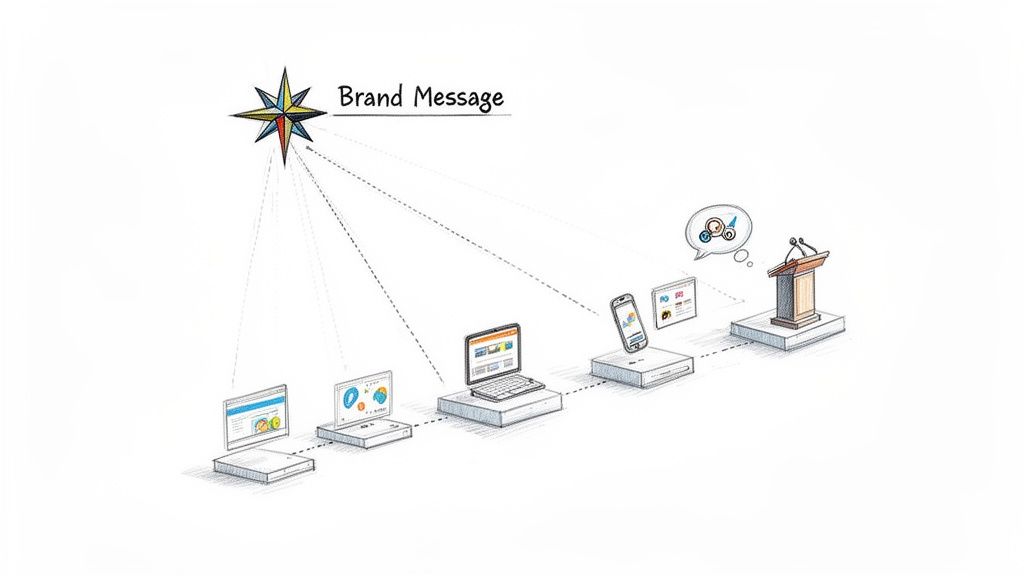
Your personal brand is a lot like a person. It has a personality, a set of beliefs, and a distinct way of speaking. Your brand messaging is the rulebook that defines that "person," making sure everything you say and create feels like it’s coming from the same place.
Without it, you’re just creating noise. Your LinkedIn posts might sound super formal, but your content on X (formerly Twitter) is full of casual slang. That kind of inconsistency creates confusion, and confusion kills trust. When people don’t know what to expect from you, it’s impossible for them to connect with what you offer.
Consistency is the quiet engine of authority. When your message is sharp, clear, and the same everywhere, people start to recognize you. They associate you with specific ideas. That repetition makes you feel reliable and predictable—in a good way.
And this isn't just some fluffy marketing concept; it has a real impact on your bottom line. Just look at the numbers. 35% of organizations saw their revenue grow by 10-20% just by keeping their branding consistent. Another 32% saw growth of 20% or more.
On the flip side, a whopping 71% of businesses admit that inconsistent branding confuses their customers. That confusion chips away at the very trust you're working so hard to earn.
Your brand messaging is the connective tissue that links your audience’s problems to your unique solutions. It’s how you articulate your value in a way that resonates deeply and memorably.
So, what is brand messaging when you boil it all down? It's the deliberate act of defining what you stand for, who you're talking to, and how you want to sound. Then, you apply that system to every single thing you create. It’s what turns random posts into a story people actually want to follow.
A solid messaging framework does three critical things:
Now, don't confuse your message with your brand voice. Your voice is the personality you use to deliver that message. If you want to dive deeper into that, we have a whole guide on what is brand voice and how to build one that connects. And to see how this all fits into the bigger picture, this modern social media branding guide is a great resource.
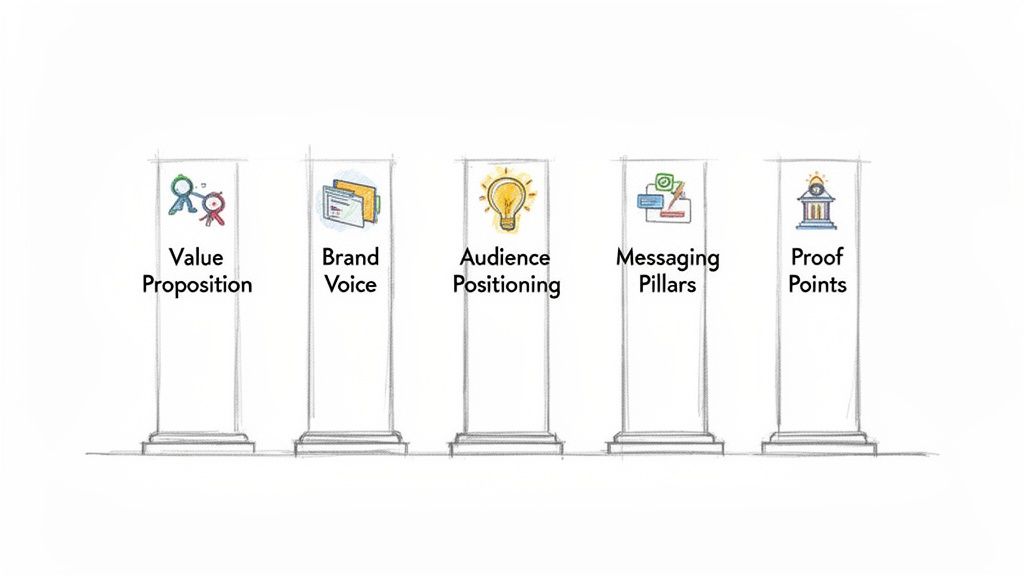
Powerful brand messaging isn’t something you stumble upon by accident. It's engineered. It's built on a solid foundation that ensures every single thing you create—from a LinkedIn post to a keynote speech—is intentional and cohesive.
Think of these five pillars as the load-bearing walls of your personal brand. Get them right, and your structure is unshakable. This framework turns your message from a random collection of thoughts into a strategic asset that actually gets you noticed.
Let’s cut to the chase. Your value proposition is your promise. It’s a dead-simple statement that answers your audience's #1 question: "What's in it for me?"
It's not just about what you do. It's the tangible, specific outcome you deliver that nobody else can.
A career coach with a weak value proposition says, "I help people find jobs." A strong one sounds like this: "I empower mid-career tech professionals to land leadership roles that double their impact and income." See the difference? The second one is specific, focused on a real transformation, and immediately signals value.
If your value proposition is what you say, your brand voice is how you say it. It’s the consistent personality that bleeds into your writing, your videos, and even your DMs.
Are you the straight-shooting, authoritative expert? Or are you the empathetic guide who encourages and supports? Your voice needs to be authentic to you while also resonating with your target audience.
Now, a lot of people mix up voice and tone. Let's clear that up. Your voice is your personality—it doesn't change. Your tone is the mood you adopt for a specific situation.
This table breaks down the difference between your unshakeable voice and your adaptable tone.
Think of it this way: your voice is non-negotiable, but your tone has to adapt. This is what makes your brand feel human and responsive without losing its core identity.
Audience positioning is all about how you connect with your specific tribe. It’s about knowing their world so well that your message feels like it was written just for them.
This means you know their biggest headaches, their secret ambitions, their deepest fears, and even the slang they use.
This is what stops your message from just broadcasting into the void. It ensures your words land with real impact because you’re speaking directly to the problems and desires of a very specific group of people. Remember, if you try to talk to everyone, you end up connecting with no one. For a deeper dive, check out our guide on how to craft powerful brand positioning statement examples that actually work.
Your messaging pillars are the 2-4 core themes you want to own. These are the big ideas you'll talk about over and over again to build your authority and reinforce your value proposition. They become your content guardrails, keeping you focused and helping you build a reputation in a specific niche.
For example, an executive coach who specializes in "human-centric leadership" might have these pillars:
Every piece of content they create—from a simple tweet to a full-blown webinar—would map back to one of these pillars. That's how you build deep, undeniable expertise.
This last pillar is what makes people believe you. Proof points are the tangible evidence that you can actually deliver on your promises. Without them, your messaging is just a bunch of empty claims.
Your claims tell people what you can do. Your proof points show them you’ve already done it. This is where trust is truly built.
Proof points are the facts, figures, and stories that back up your expertise. They are the bedrock of your credibility.
Here are the most effective types of proof points to use:
When you strategically weave these five pillars together, you stop just "creating content" and start building a powerful, authentic brand message. Each pillar supports the others, creating a framework that is clear, consistent, and impossible to ignore.
Theory is great, but seeing it in action is where the real learning happens. All those abstract ideas—value proposition, voice, positioning—suddenly click when you see them executed flawlessly by real people.
Let's break down the messaging of three very different professionals who are absolutely crushing it. We're going to deconstruct their digital presence to see how they pull it off. Think of these as practical case studies, not just fluffy inspiration. They're a blueprint for how a clear, consistent message builds a brand that pulls in the right kind of attention.
First up, a SaaS founder whose company sells automation tools to marketing teams. Their entire brand is built on a single, powerful promise: "effortless efficiency." It’s not just a tagline they slapped on a website; it’s the DNA of their brand, and you see it everywhere, delivered with a confident, data-driven voice.
The messaging here is a masterclass in consistency. That confident, slightly technical voice works perfectly with their hard data, building a powerful sense of trust. The message is simple and unwavering: we save you time, and we've got the numbers to prove it.
Next, let's look at an executive coach who helps new leaders figure out how to navigate tricky corporate politics. Her brand promise is all about "leading with authentic influence," and her messaging walks a fine line between empathy and authority. She gets that her audience is anxious, but she positions herself as the steady guide who can lead them through it.
Her content is built around core messaging pillars like "navigating difficult conversations" and "building a culture of trust." She uses storytelling constantly, sharing client anecdotes that make her audience feel like she’s reading their minds.
A powerful message doesn't just speak to professional goals; it connects with emotional reality. Empathy is the bridge that lets your authority feel like guidance, not a lecture.
Her brand voice is warm but direct. You won't find any stuffy corporate jargon here, just clear, human language. On her podcast, you might hear her say, "Feeling like an imposter in a new leadership role is normal. Let's talk about how to turn that fear into your greatest strength." By positioning herself this way, she builds an instant connection, making her expert advice feel like a conversation with a trusted mentor.
Finally, picture a content creator who has built a brand around sustainable urban gardening. Their value proposition couldn't be clearer: "Grow your own food, no matter how small your space." Their voice is passionate, encouraging, and all about bringing people together.
This creator knows that showing is more powerful than telling. Their messaging is incredibly visual and packed with proof from their own community.
This community-first approach really works. Studies show that brands using knowledge-sharing platforms see a 25% higher marketing ROI. Why? Because nearly 40% of consumers trust what their peers say as much as a personal recommendation. You can dig into more of these global marketing trends to see just how much community drives results. This creator’s messaging doesn’t just teach people how to garden; it starts a movement, turning followers into advocates who spread the word for her.
Alright, we’ve covered the theory. Now it’s time to roll up our sleeves and actually build this thing.
Let's move from just understanding brand messaging to crafting it. This is your hands-on workshop, a practical guide to give your personal brand the clarity and direction it’s been missing.
At each stage, I’ll give you some probing questions. The goal is to dig deep, uncover what makes you uniquely valuable, and then figure out how to say it in a way that truly connects. By the end, you'll have a rock-solid framework for every single piece of content you create.
The whole process boils down to three core phases: analyze, define, and adapt.
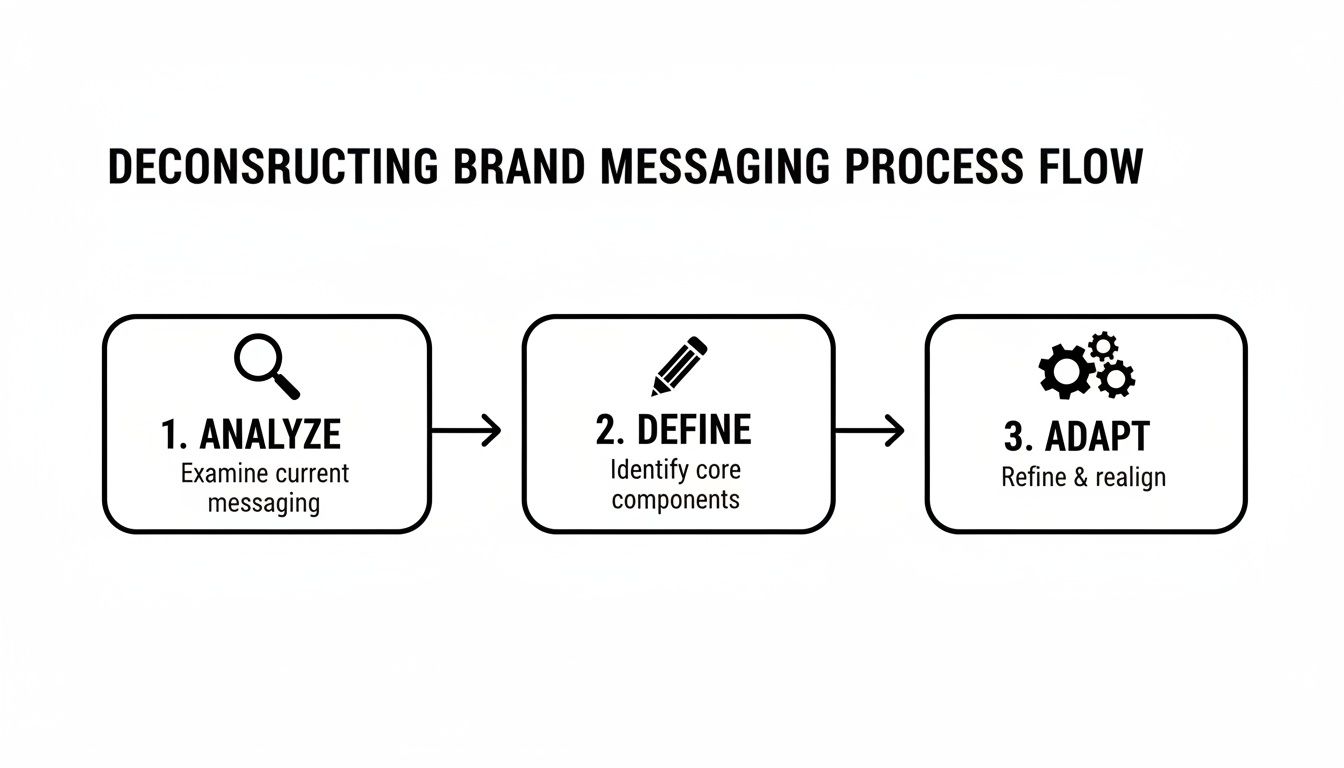
This map simplifies the journey. First, you get the lay of the land. Then, you define your message. Finally, you tweak and refine it based on what’s actually working.
Before you can write a single word, you need to know who you're talking to and what unique value you bring to the table. This is the foundation. Don’t rush it.
First, get brutally honest about your audience:
Next, turn the spotlight on yourself. Your expertise is the engine, but you need to know how to articulate it.
Now that you have all the raw materials from your discovery, it’s time to build the core components of your messaging. This is where you make the tough decisions and create the pillars that will hold up everything you do from here on out.
Start by nailing your Value Proposition. This is your singular, powerful promise. It should be so clear that a stranger can understand the transformation you offer in less than 10 seconds.
Next up: your Brand Voice. This is the personality behind your words. Are you witty and a little irreverent? Calm and authoritative? Pick 3-5 adjectives that capture how you want to sound, and then stick to them. If you need a little help here, consulting an essential social media branding guide can give you some great frameworks for dialing in your voice for different platforms.
Your voice is your brand's unchanging personality. Your tone is how you adapt that personality for different situations—like speaking differently at a conference versus in a one-on-one DM.
Now, establish your Messaging Pillars. These are the 2-4 core topics you want to be known for. These are the big ideas you’ll talk about again and again to build real authority. For a financial consultant, these might be "Wealth Creation," "Investment Strategy," and "Generational Financial Planning."
Finally, gather your Proof Points. This is the evidence that makes your claims believable. Compile a list of your best testimonials, case studies with hard data, credentials, and awards. This arsenal of proof will become the backbone of your content strategy.
The final step is to pull it all together into one simple, actionable statement. This isn't some public-facing tagline. Think of it as an internal guide—your North Star for every piece of communication. It's what keeps you consistent and focused.
Use this simple fill-in-the-blank template to create your statement:
"For [Your Target Audience] who struggle with [Their Core Problem], my personal brand offers [Your Unique Solution/Value Proposition]. I do this by consistently creating content about [Messaging Pillar 1], [Messaging Pillar 2], and [Messaging Pillar 3], delivered with a [Your Brand Voice Adjective] and [Another Adjective] voice. My expertise is backed by [A Key Proof Point, e.g., '10+ years of experience' or 'a portfolio of successful client projects']."
Once you’ve filled this out, it becomes your ultimate gut-check. Before you post anything, ask yourself: Does this align with my messaging statement?
That simple habit is the key to building a powerful, consistent, and memorable personal brand that actually stands for something.
Figuring out what you want to say is half the battle. The other half? Knowing what not to do.
It’s easy to get this wrong. I see it all the time. Professionals build a solid messaging framework, but a few common slip-ups quietly sabotage all their hard work. Their expertise ends up feeling confusing, generic, or just plain self-serving.
Steering clear of these mistakes is just as important as building your messaging pillars. A single wrong turn can unravel months of effort, breaking the trust you've worked so hard to build. Let's walk through the most common traps I see people fall into and how to sidestep them.
One of the fastest ways to lose your audience is to hide behind a wall of corporate-speak. Words like "synergy," "optimization," and "leveraging" might sound impressive in a boardroom, but to your audience, they're just noise. They're empty buzzwords that scream, "I'm trying to sound smart," instead of "I'm here to help."
Think about it: true authority doesn’t come from using big words. It comes from making complex ideas feel simple.
When you swap out the jargon for your real voice, you become instantly more relatable. More trustworthy.
See the difference? The "after" version is clear, confident, and speaks to a real problem in plain English. It proves your expertise without putting up a wall.
Here's a hard truth: your audience doesn't really care about your services, your company's history, or your long list of awards—at least, not at first.
They care about one thing: what's in it for them.
When your message is all about "I" and "we," you've already lost. Your messaging needs to act like a mirror, reflecting your audience's challenges, fears, and goals right back at them. The star of the show should always be "you" (the customer).
Your personal brand isn’t built by talking about yourself. It’s built by consistently showing your audience that you understand them better than anyone else.
So, shift your perspective. Stop talking about what you do and start talking about what your audience gets.
That simple flip reframes the entire message. It’s no longer about you; it's about their transformation. That’s what sells.
Consistency is the foundation of any memorable brand. If your LinkedIn profile reads like a stuffy academic paper but your X (formerly Twitter) feed is all casual memes, you’re giving your audience brand whiplash.
That kind of inconsistency kills trust. People don't know which "you" they're going to get, so they tune out.
Now, this doesn't mean you have to sound like a robot everywhere you go. Every platform has its own vibe. The key is to distinguish between your brand voice and your tone. Your voice is your personality—it’s fixed. Your tone is how you adapt that personality to different situations.
Your authoritative voice can absolutely have a more conversational tone on social media without losing its core identity.
The easiest way to stay on track is to use your core messaging as your north star. Before you hit "post," ask yourself: "Does this sound like me? Does it support my core promise?" A quick check like that ensures that no matter where someone finds you, they're meeting the same reliable expert every single time.
You’ve done the hard work of crafting your message. Now for the million-dollar question: is anyone actually listening?
Success isn't about likes or follower counts. That's a rookie mistake. Real impact shows up as influence, connection, and opportunity—the kind of stuff that proves your message isn't just being heard, but felt.
Forget vanity metrics. Instead, we need to track the tangible signals that show your brand messaging is truly working out in the wild. This gives you concrete feedback, letting you fine-tune your strategy based on what actually connects with the people you want to reach.
If you want to know if your personal brand is really gaining traction, you need to look at Key Performance Indicators (KPIs) that show genuine engagement and authority. These metrics tell a much richer story than simply watching your follower number tick up.
Here are the three core areas to keep your eye on:
You don't need some complex, expensive analytics software to monitor these signals. Seriously. You can start with a simple spreadsheet or even a notes app to keep a running log of these qualitative wins.
The ultimate proof that your brand messaging works is when others start telling your story for you. When a client perfectly articulates your value proposition to a new referral, you've won.
Try this: at the end of each week, jot down any inbound leads, collaboration requests, or particularly insightful comments you received. Over time, you’ll start to see patterns. You'll quickly notice which of your messaging pillars spark the best conversations and which ones lead directly to real-world opportunities.
This qualitative data is your feedback loop. It tells you exactly what to double down on and what might need a little tweaking. For a deeper dive into tracking these kinds of results, you can learn more about how to measure brand awareness in our comprehensive guide.
By focusing on these indicators, you’ll ensure every bit of effort you put in is building the influential legacy you're after.
Even with the best game plan, some questions always pop up. Here are a few common ones I get about nailing down brand messaging.
Look, your core message isn't something you should be changing with the wind. But it’s not carved in stone, either. A good rule of thumb is to give it a solid review every 12 to 18 months.
You'll also want to revisit it anytime you make a big move—like going after a whole new audience or launching a game-changing new service. Minor tweaks are fine if you see a specific message isn't hitting the mark, but keep the foundation steady. Consistency is what builds recognition.
Simple. Your mission statement is your internal compass. Brand messaging is your external megaphone.
Think of it like this: Your mission statement is your "why"—it’s the reason you get out of bed in the morning. Your brand messaging is the "how"—how you talk about that "why" so other people actually care.
Your mission guides you from the inside out. Your messaging connects you from the outside in.
This is a big one. You can't afford to sound like a stranger on your own channels. The secret? A killer brand messaging guide. It's non-negotiable. This document needs to spell out everything: your value proposition, your brand voice, what keeps your audience up at night, and your main talking points.
Before you let them run with it, have them create a few sample pieces. This is your sniff test to see if they really get your voice. Clear guidelines and direct feedback are the only way to make sure your brand sounds like you, no matter who is behind the keyboard.
Tired of feeling like you're just guessing? Let's build a personal brand that doesn't just get noticed—it gets results. At Legacy Builder, we turn your expertise into content that builds real influence. Book a call with us today, and let's start building your legacy.


You could – but most in-house teams struggle with the nuance of growing on specific platforms.
We partner with in-house teams all the time to help them grow on X, LI, and Email.
Consider us the special forces unit you call in to get the job done without anyone knowing (for a fraction of what you would pay).
Short answer – yes.
Long answer – yes because of our process.
We start with an in-depth interview that gives us the opportunity to learn more about you, your stories, and your vision.
We take that and craft your content then we ship it to you. You are then able to give us the final sign-off (and any adjustments to nail it 100%) before we schedule for posting.
No problem.
We have helped clients for years or for just a season.
All the content we create is yours and yours alone.
If you want to take it over or work on transitioning we will help ensure you are set up for success.
We want this to be a living breathing brand. We will give you best practices for posting and make sure you are set up to win – so post away.
Subscribe to our newsletter and get insights on how to grow your personal brand.
