.svg)
Subscribe to our newsletter and get insights on how to grow your personal brand.
Thank you! Your submission has been received!
Oops! Something went wrong while submitting the form.
.svg)


You're probably doing what most smart founders do at first. You publish thoughtful posts on LinkedIn, drop sharp takes on X, maybe send a newsletter when you can, and still get a weak response. A few likes. The wrong people in your DMs. No real pipeline. No clear signal that your content is attracting buyers, partners, hires, or invitations.
That usually isn't a content quality problem. It's a targeting problem.
If you've been asking what is audience segmentation, strip away the jargon. It's the discipline of separating your audience into meaningful groups so you can say the right thing to the right people, instead of pushing the same message at everyone. For a solo founder or CEO, that matters even more than it does for a big brand. You don't have unlimited attention, unlimited content capacity, or room for sloppy positioning.
When personal branding works, it doesn't work because you posted more. It works because the right people felt like you were speaking directly to them.
A founder spends two hours writing a post about leadership, product strategy, and hiring. It gets polite engagement, but no buyers respond. The next day, the same founder posts a thread about one painful problem their ideal client is actively trying to solve. Suddenly the comments get sharper. DMs get more specific. Sales conversations start.
That difference isn't luck. It's segmentation.
Most professionals are still broadcasting. They speak to “founders,” “executives,” or “consultants” as if those groups all want the same thing. They don't. A bootstrapped SaaS founder wants different content than a venture-backed CEO. A marketing leader looking for visibility wants different content than a consultant looking for inbound leads.
You don't need a bigger audience first. You need a clearer one.
If your content feels inconsistent, it's often because you're unconsciously trying to serve too many people at once. One post is for peers. The next is for prospects. Another is for potential hires. Then you throw in a personal story because someone said authenticity matters. The result is a feed that says many things, but lands with nobody in particular.
Practical rule: If your audience description is broad enough to include everyone you'd be happy to know, it's too broad to guide content.
That's why segmentation matters. It moves you from vague visibility to deliberate relevance. You stop asking, “How do I get more engagement?” and start asking, “Which group am I trying to move, and what do they need to hear from me right now?”
For a personal brand, audience segmentation usually starts with simple distinctions:
Those groups may all follow you, but they should not all get the same message.
If you haven't clarified that yet, start with a sharper audience foundation using this target audience framework for a personal brand. It'll save you months of publishing content that sounds smart but doesn't convert.
Most founders treat personal branding like reputation management. That's too small. A strong personal brand is a demand engine. Segmentation is what makes it work.
When you segment your audience, your content stops trying to impress everyone and starts influencing the people who matter. Your posts become easier to write because you know who they're for. Your calls to action get clearer. Your profile attracts better-fit conversations. That's how authority is built online. Not through volume, but through precision.
The strongest argument for segmentation isn't aesthetic. It's commercial.
A segmented campaign can result in a 760% increase in revenue, according to Salesgenie's customer segmentation statistics. That stat comes from business marketing, but the principle applies cleanly to personal brands. If segmenting an audience changes business outcomes that dramatically, then a founder who speaks differently to buyers, partners, and industry peers gains a serious advantage over the one publishing generic thought leadership.
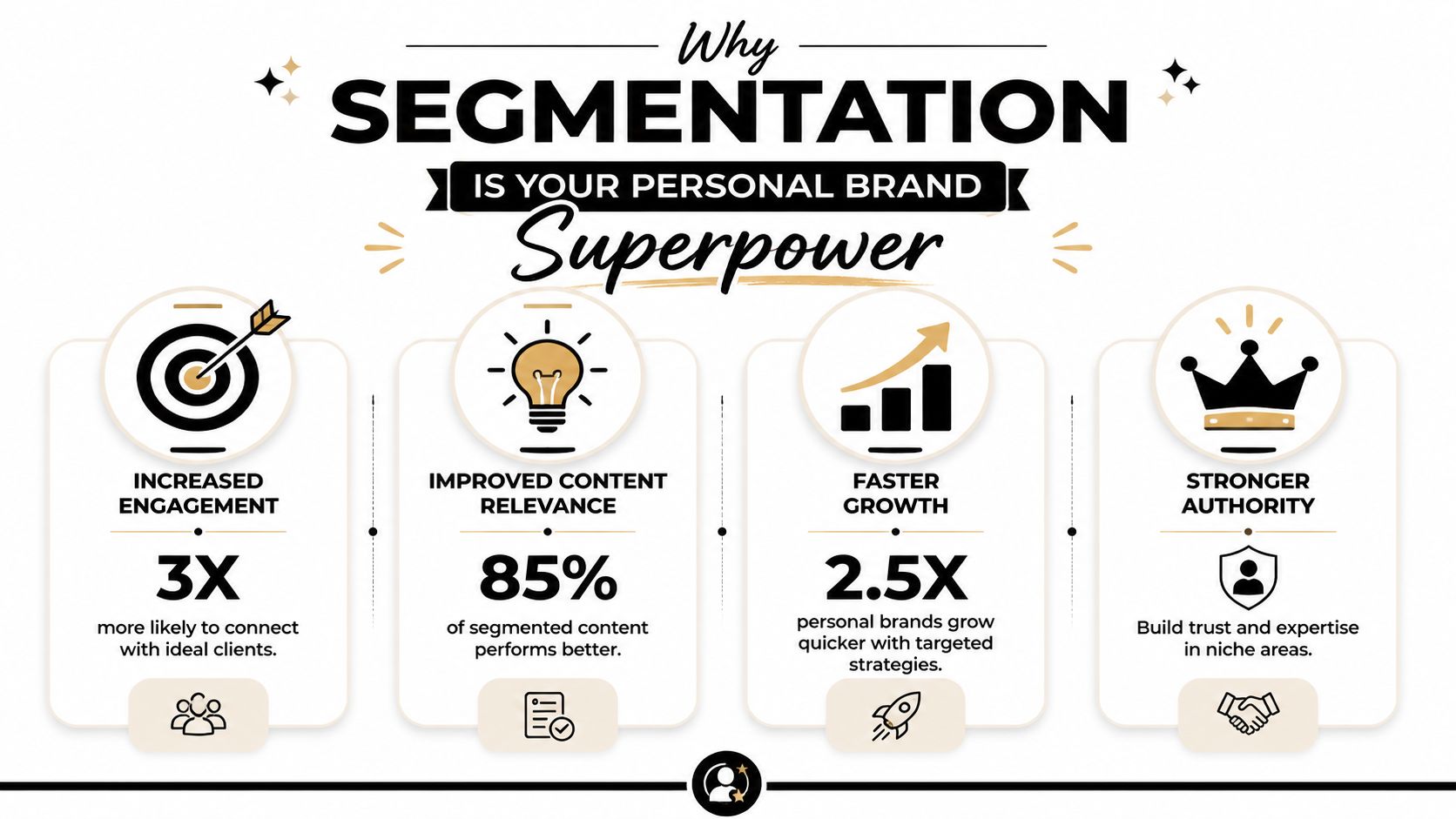
Ignore the inflated vanity metrics people obsess over. The fundamental value of segmentation is simpler:
A company can get away with broad messaging because different departments, campaigns, and sales reps can patch the gaps. You can't. Your face, your name, and your judgment are the brand. If your message is muddy, the market reads that as a positioning problem.
That's why I push founders to take segmentation seriously early.
You don't need a huge audience to build authority. You need a clearly divided one.
On LinkedIn, that may mean writing one category of posts for buyers with active pain, another for peers who share your work, and another for future hires who are evaluating your thinking. On X, it may mean using short-form ideas to attract one segment while using replies and DMs to deepen conversations with another.
The point is not to become more complicated. The point is to become more intentional.
If you're trying to understand what is audience segmentation without getting buried in marketing jargon, focus on four practical lenses. They tell you who people are, why they care, what they do, and where they sit in a business context.
Matomo describes audience segmentation as dividing a customer base into distinct types, including demographic, behavioural, psychographic, and lifecycle segmentation, so marketers can tailor messages based on traits like location, interests, and online behavior in its audience segmentation guide. For personal brands, you don't need every advanced model on day one. You need a usable framework.
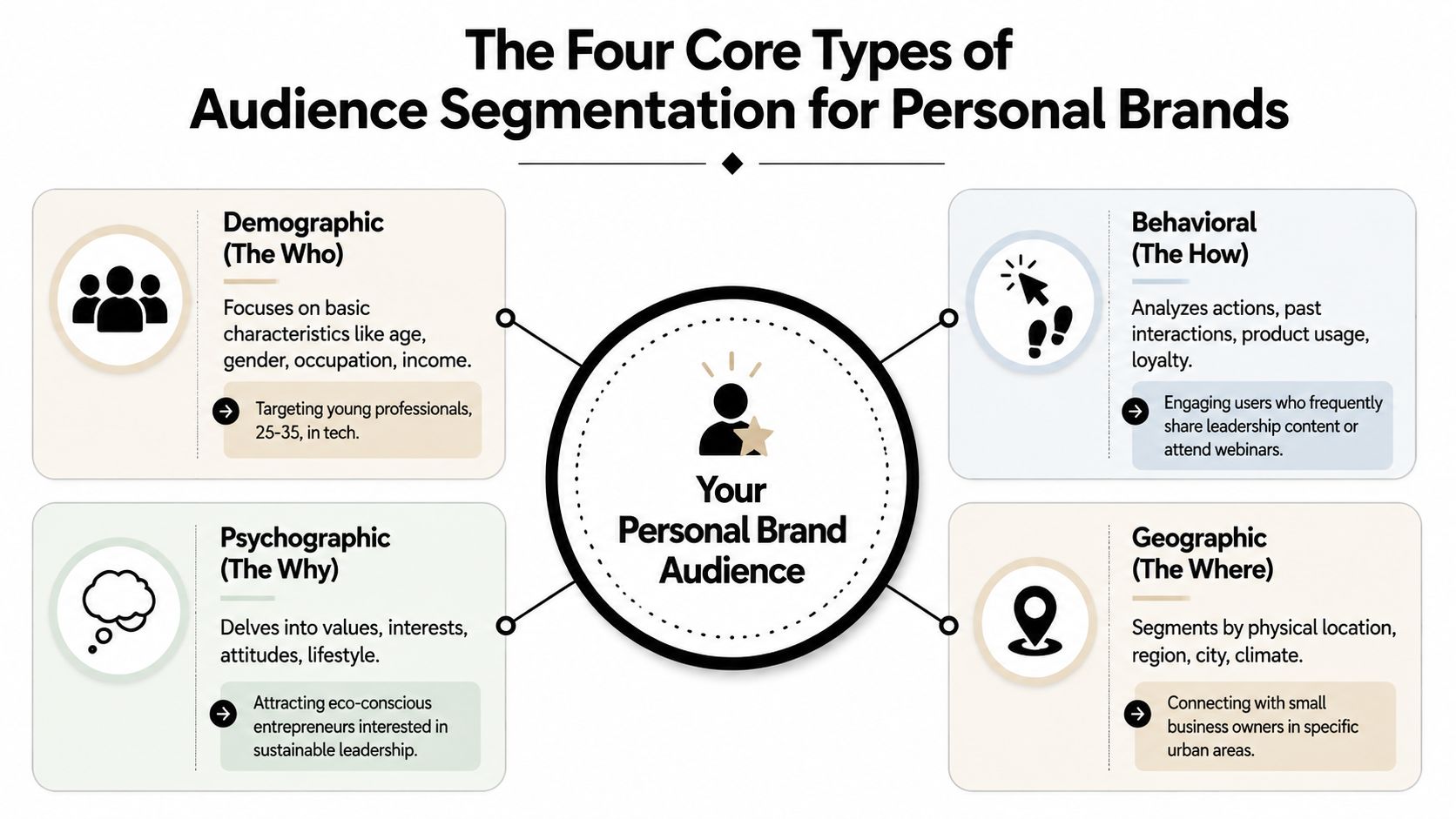
This is the basic layer. Role, seniority, industry experience, geography, company stage.
For a founder on LinkedIn, demographic segmentation might mean separating:
The way a post about “building distribution” lands varies between a first-time founder and a seasoned CMO.
Most personal brands either become powerful or stay generic; the outcome depends on the depth of audience insight. Psychographics look at values, ambitions, frustrations, identity, and decision style.
Two CEOs may have the same title and company size, but one wants prestige and category authority while the other wants a quieter, more efficient pipeline. They need different language.
You won't find this in a spreadsheet first. You'll find it in comments, DMs, podcast interviews, objections on sales calls, and the kinds of posts people save but don't publicly engage with.
Signal to watch: Repeated phrases from your audience often reveal psychographics faster than profile data does.
Behavioral segmentation tracks action. Who comments on hiring posts? Who clicks when you talk about pricing? Who replies when you publish a strong opinion? Who consistently engages with problem-aware content?
This is one of the most useful forms of segmentation for solo professionals because behavior is visible. You don't need a research team. You need pattern recognition.
For B2B personal brands, firmographics matter. Company size, growth stage, business model, and market category often shape what kind of message works.
A founder selling to startups shouldn't sound like they're selling to enterprise procurement. A consultant targeting private equity-backed firms shouldn't create the same content they'd use for solo operators.
| Segmentation Type | What It Answers | Personal Brand Example |
|---|---|---|
| Demographic | Who is this person? | VP Marketing at a SaaS company versus solo coach |
| Psychographic | Why do they care? | Wants category authority versus wants steady inbound leads |
| Behavioral | What are they doing? | Regularly engages with posts about hiring, messaging, or growth |
| Firmographic | What kind of business are they in? | Seed-stage startup, agency, mid-market B2B company |
Don't overcomplicate this. Start with these four. If you can identify who someone is, what they want, what they respond to, and what kind of business context they operate in, you can create far better content than most of your competitors.
You do not need expensive software to start segmenting your audience. You need a process and the discipline to use the data already sitting in front of you.
This visual breaks the workflow down cleanly.
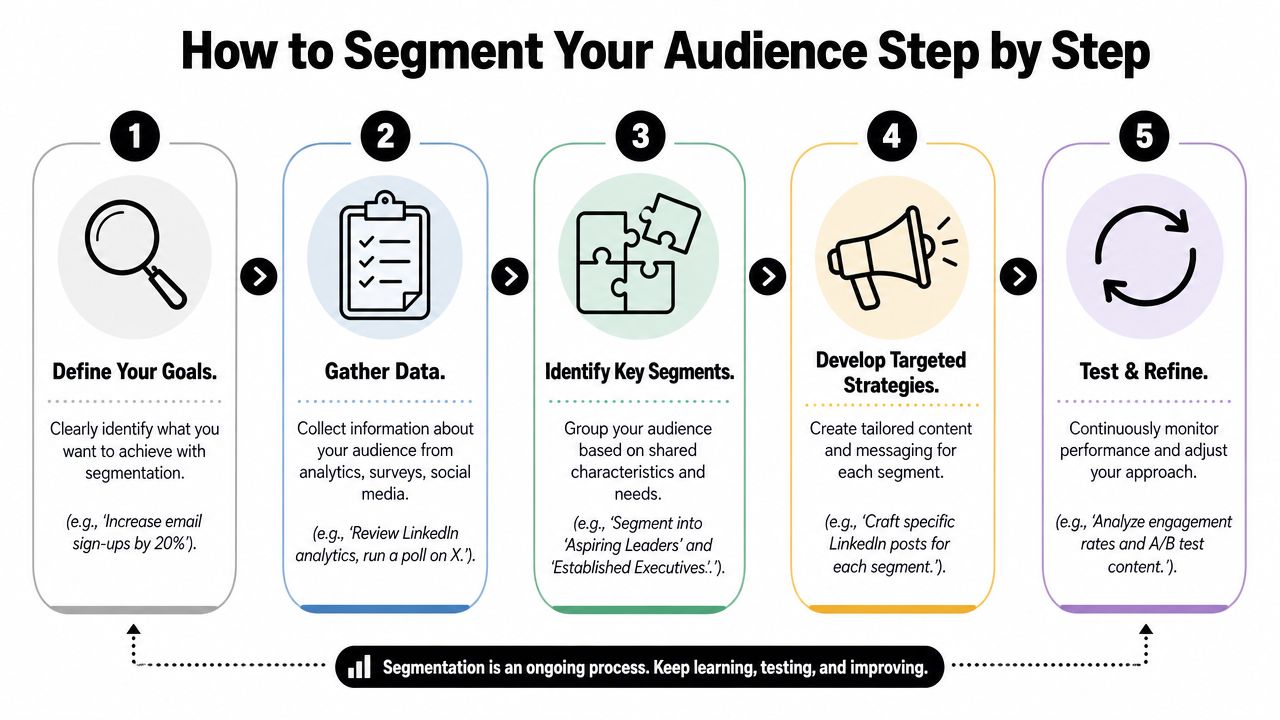
Segmentation without a goal becomes an interesting hobby. Decide what you want your brand to do.
Pick one outcome:
The goal determines the segments that matter. If you want leads, your audience split should center on buying intent and pain level. If you want authority, your split may focus more on peers, amplifiers, and decision-makers.
Most solo professionals already have enough raw material to segment. They just haven't organized it.
Look at:
Bombora notes that in B2B, intent-based segmentation identifies prospects researching solutions through real-time research signals, and for personal brands that idea can be adapted by tracking who engages with specific problem-focused content in its audience segmentation explainer. That's the key. Watch what people do when you speak about a problem they may be trying to solve.
A person who repeatedly engages with your content on team hiring is not the same as someone who only likes your culture posts. Treat them differently.
To tighten your approach further, this guide to strategic audience segmentation is worth reviewing because it helps translate broad segmentation theory into practical campaign choices.
Don't create a dozen tiny segments because you can. Group people by meaningful similarities.
For example:
Keep the groups useful. If a segment doesn't change what you publish, how you DM, or what offer you present, it's probably unnecessary.
Here's a useful walkthrough on the mechanics behind audience analysis and messaging:
Now give each segment a working profile. Not a fluffy branding document. A practical one.
Include:
If you need a structure, use this buyer persona guide for founders. It's a practical way to turn scattered observations into messaging you can use.
Many stop too soon. They identify segments once and never revisit them.
Instead, run small tests:
If you want tooling support, platforms like LinkedIn analytics, X analytics, a CRM, Airtable, Notion, or even a tagging system inside your email platform can handle the basics. Legacy Builder also supports personal branding workflows that include segmentation-informed content planning and distribution for professionals who want help operationalizing this process.
Segmentation works when it changes behavior, yours first, then your audience's.
Theory is easy to agree with. Application is where most founders stall. Here's what audience segmentation looks like when someone uses it.
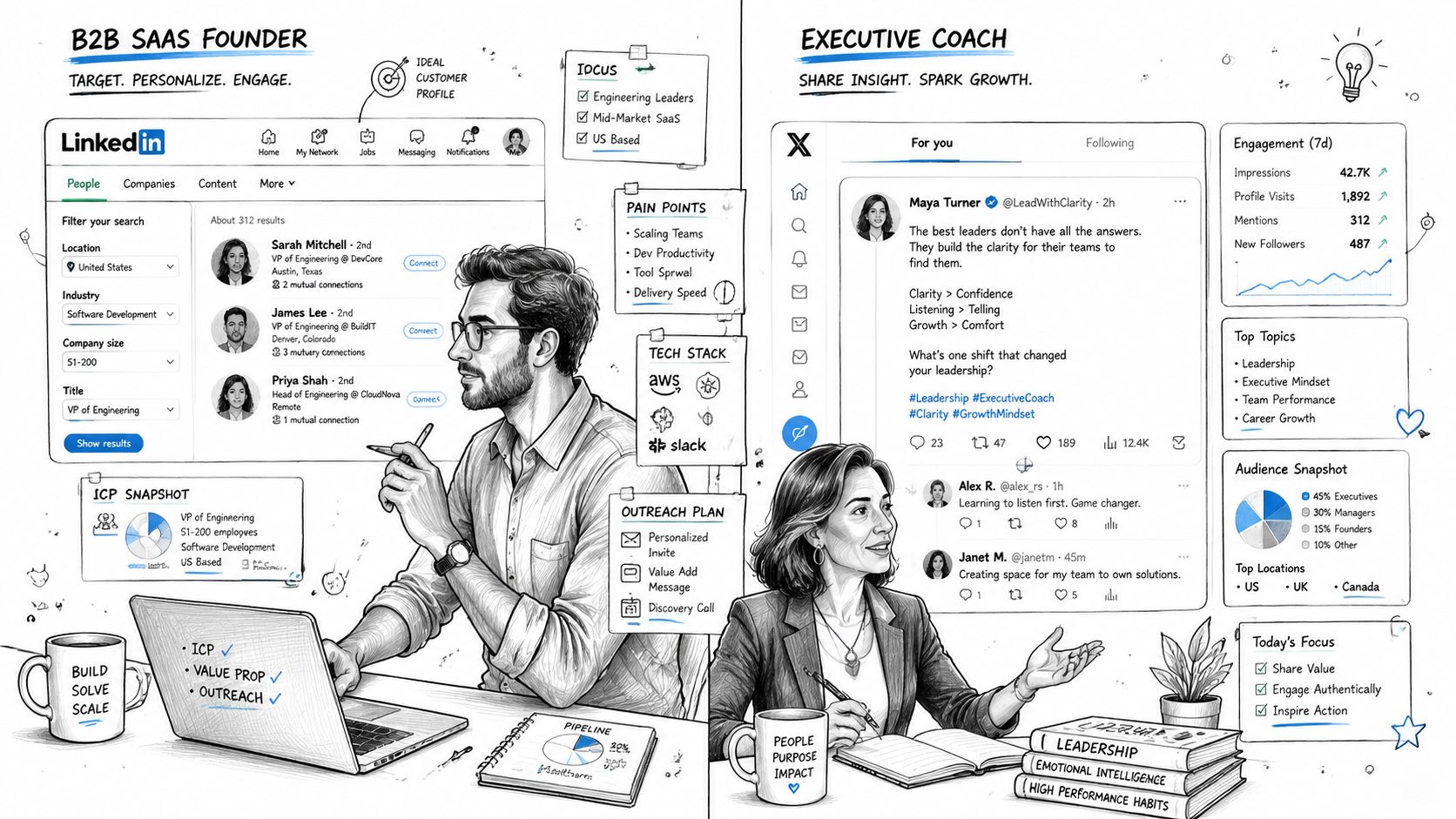
This founder has three real audience groups. Buyers. Investors. Potential hires.
So the content gets split accordingly. Posts about operational bottlenecks and product outcomes are written for buyers. Posts about market insight and category direction are shaped for investors and peers. Posts about culture, standards, and decision-making attract talent.
The founder doesn't publish one blended message trying to satisfy all three. Each post has a job.
This coach noticed two distinct engagement patterns. Some followers respond to mindset and leadership identity. Others light up when the coach writes about hard management situations like conflict, delegation, or executive presence.
So the coach segments by behavior and intent. The first segment gets broader top-of-funnel content. The second gets sharper threads, direct replies, and DM follow-ups tied to specific leadership problems.
That's how X becomes more than a broadcasting platform. It becomes a sorting mechanism.
Circana notes that analyzing total basket data and cross-purchase habits can reveal underserved segments at low cost, challenging assumptions about who buys what in its analysis of affordable ways to find underserved consumer markets. For a personal brand, the equivalent is watching what different follower groups engage with at the same time.
A creator might assume founders want growth content and employees want career content. Then they notice both groups consistently engage with posts about clarity, decision-making, and communication. That overlap reveals a new underserved segment: ambitious professionals navigating responsibility, not just job titles.
The best segments often appear where two audience groups react to the same problem for different reasons.
That insight can shape a newsletter series, a lead magnet, or an email sequence. If you're moving segmented followers into email, these email segmentation best practices for personal brands will help keep the message consistent after the first touchpoint.
Smart people overcomplicate segmentation all the time. They build elaborate categories, then publish the same vague content anyway. Don't do that.
If you slice your audience into tiny groups from the start, you'll create operational drag. You'll spend more time managing labels than making decisions.
The fix is simple. Start with a few segments that clearly change your message, your offer, or your outreach. Expand only when a new group behaves differently enough to deserve distinct treatment.
Job title alone won't save you. “Founder,” “CEO,” and “consultant” tell you almost nothing about urgency, taste, or buying intent.
Use demographics as a starting point, then layer in behavior and motivation. A founder engaging with pricing content is not in the same state as a founder engaging with inspirational storytelling.
People move. A follower can become a buyer. A peer can become a partner. A silent reader can become a high-intent lead after one post hits the right nerve.
Review your segments regularly through fresh comments, DMs, sales conversations, and analytics. If your audience evolves and your segmentation doesn't, your content gets stale fast.
This one matters most for personal brands. Just because you can monetize a niche doesn't mean you should.
Audience Doctor argues that when monetizing underserved segments, companies need to evaluate whether serving a niche will degrade the product or dilute attention for the core audience in its piece on monetizing underserved audience segments. That applies directly to founders and CEOs building a public presence. If a side segment pulls your message away from your core authority, it can cost more than it creates.
Ask yourself:
The goal isn't to serve everyone who might listen. It's to serve the right people well enough that your brand compounds.
Audience segmentation isn't really about sorting people into boxes. It's about understanding how different people connect to your work, your message, and your value.
That's why this matters more than most content advice. When you segment well, you stop posting to fill the feed. You start creating content that helps one group feel seen, another group feel challenged, and a third group feel ready to act. That's the shift from attention to trust.
And trust is what turns an audience into a community.
If you want to go deeper on the community side, this guide on how to create community online is useful because it pushes the conversation beyond content mechanics and into sustained engagement. That's the right end goal. Not more impressions. Not random followers. A group of people who care about the same problems, respect your perspective, and want to keep building with you.
Segment first. Speak clearly. Repeat what resonates. Cut what confuses. That's how a founder builds a personal brand people don't just follow, but join.
If you want help turning audience insight into a content system, Legacy Builder works with founders, CEOs, and professionals to shape authentic personal brands through strategy, content creation, and audience-focused distribution. It's a practical next step if you're done posting broadly and ready to build with precision.


You could – but most in-house teams struggle with the nuance of growing on specific platforms.
We partner with in-house teams all the time to help them grow on X, LI, and Email.
Consider us the special forces unit you call in to get the job done without anyone knowing (for a fraction of what you would pay).
Short answer – yes.
Long answer – yes because of our process.
We start with an in-depth interview that gives us the opportunity to learn more about you, your stories, and your vision.
We take that and craft your content then we ship it to you. You are then able to give us the final sign-off (and any adjustments to nail it 100%) before we schedule for posting.
No problem.
We have helped clients for years or for just a season.
All the content we create is yours and yours alone.
If you want to take it over or work on transitioning we will help ensure you are set up for success.
We want this to be a living breathing brand. We will give you best practices for posting and make sure you are set up to win – so post away.
Subscribe to our newsletter and get insights on how to grow your personal brand.
