.svg)
Subscribe to our newsletter and get insights on how to grow your personal brand.
Thank you! Your submission has been received!
Oops! Something went wrong while submitting the form.
.svg)


Most advice on buyer personas is built for companies with sales teams, product teams, and long buying cycles. That advice usually tells you to fill out a template with age, job title, salary, goals, and objections, then call it strategy.
That approach is lazy, and for a personal brand, it often backfires.
If you're a founder, CEO, or expert, you are not just marketing a product. You're building trust in your judgment. People don't follow you because your persona spreadsheet says they work in operations and like podcasts. They follow you because your ideas feel relevant, your perspective feels earned, and your content makes them feel understood.
So when people ask me how to create buyer personas, I tell them to stop thinking like a corporate marketing department. Start thinking like a credible operator. Your audience is not only a buyer. They're a reader, follower, lurker, referrer, skeptic, and sometimes an internal advocate long before they ever become a client.
A useful persona for a personal brand should help you answer practical questions. Why does this person pay attention to me? What are they worried about but not saying out loud? What kind of proof do they trust? What would make them share my content with a colleague? If your persona can't answer those questions, it's not helping you.
Buyer personas became a formal marketing practice in the 1990s, when software and product teams started using researched archetypes instead of relying only on broad demographics. The original point was alignment. Teams needed marketing, sales, and product working from the same picture of the customer, as outlined in Adobe's buyer persona guide.
That origin matters because most persona templates still carry corporate assumptions.
They assume you're selling a clearly defined product to a clearly defined buyer. They assume the audience appears at the bottom of a funnel. They assume the main job of the persona is to help a team move a deal forward. That's fine for enterprise software. It's weak for a personal brand.
A founder's audience behaves differently from a product buyer list. Some people buy. Some compare. Some observe for months. Some trust you enough to invite you into a room you couldn't access otherwise. A personal brand grows because people attach meaning to your point of view.
That's why generic corporate templates miss the mark. They over-focus on demographics and under-focus on influence, trust, timing, and perceived authority.
If you're building your own presence, your persona should tell you things like:
Corporate personas ask, "Who approves the purchase?"
Personal brand personas ask, "Who believes you enough to keep listening?"
A lot of founders create personas by guessing. They describe the kind of person they want to attract, not the people already paying attention. That's branding theater.
Your persona should come from observed behavior and direct conversations. It should also help you align your content across platforms, the same way strong personas align teams in larger companies. If you want a useful mental model for that broader brand alignment, this personal branding guide for entrepreneurs is worth reading.
Here's my opinion. Stop building personas that read like HR files. Build personas that explain attention, trust, and action. That's what makes them usable.
Before you interview anyone, look at the data sitting right in front of you.
Most founders skip this step because they think they need fancy research software. You don't. You need pattern recognition. A solid persona workflow starts by triangulating quantitative data from your website, CRM, and social media, then validating those patterns with 3–5 qualitative interviews per persona, as HubSpot recommends in its guide to buyer persona research.

You are probably sitting on useful audience signals already. The mistake is treating each channel separately. You need to compare them.
Use this quick scan:
This isn't about building a giant dashboard. It's about finding overlap.
If LinkedIn says your strongest engagement comes from founders, your newsletter gets replies from consultants and advisors, and your CRM shows that operators are the people who book calls, you probably don't have one persona. You have at least a few distinct audience groups with different reasons for paying attention.
Founders often get distracted by popularity. Views feel exciting. Comments feel validating. Neither automatically helps you create buyer personas that drive better content and positioning.
Focus on signals with strategic value.
| Signal | What to check | Why it matters |
|---|---|---|
| Role | Founder, CEO, marketer, operator, creator | Role often shapes pain points more than age does |
| Seniority | Owner, manager, head of department, consultant | Seniority changes decision pressure and trust needs |
| Industry | SaaS, services, local business, professional services | Industry changes language and examples that resonate |
| Action type | Like, save, reply, DM, book call | Different actions reveal different intent levels |
| Topic pattern | Strategy, storytelling, systems, visibility, hiring | Content themes hint at what they want help with |
If you want extra structure while you analyze segments, a resource on B2B market analysis can help you think more clearly about market patterns without defaulting to guesswork.
Practical rule: Don't build a persona from your loudest followers. Build it from the people whose role, behavior, and intent match the business you actually want to grow.
At this stage, don't write a polished narrative. Draft a rough segment sketch.
For example:
That's enough to move forward. If you need a sharper process for narrowing those segments, this article on finding your target audience for a personal brand gives a practical starting point.
The point of quantitative research isn't perfection. It's to stop you from interviewing random people and calling the result insight.
Data tells you what people do. Interviews tell you why they do it.
Most founders overcomplicate this. You do not need a formal research project. You need short conversations with the right people and better questions than, "What kind of content do you like?"
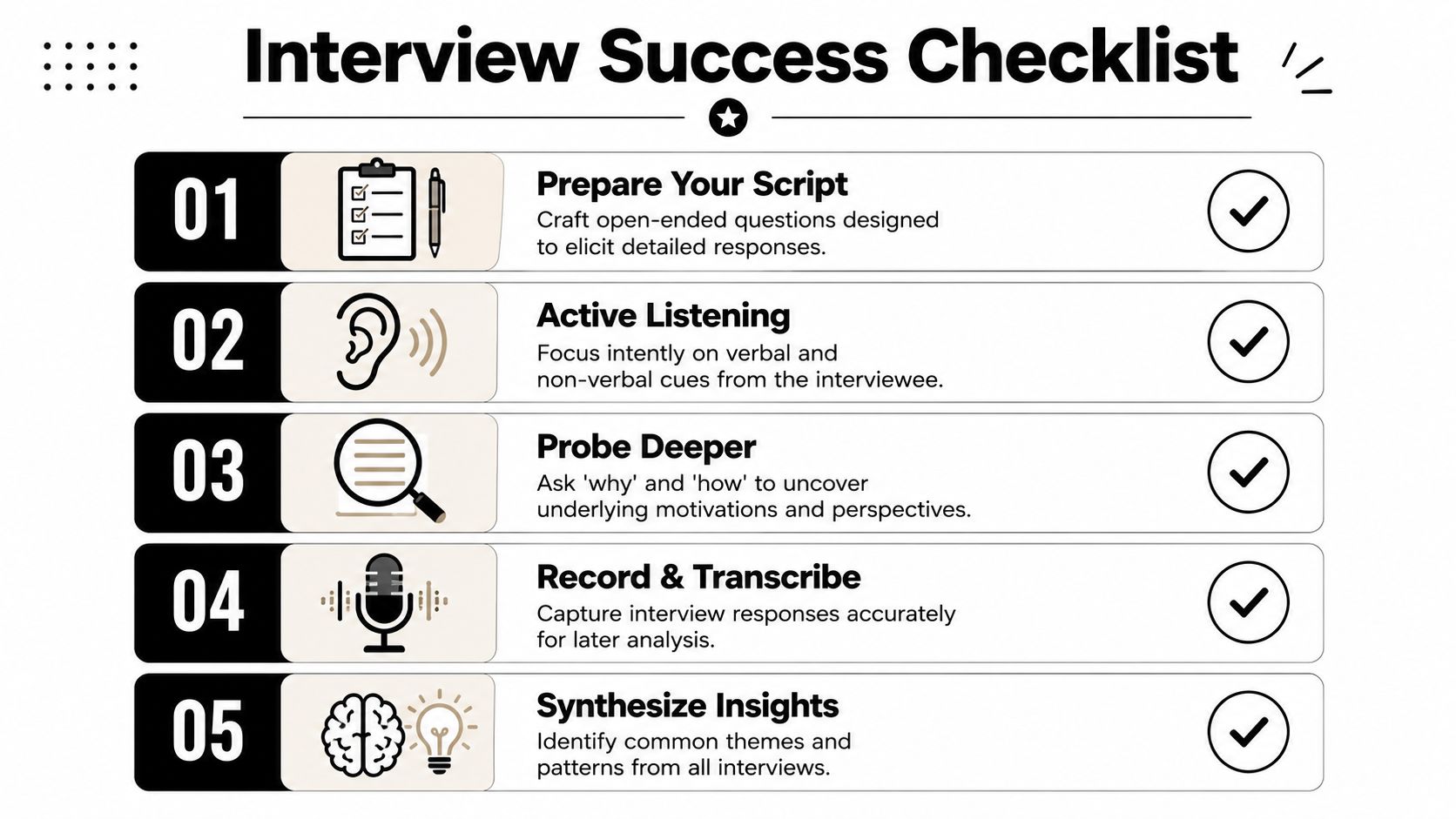
Start with people already close to your orbit.
That usually means:
You only need a small batch per persona. The goal is not volume. The goal is pattern clarity.
The worst interview questions ask people to predict their future behavior. People are bad at that. Ask about what already happened.
Use prompts like these:
These questions work because they uncover context, friction, language, and trust patterns.
Most first answers are polished. That's normal. People give summary answers because they're used to sounding competent.
Your job is to go one level deeper.
If they say, "I wanted to grow my audience," ask:
If they say, "I liked your content because it felt authentic," ask:
Ask "why" and "how" more than "what." "What" gives you categories. "Why" gives you messaging.
You're not collecting compliments. You're listening for repeated clues.
Listen for:
A good interview should leave you with sentences you can paraphrase into sharper messaging, not vague affirmations that your content is "helpful."
"If you can't explain what your audience was trying to avoid, your persona is still superficial."
Now you turn scattered notes into something your content can use.
Most persona documents fail because they're bloated. They read like reports, not tools. You don't need a ten-page deck. You need a one-page operating document that helps you write better posts, emails, videos, and offers.
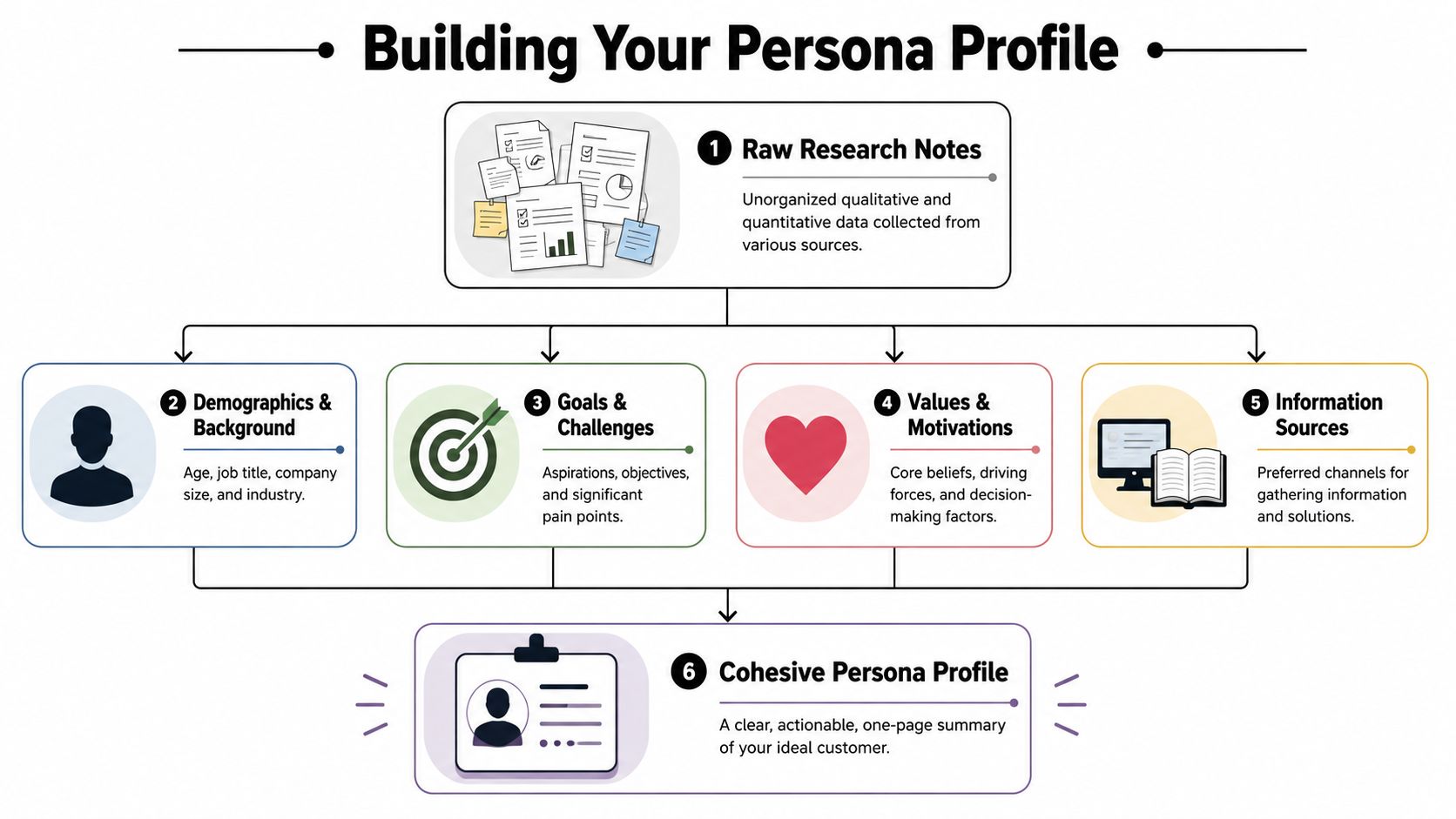
Use these fields and skip the corporate fluff.
| Section | What to include | Why it matters |
|---|---|---|
| Persona name | A simple label like Founder Faye | Makes the profile memorable |
| Role and context | Founder, CEO, consultant, creator | Grounds the persona in a real operating environment |
| Current pressure | What they're dealing with right now | Creates urgency and relevance |
| Primary goal | What they're trying to achieve | Focuses your message |
| Hidden friction | Fear, confusion, resistance, internal tension | Reveals what they won't say publicly |
| Trust triggers | What makes them believe you | Shapes tone and proof |
| Content triggers | Topics that get their attention | Drives editorial planning |
| Unspoken questions | What they're wondering but not posting online | Creates resonance |
| Preferred formats | Post, email, video, carousel, podcast | Helps package your ideas |
| Buying influence | Who else shapes the decision | Keeps your content realistic |
If you want a stronger process for organizing and coding interview notes before you write the final profile, these qualitative data analysis techniques are useful.
A quick walkthrough can help make this concrete.
Let's build one.
Founder Faye
Notice what's missing. No filler demographics. No fake precision. No personality type nonsense.
This persona works because it helps you make decisions.
If you're writing for Founder Faye, you know to avoid fluffy inspiration. You know to lead with real tension, not broad motivation. You know she needs both strategic clarity and emotional permission. You know she is evaluating not just your offer, but your judgment.
That last point matters most for personal brands.
If your brand serves founders, executives, or teams in complex organizations, don't stop at one persona. In B2B and leadership contexts, buying is often non-linear and shaped by multiple stakeholders. Salesforce notes that personas should include the buyer's role in the process and that teams should account for influence and consensus in the path to purchase in its overview of buyer personas in sales.
So if Founder Faye can approve the budget but her operator worries about execution and her finance lead worries about spend, your content can't speak to only one concern.
You don't need separate brands for each stakeholder. But you do need persona notes on:
That's how to create buyer personas that reflect real decision environments instead of imaginary solo buyers.
A persona sitting in a Notion doc does nothing. The only reason to create one is to make your content sharper.
So let's use Founder Faye and turn insight into output.
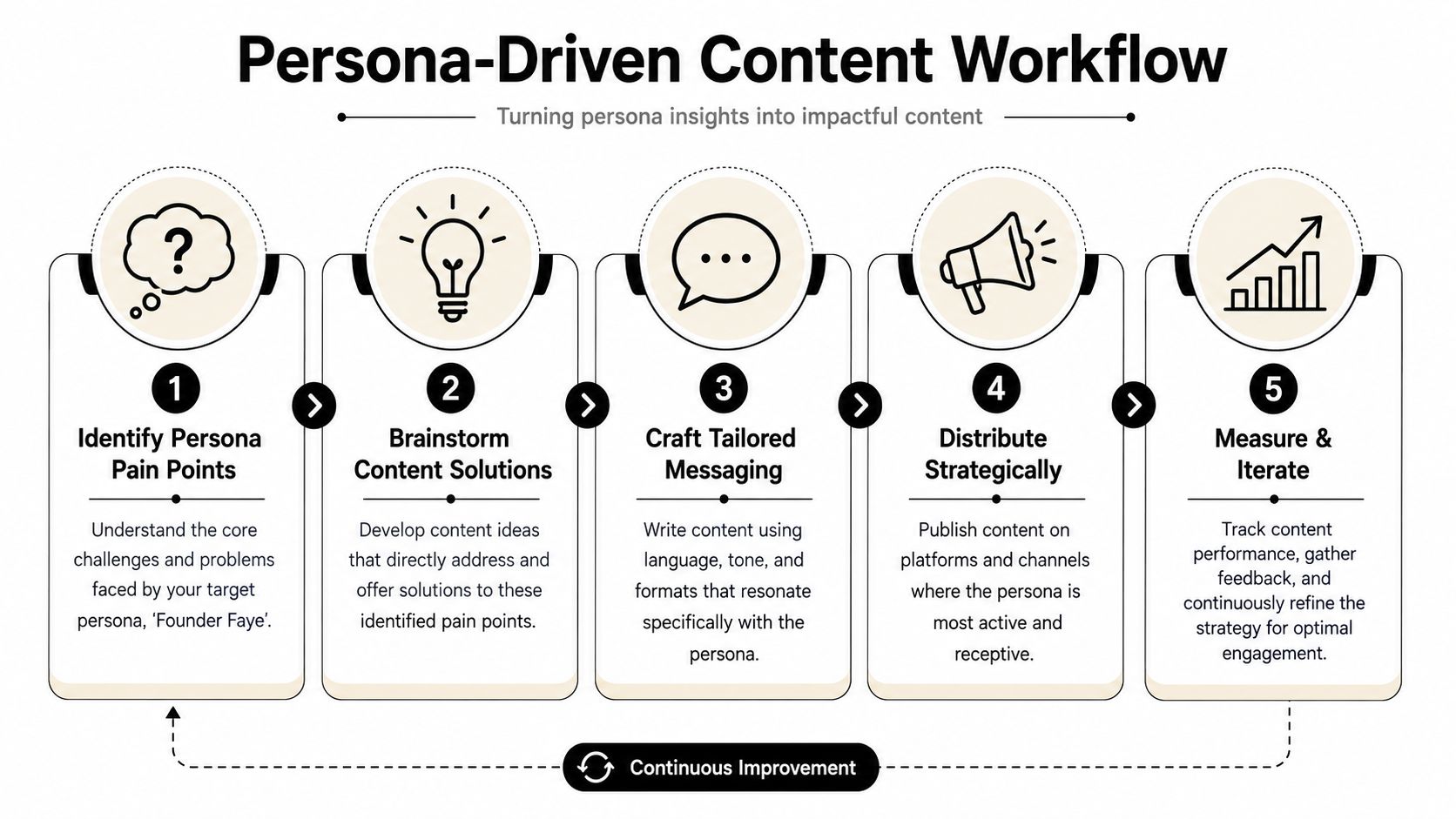
Founders usually plan content around categories. Branding. Marketing. Leadership. Growth.
That sounds organized, but it creates bland content.
Plan around a specific tension inside the persona. For Founder Faye, one strong tension is this: she wants to be visible, but she doesn't want to look manufactured.
That tension can become a week of content.
Here is how I'd translate that into a practical content stack.
LinkedIn post
Topic: Why smart founders sound bland online
Angle: Explain that expertise often becomes invisible when you over-edit it into generic advice. Show the difference between polished commentary and lived perspective. End with a punchy example.
Newsletter
Topic: Why your content feels flat
Angle: Go deeper. Explain that the issue usually isn't writing skill. It's weak persona clarity. If you don't know the fear, pressure, and trust trigger of the person reading, your content defaults to surface-level tips.
Short-form video
Topic: You do not need to sound inspirational to build authority
Angle: Speak directly to camera. Contrast empty motivational content with precise operator insight. Use one concrete example of how a founder can turn a client conversation into a useful post.
That is how persona work pays off. One insight gives you multiple assets without forcing repetition.
Good content doesn't come from asking, "What should I post today?" It comes from asking, "What does this specific person need to hear from me right now?"
If your audience operates in B2B or leadership settings, remember that the path to action is rarely linear. Your content has to reflect different information needs across the decision chain, especially when founders, finance, operators, and end-users care about different outcomes.
That means you should vary your content on purpose:
Many founders underperform; they create content only for the person who emotionally relates to them, not the people surrounding the decision.
Use this sequence every week:
If you're publishing heavily on LinkedIn, a tactical resource like Bazzly's LinkedIn campaign guide can help you think through distribution and campaign structure more deliberately.
And if you want to operationalize this across a full publishing schedule, a clear content plan for your personal brand will keep your persona insights from dying in a document.
Before you publish, ask:
| Question | If the answer is no |
|---|---|
| Does this speak to a real pressure my persona feels? | The post is probably too broad |
| Would they recognize themselves in the opening? | Your hook is weak |
| Am I using proof they actually trust? | Your authority signal is off |
| Could they share this with a colleague easily? | The framing is too personal or too vague |
| Does this move them toward belief, trust, or action? | It is content for activity, not impact |
You do not need more ideas. You need tighter translation from persona insight to message.
The fastest way to ruin a good persona is to treat it like a finished document.
Audience behavior shifts. New roles enter your orbit. Old pain points get replaced by new ones. Your content changes too, which means the people responding to it can change. That's why buyer personas should be treated as a living, data-driven asset, not a workshop artifact. Monday.com recommends revisiting personas regularly, with quarterly reviews specifically suggested to incorporate fresh feedback and campaign performance, in its guide to buyer persona templates.
You don't need a big offsite. You need one recurring review.
Check these questions:
Review your personas before they become fiction.
A persona is accurate only if it still helps you explain attention, trust, and action in the present tense. If it doesn't help you make better content decisions today, rewrite it.
If you're building a personal brand and want a team that can turn your real expertise into consistent, strategic content, Legacy Builder can help. They work with founders, CEOs, and experts who want sharper positioning, stronger audience trust, and a content engine that sounds like them.


You could – but most in-house teams struggle with the nuance of growing on specific platforms.
We partner with in-house teams all the time to help them grow on X, LI, and Email.
Consider us the special forces unit you call in to get the job done without anyone knowing (for a fraction of what you would pay).
Short answer – yes.
Long answer – yes because of our process.
We start with an in-depth interview that gives us the opportunity to learn more about you, your stories, and your vision.
We take that and craft your content then we ship it to you. You are then able to give us the final sign-off (and any adjustments to nail it 100%) before we schedule for posting.
No problem.
We have helped clients for years or for just a season.
All the content we create is yours and yours alone.
If you want to take it over or work on transitioning we will help ensure you are set up for success.
We want this to be a living breathing brand. We will give you best practices for posting and make sure you are set up to win – so post away.
Subscribe to our newsletter and get insights on how to grow your personal brand.
