.svg)
Subscribe to our newsletter and get insights on how to grow your personal brand.
Thank you! Your submission has been received!
Oops! Something went wrong while submitting the form.
.svg)



Audience engagement is the percentage of an audience that takes a visible action after seeing your content, and that's why 3.70% on TikTok, 0.48% on Instagram, and 0.15% on Facebook matter more than raw follower counts or pretty screenshots (Zoom's audience engagement guide). Likes alone do not prove anything useful. Executives love to point at a post with a pile of reactions, then wonder why the inbox stayed quiet.
Audience engagement is the share of people who do something measurable after seeing your content, and that action has to show real intent. Comments, shares, clicks, saves, replies, and time spent with the message all count because they prove the post did more than sit there and collect exposure (Zoom's audience engagement guide). A useful operational readout is interactions ÷ reach × 100, which turns engagement into a percentage instead of a feeling.
A lot of LinkedIn advice gets this wrong. It treats visibility as the prize, then celebrates vanity metrics that can rise while the business result stays flat. A post can pick up impressions and still fail if nobody reads past the hook, nobody leaves a substantive comment, and nobody takes the next step.
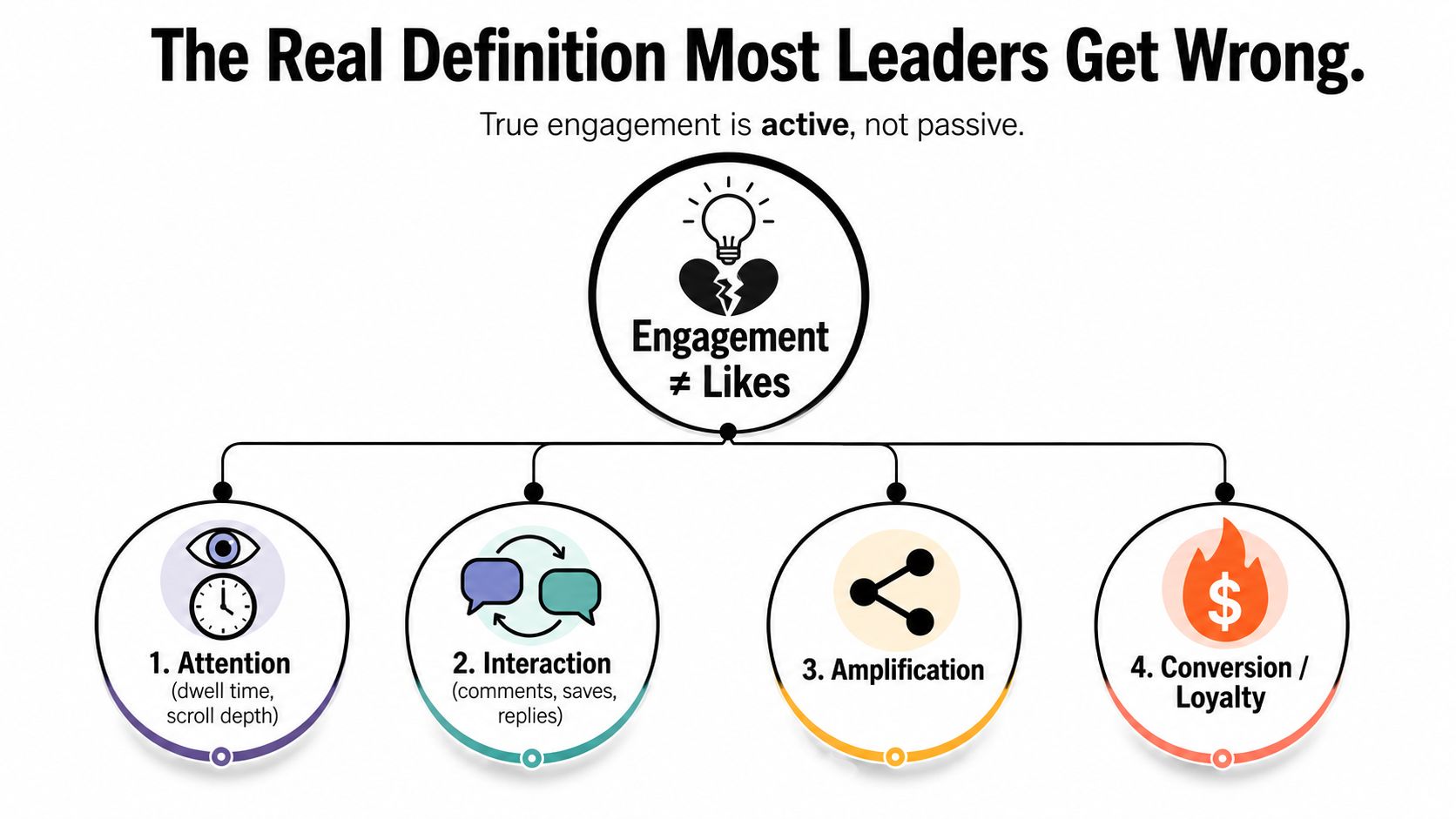
If you run a personal brand, use a colder standard. Engagement is proof that your message triggered a visible response, and that response has to be meaningful enough to support your next move. A like is the weakest signal. A comment, save, click, reply, or DM tells you the content cut through the noise.
Practical rule: if a post gets attention but no downstream action, it is content, not engagement.
That distinction matters because audience behavior is selective. The benchmark in the Zoom guide shows TikTok averaging 3.70% engagement per post, while Instagram sits at 0.48%, Facebook at 0.15%, and X drops from 0.15% in 2024 to 0.12% in 2025 (Zoom's audience engagement guide). Channel matters. Format matters. Timing matters. If your team keeps judging every platform by the same superficial metric, you are managing by confusion.
The founder or CEO who uses this definition stops chasing empty scale and starts asking better questions. Did the content earn attention, did it trigger interaction, and did it produce an outcome that helps the brand grow? That separates posting for ego from building an asset.
Once you use the right definition, the rest gets simpler. You can stop arguing about whether a post did well and start asking where the funnel broke.
Audience engagement is not a vibe. It works like a funnel, and the useful model is attention, interaction, outcome. Each layer answers a different question. If one layer is weak, the next one loses force.
Attention is the first test. It tells you whether people slowed down, stayed long enough to absorb the message, or moved past it instantly. In web and app analytics, that shows up in average engagement time, scroll depth, and normalized engagement rate, not just raw views or impressions (Umbrex on audience engagement rate).
A strong attention signal looks like this in practice. Someone opens your post, reads the first few lines, scrolls, and stays long enough to finish the argument. A weak one looks like a fast swipe, a half-second glance, and nothing else.
Attention is where a lot of executive content fails. The post may be polished, but if readers bail immediately, the message never had a chance to work.
Interaction is the visible proof that the content mattered enough to prompt a response. Comments, replies, shares, saves, poll votes, and Q&A participation all sit here (Zoom's audience engagement guide). This layer is where the conversation starts, and executives often underperform here because they post like broadcasters instead of participants.
If a founder publishes a sharp point of view and people argue with it, ask follow-up questions, or reshare it into their own network, that is real engagement. If people only tap like, the post may have landed, but it did not travel.
Interaction also reveals whether the audience feels safe enough to respond publicly. A quiet feed usually means the content was too generic, too safe, or too polished to invite a reaction.
Outcome is where engagement turns into business movement. CTR, DMs, calls booked, sign-ups, resource downloads, and conversions all sit here (EventsAir on measuring audience engagement). This is the layer executives should care about most, because it shows whether the content produced something beyond the platform itself.
A founder post can have modest reach and still drive a pipeline if it creates the right clicks and follow-up conversations. A post can also rack up comments and still do nothing for the business. That is the trap. It is easy to celebrate activity that never leaves the platform.
The three-layer model separates being seen, being felt, and being acted on.
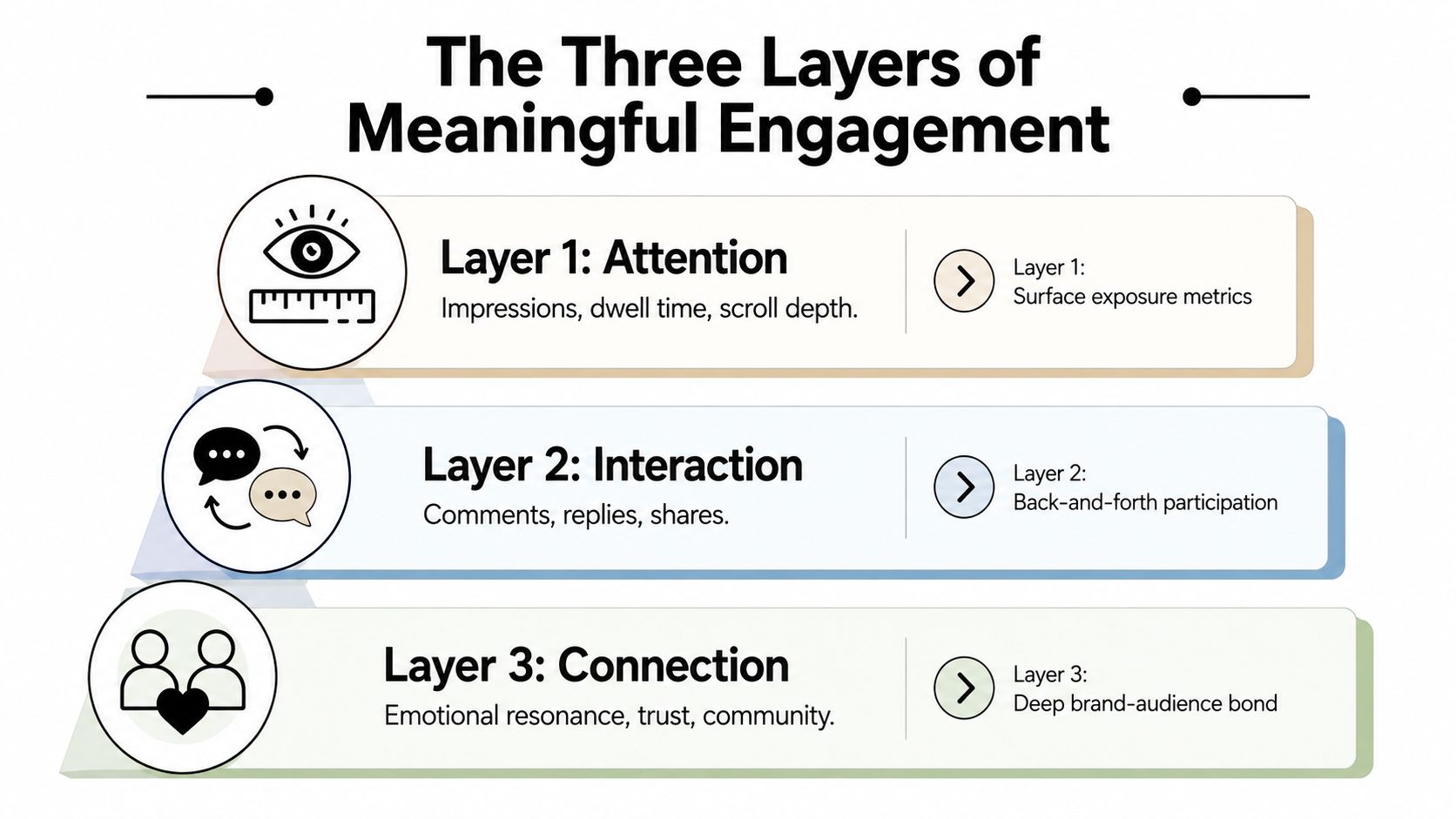
If your team cannot say which layer is failing, they are guessing. Guessing is expensive.
Track engagement like an operator, not a cheerleader. Raw counts are easy to inflate. Ratios and depth signals tell the truth.
| Layer | Metric | What Strong Looks Like |
|---|---|---|
| Attention | Engagement rate | A normalized percentage, not a raw count, so bigger audiences don't automatically win |
| Attention | Average time on page | People stay long enough to read, not just land and leave |
| Attention | Scroll depth | Readers move through the piece instead of bouncing at the top |
| Interaction | Comments, shares, saves | Real response, not just passive approval |
| Interaction | Comment quality | Actual questions, disagreement, examples, or next-step intent |
| Outcome | CTR | Readers leave the platform for something useful |
| Outcome | Return visitor rate | People come back because the content earned trust |
Read the scorecard in order. Weak attention means the hook or opening is failing. Decent attention with flat interaction means the idea is interesting but not sharp or useful enough to make people respond. Strong interaction with weak outcome means the call to action is muddy, or the next step does not earn the click.
Ignore applause without context. A post can collect visible reactions and still produce no momentum if it never pushes people toward action. The same warning applies to comment volume without substance. Ten thoughtful replies beat fifty “great post” comments every time.
Use a weekly review, not a monthly panic. Compare your own results against your own recent baseline, not some random industry benchmark pulled from a slide deck. If your last four posts had improving CTR but falling time on page, the content is getting clicked but not held. That is a useful problem to solve.
For a clearer framework on tracking content performance without fooling yourself, see how to measure content performance for your personal brand.
Operator's rule: separate attention, interaction, and outcome before changing the content. Skip that step, and you end up fixing the wrong problem.
A SaaS founder I'd call the quiet type did one thing differently. He stopped treating comments like noise and started replying to every one for ninety days. Not with canned thanks, but with real follow-up questions, clarifications, and occasional disagreement. His audience didn't just get bigger in spirit, it got warmer in behavior, because the page became a conversation instead of a billboard.
The result was simple. People who had been passive readers started introducing themselves in the replies and moving into DMs. The content still mattered, but the engagement mechanic changed the outcome. If you want comparable pattern recognition, browse SEO case studies for SaaS, then look for the same underlying theme, not the glossy surface metrics.
The second example is a CEO who kept posting polished thought leadership and getting huge visible traction. Likes piled up. Reactions looked impressive. None of it turned into meaningful inbound because the posts never created a clear next step, and the audience had no reason to move off-platform.
That's the trap. High surface activity can hide a dead funnel. If nobody clicks, books, downloads, or replies, the brand is admired and ignored at the same time. Executives usually blame the algorithm. The issue is that the content created attention but not enough interaction or outcome.
The difference between those two leaders wasn't charisma. It was structure. One built a loop that rewarded response, the other chased visibility that stopped at the feed.
Stop asking for more content. Ask for better content behavior. The fastest lift usually comes from changing how you show up, how often you show up, and how aggressively you participate after publishing.
For a broader tactical library, the playbook on 10 audience engagement techniques for brand builders is worth comparing against your current workflow.
If you only have one hour a day, spend it where the greatest impact is. Publish one strong piece, then use the rest of the time to reply, tag thoughtfully, and keep the thread alive. Posting and disappearing is lazy. The algorithm isn't your real problem. Your lack of follow-through is.
For teams that want to speed up testing on hooks, formats, and distribution angles, rapid prototyping for viral content is a useful lens, especially if you're trying to turn one idea into multiple native assets without sounding repetitive.
Good engagement is built after the post goes live. If your team disappears once content is published, you're leaving the highest-value part of the conversation untouched.
Engagement compounds because people remember repeated proof, not isolated posts. Attention creates familiarity. Interaction creates trust. Outcome creates proof that your voice can move someone to act. Over time, those signals turn into brand equity that outlasts a single campaign.
That matters for executives because platform rules change and reach can disappear overnight. A brand built only on impressions is brittle. A brand built on repeated engagement holds up because the audience has already decided your voice is worth following, responding to, and sharing.

One-off viral hits rarely build a durable brand if the audience never comes back. Repeated signals do. A post that earns thoughtful replies teaches the market that you are worth engaging with. A profile that keeps getting clicks tells people your ideas lead somewhere useful. A brand that keeps pulling return visitors starts to feel like a destination, not just another feed item.
The practical test is simple. Attention fills the top of the funnel, interaction shows the message landed, and outcome proves the brand can move people toward action. If one layer is weak, the whole system leaks. High views with no replies are vanity. Replies with no next step are noise. Actions without repeat attention are a one-time spike, not compounding.
The strongest brands keep showing up in ways that feel consistent to the audience and useful to the business. That is why executive content cannot stop at posting. It has to create a loop, attention first, interaction second, outcome third, then back again with more trust than the last round.
For brand owners who want a fuller system view, this blueprint for building a community around your brand is the right next reference point.
The biggest engagement mistake is still the oldest one, chasing vanity metrics. Likes can make a post look healthy while the business side stays empty. The quick win is ruthless: judge every post by whether it produced attention, interaction, and outcome, not applause alone.
The second mistake is posting and ghosting. A lot of leaders publish, then vanish. Fix it by replying to the first wave of comments and turning at least a few replies into real conversation.
Ignoring DMs and tag notifications is next. That's where the warmest signals live, and missing them tells people your brand is performative. Set a daily block to clear those messages and respond while the thread still matters.
Inconsistent cadence breaks trust fast. If you only post when inspiration hits, your audience learns not to expect you. Pick a schedule you can sustain and keep it boringly reliable.
The final mistake is one-channel thinking. If all your effort sits in one feed, one platform change can kneecap the whole brand. Adapt the same idea for multiple channels, and keep the message native to each format.
Legacy Builder helps executives turn this into a working system with consistent content creation, profile optimization, and strategic audience interaction. If you're done guessing which metrics matter and want a brand that compounds, visit Legacy Builder and make the engagement work like a process instead of a hobby.


You could – but most in-house teams struggle with the nuance of growing on specific platforms.
We partner with in-house teams all the time to help them grow on X, LI, and Email.
Consider us the special forces unit you call in to get the job done without anyone knowing (for a fraction of what you would pay).
Short answer – yes.
Long answer – yes because of our process.
We start with an in-depth interview that gives us the opportunity to learn more about you, your stories, and your vision.
We take that and craft your content then we ship it to you. You are then able to give us the final sign-off (and any adjustments to nail it 100%) before we schedule for posting.
No problem.
We have helped clients for years or for just a season.
All the content we create is yours and yours alone.
If you want to take it over or work on transitioning we will help ensure you are set up for success.
We want this to be a living breathing brand. We will give you best practices for posting and make sure you are set up to win – so post away.
Subscribe to our newsletter and get insights on how to grow your personal brand.
