.svg)
Subscribe to our newsletter and get insights on how to grow your personal brand.
Thank you! Your submission has been received!
Oops! Something went wrong while submitting the form.
.svg)



Most advice about content pillars starts with a neat list of topics. Pick a few categories, rotate through them, and your personal brand will supposedly become consistent. That advice is incomplete. A list can organize your calendar, but it can't make a founder credible, clarify what you stand for, or give an audience a reason to remember you.
Content pillars are recurring promises. They define the subjects, perspectives, and problems your audience can expect you to address repeatedly. For a leader, that makes them less like social media buckets and more like a credibility architecture, a structure that connects expertise, point of view, proof, and business relevance across every channel you use.
The common definition is useful but too shallow. Industry glossaries generally describe content pillars as three to five core themes that guide recurring content categories, helping a brand remain consistent, relevant, and authoritative over time, as summarized by Socialinsider's overview of content trends. The problem begins when marketers treat those themes as labels rather than commitments.
“Leadership,” “marketing,” and “entrepreneurship” aren't pillars yet. They're broad territories. A pillar becomes strategically useful only when it answers three questions:
A founder who publishes about leadership one week, productivity the next, and personal finance after that may be active without becoming recognizable. The audience sees isolated opinions rather than a coherent body of thinking. Topic overlap creates another problem. Posts about hiring, culture, delegation, and management can blur together unless each pillar has a clear job.
Practical rule: A pillar isn't a category you can fill. It's a promise your audience can recognize.
Static labels also encourage content fatigue. If every post under “founder lessons” repeats the same motivational pattern, people stop learning anything new. The solution isn't automatically adding more pillars. Several current frameworks still favor a focused set of three to five themes, because repetition can build recognition more effectively than constant variety, as discussed in StoryChief's guide to content pillars.
For personal brands, the commercial consequence matters. Your content should support the way buyers understand your expertise, evaluate your judgment, and decide whether they trust you. A pillar that attracts attention but has no relationship to your work may inflate activity while weakening positioning.
A stronger pillar system therefore includes a point of view, a recurring audience problem, and a credible source of experience. If you want to develop that thinking alongside broader positioning work, the Unfloppable guide to thought leadership offers useful context on turning expertise into a recognizable public perspective.
Authority is not created by mentioning a subject once. It forms when founders and leaders present useful, consistent thinking across related questions, platforms, and formats. Content pillars provide the architecture for that pattern, so individual posts reinforce a recognizable point of view instead of becoming isolated updates.
The structure often follows a pillar and topic-cluster model. A pillar establishes the central theme or main resource. Supporting pieces answer narrower questions, compare options, show practical applications, and address objections. Links between those assets help readers move from a broad explanation to a specific answer while keeping the same subject and perspective in view.
That structure serves both discovery and trust. Search engines can interpret relationships among connected pages, while human readers begin to associate your name with a defined area of expertise. A founder who explains go-to-market strategy through hiring decisions, customer research, pricing, and sales enablement creates a stronger credibility signal than one who publishes unrelated business observations.
For a personal brand, the value extends beyond search visibility. Repeated exposure to the same underlying principles lets an audience judge how you reason, what evidence you use, and where your experience applies. This matters across fragmented platforms, where a person may encounter one idea in a LinkedIn post, another in a newsletter, and a third in a podcast. The formats change, but the credibility architecture remains recognizable.
Structured content also supports commercial outcomes. Research summarized by Socialinsider research summary reports that 97% of B2B marketers had a content marketing strategy by 2025, showing how organized planning had entered mainstream practice. A separate Bloghunter's 2026 content marketing roundup reports that content marketing generates 3x more leads than outbound marketing, costs 62% less per lead, and cites an average cost per lead of $47 versus $121 for paid advertising. These figures do not guarantee results. They explain why companies build systems rather than rely on isolated posts.
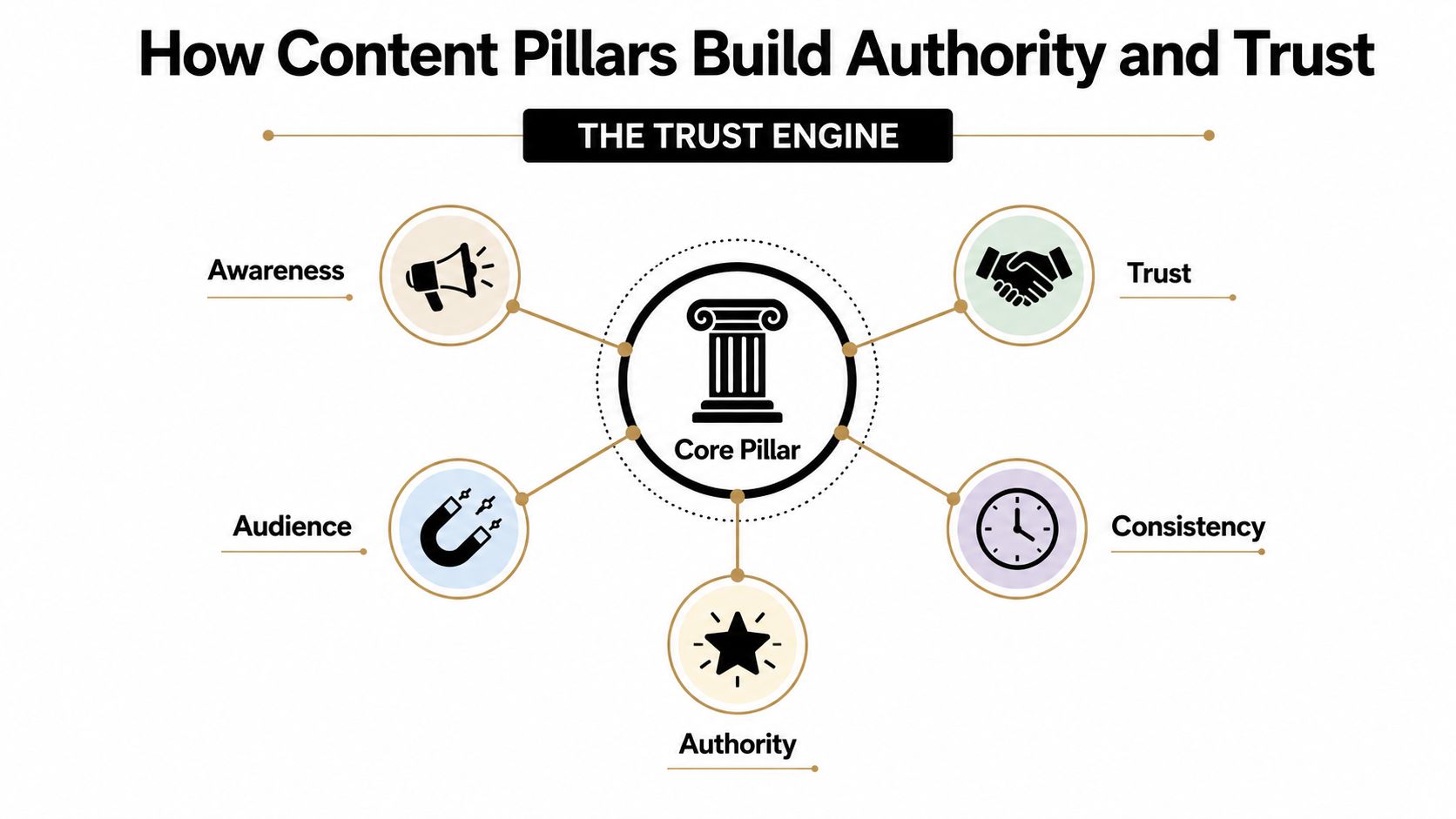
A strong asset should make the next asset easier to create and understand. A detailed article can become a LinkedIn argument, short video, newsletter explanation, or response to a recurring sales objection. The wording can change. The central idea and standard of evidence should not.
Content pillars also sharpen editorial judgment. Before publishing, ask whether an idea strengthens an established area, answers a useful adjacent question, or pulls the brand toward an unrelated identity. That filter helps leaders stay consistent without repeating the same post.
Academic work describes content pillars as thematic domains that create thematic consistency, narrative framing, and audience relevance. Those qualities matter because trust depends on pattern recognition. Audiences remember the executive who repeatedly explains difficult decisions clearly, not the executive who occasionally posts a polished thought.
A single post can earn attention. A connected body of work gives people repeated evidence of how you think, what you know, and why your judgment deserves consideration.
Choosing pillars starts with constraints. Frameworks commonly recommend three to seven core themes, with each theme broad enough to support 15 to 40 subtopics, according to Umbrex's content pillars and topic cluster framework. For a founder-led personal brand, the lower end is often more practical. Fewer themes make it easier to build memory, depth, and a distinct voice.
Write down the people you want to influence, the problems they face, and the decision you want your content to support. A SaaS founder may want to reach operations leaders evaluating software. A CEO may want to attract senior talent, partners, or enterprise buyers. Those audiences may overlap, but they don't ask identical questions.
Next, audit your own evidence. Look at client conversations, sales calls, product decisions, internal memos, presentations, and questions you answer repeatedly. Your strongest pillars usually sit where earned expertise, audience demand, and commercial relevance intersect.
Brainstorm freely first, then apply a sharper test. For each possible theme, ask:
Discard themes that fail several tests. “Business advice” is too broad. “Building a profitable service business without founder dependency” is more useful because it defines a problem, audience context, and perspective.
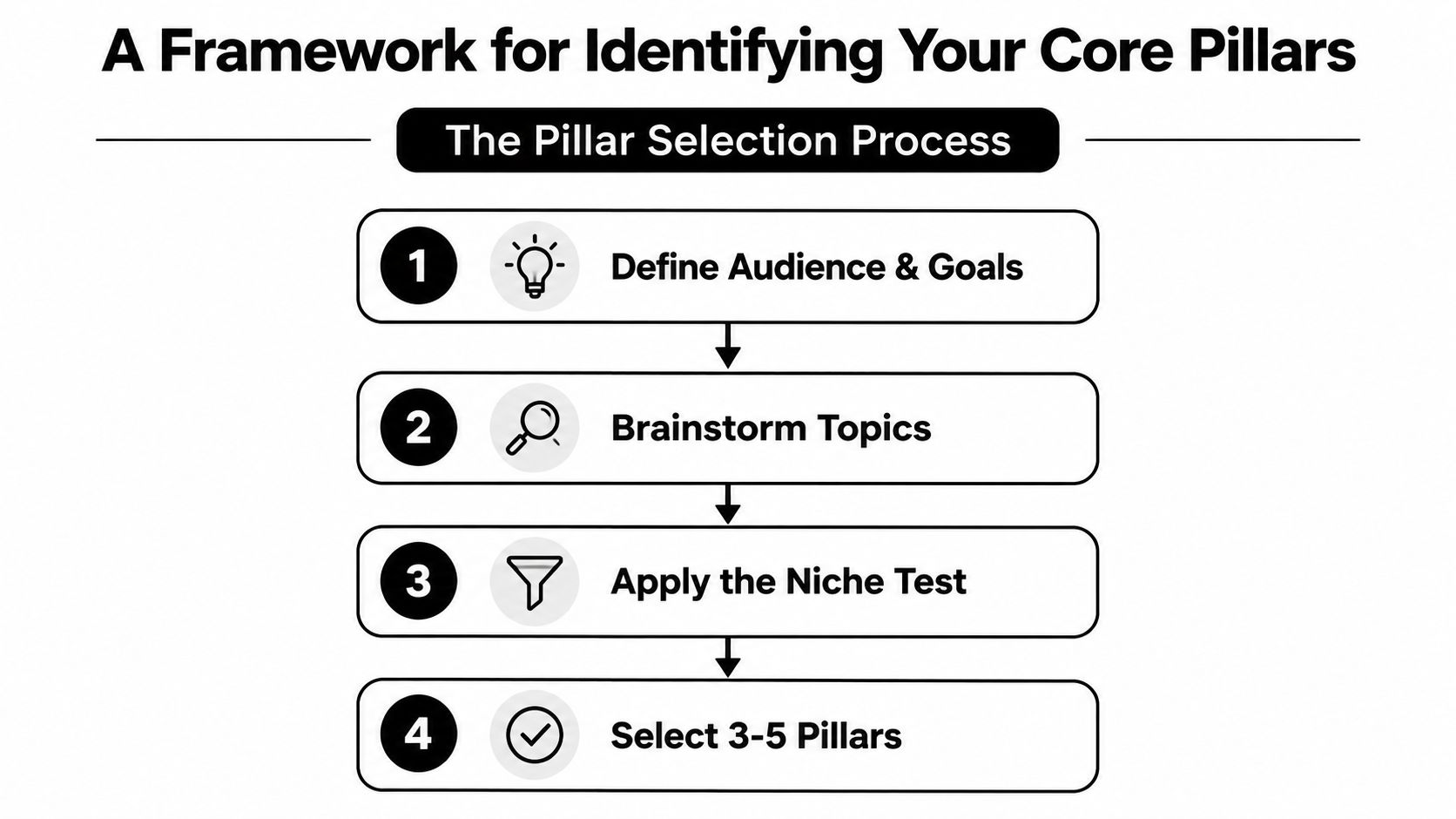
Give every selected pillar a one-sentence promise. For example, “I help founders make better hiring decisions as they move from founder-led execution to a durable leadership team.” That sentence can support definitions, mistakes, processes, comparisons, and personal lessons without becoming a random collection of posts.
Use a simple scoring table before finalizing:
| Test | Question |
|---|---|
| Expertise | Do you have direct knowledge or experience? |
| Audience need | Does the theme address a recurring concern? |
| Distinctiveness | Can your perspective differ from generic advice? |
| Commercial fit | Does it support your work or positioning? |
| Sustainability | Can you develop the theme across formats? |
For search-led planning, pair this exercise with a traffic-driving SEO content strategy. For personal-brand architecture, compare your choices with this data-driven content strategy for personal brands. Then test the pillars in conversation. If your audience can't describe why each one matters, the labels still need work.
The same role can produce very different pillars depending on its audience and business model. Copying a template usually fails because the topic isn't the strategy. The relationship between the topic, the audience, and the creator's lived expertise is the strategy.
A founder of a recruiting firm might build around hiring judgment, team design, founder lessons, and workplace decision-making. The first pillar demonstrates technical understanding. The second addresses the operating problems buyers face. The third adds personal credibility. The fourth gives the founder room to discuss the principles behind difficult choices.
A SaaS leader needs a different mix. Useful pillars might include product education, operational pain points, implementation lessons, and the future of the category. Product education explains what the platform does, but implementation lessons reveal whether the leader understands the messy reality after purchase. Category commentary creates a point of view, provided it connects to genuine experience rather than generic prediction.
An email marketer could organize around deliverability, lifecycle strategy, conversion psychology, and campaign teardowns. The distinction between these themes matters. Deliverability builds technical trust. Lifecycle strategy shows strategic range. Teardowns provide visible proof of analytical ability. Promotional content can sit inside those pillars without becoming a pillar itself.
For a creator, the architecture may be more personal. A photographer could focus on visual storytelling, creative process, client communication, and the business of independent work. The personal element isn't a separate diary category. It becomes useful when it reveals decisions, standards, and lessons that help the intended audience.
Executives often need pillars that balance internal and external credibility:
The best examples don't hide the person behind polished education. They use expertise to interpret real situations. A pillar should give the audience a reason to return to this particular voice, not just to the subject in general.
A pillar becomes operational when you can translate it into a repeatable content system. Start with one substantial idea, then decide which format best serves each audience question. A complex framework may deserve a long-form article. A single insight may work better as a short video or a concise LinkedIn post.
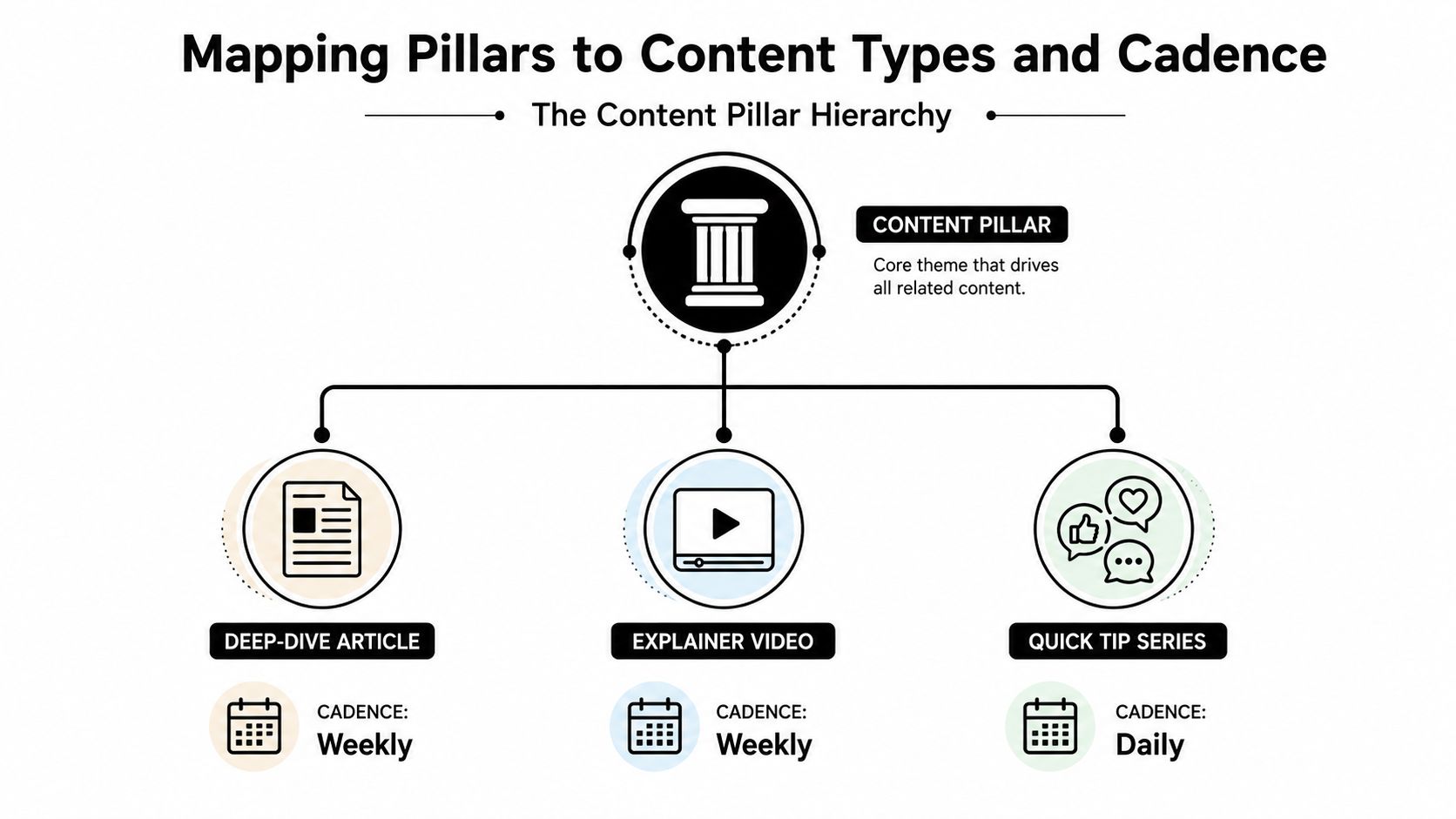
For each pillar, choose a primary format and supporting formats:
| Core asset | Supporting adaptations | Best use |
|---|---|---|
| Deep-dive article | Short posts, email summary, video explanation | Search visibility and durable education |
| Founder video | Transcript, quote-led posts, newsletter reflection | Voice, personality, and reach |
| Customer or project lesson | Carousel, checklist, sales enablement note | Proof and practical application |
| Newsletter essay | Social excerpt, discussion prompt, follow-up answer | Relationship and repeat attention |
One pillar shouldn't appear everywhere in exactly the same form. LinkedIn rewards conversation and clear points. Search content needs completeness and useful navigation. Email can carry nuance because the reader has already opted into a closer relationship. AI-assisted discovery also favors clear, reusable explanations, but it doesn't replace the need for original judgment.
Cadence should follow capacity, not ambition. A small team may create one substantial asset and adapt it across channels. A larger team can build a deeper editorial program. The important question is whether the schedule gives each pillar enough repetition to become familiar without making the audience feel trapped in a content loop.
Repurposing works when you preserve the idea and change the delivery. Don't paste an article into every platform. Extract the tension, example, framework, or objection that fits the channel. Keep the claim accurate, the voice recognizable, and the call to action appropriate to the reader's context.
A practical calendar should show the relationship between pillar, audience question, format, channel, owner, and status. This guide to creating a content calendar that actually works can help turn that logic into a workable publishing routine.
Likes and follower counts can provide directional feedback, but they rarely tell you whether a pillar is strengthening credibility. A leader's content may influence a buyer long before that buyer clicks a post, fills out a form, or mentions the content in analytics.
Measure each pillar through several signals:
Track these signals by pillar rather than only by channel. A post can perform well socially while attracting the wrong audience. Another may receive modest visible engagement but become a useful reference during sales conversations. Neither should be judged from a single surface.
Trust often appears first in the quality of questions people ask you, not in the number of people who react.
Review performance over a meaningful period and compare patterns. A healthy pillar tends to produce new questions, reusable ideas, stronger internal linking, and better-fit conversations. A weak pillar attracts attention unrelated to your positioning, overlaps with another theme, or leaves you repeatedly searching for something to say.
Refinement doesn't mean abandoning a topic after one quiet post. Change the angle, audience, format, or proof. Retire a pillar when it no longer reflects your expertise or the direction of the business. For a more detailed measurement process, use this guide to measuring content performance for your personal brand.
You can audit your pillar system in one focused working session. Use this worksheet for each proposed theme:
Then audit your existing library. Assign every relevant article, post, email, or video to a pillar. Mark pieces that fit more than one theme, have no clear home, or repeat an existing argument. Keep the strongest assets, update useful ones, and convert recurring gaps into new cluster ideas.
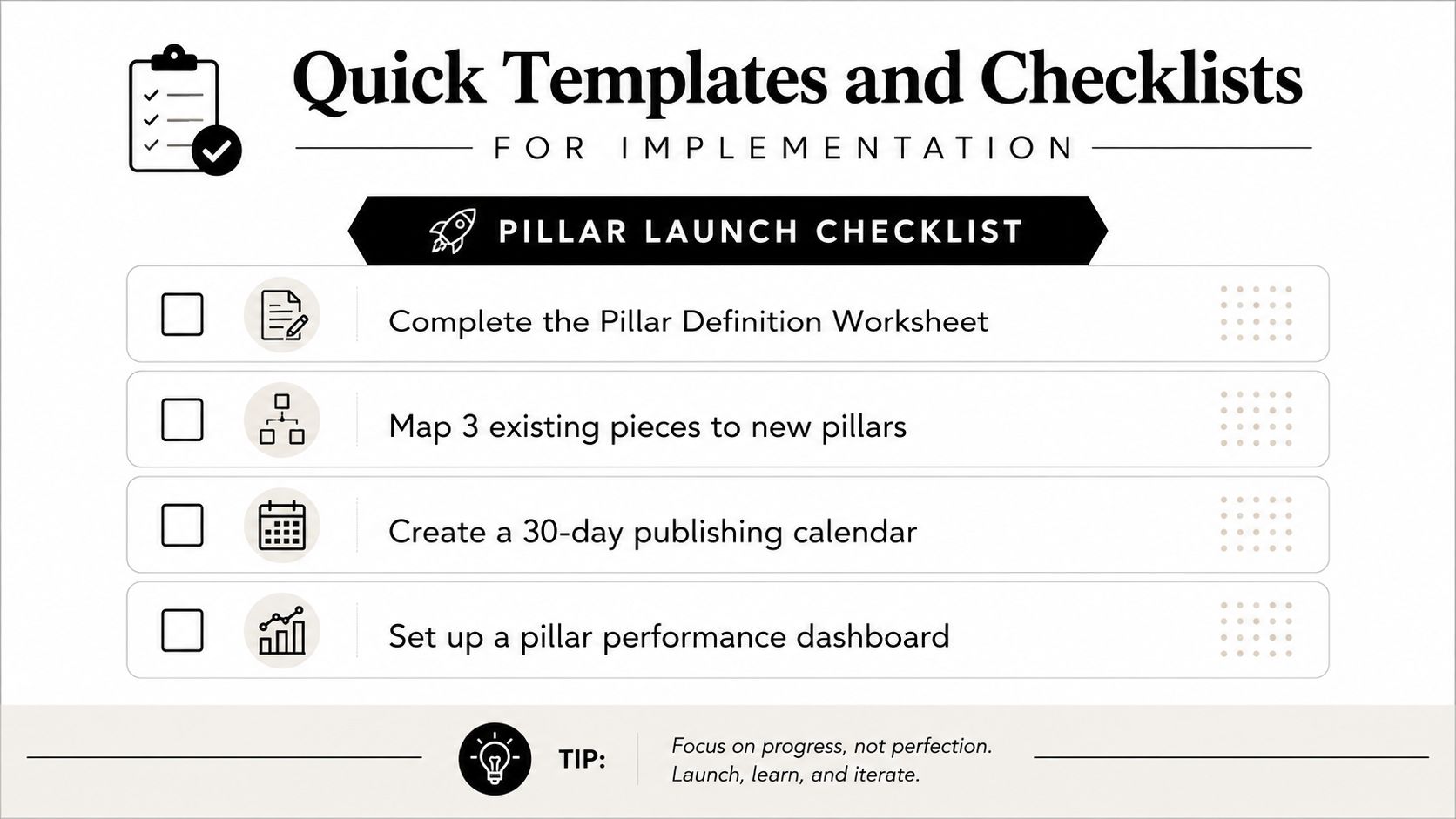
Your launch checklist is simple:
Start with a small set, publish enough to learn, and revise the system as your expertise and audience develop. Legacy Builder helps professionals turn their stories, positioning, and expertise into structured content pillars, then supports ongoing creation and distribution. Visit Legacy Builder to explore a personal-brand system built around credible, consistent ideas rather than random posting.


You could – but most in-house teams struggle with the nuance of growing on specific platforms.
We partner with in-house teams all the time to help them grow on X, LI, and Email.
Consider us the special forces unit you call in to get the job done without anyone knowing (for a fraction of what you would pay).
Short answer – yes.
Long answer – yes because of our process.
We start with an in-depth interview that gives us the opportunity to learn more about you, your stories, and your vision.
We take that and craft your content then we ship it to you. You are then able to give us the final sign-off (and any adjustments to nail it 100%) before we schedule for posting.
No problem.
We have helped clients for years or for just a season.
All the content we create is yours and yours alone.
If you want to take it over or work on transitioning we will help ensure you are set up for success.
We want this to be a living breathing brand. We will give you best practices for posting and make sure you are set up to win – so post away.
Subscribe to our newsletter and get insights on how to grow your personal brand.
