.svg)
Subscribe to our newsletter and get insights on how to grow your personal brand.
Thank you! Your submission has been received!
Oops! Something went wrong while submitting the form.
.svg)


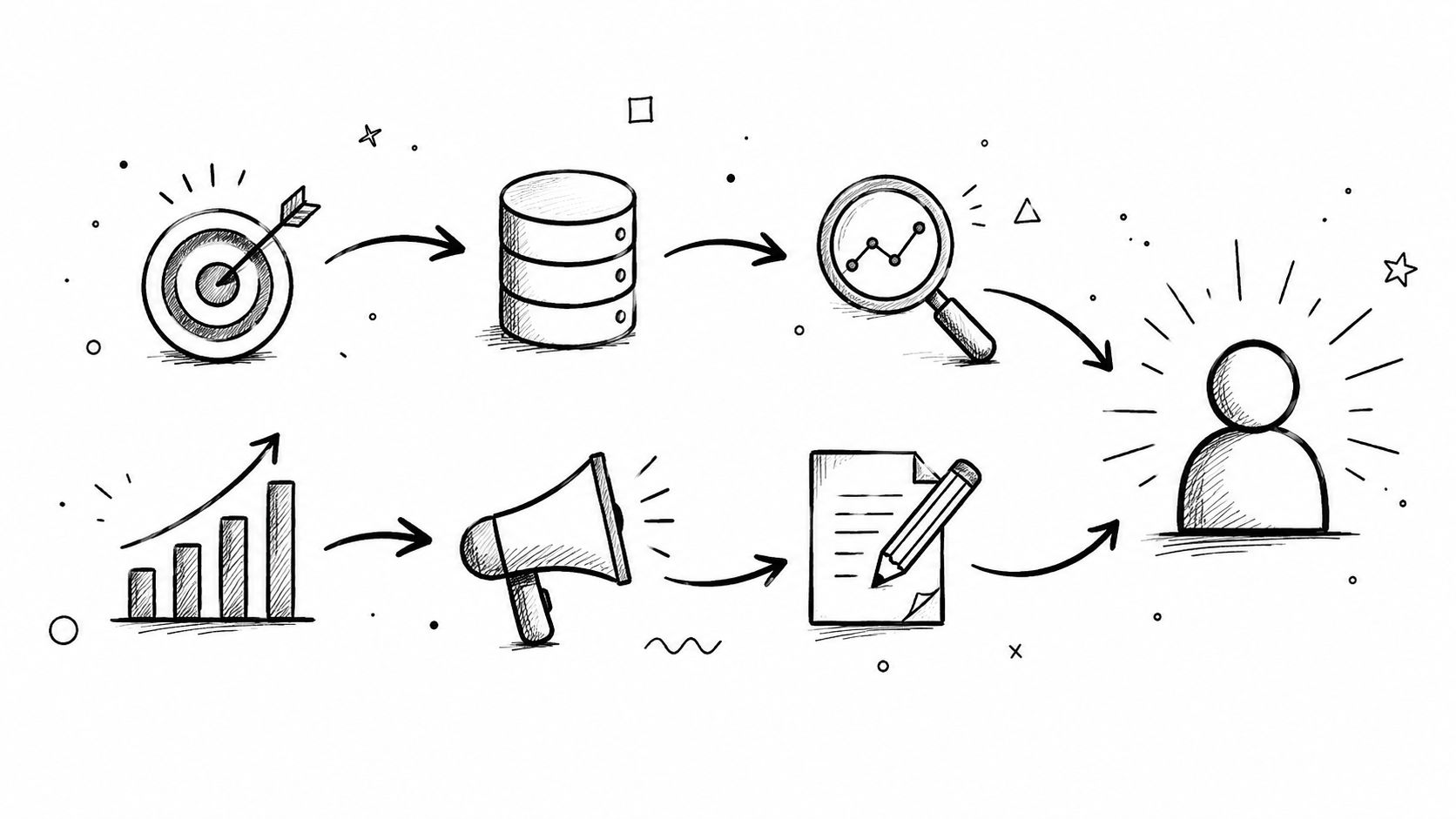
Many approach personal branding incorrectly. They think a data driven content strategy makes you sound like a machine, when the opposite is true. Data shows you what people are reacting to, so you can stop performing for the room and start speaking to the people who matter.
That matters because modern content lives in a crowded, fragmented environment. If you want a useful primer on how SEO visibility fits into that reality, this piece on actionable SEO insights is worth your time. The point is simple, data is not there to replace your voice, it is there to sharpen it.
The biggest myth in personal branding is that intuition alone makes content authentic. It doesn't. Intuition without feedback is just self-expression, and self-expression is not the same thing as influence.
A data driven content strategy gives you something better than hunches, it gives you evidence of what your audience values. That doesn't make your content colder. It makes your message more precise, because you're no longer guessing at what people need from you.
The ultimate win is empathy at scale. You can't sit with every follower, reader, or client prospect one by one, but you can read their behavior, questions, and responses as a pattern. That pattern tells you which ideas create trust, which examples land, and which topics make people lean in instead of scroll past.
Practical rule: If your content sounds more polished but gets less response, you've optimized for appearance, not connection.
This is why data works so well for leaders and professionals who want a stronger public presence. It helps you build a brand that feels human because it is grounded in actual audience feedback, not in whatever content trend is loudest this week. For a practical companion on audience definition, the guide to building buyer personas for founders pairs well with this mindset.
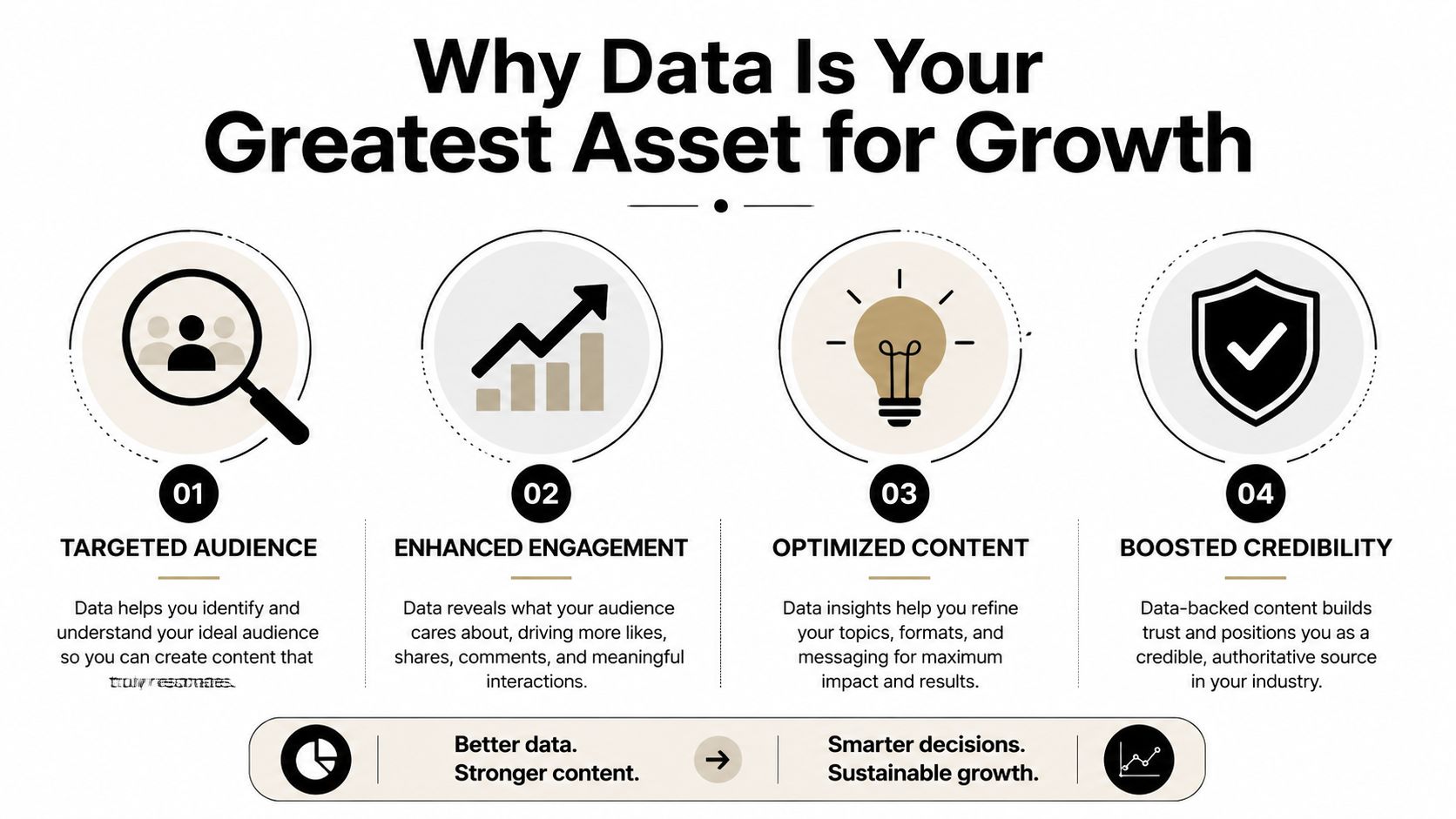
A strong personal brand doesn't grow because you post more. It grows because the right people keep seeing ideas that matter to them, and they trust you enough to keep listening. Data helps you identify those ideas faster, then double down on the ones that build real authority.
The business case is already obvious in the numbers. In the 2026 Datalily report on data-driven content marketing, 59% of respondents said they saw increased lead quality and volume, 50% reported higher customer lifetime value from content-sourced customers, 43% reported more pipeline influenced by content, and 27% reported reduced customer acquisition costs. Those figures matter for personal brands because they show that measurement isn't a vanity exercise, it connects content directly to commercial outcomes. Datalily's report makes the case clearly.
If you're a consultant, founder, executive, or creator, vanity metrics can mislead you. A post can attract attention and still bring in the wrong audience. Data keeps you focused on who converts into opportunities, clients, partnerships, or speaking invites.
That is especially important when content strategy maturity is already common. Submerge Digital cites Content Marketing Institute data saying 97% of marketers reported having a content strategy in 2025, and Semrush data saying 33% of marketers conduct a content audit twice a year. In other words, the baseline is no longer “do we have a strategy”, it's “does our strategy produce the right outcomes”? The Datalily report and Submerge Digital's summary show why that shift has already happened.
Data also saves time, which is one of the most underrated benefits for solo professionals. If a topic repeatedly fails to spark thoughtful replies, saves, or follow-up conversations, stop forcing it. Put your energy into the themes that make people say, “I needed this.”
That's the advantage of a data driven content strategy for personal brands. You stop publishing for theoretical reach and start building a reputation around the ideas people consistently recognize as useful. For a broader content planning perspective, the article on developing effective content strategies is a useful reference point.
Think of your personal brand like a chef's menu. A good chef doesn't keep serving a dish just because it looked good on paper. They listen to diners, watch what comes back untouched, notice what gets requested again, and refine the recipe until it earns repeat demand.
Don't start with content ideas. Start with the business result you want from your public voice. That might be better inbound leads, stronger relationships in a niche, more speaking requests, or deeper trust from a target audience.
If the goal is too vague, your data will be noisy. “Grow my brand” is not enough. “Attract more qualified consulting inquiries from operators in my niche” gives you something you can measure against.
Use the data you already have. Comments, DMs, post saves, replies, search queries, site analytics, CRM notes, webinar questions, podcast feedback, and even sales call transcripts can tell you what your audience cares about. A lot of leaders ignore these signals because they're messy, but messy is where the truth lives.
Here's the key. You're not trying to build a giant dashboard. You're trying to listen at scale. One strong comment thread can tell you more than a month of random brainstorming.
The point of analysis is not to admire charts. It's to find recurring pain points, repeated phrases, and obvious gaps in your message. If three different people ask the same thing in different ways, that's not a coincidence, that's content demand.
Useful filter: Create content for repeated questions, repeated confusion, and repeated objections. Skip the one-off requests unless they reveal a broader pattern.
Authenticity re-emerges as vital. Use the data to choose the topic, angle, and format, then write in your actual voice. Don't let the data flatten your perspective into safe, generic advice. If you have a strong opinion, keep it.
The best personal brands don't sound broad. They sound specific, useful, and a little unmistakable. Data should help you get there faster.
A lot of people create first and think about distribution later. That's backwards. If your audience asks questions in LinkedIn comments but you only post to one feed and move on, you're wasting the signal.
Match the format to the channel. A sharp insight might work as a short post, a longer teachable point might become a carousel, and a recurring question might deserve a live session or article.
The final stage is where many individuals quit. They post, then they hope. Don't do that. Revisit the content after it has had time to collect responses, and ask whether it started useful conversations, brought in the right people, or nudged someone toward a real next step.
A simple way to think about it is this, if the audience keeps pulling on a thread, keep pulling it with them. If the thread goes nowhere, drop it. That's how a personal brand stays relevant without becoming reactive.
Many measure the wrong things. Likes feel good, but they don't always tell you whether your thinking is building influence. For a personal brand, the better question is whether your content is attracting the right attention and turning it into trust.
| Metric Category | What to Track | Why It Matters for Your Brand |
|---|---|---|
| Audience Growth | Follower quality, profile visits, repeat viewers | Shows whether the right people are finding you |
| Engagement Quality | Saves, shares, thoughtful comments, direct replies | Reveals whether the content is useful enough to keep |
| Search Demand | High-impression, low-CTR queries in Google Search Console | Highlights topics people want but your packaging isn't earning clicks |
| Conversation Start Rate | DMs, replies, booked calls, consultation requests | Measures whether content is creating real business momentum |
| Content Resonance | Posts that spark multiple related questions | Helps you identify themes worth expanding |
| Conversion Evidence | CRM notes, leads, demo requests, bookings | Ties content back to actual opportunities |
The useful move is to connect what people search for with what they do next. An effective strategy links high-impression, low-CTR terms from Google Search Console with CRM data so you can see which topics attract attention and which ones drive actions like demo requests or consultation bookings. That's the difference between content that merely gets seen and content that moves a career forward, and the guidance from Legacy Builder's content performance measurement guide fits this approach well.
You don't need an enterprise stack to do this well. Native analytics from LinkedIn, Instagram, YouTube, or X can show what people stop for. Google Search Console shows what you're already showing up for in search. Simple survey tools can tell you what your audience wants more of, and a CRM helps you connect content to real opportunities.
Use those tools in combination, not in isolation. If a post gets a lot of engagement but no meaningful replies, that's not a success for a thought leader. If a quieter piece brings in a serious inquiry, that piece deserves more attention than the loud one.
The smartest personal brands treat metrics as feedback, not as identity. You're not your reach. You're the quality of the conversations your ideas start.
A consultant I'd trust doesn't start by asking, “What should I post more of?” She starts by asking, “What are people already asking me that I keep answering in different ways?” That's where content gold lives. One repeat question becomes a post, then a newsletter, then a webinar outline.
A founder can use the same logic with comment sections and sales calls. If the same pain point keeps surfacing in both places, that's not random chatter, it's a content opportunity with commercial value. The point isn't to chase every comment, it's to notice which comments reveal the market's real language.
The strongest systems use closed-loop attribution, where performance feedback from analytics and CRM data keeps retraining future content decisions. 5WPR's guidance on data-driven strategy makes that mechanism clear. For a personal brand, that means your next post gets better because the last one taught you something real.

A SaaS founder can look at recurring support questions and turn them into authority content that reduces confusion and builds trust before a sales call even happens. A finance professional can notice which post themes get thoughtful replies, then build a deeper point of view around those themes instead of publishing generic market commentary. A leadership coach can compare which posts lead to DMs versus which ones only draw surface-level applause, then focus on the ideas that start real conversations.
The same principle applies if you're building an executive brand inside a larger company. Content that helps your market understand your judgment is more valuable than content that merely fills the feed. Data makes that judgment visible.
If you want a way to keep the useful ideas from fading after the first post, the guide to evergreen content strategy for personal brands is worth using alongside this framework.
Your content should solve the problem people keep naming, not the one you wish they had.
That sentence is the difference between content that performs and content that performs for your brand. The more often you let audience signals shape your topics, the more your voice starts sounding earned.
A data driven content strategy is not a formula that makes you less authentic. It is a compass that keeps your voice pointed at the people who need it most. That is how you build influence without becoming generic.
Use data to choose the topic, then use judgment to shape the message. Use feedback to refine the message, then use consistency to earn trust. If you keep those two things together, evidence and perspective, your content starts building a legacy instead of just filling a feed.
For a practical next step, pair this mindset with the guidance in developing effective content strategies, then strip the process down to one simple habit. Track one meaningful signal, create one piece of content from it, and let the response tell you what to do next.
Legacy Builder helps professionals turn their insights, audience questions, and content themes into a structured personal brand system. If you want a team that can help you build that rhythm with clear strategy and consistent execution, visit Legacy Builder and see how their content service fits this approach.


You could – but most in-house teams struggle with the nuance of growing on specific platforms.
We partner with in-house teams all the time to help them grow on X, LI, and Email.
Consider us the special forces unit you call in to get the job done without anyone knowing (for a fraction of what you would pay).
Short answer – yes.
Long answer – yes because of our process.
We start with an in-depth interview that gives us the opportunity to learn more about you, your stories, and your vision.
We take that and craft your content then we ship it to you. You are then able to give us the final sign-off (and any adjustments to nail it 100%) before we schedule for posting.
No problem.
We have helped clients for years or for just a season.
All the content we create is yours and yours alone.
If you want to take it over or work on transitioning we will help ensure you are set up for success.
We want this to be a living breathing brand. We will give you best practices for posting and make sure you are set up to win – so post away.
Subscribe to our newsletter and get insights on how to grow your personal brand.
