.svg)
Subscribe to our newsletter and get insights on how to grow your personal brand.
Thank you! Your submission has been received!
Oops! Something went wrong while submitting the form.
.svg)


You're probably getting the same advice from every direction. Post more on LinkedIn. Start a newsletter. Launch a podcast. Fix your website. Be on video. Show more personality. Build a founder brand.
That advice isn't wrong. It's just incomplete.
Most founders don't have a visibility problem. They have an allocation problem. They're spreading limited time across too many channels with no clear role for each one. The result is a digital presence that looks busy but doesn't build trust, authority, or inbound demand.
The question isn't which platform matters most. It's which types of online presence deserve your attention based on your goals, your audience, and how much control you want over the relationship.
A lot of professionals still treat online presence like a homepage plus a few neglected social accounts. That model is outdated.
In 2025, global social media use reached roughly 5.17 billion users, and the average person visits 6–7 social media platforms per month, according to Hootsuite's social media statistics. Your audience isn't sitting in one place waiting for your website to do all the work. They're discovering people across search, social feeds, podcasts, newsletters, reviews, guest appearances, and private communities.
That doesn't mean you need to be everywhere. It means you need a system.
Your online presence is better understood as an ecosystem of touchpoints. Some assets help people find you. Others help them trust you. A few help them take action.
If you only invest in one digital asset, you're asking one piece of real estate to do every job. That's inefficient. Your website shouldn't be your only discovery engine. Your social profile shouldn't be your only proof of expertise. Your inbox shouldn't be the first place someone ever hears from you.
Practical rule: Build for consistency across a few connected touchpoints, not visibility across every platform.
This matters even more if your work involves sales calls, partnerships, hiring, or investor conversations. People don't just judge your website. They judge the total pattern of how you show up online, including how you communicate live. If that's an area you want to sharpen, these professional online meeting tips by Whisper AI are worth reviewing because your digital brand includes your behavior, not just your content.
Think of your online presence as a portfolio. Some assets you own. Some you borrow from platforms. Some you earn from other people talking about you.
Once you see it that way, the goal changes. You stop asking, “Which platform should I post on?” and start asking, “Which mix of assets gives me reach, trust, and control?”
That's the right question.
Most advice about the types of online presence turns into a random checklist. Website. LinkedIn. Instagram. YouTube. Reviews. Press. That's not strategy. That's inventory.
Use a simpler framework instead. Every online asset falls into one of three buckets: owned, rented, or earned.

Owned media is your home base. Your website, newsletter, blog, and any audience list you control belong here.
This is the layer that matters most because it gives you control over message, measurement, and conversion. The strongest systems use the website as the canonical owned identity layer, social profiles as rented distribution, and email as retention, as explained in Duffy Agency's overview of web presence. That same source notes that Google's mobile-first indexing makes a mobile-optimized site a baseline requirement, not a nice-to-have.
If your owned layer is weak, every other visibility effort leaks value.
Rented media includes platforms like LinkedIn, YouTube, X, Instagram, and any third-party platform where you publish but don't control the rules.
These channels are useful for discovery. They put you in front of people who would never type your name into Google. But they come with a price. You don't control the algorithm, the format, the reach, or the long-term access to your audience.
That's why smart founders use rented platforms as distribution engines, not as their only brand asset.
Earned media is what other people say about you. Press mentions, podcast invitations, reviews, backlinks, testimonials, reposts, recommendations, and third-party references all fit here.
You can influence earned media, but you can't command it. That's exactly why it's powerful. It acts as external proof. People trust signals they didn't write themselves.
Build your owned layer first, use rented platforms to drive attention into it, and treat earned media as trust acceleration.
A founder with only rented media is exposed. A founder with only owned media is invisible. A founder with no earned media looks unproven.
You need all three. Not equally. But deliberately.
You don't need every possible asset. You do need to understand what each one is for. Below is a practical catalog of the main types of online presence, sorted by the role they play in your portfolio.
| Presence Type | Category (Owned/Rented/Earned) | Best For | Effort Level |
|---|---|---|---|
| Personal website | Owned | Authority, search visibility, conversion | Medium |
| Blog or article hub | Owned | Thought leadership, SEO, trust | High |
| Email newsletter | Owned | Retention, direct audience relationship | Medium |
| Landing pages | Owned | Lead generation, offers, campaigns | Medium |
| LinkedIn profile and content | Rented | Professional discovery, networking, B2B trust | Medium |
| Other social profiles | Rented | Reach, audience development, brand familiarity | Medium to High |
| Video channels or podcast platforms | Rented | Depth, personality, long-form authority | High |
| Community participation | Rented/Visited | Relationship building, niche visibility | Medium |
| Guest articles and podcast appearances | Earned | Borrowed authority, new audience access | Medium |
| Reviews, mentions, and third-party features | Earned | Reputation, credibility, validation | Low to Medium |
Personal website
This is your digital headquarters. It tells people who you are, what you do, who you help, and what to do next. If you're a founder, consultant, executive, or creator, your site should be clear before it is clever.
Blog or article hub
A blog is where you prove your thinking over time. It works well for people selling expertise, not just products. The downside is obvious. It demands consistency and decent editorial standards.
Email newsletter
Email is where audience attention becomes a relationship. You're not competing with a feed in the same way, and you're not hostage to platform changes. If you've got useful ideas and a clear audience, this is one of the highest-impact assets you can build.
Landing pages
These are often ignored because they aren't glamorous. That's a mistake. A good landing page turns interest into action. If you run campaigns, launch offers, or speak publicly, you need pages built for conversion, not just a general website.
LinkedIn profile and content
For professionals, this is often the first stop after someone hears your name. Your profile isn't a resume. It's a positioning asset. It should explain your value fast, show proof, and make the next step obvious.
Other social profiles
Instagram, X, YouTube, TikTok, and platform-specific communities all have different jobs. Some build familiarity. Some reward commentary. Some reward entertainment. Don't choose based on popularity. Choose based on format fit and audience behavior.
Video channels or podcast platforms
These can build trust quickly because people can hear your thinking and see your personality. They also require more production discipline. If you can't sustain the format, don't start it just because it sounds impressive.
Community participation
This includes Slack groups, founder communities, industry forums, and niche spaces. These channels are underrated because they don't always look scalable. But they're often where trust compounds fastest in specialized markets.
If budget is tight and you're trying to get the basics in place without overspending, this guide on how to build an online presence affordably is useful for deciding what to create first and what can wait.
Guest articles and podcast appearances
These work because they let you borrow someone else's audience and credibility. They're especially useful if you don't want to publish constantly on your own channels but still want visible expertise.
Reviews, mentions, and third-party features
These signals matter because they reduce perceived risk. A founder saying “I'm credible” has limited power. A customer, journalist, host, or respected peer saying it carries more weight.
Your goal isn't to collect assets. Your goal is to assemble a portfolio where each asset has a job.
Trying to maintain every type of online presence at once is how smart people disappear. They burn energy on low-return activity, then conclude that personal branding doesn't work.
It works. Their priorities don't.
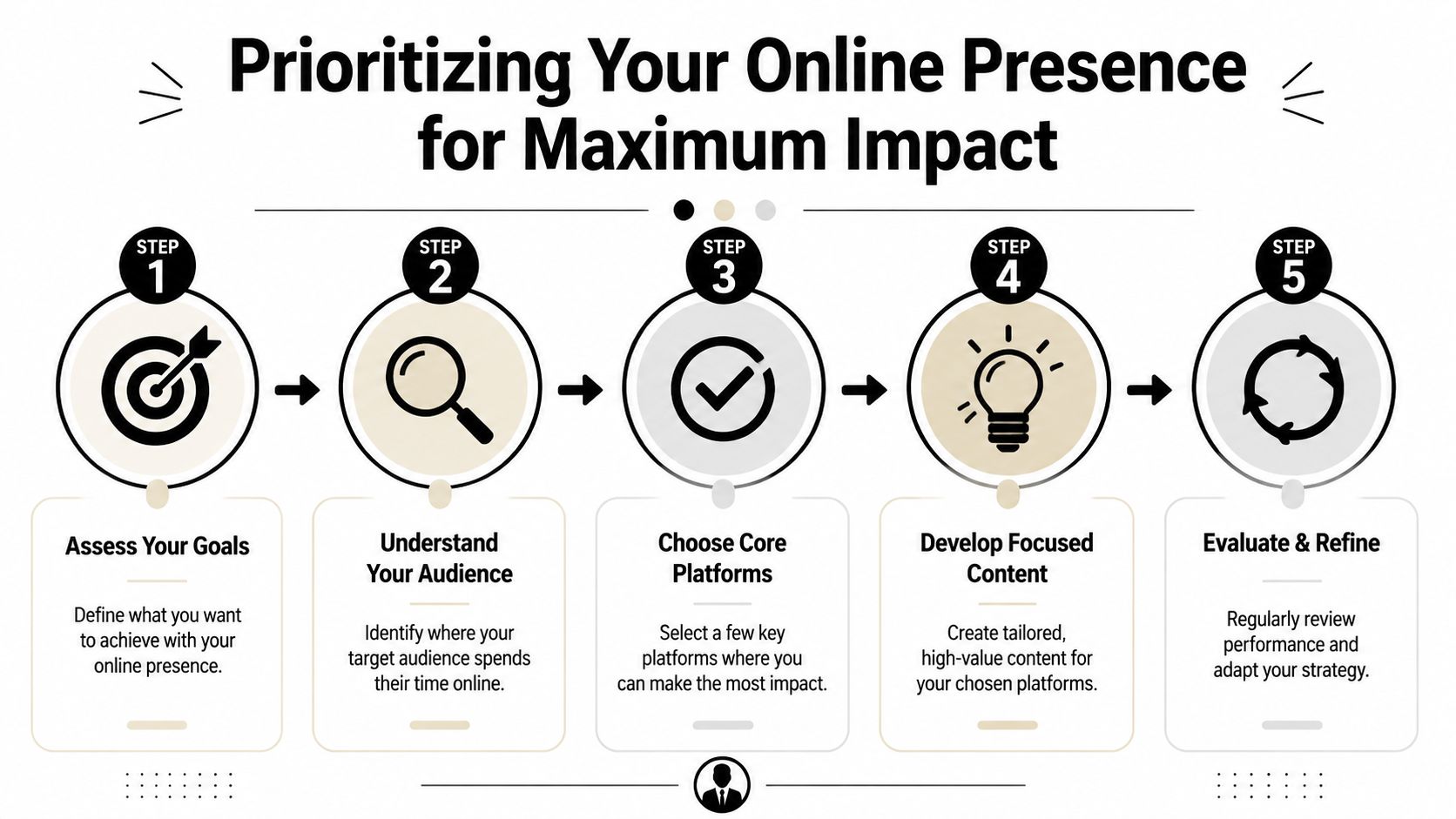
Many guides lump hiring visibility, lead generation, and reputation management into one vague goal. That's lazy. They require different architectures. And because LinkedIn has surpassed 1 billion members, the choice between emphasizing a personal brand, a company brand, or both has become a real strategic decision, as noted in Rasmussen University's guide to online presence.
Prioritize assets that convert attention into conversations.
Start with:
Skip the podcast unless you already have distribution or a team to support it. It's a prestige play for most founders, not a first move.
You need depth, not just frequency.
Focus on:
Founders often get distracted by content volume. Ignore that pressure. Strong ideas win over busy posting.
If you want a practical sense of what disciplined platform execution looks like, Klap's marketing recommendations are a useful reference point for tightening your distribution habits without turning your strategy into noise.
Your priority is discoverability plus professional credibility.
That usually means:
You don't need an aggressive content engine. You need a coherent professional identity that survives scrutiny when someone searches your name.
This is less about publishing and more about shaping the evidence people find.
Your stack should include:
One practical option for founders who have clear expertise but not enough time to turn it into a steady content and distribution system is Legacy Builder. It helps professionals translate their stories, insights, and positioning into consistent brand content across channels. That's useful if the strategy is clear but execution keeps slipping.
Pick one primary goal, one owned platform, one rented platform, and one proof mechanism. That's enough to start building momentum.
Most weak online brands don't fail because the founder lacks expertise. They fail because the internet receives that expertise in fragments.
One decent LinkedIn post. A stale website. A clever podcast interview that sounds nothing like the homepage. A bio written in corporate language that doesn't match how the person speaks.
That inconsistency creates doubt.

You don't need a different identity for every platform. You need one strong core message expressed in different formats.
Start with three questions:
From there, define a narrative spine. That includes your point of view, your credibility markers, your recurring themes, and your tone. If you need a deeper framework for this, Legacy Builder's article on brand consistency and why it builds unshakable trust is worth reading.
Founders waste time when they treat every platform like a blank page. Don't do that.
Use a simple workflow:
That approach keeps your narrative coherent. It also keeps you from sounding like a different person on every platform.
Consistency doesn't mean repetition. It means people keep hearing the same underlying truth about your work.
A strong content operation also needs a repeatable publishing rhythm. Not an elaborate spreadsheet you'll abandon in ten days. Something simple. One weekly article or memo. A few social posts drawn from that idea. One email if email matters to your model. That's enough for most founders.
Here's a practical breakdown of how a content system can support visibility without drifting into performative posting:
People talk about authenticity like it's a personality trait. It's not. It's a production standard.
Your voice should sound like you. Your examples should come from your real work. Your opinions should be specific enough that someone could disagree with them. That's what makes a brand believable.
If every post sounds like committee-written marketing, your audience won't trust the person behind it.
If you can't tell what your online presence is producing, you're not building a brand. You're running a hobby.
Most founders track the wrong signals. Likes and follower counts are easy to monitor and easy to misread. They don't tell you whether people found you, trusted you, or took action.
According to LeadNicely's guide to measuring and improving your online presence, the highest-value KPIs are traffic, engagement rate, conversion rate, search rankings, and brand mentions. Those metrics matter because they map to different parts of the system. Weak search rankings hurt discovery. Low engagement suggests poor audience fit. Weak conversion means attention isn't turning into outcomes.

Use a small dashboard. Track fewer metrics, but track the right ones.
Google Analytics is still a practical starting point for website traffic and goal tracking. Native platform analytics help you monitor reach and engagement. SEO tools help you watch rankings. Social listening and mention tracking tools help you see whether your brand is spreading beyond your own channels.
What matters is the connection between metrics and decisions.
If website traffic is healthy but conversions are weak, fix the page. If social engagement is flat, improve the angle or audience fit. If nobody mentions your brand, your content may be too generic to repeat.
Pay attention to the quality of inbound interest. What kind of inquiries are you getting? Are they aligned with your positioning? Are people referencing your content, your perspective, or your reputation?
That's often a stronger sign of brand health than raw volume. For a broader strategic lens on protecting and strengthening those signals, this online reputation management guide for building a powerful brand gives useful context.
Don't measure activity. Measure movement from discovery to trust to action.
A strong online presence isn't a stack of disconnected profiles. It's a deliberate portfolio.
You need owned media that you control, rented media that expands discovery, and earned media that proves credibility. You need fewer channels than you think, but better alignment between them. And you need to treat consistency like strategy, not admin work.
That's how online visibility turns into real authority.
Founders who win online don't chase every platform trend. They build a body of digital proof. They make it easy for the right people to find them, understand them, trust them, and remember them. That's what separates attention from reputation.
If you want your digital footprint to outlast the next algorithm change, build it like an asset. Start with your positioning. Choose the right mix of channels. Publish with discipline. Measure what matters. Refine without losing your voice.
That's not just marketing. It's legacy work.
If you want to sharpen the foundation behind that work, start with this guide on how to create a brand identity for a lasting legacy.
If your online presence feels scattered, Legacy Builder can help you turn it into a focused brand system. The team works with founders and professionals to shape your positioning, create consistent content, and build a digital presence that reflects your expertise without forcing you to manage every moving part yourself. Explore Legacy Builder if you're ready to build with more intention.


You could – but most in-house teams struggle with the nuance of growing on specific platforms.
We partner with in-house teams all the time to help them grow on X, LI, and Email.
Consider us the special forces unit you call in to get the job done without anyone knowing (for a fraction of what you would pay).
Short answer – yes.
Long answer – yes because of our process.
We start with an in-depth interview that gives us the opportunity to learn more about you, your stories, and your vision.
We take that and craft your content then we ship it to you. You are then able to give us the final sign-off (and any adjustments to nail it 100%) before we schedule for posting.
No problem.
We have helped clients for years or for just a season.
All the content we create is yours and yours alone.
If you want to take it over or work on transitioning we will help ensure you are set up for success.
We want this to be a living breathing brand. We will give you best practices for posting and make sure you are set up to win – so post away.
Subscribe to our newsletter and get insights on how to grow your personal brand.
