.svg)
Subscribe to our newsletter and get insights on how to grow your personal brand.
Thank you! Your submission has been received!
Oops! Something went wrong while submitting the form.
.svg)


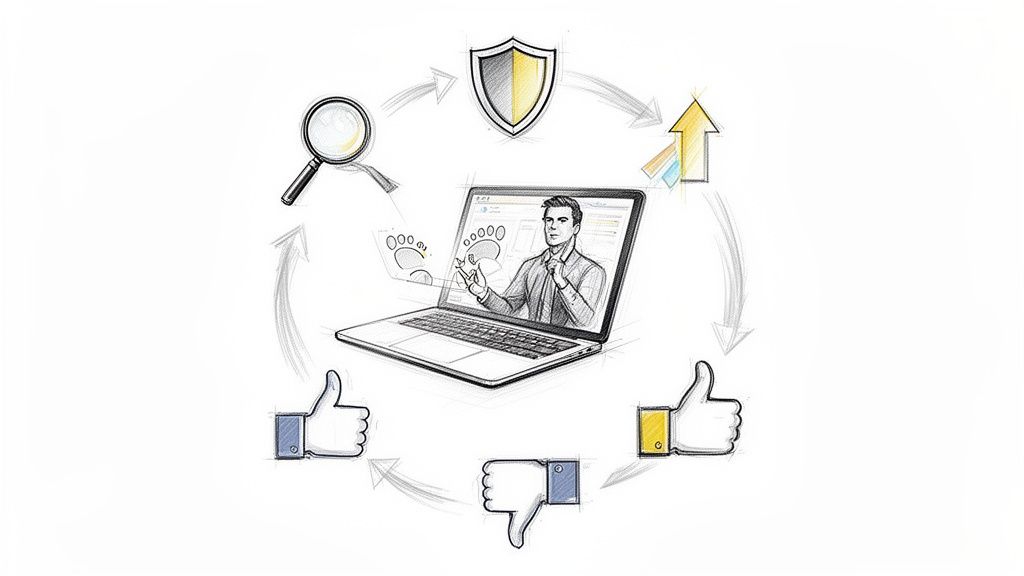
A solid plan for managing your online reputation gives you a clear framework to control your own story. It really comes down to a four-part system: auditing what’s out there now, monitoring new mentions as they happen, remediating anything negative, and proactively building the positive presence you want.
This isn't just about damage control. It's about turning your reputation from something you worry about into one of your most powerful assets.
Let’s be real. Before anyone meets you, they’ve already Googled you. That search result page is the new handshake. What potential clients, partners, or employers find—or don't find—instantly frames how they see you.
In today's world, having no online presence isn't a neutral position. It’s a massive disadvantage.
Think about the numbers. A single negative article can cost a business up to 22% of its potential customers. That's a direct hit to the bottom line. This guide isn't about fluffy social media tips; it's a practical system for founders and executives to not just clean up the past but to intentionally build a powerful narrative for the future.
Trying to fix your reputation after something goes wrong is expensive, stressful, and slow. A proactive approach, on the other hand, is like building a digital moat around your name.
It’s about creating a consistent stream of positive, authoritative content that cements you as an expert. This pushes any potential negative results so far down the search page that almost no one will ever see them.
Here's how I see it:
Your online reputation is what people find when they search your name. It's the sum of your search results, social media profiles, and any public mentions—a digital resume that works for you 24/7.
This guide is your playbook for taking command of that resume. By mastering the four-part framework—Audit, Monitor, Remediate, and Build—you’ll have a repeatable system for shaping how you’re seen online.
If you're just getting started, nailing the fundamentals is everything. We break it down even further in our complete guide on how to build an online presence for beginners, which is a great place to start.
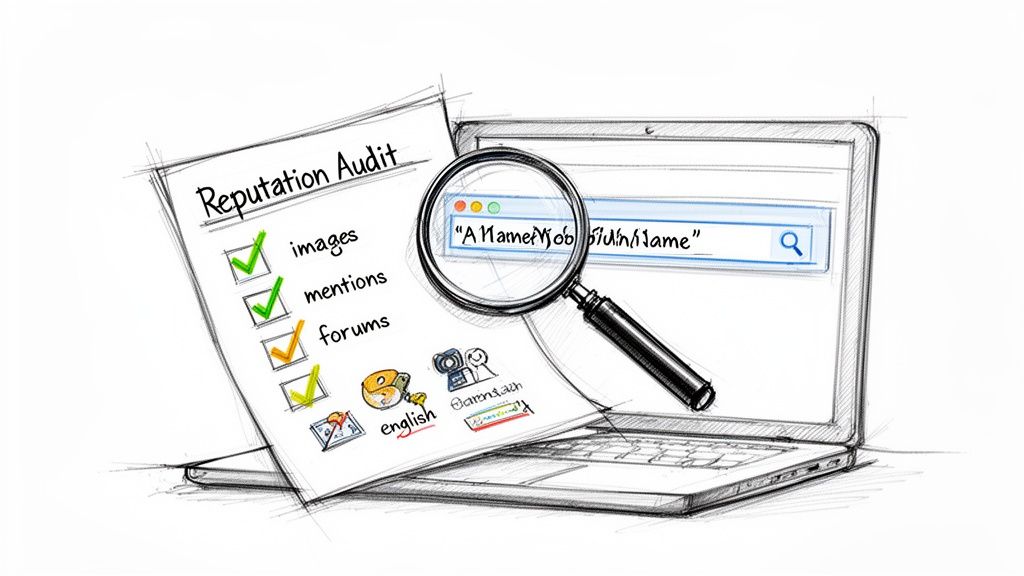
Before you can start building a powerful online presence, you have to get brutally honest about where you stand right now. Think of a digital reputation audit as the essential first step—it's the only way to get a clear, objective baseline of your current digital footprint.
This isn't just about hunting for negative comments. It’s about seeing yourself exactly how a potential client, a future employer, or a key partner would see you for the first time. The goal is to create a complete inventory of everything out there with your name on it, good and bad. This inventory becomes the foundation for your entire strategy.
First rule of the audit: always use an incognito or private browser window. Your personal search history and cookies skew Google's results, showing you a personalized version of the internet. You need to see what a complete stranger sees.
Start broad, then drill down. A simple search for your name is a starting point, but the real insights come from using more advanced queries.
Your Name"Your Name" (those quotes are a game-changer for accuracy)"Your Name" + Industry (e.g., "Jane Doe" + Fintech)"Your Name" + "Company Name""Your Name" + CityThese variations will uncover mentions tied to your professional life, past jobs, and where you've lived. Pay special attention to the first three pages of results—over 90% of people never click past the first page, so what shows up there is your reputation.
Your digital story isn't just told in articles and blog posts. It's visual, it's on video, and it’s in niche communities. A thorough audit means looking everywhere.
"Your Name". Are the top results professional headshots that you control? Or are they unflattering photos from a decade ago, or worse, pictures of someone else with your name?By the end of your audit, you should have a clear, documented understanding of your digital presence—the good, the bad, and the neutral. This objective assessment is the bedrock of a successful reputation management plan.
As you dig in, you need to log everything systematically. A simple spreadsheet is your best friend here. This turns a messy list of links into an actionable plan and helps you see exactly what to tackle first.
For every result, jot down the key details. This record will be your guide when you start remediating the negatives and amplifying the positives.
To make it easy, I've put together a simple framework you can use.
Use this framework to log and categorize your online search results during your self-audit.
This organized log moves you from discovery to pure strategy. You now have a prioritized to-do list that shows where your reputation is crushing it and where it needs immediate attention. With this baseline locked in, you’re ready to build a system for ongoing monitoring.
Think of your audit as a snapshot in time. It's a crucial starting point, but your online reputation isn't static—it’s a living, breathing thing that changes by the minute. To really manage it, you need to move from that one-time check-in to a dynamic, real-time monitoring system.
The goal is to know the second your name or brand is mentioned online.
This isn't about being paranoid. It's about being prepared. Imagine catching a negative blog post minutes after it was published. Because your monitoring system pinged you instantly, you could jump in and control the narrative before it snowballed. That's the power of being proactive.
You don't need a massive budget to get started. The easiest and most effective first step is setting up Google Alerts. It's free, simple, and acts as your first line of defense, emailing you whenever new content matching your keywords pops up.
Here’s how to get it running in under five minutes:
"Your Name", "Your Name" + "Company", and even common misspellings.Think of this as your digital smoke detector. It won't catch every flicker, especially on social media, but it makes sure you’re never caught completely off guard by a fire.
The goal of monitoring isn't to become paranoid; it's to be informed. Knowing what's being said allows you to be the first responder to your own reputation, turning potential crises into opportunities to demonstrate transparency and control.
As you build your system, keep the current digital trust landscape in mind. It's shaky. By 2025, it's estimated that over 30% of all online reviews will be fake or manipulated. People are skeptical, but they're still heavily influenced by what they see. This makes your authentic, monitored presence more critical than ever.
Google Alerts is a fantastic start, but it has its blind spots. It often misses mentions on social platforms like X and Instagram, forums like Reddit, or in podcast transcripts. When your online presence starts to grow, or if you're in a high-stakes industry, upgrading to a paid tool isn't a luxury—it's a necessity.
These platforms bring some serious firepower:
When you're ready to explore these more advanced platforms, you can check out some of the best reputation management software options out there. These tools pull all that scattered data into one place, giving you a unified command center for your digital footprint.
This data is gold for tracking the real impact of your brand-building efforts. And if you want to get into the weeds on that, we have a whole guide on how to measure brand awareness.
Your monitoring system is the engine of modern reputation management. It gives you the real-time intel you need to protect what you've built and proactively shape a powerful, authentic personal brand.
Seeing a negative review, a nasty comment, or a flat-out wrong article about you feels like a shot to the gut. The knee-jerk reaction is to either lash out or curl up in a ball and hope it blows over.
Trust me, neither works. The only way forward is with a clear head and a solid game plan. A smart response framework doesn't just put out the fire—it can actually turn a bad situation into a win.
The first thing to do is… nothing. Don't fire off a reply. Don't make a call. Just breathe and assess what you're actually dealing with. A disgruntled customer on Yelp needs a completely different playbook than a defamatory blog post.
When it comes to public feedback, speed and professionalism are everything. If you ignore a bad review, you look like you don’t care. If you get defensive, you look like a hothead and just add fuel to the fire.
The real goal here is to acknowledge the issue publicly and then immediately take it private.
Here’s a simple script I’ve used that you can steal:
This approach does two things: it de-escalates the public drama and shows everyone else watching that you take feedback seriously. It’s a foundational move in managing your reputation.
Now, if you’re facing something more serious—like an article full of lies or a malicious post designed to hurt you—the strategy changes. We're no longer in the realm of public engagement. We're talking about removal or suppression.
Your first move is to see if the content breaks the platform's rules. If it's hate speech, harassment, or doxxing, you can report it and often get it taken down.
If it's just factually incorrect, you can try reaching out to the website owner. Politely lay out your case with proof. But let's be real—that's a long shot and can take forever.
The most reliable long-term strategy isn't removal, it's suppression. You create so much high-quality, positive, SEO-friendly content that the negative stuff gets pushed down so far in Google search results that it becomes practically invisible.
This is where being proactive pays off big time. When you’re consistently publishing great articles, optimizing your LinkedIn, and getting positive mentions in the press, you're building a digital fortress of assets you control. These high-ranking pages naturally push the junk out of sight.
The stakes are higher than you think. A single negative article on page one of Google can cost you 22% of your potential customers. It takes something like 40 positive reviews to undo the damage of one really bad one. And when 57% of consumers won't even consider a business with less than a three-star rating, it's clear this isn't about ego—it's about revenue. You can dig into more reputation management statistics that prove the point.
This is how you go from playing defense to playing offense. You stop just reacting to what other people say and start architecting the exact story they find when they search your name.
Alright, let's stop playing defense.
After you've done your audit, set up alerts, and figured out how to handle the inevitable negative comment, the real work begins. It’s time to go on the offense.
We're moving beyond just cleaning things up. The goal here is to build a digital fortress of positive, authoritative assets that you own and control. This is what separates people who just manage their reputation from those who actively build a powerful personal brand.
Instead of letting others define you by what they say, you're going to create a strong, consistent story that shapes how people see you from the very first Google search.
First things first: you need to identify your core areas of expertise. Think of these as your "content pillars"—the subjects you can talk about with genuine authority and passion.
If you're a SaaS CEO, maybe your pillars are product-led growth, scaling remote teams, and AI integration. For a financial advisor, it could be retirement planning for millennials and sustainable investing.
Pick three to five pillar topics that line up with your professional goals. Seriously, write them down. These pillars are the foundation for every piece of content you create, keeping you focused, consistent, and on-brand.
From there, you can start mapping out a simple content plan:
The idea is to build a library of high-quality content that ranks for your name and cements you as a go-to expert in your field. This is the stuff that will bury any negative results and build that digital moat around your name. If you want a full-blown strategy on this, we break it down in our modern playbook for personal branding for leaders.
I once worked with a tech founder who was practically a ghost online. Her expertise was off the charts, but when you Googled her name, you got… nothing. A few old directory listings and a skeleton of a LinkedIn profile.
Then, a minor negative comment from a disgruntled ex-employee popped up. Because there was a content vacuum, it shot straight to the top of the search results.
Instead of just trying to get the comment removed, she launched a proactive, six-month content blitz.
By the end of six months, that negative comment was buried on the second page of Google, which is basically Siberia. More importantly, page one was now dominated by assets she controlled: her LinkedIn profile, her website, and positive media mentions.
She didn't just fix a problem. She built a powerful brand that started generating real opportunities.
When negative content does appear, you need a clear process to decide how to react. A structured response is always better than a panicked one.
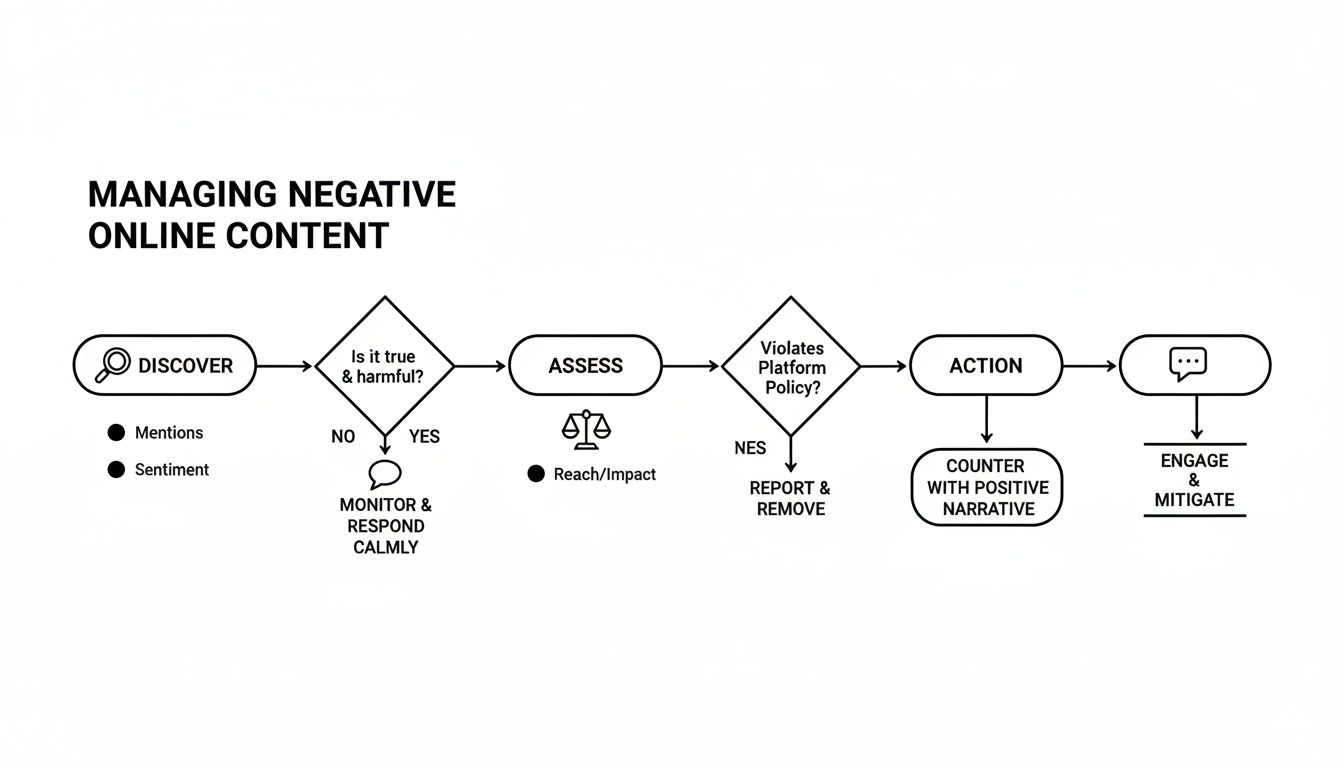
This flowchart breaks down the key decision points, helping you assess the situation calmly before taking action.
Thinking of your personal brand as a strategic asset isn't just a good idea anymore; it's how the modern market works.
The global online reputation management market is expected to rocket from about $5.2 billion to $14.02 billion between 2024 and 2031. This isn't just fluff; it shows that smart professionals are investing serious money to control their own narrative.
When you consider that over 90% of executives believe reputation is tied to at least a quarter of a company's market value, your personal brand becomes a direct contributor to the bottom line.
When you start getting serious about managing your online reputation, the real questions start popping up. You’ve done the audit and set up some monitoring, but now you’re in the trenches. What do you do now?
This is where theory meets reality. Let's break down the common hurdles professionals run into. First, it helps to have a solid grasp of What is online reputation management — it's all about strategically shaping how you're perceived online.
Now, let's get into the specifics.
Look, there's no quick fix here. The timeline depends entirely on two things: how bad the damage is and who caused it.
If you're dealing with a few negative reviews on a site like Yelp or your Google Business Profile, you can often see a shift in 1-3 months. The game plan is simple: consistently get new, positive reviews while professionally handling the negative ones. It's about changing the average over time.
But if you're trying to bury a negative article from a major news source? That's a whole different ballgame. You're looking at 6-12 months, maybe longer. It takes a serious, sustained effort to create enough positive, authoritative content to push that negative piece off the first page of Google.
Think of it this way: you're building a digital fortress, not just patching a hole. Consistency is everything. A steady strategy not only deals with today's problem but protects you from tomorrow's.
If only it were that easy. Unless the negative content is on a profile or website you own, you can’t just hit delete. Your options are pretty limited.
You can try a couple of things:
For most people, the most effective strategy isn't removal—it's suppression. You essentially create so much high-quality, positive content about yourself that it pushes the negative stuff down in the search results until it's practically invisible.
Always respond. Always.
Ignoring a bad review tells everyone—not just the unhappy customer—that you don't care about feedback. That silence can be more damaging than the review itself.
A quick, professional response, on the other hand, shows you're accountable. It can completely turn the situation around. The trick is to respond publicly without getting defensive. Acknowledge their point, apologize for their bad experience, and offer to take the conversation offline to fix it.
Your investment can be anything from zero to thousands of dollars a month. It all comes down to your goals, how deep the hole is, and how much of your own time you're willing to put in.
At Legacy Builder, we don't just fix problems; we build digital assets. We help you take control of the narrative by turning your expertise into a powerful online presence. If you're ready to stop playing defense and start building a brand that opens doors, we should talk. Learn more about our services.


You could – but most in-house teams struggle with the nuance of growing on specific platforms.
We partner with in-house teams all the time to help them grow on X, LI, and Email.
Consider us the special forces unit you call in to get the job done without anyone knowing (for a fraction of what you would pay).
Short answer – yes.
Long answer – yes because of our process.
We start with an in-depth interview that gives us the opportunity to learn more about you, your stories, and your vision.
We take that and craft your content then we ship it to you. You are then able to give us the final sign-off (and any adjustments to nail it 100%) before we schedule for posting.
No problem.
We have helped clients for years or for just a season.
All the content we create is yours and yours alone.
If you want to take it over or work on transitioning we will help ensure you are set up for success.
We want this to be a living breathing brand. We will give you best practices for posting and make sure you are set up to win – so post away.
Subscribe to our newsletter and get insights on how to grow your personal brand.
