.svg)
Subscribe to our newsletter and get insights on how to grow your personal brand.
Thank you! Your submission has been received!
Oops! Something went wrong while submitting the form.
.svg)


Building a brand that actually stands out isn't about having the slickest logo or a clever tagline. It’s about building a cohesive experience that builds real trust and recognition.
To build a brand that lasts, you have to nail four key areas: Brand Discovery, Strategic Positioning, Visual Identity, and Content Activation. Think of it as the harmony between your story, your values, your voice, and your visuals.
This isn't some fluffy, abstract guide. I'm going to give you the exact, actionable playbook to turn your vision into a brand that people remember and trust. Your brand is the entire experience you create—from the first impression to the final sale.
Building a memorable identity isn't a random stroke of genius. It’s a methodical process. It takes some real introspection, sharp analysis, creative design, and—most importantly—consistent execution.
I've seen it time and time again. The brands that win are built layer by layer, starting with a solid foundation.
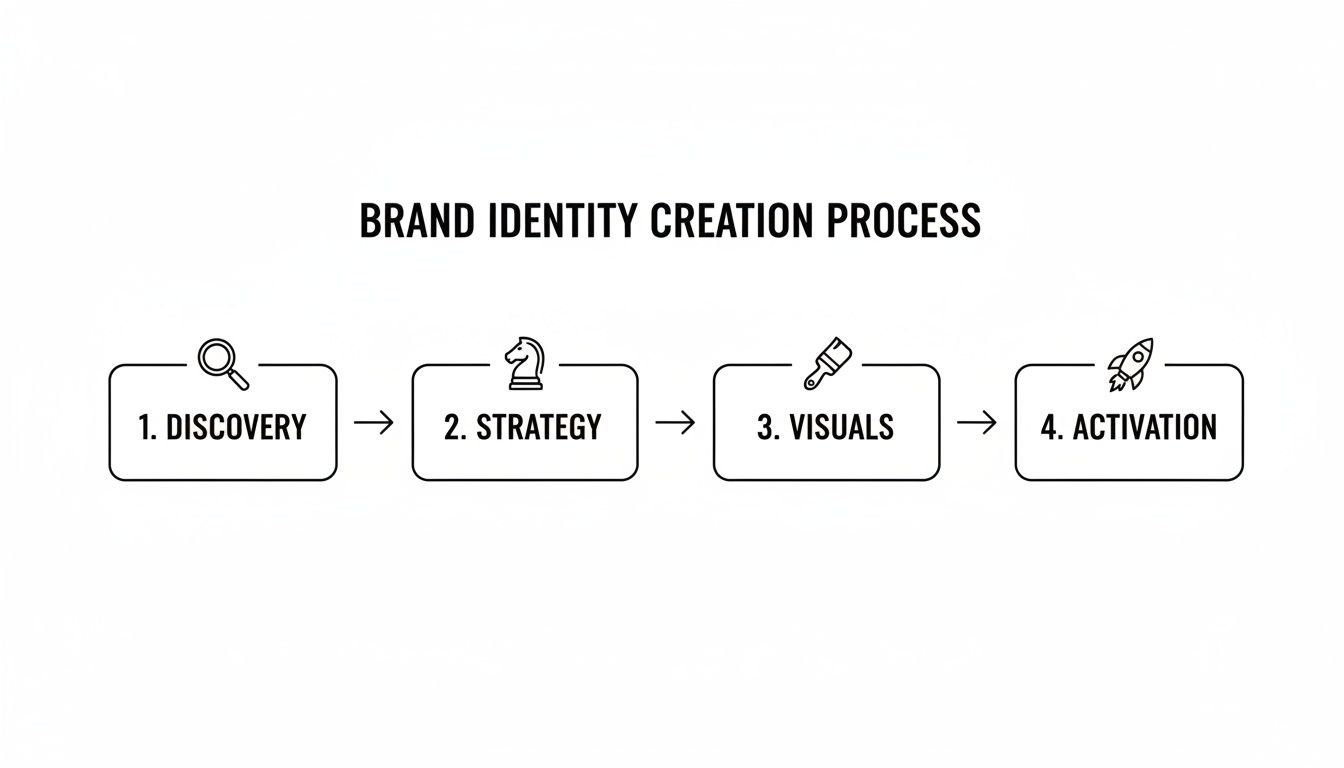
This process isn't just a suggestion; it's the framework that ensures everything you do is aligned, from your internal "why" to what your audience sees every single day.
A consistent brand isn't just a "nice-to-have." It directly hits your bottom line. We're talking about real, measurable growth.
The numbers don't lie: Companies that get their brand identity in order see an average 39.7% lift in brand recognition. This isn't just about vanity metrics. That consistency translates directly to cash, with 35% of businesses reporting 10-20% revenue growth and another 32% seeing growth jump by over 20% from having uniform messaging.
This is why we start here. Investing the time upfront to build this framework is the difference between being just another face in the crowd and becoming a recognized authority.
To get your thoughts organized as you work through this, I recommend using a brand strategy template as your starting point. It’ll help you map everything out.
Let’s break down the four essential pillars you need to build. Each stage has a clear goal and specific actions you need to take.
Once you’ve put in the work to define these pillars, you absolutely must document them. Don't let your hard work go to waste.
Check out our guide on how to create brand guidelines to make sure everyone on your team—or anyone you work with—applies your new identity consistently. This is how you turn your brand into a scalable, long-lasting asset.
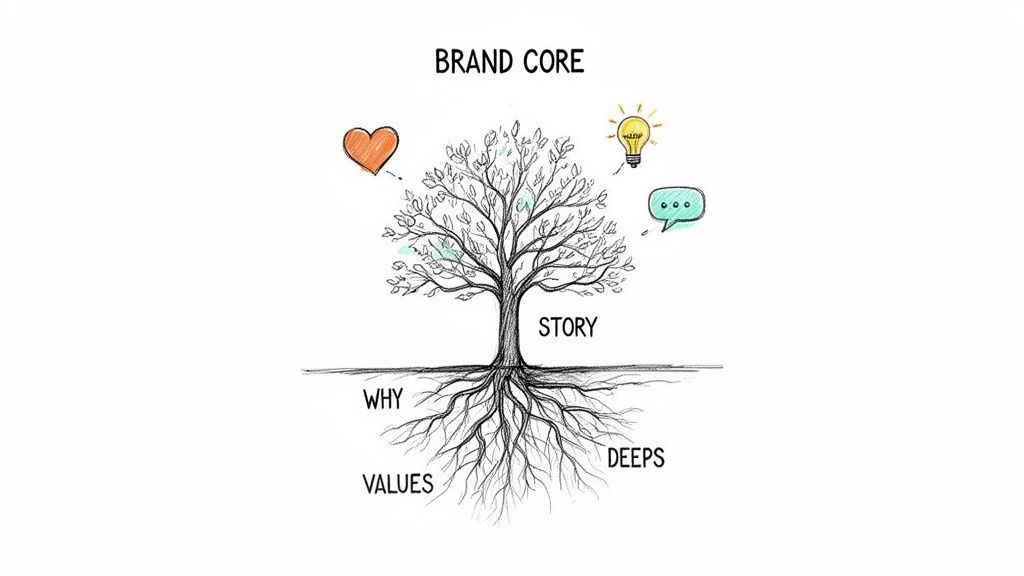
Before you ever think about a logo, a website, or a color palette, you have to do the real work. The most powerful brands—the ones that feel real and stick with you—are built on an unshakable foundation.
This is where most entrepreneurs get it wrong. They jump straight into the visuals because it’s the fun part. But a great brand isn’t just a pretty face; it’s the tangible expression of something much deeper.
Defining your brand core isn’t some philosophical side quest. It's the strategic bedrock that will guide every single decision you make from here on out. It’s your North Star.
Your story is what separates you from everyone else doing something similar. It’s your single most powerful asset. It’s what turns a faceless business into a human-centric brand that people actually connect with.
This isn't about crafting some perfect, polished narrative. It’s about finding the authentic thread that runs through your entire journey.
Start by digging into these questions:
Your story gives context to your mission. Think about it: a financial advisor who clawed their way out of debt has a story that instantly builds more empathy and trust than one who just “likes numbers.”
Brand values aren’t just a few feel-good words like "integrity" or "innovation" you slap on your about page. Real values are active principles that dictate your behavior and decisions. They’re your non-negotiables.
Get away from the generic fluff. Define your values as concrete commitments.
Instead of just "Innovation," try "We find elegant solutions to messy problems." Instead of "Customer-Focused," it might be "We treat every client's business like it's our own." See the difference?
As Harvard Business School Professor Jill Avery put it, your values are like tinted glasses that "color how consumers understand, experience, and value a product or service.” They should directly shape how people see you.
When you have to make a tough call, you can ask, "Does this decision align with our commitment to...?" It simplifies everything and keeps you consistent.
Beyond what you do and how you do it, you have to define why it matters. This is your purpose. It's the reason you exist beyond just making a profit. It’s the impact you want to have on your clients, your industry, or the world.
Think bigger. What's the fundamental problem you are uniquely equipped to solve? This question gets you past features and into the territory of true value.
Burt's Bees is a perfect example. Their purpose isn't just selling lip balm. It's to connect people to the wisdom and power of nature. This single idea drives everything—their natural ingredients, their eco-friendly packaging, and their "By Nature, For Nature, For All" tagline.
To nail down your own purpose, fill in this blank: "We exist to ______ so that ______."
Last but not least, if your brand were a person, who would they be? This is your brand personality. It’s what makes your communication style consistent and recognizable, and it’s the difference between sounding like a faceless corporation and a trusted friend.
Choose 3 to 5 core personality traits that really capture your brand's vibe. And get specific.
These four elements—Story, Values, Purpose, and Personality—are your authentic brand core. Write them down. Keep them somewhere you can see them. This is the foundation for building an identity that doesn’t just get attention, but earns real trust and loyalty.
Once you've dug deep to figure out who you are, it’s time to stop looking in the mirror and start looking out the window. A strong brand isn't just about what you stand for; it's about who you stand for.
This is where strategy takes over.
Too many entrepreneurs fall into the trap of trying to be everything to everyone. Let's be clear: a brand that speaks to everyone ends up speaking to no one. To build a brand that actually connects, you need to get laser-focused on a specific group of people and plant your flag.
This means two things: getting to know your ideal audience on a deep level and figuring out where your competitors are dropping the ball.
You can't connect with people if you only see them as demographics. Sure, age, location, and income are a starting point, but that data doesn't tell you what keeps them up at night or what they're truly trying to achieve.
This is why we build audience personas. A persona is basically a character sketch of your perfect customer. It turns your target audience from a faceless group into a real person, making it so much easier to create content that genuinely helps them.
For instance, don't just target "SaaS founders." Create "Alex."
When you have Alex in mind, you stop making generic content. You start writing directly to his fears and goals. That’s how you build a loyal following.
You’re not building your brand in a vacuum. Your audience is seeing messages from your competitors every single day, so you have to know where you fit in. A simple competitive analysis will show you what others are doing right and—more importantly—where the gaps are.
Start by listing three to five of your direct competitors. These are the people solving the exact same problem for the same audience. Then, break down what they're doing:
The point here isn’t to copy them. It’s to find your opening. If every competitor is racing to the bottom on price, you can position yourself as the premium, white-glove service. If they all sound like robots, you can be the one who sounds human and approachable.
This analysis is about identifying your unique lane. Your brand identity must carve out a distinct mental space in the consumer's mind, communicating who you are at a glance.
By finding these gaps, you define an angle that makes you the only logical choice for your ideal person.
All this work—understanding your audience and the market—comes together in your brand positioning statement. Think of it as a short, internal mission statement that spells out your unique value. It’s the north star for every tweet, article, and video you create.
A solid positioning statement uses a simple framework:
For [Target Audience], who [Audience's Need or Problem], [Your Brand] is the [Category] that provides [Key Benefit] because [Reason to Believe].
Let’s see it in action:
This statement is your filter. Before you post anything, you can ask, "Does this align with our positioning?" You can learn more and get started with these helpful brand positioning statement examples to make sure your promise is always sharp and consistent.

If you've done the hard work of defining your brand's story and purpose, that's the soul. Now, we need to give it a face. This is the first handshake, the gut feeling someone gets about you in a split second.
Let’s be clear: good design isn't about making things pretty. It's a strategic tool. Your visuals are either telling the right story or the wrong one. There’s no in-between.
This is where all your big ideas about who you are and what you stand for become real. Every single visual choice you make either reinforces your message or completely undermines it.
Your logo is the single most concentrated piece of your brand. Think of it as the visual shortcut people will use to identify you everywhere. It doesn't need to be some complicated piece of art to work, either.
I’ve seen too many entrepreneurs overcomplicate this. A simple, memorable logo is a thousand times more effective than a busy design nobody can recognize. Ask yourself: does it work as a tiny profile picture on social media? Is it still clear in black and white?
Your color palette is just as crucial. It's raw, non-verbal communication. The right colors instantly signal trust, energy, or authority before anyone reads a single word.
The numbers don't lie. Visuals drive 55% of first impressions. Just using a signature color can crank up brand recognition by 80%. This is why 77% of executives know that branding is essential for cutting through the noise and building real loyalty. You can dig deeper into the data in the full market report.
Look at a brand like Headspace. They use a soft orange and blue palette to feel calm and easy to approach. That wasn't a lucky guess—it was a strategic move to support their mission of making meditation less intimidating.
Typography is your brand’s voice, but in written form. The fonts you pick have a personality, and you need them to match the voice you want to project. Otherwise, it just feels off.
The biggest mistake I see? Using way too many fonts. It creates visual chaos. Keep it simple and stick to two, maybe three at the most.
Let's say your brand personality is Calm Authority. You could pair a classic serif like Garamond for headlines with a clean sans-serif like Lato for the body text. It feels established, professional, and trustworthy.
But if you're an Encouraging Mentor, you'd want something more approachable. A modern, rounded sans-serif like Nunito would feel warm and supportive.
The photos and graphics you use—from your website's main image to your daily social media posts—set the entire mood. Are your photos bright and full of life, or are they more serious and thoughtful? Do you show real people or stick to abstract designs?
Whatever you choose, it all needs to feel like it came from the same collection. That consistency is what makes your brand look professional and dependable.
Here are a few tips to nail your imagery style, even if you’re on a budget:
When you thoughtfully choose your logo, colors, fonts, and images, you're not just decorating. You're building a powerful visual system that works around the clock to build recognition and connect with the exact people you want to reach.
Look, a great brand identity is useless if it just collects dust in a Google Drive folder. All the work you’ve done on your strategy, story, and visuals only means something when you put it out into the world.
This is the activation phase. It’s where your brand stops being a concept and starts being a living, breathing thing that people can actually connect with.
Content is how you make that happen. It’s the daily practice of showing up, proving you’re the real deal, and building the relationships that will define your legacy.
Your brand voice isn’t just what you say—it’s how you say it. It’s the real-world application of the personality you defined earlier. A consistent voice makes you instantly recognizable and builds that gut-level feeling of trust.
Think back to the personality traits you landed on. Let's make them real.
Write this down. Seriously. A simple "is vs. isn't" chart is one of the best tools I've used. For example: "We're confident, but not arrogant. We're witty, but not sarcastic." This single page will save you from so much brand drift down the road.
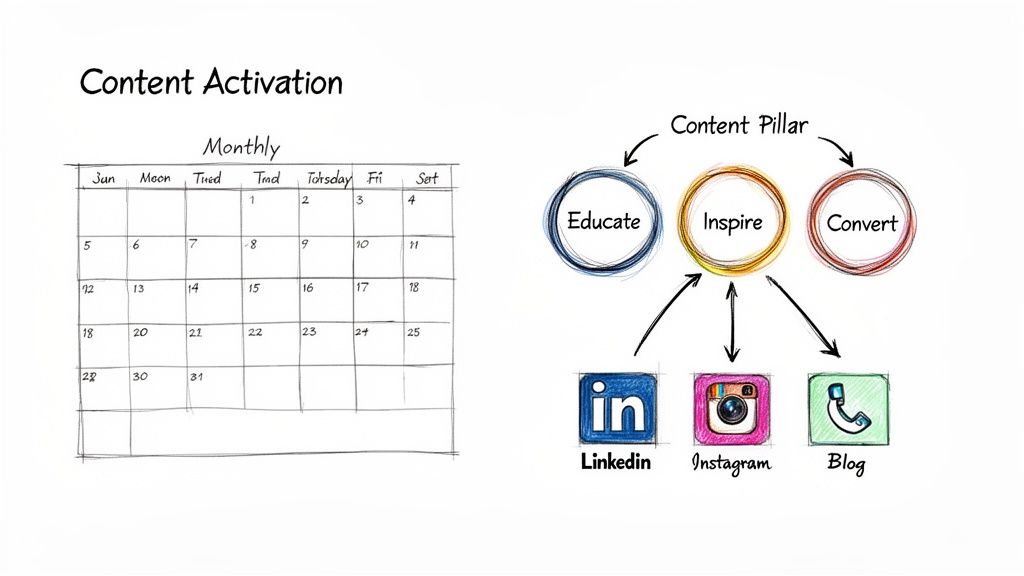
Randomly posting about whatever comes to mind is a fast track to being forgotten. You need structure. This is where content pillars come in.
Think of these as the three to five core topics you’ll own. These themes should be a direct reflection of your purpose, your audience’s biggest problems, and the unique expertise only you can offer.
Let's say you're a leadership coach who helps new managers find their footing. Your content pillars could be:
These pillars become your well of ideas, making sure every single thing you create reinforces why people should listen to you. If you want to go deeper on this, check out our full guide on how to create a content strategy that builds your brand.
Your brand voice stays the same everywhere, but your delivery has to change. What crushes it on LinkedIn will get zero traction on Instagram. You have to speak the language of the platform.
Here’s what I mean. Take one simple idea—"3 delegation mistakes new managers make"—and see how it plays out:
And don't forget that your content often leads somewhere else, like a specific offer or signup. Knowing the fundamentals of things like landing page design best practices ensures that when people click, the experience feels seamless and reinforces the promise your content made.
Your brand is a promise. Your content is how you deliver on that promise day after day. It's the daily practice of showing up and providing value, which is what ultimately builds a loyal audience and a lasting legacy.
Getting this right isn't just a "nice-to-have" anymore. The market for corporate identity design is projected to hit $16.36 billion by 2029, growing at a 13.5% CAGR. That tells you one thing: businesses investing in a strong identity and activating it with consistent content are building real, measurable value. It's time you did, too.
Alright, we've laid out the playbook for building a killer brand identity. But I know what happens next. The big, practical questions start to surface.
Let's tackle the stuff that founders and leaders really ask when the theory meets the road. No fluff, just straight answers from someone who’s been in the trenches.
This is the big one. Everyone wants a timeline, and I get it. The honest answer comes in two parts.
First, there’s the foundational sprint: the strategy, positioning, and visual design. You can knock this out in a few intense weeks or let it stretch over a couple of months. It all depends on how fast you move.
But building the brand itself—the real-world recognition and trust—that's a marathon, not a sprint. The first 6 to 12 months of putting your brand out there consistently are where the magic happens. That's when people actually start to get you.
Think of it like this: It's a 1-3 month setup for a year-long mission. The initial work just gets you to the starting line. Consistency is what builds the legacy.
Absolutely. In fact, I'd argue that a tight budget is a secret weapon. It forces you to get laser-focused on what actually matters and cut out the expensive nonsense.
Your two most powerful assets cost you zero dollars: brand discovery and strategic positioning.
You don’t need a fancy agency to figure out your story, your values, or who you're talking to. Nail that foundation first. Then, you can get scrappy with the visuals.
Here’s your low-budget toolkit:
Remember this: consistency is way more powerful than a big budget. A simple identity, applied with discipline, will crush an expensive but chaotic one every single time. Your dedication is the ultimate advantage.
People throw these terms around like they’re the same thing. They're not. Getting this right is the key to thinking like a strategist.
Brand: This is the gut feeling people have about you. It’s your reputation. It’s the intangible perception that lives in your audience’s minds. You don't own it; they do.
Brand Identity: This is your toolkit for shaping that perception. It's the tangible stuff you control: your logo, colors, fonts, messaging, and voice.
Branding: This is the action. It’s the process of using your brand identity—through marketing, content, and customer service—to influence your brand.
Simply put: your brand is the feeling. Your brand identity is the set of tools you use to create it.
While consistency is king, brands have to evolve or die. But you need to know the difference between a quick touch-up and a complete overhaul.
A minor refresh every 1-2 years is smart. This could mean updating your marketing materials, tweaking your message to stay current, or getting new headshots. It keeps you from looking dated without confusing anyone.
A major rebrand, on the other hand, is a massive strategic move. We’re talking a new name, logo, or mission. You should only even think about this if:
Don't rebrand just because you’re bored or a new design trend pops up. A rebrand isn’t a cosmetic fix—it’s a strategic realignment with your business. Treat it like the serious decision it is.
Ready to stop guessing and start building a personal brand that actually drives results?
The team at Legacy Builder turns expertise like yours into high-impact content that builds trust and grows your influence. We've done it for over 200 founders, and we can do it for you.
Book your free consultation today and let’s talk about how our strategists, writers, and designers can build your legacy.


You could – but most in-house teams struggle with the nuance of growing on specific platforms.
We partner with in-house teams all the time to help them grow on X, LI, and Email.
Consider us the special forces unit you call in to get the job done without anyone knowing (for a fraction of what you would pay).
Short answer – yes.
Long answer – yes because of our process.
We start with an in-depth interview that gives us the opportunity to learn more about you, your stories, and your vision.
We take that and craft your content then we ship it to you. You are then able to give us the final sign-off (and any adjustments to nail it 100%) before we schedule for posting.
No problem.
We have helped clients for years or for just a season.
All the content we create is yours and yours alone.
If you want to take it over or work on transitioning we will help ensure you are set up for success.
We want this to be a living breathing brand. We will give you best practices for posting and make sure you are set up to win – so post away.
Subscribe to our newsletter and get insights on how to grow your personal brand.
