.svg)
Subscribe to our newsletter and get insights on how to grow your personal brand.
Thank you! Your submission has been received!
Oops! Something went wrong while submitting the form.
.svg)


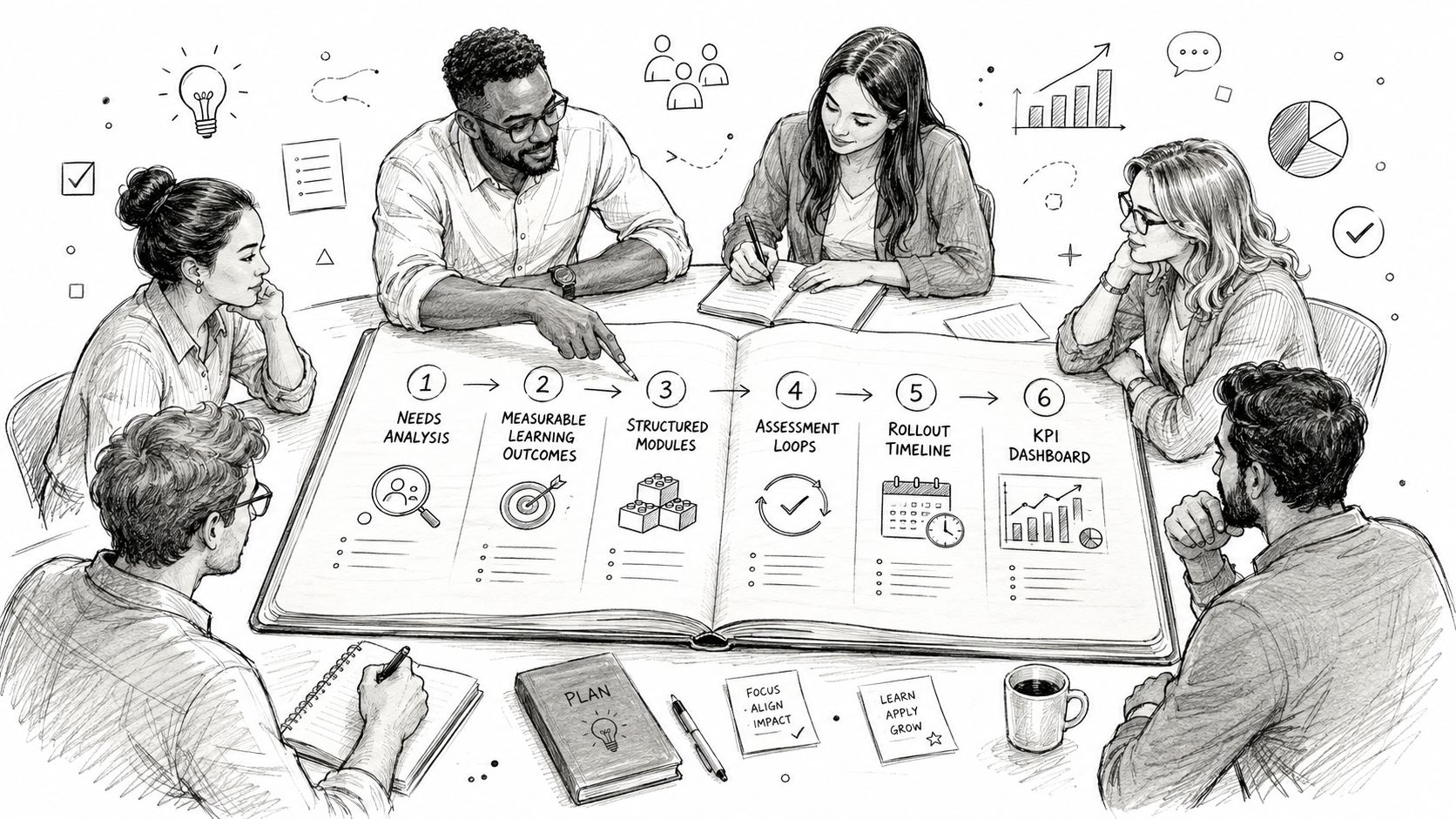
Most advice about training program development starts in the wrong place. It starts with slides, modules, and platforms, then acts surprised when people still don't do the job differently. A program only matters if it changes behavior in the workflow, under pressure, with the tools and manager support people have.
That's why the question isn't “What content should we build?” It's “What performance problem are we solving, and is training even the right fix?” In most organizations, the answer sits in the gap between intent and transfer. The evidence is blunt, only about 10% of organizational training programs produce sustained, worthwhile performance improvement, and around 70% of trainees discontinue using new skills within a year Docebo's training effectiveness review.
The business case for doing this well is still strong. Organizations with employee training programs report 218% higher income per employee than organizations without formalized training, U.S. training expenditures reached $102.8 billion in 2025, organizations spent an average of $1,254 per employee on learning in 2024, and the global workplace training market reached $401 billion in 2024 Lorman's training statistics roundup. The point isn't to justify more courses. It's to justify better design.
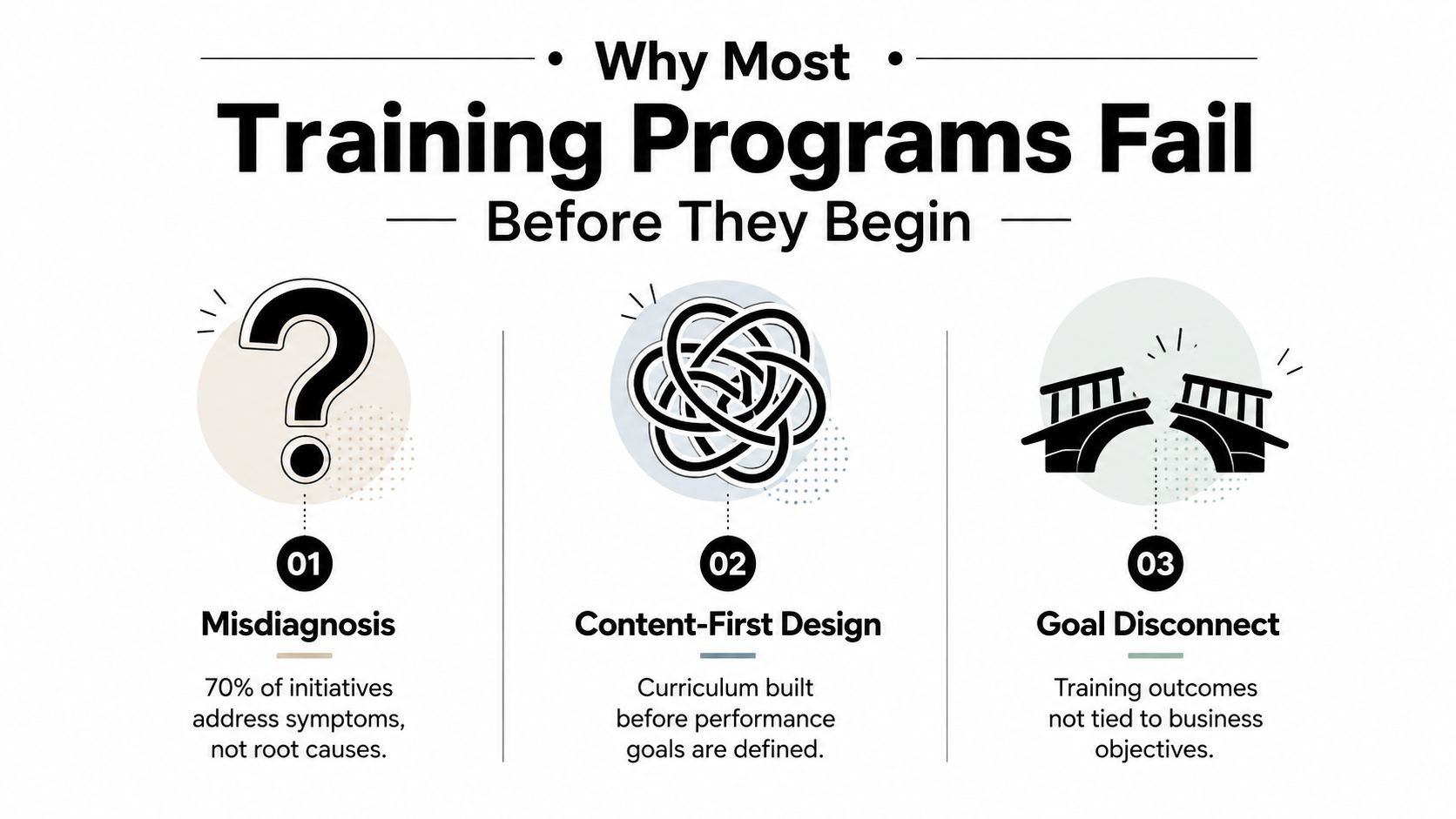
| Failure Point | Design Stage It Starts In | Symptom You See |
|---|---|---|
| Misdiagnosis | Before content planning | The team trains the wrong problem |
| Content-First Design | Curriculum building | Polished modules, weak behavior change |
| Goal Disconnect | Measurement planning | Completion looks good, performance doesn't move |
The most expensive mistake in training program development is building a program for a problem that training can't solve. If sales reps don't know the qualification standard, that is a learning issue. If they know it but the CRM is clunky, managers don't coach it, and compensation rewards speed over rigor, that is a workflow issue with a little training layered on top.
That distinction matters because leaders often celebrate attendance and satisfaction while the job stays the same. The work still breaks in the same place, and the same fixes get recycled. A course can be well produced and still fail if it never reaches the actual moment of performance.
Practical rule: if the desired behavior can't be observed on the job, the program is probably under-specified.
Another common failure shows up before any content exists. A team picks a launch date before it has defined what people must do differently, who reinforces it, and how success will be measured. Training then turns into a compliance artifact instead of a system that changes performance.
A better starting point is a blunt question, should this be solved with training, with process change, or with both? Sometimes the right answer is no module at all. Sometimes it is a job aid, a manager script, a revised handoff, or a clearer expectation sheet. That is the difference between serious program design and content production.
The transfer problem is usually bigger than the curriculum problem. Learners do not need more slides if the task is unclear, the tool is awkward, or the manager never checks for application. Accessibility matters here too, because if people cannot access the learning or the support materials in the flow of work, the program never gets a fair test.
A practical check is to map the handoff after training. What support exists on day one back in the job, what does the manager reinforce, what job aids are available, and what barrier is still in the way? If those answers are fuzzy, the program is not ready, even if the content deck looks polished. For teams that already build audience profiles, the same logic applies to this buyer persona creation guide for founders, because context drives behavior more than presentation does.
A good needs analysis starts at the business level, then narrows to tasks, then to people. First, ask where performance is lagging against strategy. Then ask which behaviors create the gap. Only after that should you ask who needs help and what's blocking them.
That layered view keeps teams from confusing symptoms with causes. A complaint like “our onboarding is broken” can mean three very different things. New hires may not understand what good looks like. They may understand it but lack job aids or access to the right systems. Or they may have a manager coaching gap that makes early performance inconsistent.
If expectations are unclear, training won't rescue the program. If the job aid is missing, a workshop creates temporary confidence and no durable change. If managers aren't reinforcing the skill, the learner returns to the old habit the next day.
A lean diagnosis usually comes from three cheap sources. Manager interviews tell you where friction shows up. Ticket, CRM, or support-note mining reveals patterns in real work. Short learner surveys expose confidence, access, and schedule constraints. You don't need a research platform to do this well, you need a disciplined question set and a willingness to listen.
For teams building personas for internal or external audiences, the logic is similar to the approach in this persona-building guide, because the mistake is the same, assuming one audience behaves like another. Training audiences are never uniform, even inside one team.
Ask for evidence of the gap, not opinions about the gap.
When the gap is complex, a competency-based needs analysis is the right move. That means mapping the specific competencies tied to the role, then checking where the current performance falls short. It's slower than guessing, but it saves the rework that happens when you build the wrong curriculum and discover it after launch.
Weak learning outcomes hide in words like “understand,” “know,” and “be familiar with.” Those phrases sound professional, but they don't tell a designer what to build or a manager what to observe. Strong outcomes describe a visible behavior, the context, and the standard.
A useful test is simple. If a manager can't watch the behavior, score it, or hear it in a customer call, the outcome needs another draft. The same is true if the outcome doesn't connect to a business metric leadership already tracks. Outcomes should point to something the organization cares about, not just something the learner can recall.
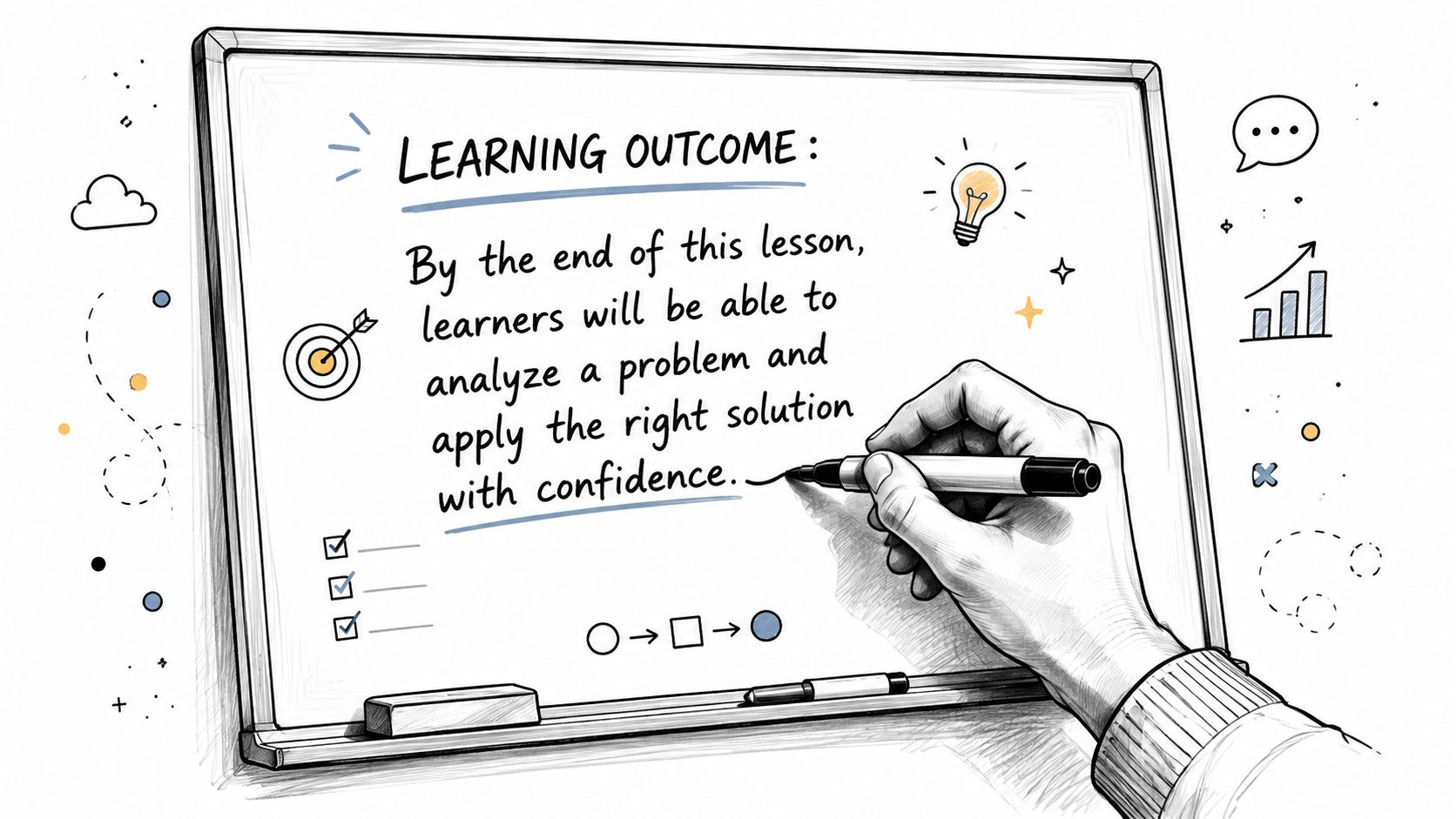
“Understand our sales process” is vague. “Qualify an inbound lead using MEDDIC within a 15-minute discovery call and log the next step in the CRM” gives the designer a target and gives the manager something to verify. One is content-shaped, the other is performance-shaped.
Different audiences need different outcome depth. Beginners may need recall and basic execution. Experienced people may need judgment, adaptation, or exception handling. If you teach both groups the same way, the curriculum gets too shallow for one and too slow for the other.
For contractor, partner, or customer education, the learner might not even be an employee, but the same rule still applies. Write outcomes around the task, not the employment status. A partner training outcome should still name the action, the condition, and the standard.
A practical mapping sheet only needs four columns.
That sheet keeps curriculum decisions honest. If an outcome doesn't map to a metric or an evidence source, it's probably too vague to belong in the program.
Once the outcomes are clear, curriculum design becomes a sequencing problem. The question isn't how much content you can fit into a session. It's which behaviors need practice first, which can be learned asynchronously, and where people need live feedback.
The format choice should follow the task. Traditional delivery scored 4.429, pure digital delivery scored 4.308, and hybrid delivery scored 4.348 in the workplace-learning analysis cited in the research brief PMC review on blended and competency-based training design. The numbers don't say digital is weak. They say single-format thinking is usually too simple for complex work.
Hybrid design works when it combines strengths. Digital is useful for prework, reference material, and repeatable drills. Live sessions are useful for practice, correction, and discussion. On-the-job application matters because that's where new behavior either sticks or disappears.
That's also why a plain “watch this course” rollout often fails. If the learner can't practice the behavior in context, the curriculum stays abstract. If the manager never sees the skill, it never gets reinforced. Good curriculum design makes practice unavoidable.
For a useful comparison of recurring coaching conversations, the Coachful coaching guide is a solid reminder that coaching works best when it's structured around behavior and follow-up, not vague encouragement.
Sequencing rule: front-load the skills that create the most leverage or the most risk, then put supporting knowledge behind them.
A realistic rollout often runs 8 to 12 weeks, but the pacing should be driven by complexity, not by a calendar template. Early modules should cover the behaviors that break most often. Later modules can deepen judgment, exceptions, and edge cases.
The structure also matters for knowledge-sharing programs, especially when subject-matter experts are already stretched. This knowledge-sharing strategy guide is a useful adjacent reference when you need to turn tacit know-how into repeatable learning assets.
| Delivery Format | Best For | Watch Out For |
|---|---|---|
| In-person | Live practice, feedback, sensitive conversations | Hard to scale and harder to repeat consistently |
| Async digital | Prework, reference, basic knowledge | Easy to confuse completion with capability |
| Blended | Complex roles that need practice and reinforcement | Needs tight sequencing and manager follow-up |
| On-the-job | Real work transfer, habits, workflow integration | Fails if the environment doesn't allow practice |
A simple module worksheet keeps the design honest. For each module, define the target outcome, the format, the practice activity, the reinforcement owner, and the artifact that proves transfer. That keeps the curriculum from becoming a pile of content blocks with no learning logic.
Most evaluation plans fail because they measure the wrong thing too early. Completion only shows who finished. A quiz only shows what people remembered right after the session. Neither tells you whether the skill changed behavior or moved the business.
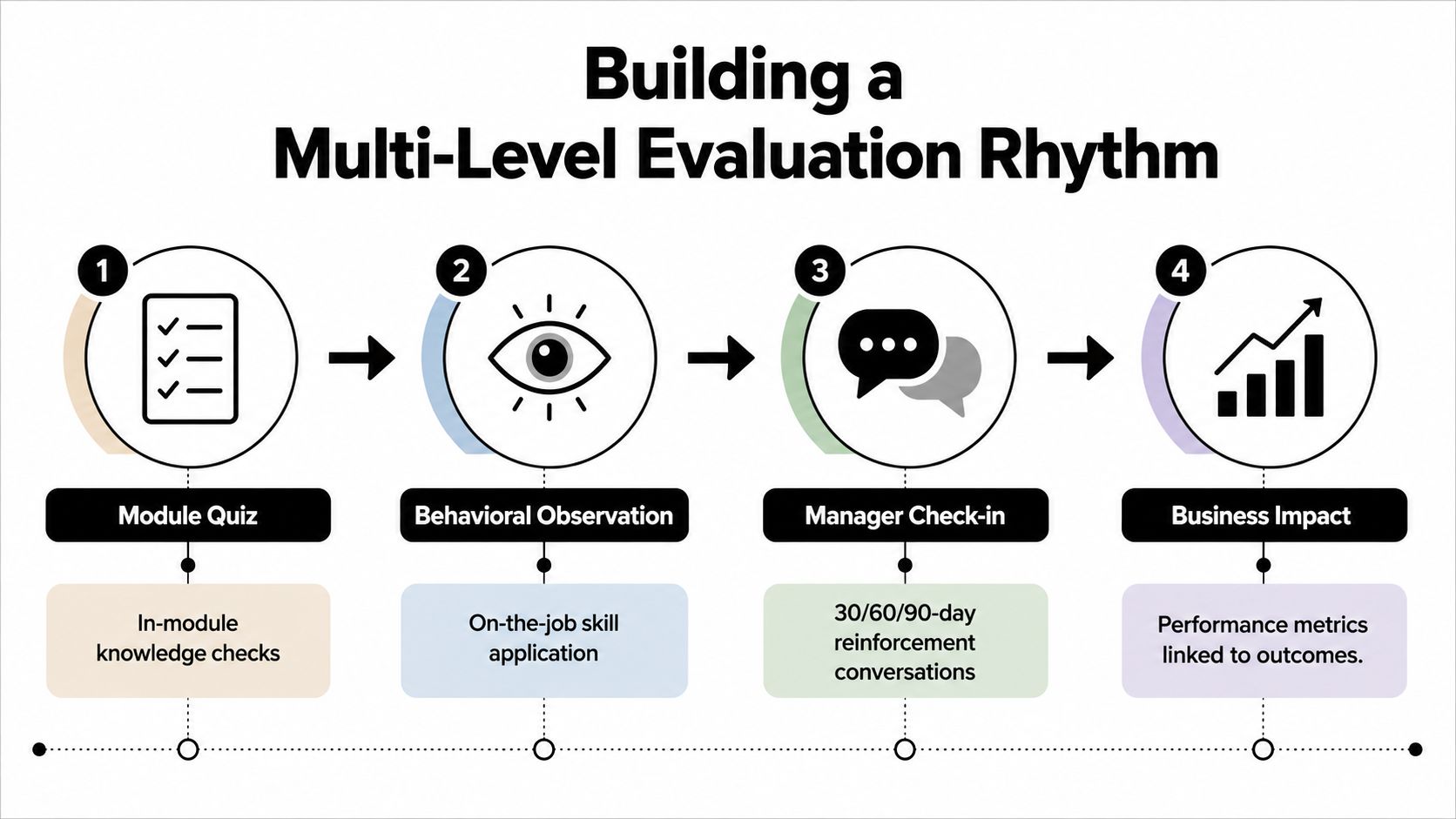
Use a layered rhythm. Start with in-module knowledge checks. Add end-of-module performance tasks. Then look for behavior in manager observation after the learner has had time to use the skill. After that, review business impact once enough workflow time has passed for the change to show up.
The evidence brief recommends measuring transfer at 1 to 3 months and business impact at 6 to 12 months Docebo's training effectiveness review. That timing makes sense because immediate scores mostly capture reaction and short-term learning, while later checks show whether the behavior held up on the job.
You do not need a fancy analytics stack to do this well. CRM fields can track whether the new behavior shows up in calls. Support ticket tags can show whether errors drop in a specific category. Manager 1:1 templates can record the observed behavior and the next coaching action. The point is to connect training to work outputs, not to create another reporting artifact that nobody uses.
Managers usually do not need another reminder to support learning. They need a narrow prompt they can use.
A simple reinforcement script can sound like this:
What part of the new process felt awkward in the last week, and what made it hard to use in the moment?
That question works because it surfaces friction instead of asking the learner to defend themselves. It also tells the manager whether the barrier is skill, confidence, or environment.
The reinforcement checklist should include three things. Who owns the check-in. What behavior they are looking for. What action happens if the behavior is missing. If the manager cannot answer those three questions, reinforcement is still an idea, not a system.
A uniform learner is a design myth. Real teams include different literacy levels, language preferences, cultural communication styles, schedules, and levels of digital comfort. If the program assumes everyone processes information the same way, transfer suffers before the course even starts.
CDC guidance for reaching underserved workers recommends participatory methods like games, mapping, and quizzes, and explicitly warns against relying on charts, graphs, or reading-heavy materials CDC guidance on engaging underserved learners. That doesn't mean lowering the bar. It means removing format barriers that have nothing to do with capability.
Field-test the material with a small sample of the intended audience before launch. Watch where they hesitate. Ask what language felt unclear. Check whether examples map to the work they do. If the audience gets lost in the wording, the issue is in the design, not the learner.
Translation and captioning should be part of the initial plan when the audience needs them. Retrofitting accessibility after launch usually means a second round of confusion, a second round of edits, and a second round of avoidable friction. The same is true for audio quality, pacing, and screen density.
If a person can do the job but can't access the training, the program has an inclusion problem, not a talent problem.
The harder question is whether training is the right intervention at all. Workforce guidance for hard-to-serve groups emphasizes wrap-around supports, employer partnerships, supportive services, and sector alignment, because the surrounding conditions often determine whether training is usable American Progress workforce development guidance. If transportation, childcare, scheduling, or internet access is the true blocker, another module won't fix it.
That's why accessibility and context belong in the design brief. They're not special cases. They're part of the performance environment.
A good program can still fail in rollout. The pilot goes well, the launch email lands, and then managers drift back to old habits. The issue isn't usually the curriculum. It's the change system around it.
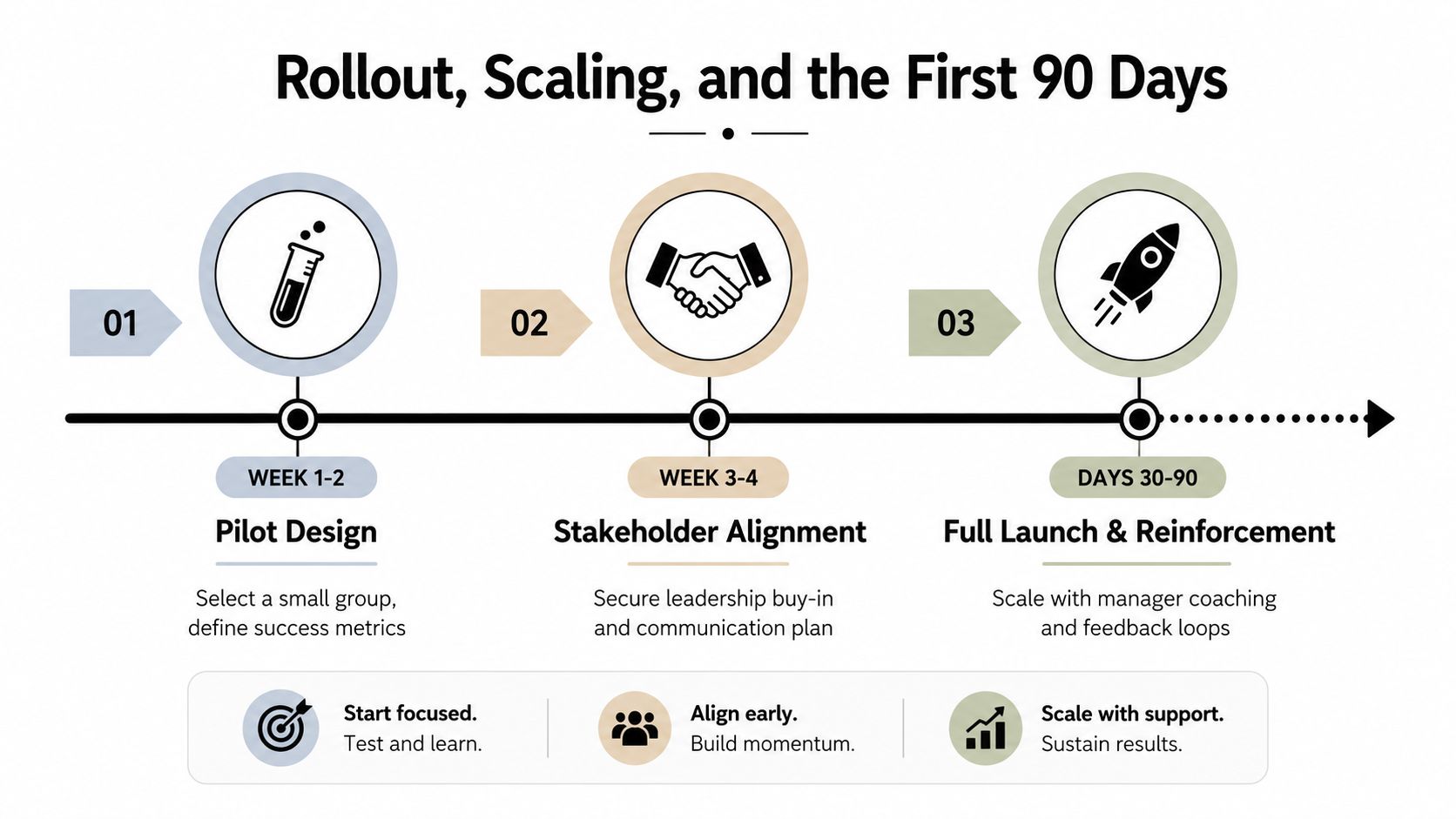
The first 90 days should be treated like an operating rollout, not a soft launch. A small pilot group reveals friction faster than a broad release. Stakeholder alignment keeps sponsors from changing the scope midstream. Full launch works only when managers know what they're reinforcing and learners know what “good” looks like in the workflow.
A useful rollout rhythm looks like this:
| Phase | Weeks | Key Outputs |
|---|---|---|
| Pilot design | 1 to 2 | Small group selected, success metrics defined |
| Stakeholder alignment | 3 to 4 | Leadership buy-in, comms plan, manager roles set |
| Full launch and reinforcement | 30 to 90 days | Coaching cadence, feedback loop, behavior tracking |
The work in week one is not a content polish pass. It's operational. Decide who owns communications, who answers learner questions, and who escalates when adoption stalls. If that isn't clear, the pilot becomes a help desk for the whole company.
For teams that want a practical example of repeatable operations, how tutoring centers manage operations is a useful external model because it shows how scheduling, staffing, and follow-through shape service quality as much as the lesson itself. Training programs have the same problem, they're only as reliable as the surrounding system.
If you need to delegate rollout work across facilitators, managers, and operations leads, this delegation guide is a useful companion for breaking the launch into owned pieces.
A monthly dashboard should stay tight. Track completion rate, assessment pass rate, on-the-job behavior adoption, and one lagging business metric tied back to the original needs analysis. Anything else tends to become noise.
The most common first-quarter failures are predictable. Pilot confusion happens when no one knows what success means. Manager drift happens when coaching isn't scheduled. Content over-customization happens when too many stakeholders try to make the program reflect every local preference, which often weakens the core behavior standard.
A clean 90-day plan keeps the launch from becoming a one-time event. It turns the program into something the organization can run, inspect, and improve.
Legacy Builder helps teams turn messy internal knowledge into structured content systems, which is useful when training program development stalls at the “we know it, but can't document it” stage. If you need a partner for content strategy, audience alignment, and consistent publishing around complex expertise, visit Legacy Builder and see how their process fits your team's learning and communication goals.


You could – but most in-house teams struggle with the nuance of growing on specific platforms.
We partner with in-house teams all the time to help them grow on X, LI, and Email.
Consider us the special forces unit you call in to get the job done without anyone knowing (for a fraction of what you would pay).
Short answer – yes.
Long answer – yes because of our process.
We start with an in-depth interview that gives us the opportunity to learn more about you, your stories, and your vision.
We take that and craft your content then we ship it to you. You are then able to give us the final sign-off (and any adjustments to nail it 100%) before we schedule for posting.
No problem.
We have helped clients for years or for just a season.
All the content we create is yours and yours alone.
If you want to take it over or work on transitioning we will help ensure you are set up for success.
We want this to be a living breathing brand. We will give you best practices for posting and make sure you are set up to win – so post away.
Subscribe to our newsletter and get insights on how to grow your personal brand.
