.svg)
Subscribe to our newsletter and get insights on how to grow your personal brand.
Thank you! Your submission has been received!
Oops! Something went wrong while submitting the form.
.svg)



Most advice about knowledge sharing is shallow. It treats the whole thing like an internal filing problem. Build a wiki. Upload some docs. Tell the team to contribute. Then act surprised when nobody uses it.
That's not a knowledge sharing strategy. That's digital storage with a better name.
If you're a founder, the core issue is bigger than operations. When your best thinking lives only in your head, your company becomes dependent on your availability, your team stays narrower than it should, and your personal brand never compounds into institutional authority. You stay the bottleneck. Your company stays forgetful. Your legacy stays fragile.
A strong knowledge sharing strategy fixes all three.
Founders lose far more money to trapped knowledge than to bad software or bloated process. They just rarely label it correctly.
The cost shows up in slower decisions, repeated mistakes, longer ramp time, weaker client delivery, and senior leaders answering the same question for the tenth time. McKinsey found that improved knowledge sharing and collaboration through social technologies can raise the productivity of knowledge workers by 20 to 25 percent, which makes poor knowledge flow a direct growth tax, not an admin issue. You can review the broader context in McKinsey's research on the social economy.
If you lead the company, the loss is even bigger.
Every time your team waits for your interpretation, your judgment stays trapped in meetings instead of scaling through the business. That hurts output. It also caps your authority. A founder's reputation grows when their ideas travel without them.
Plenty of companies confuse stored information with usable knowledge. They buy a tool, dump in documents, and call the job done. Then the team keeps asking the same people the same questions because the value was never captured in a form people trust and use.
That failure usually shows up in four places:
The fourth point is the one founders miss.
Your way of thinking is part of the asset. The way you frame tradeoffs, explain the market, judge quality, and make decisions shapes the brand in every room you are not in. If that thinking never gets codified and shared, your company stays dependent on your presence and your personal brand stays louder than your institutional brand. That is a weak legacy.
Contesimal's content organization insights are useful here because they point to the same reality. Information only creates value when people can find it, trust it, and use it in the moment a decision needs to be made.
Here is the standard I recommend. If your company needs you to explain the same principle twice, document the principle, add context, and make it reusable. If your team still needs to ask after that, improve the format until they do not.
Founders love the idea of lasting impact. Very few build the systems that make their thinking survive contact with growth.
A strong knowledge sharing strategy transfers judgment, not just instructions. It shows people how decisions get made, why standards exist, what tradeoffs matter, and where exceptions belong. That is how you build continuity across hiring, expansion, and leadership layers.
The financial upside is obvious. The brand upside is bigger.
When your knowledge moves through the company clearly, your business starts to teach the market in a consistent voice. Clients feel it. New hires adopt it faster. Partners repeat it. Over time, your company stops sounding like a collection of departments and starts sounding like a school of thought. That is how a founder turns expertise into authority, and authority into legacy.
Knowledge sharing isn't a static library. It's closer to a living brain.
A library stores information. A brain connects ideas, retrieves patterns in context, and helps people act. That's the standard you should use. If your current system only stores files, you don't have a knowledge sharing strategy. You have an archive.
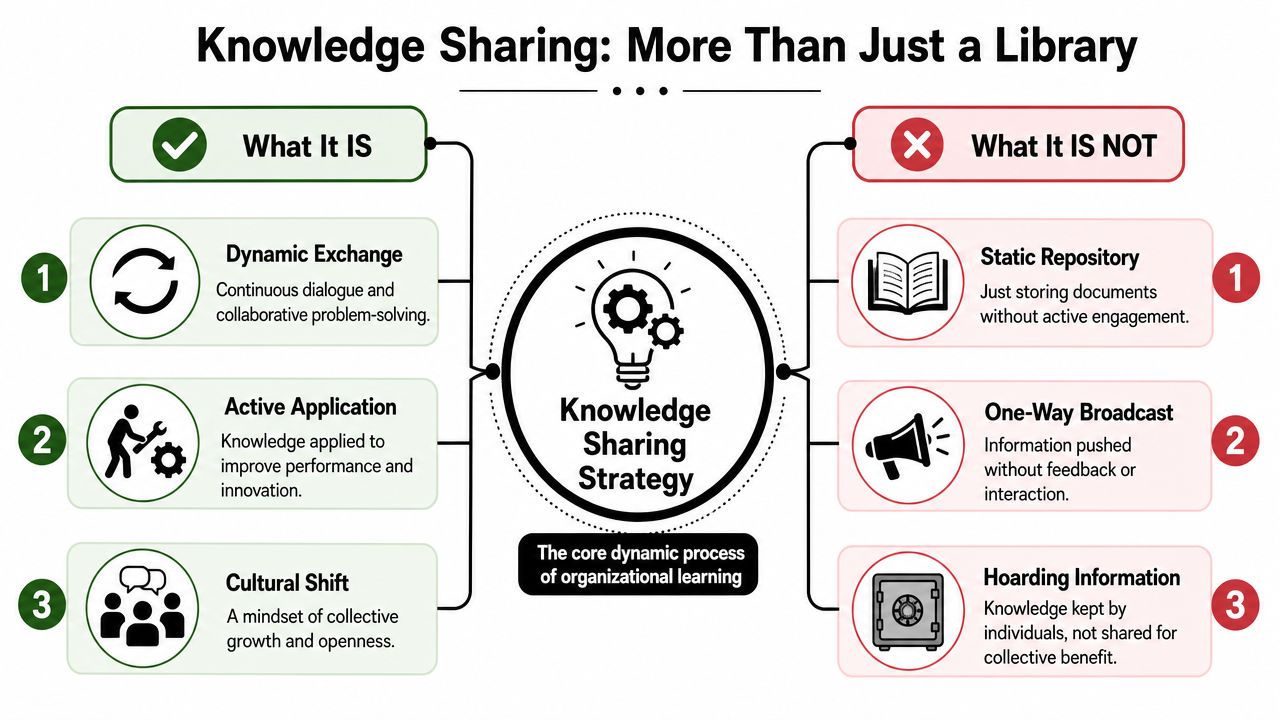
Many teams focus on the easy half.
Explicit knowledge is the documented stuff. Playbooks, onboarding docs, pricing policies, brand guidelines, meeting notes, customer support macros. It matters because people can find it, reuse it, and update it.
Tacit knowledge is where the value sits. It's the instinct behind the process. It's the sales leader's read on when a deal is healthy. It's the product lead's sense of which customer feedback matters and which doesn't. It's the founder's ability to explain why one message sounds authoritative and another sounds generic.
Tacit knowledge is harder to capture because people often can't explain it cleanly on the first try. They just “know.”
That's why weak strategies fail. They collect explicit documents while letting the highest-value thinking stay trapped inside experienced people.
A real knowledge sharing strategy has three moving parts:
Structure is essential. If you're sorting content, defining ownership, and trying to avoid a messy internal sprawl, Contesimal's content organization insights are useful because they frame systems around usability instead of document hoarding.
A good knowledge system answers two questions fast: “Who knows this?” and “What should I do next?”
Let's kill the common confusion.
A knowledge sharing strategy is not:
If you want this to work, stop rewarding people for being hard to replace. Reward them for making others sharper.
That's the shift. Knowledge sharing is not clerical work. It's leadership design.
Most founders sell themselves short here. They think knowledge sharing is mainly about reducing friction inside the company.
It does that. But the bigger upside is external.
When your company captures insight well, your personal brand stops running on inspiration and starts running on evidence, pattern recognition, and repeatable intellectual property. You don't have to manufacture thought leadership out of thin air. You already have raw material in internal debriefs, decision frameworks, customer objections, hiring lessons, product retrospectives, and the reasoning behind major calls.
The strongest founder brands don't sound polished first. They sound clear.
That clarity usually comes from repeated internal teaching. The same explanation you give your team about positioning, pricing, delivery, or culture can often become a LinkedIn post, newsletter essay, keynote theme, or podcast talking point. Internal knowledge sharing creates the source material.
Here's what that gives you:
If you want a useful framing for the public-facing side of this, this guide on what thought leadership actually is and how influence gets built is worth reading. It aligns with a simple truth. Authority grows when your ideas become recognizable, repeatable, and useful to other people.
Talented people don't just want compensation. They want proximity to sharp thinking.
A company that shares knowledge well becomes a place where ambitious people can learn faster, contribute sooner, and teach others as they grow. That changes hiring conversations. It changes retention. It changes the quality of discussion.
People stay longer in environments where expertise circulates instead of getting hoarded.
A personal brand without internal transfer is vanity. It may look influential from the outside, but it collapses if the founder goes quiet for a month.
Legacy is different. Legacy means your ideas shape how people work even when you're not in the room. It means the company can articulate principles you established, apply them under pressure, and keep evolving without losing its identity.
Your personal brand gets stronger when your company can prove your ideas work without your constant intervention.
That's why I push founders to stop treating knowledge sharing like admin. It's a brand multiplier. It converts private insight into public authority and operational continuity.
That's a much bigger win than a better wiki.
Most companies pick a model by accident. They inherit the founder's habits, the ops lead's preferences, or whatever their software happens to support. That's lazy, and it creates friction fast.
Choose your model on purpose.
There are three practical ways to structure a knowledge sharing strategy. None is universally best. Each fits a different stage, culture, and tolerance for control.
Centralized works like an editorial system. A smaller group owns quality, structure, and publishing standards. This is useful when consistency matters more than speed.
Decentralized pushes contribution out to teams. People closest to the work create and share what they know. This can produce faster learning, but it also creates mess if nobody governs it.
Networked is the grown-up option for many scaling companies. It blends both. Subject matter experts and designated owners set standards, while teams contribute actively across the business.
| Model | Control | Speed of Contribution | Best For |
|---|---|---|---|
| Centralized | High | Moderate to low | Regulated teams, brand-sensitive environments, companies needing a single source of truth |
| Decentralized | Low to moderate | High | Fast-moving startups, creative teams, expert-led functions with strong autonomy |
| Networked | Moderate to high | High | Scaling companies that need both consistency and broad participation |
Ask yourself three blunt questions.
If your team is still learning how to document decisions clearly, a centralized or networked model will protect quality. If your culture already values clarity and peer review, decentralization can work.
In legal, finance, healthcare, or heavily branded environments, sloppy knowledge hurts trust fast. You need ownership and review. In looser creative or product environments, faster exchange may matter more than polished control.
If expertise is concentrated in a few senior leaders, start with a more centralized model and deliberately expand contribution over time. If expertise is distributed across pods, markets, or specialties, a networked model usually fits better.
A practical move here is to compare knowledge base platforms before you lock the process. The tool shouldn't dictate the model, but it will either support the behavior you want or sabotage it.
Decision test: If your model makes contribution painful or quality unreliable, it's the wrong model.
Early-stage founders often lean too centralized because they don't trust the team yet. Later-stage teams often overcorrect and let everything become decentralized chaos.
Start networked sooner than you think.
Give clear owners to critical domains. Let teams contribute close to the work. Keep lightweight standards for naming, tagging, review, and usage. That gives you quality without killing velocity.
A knowledge sharing strategy should reflect how your company thinks at its best, not how it behaves when nobody is paying attention.
Founders who treat knowledge sharing like an IT project build expensive archives nobody uses. Build it like a legacy system instead. Your job is to preserve judgment, spread standards, and make your company smarter without your constant presence.
The order matters. Decide what knowledge carries the most business value, capture it in reusable formats, assign ownership, and make sharing part of daily operations.
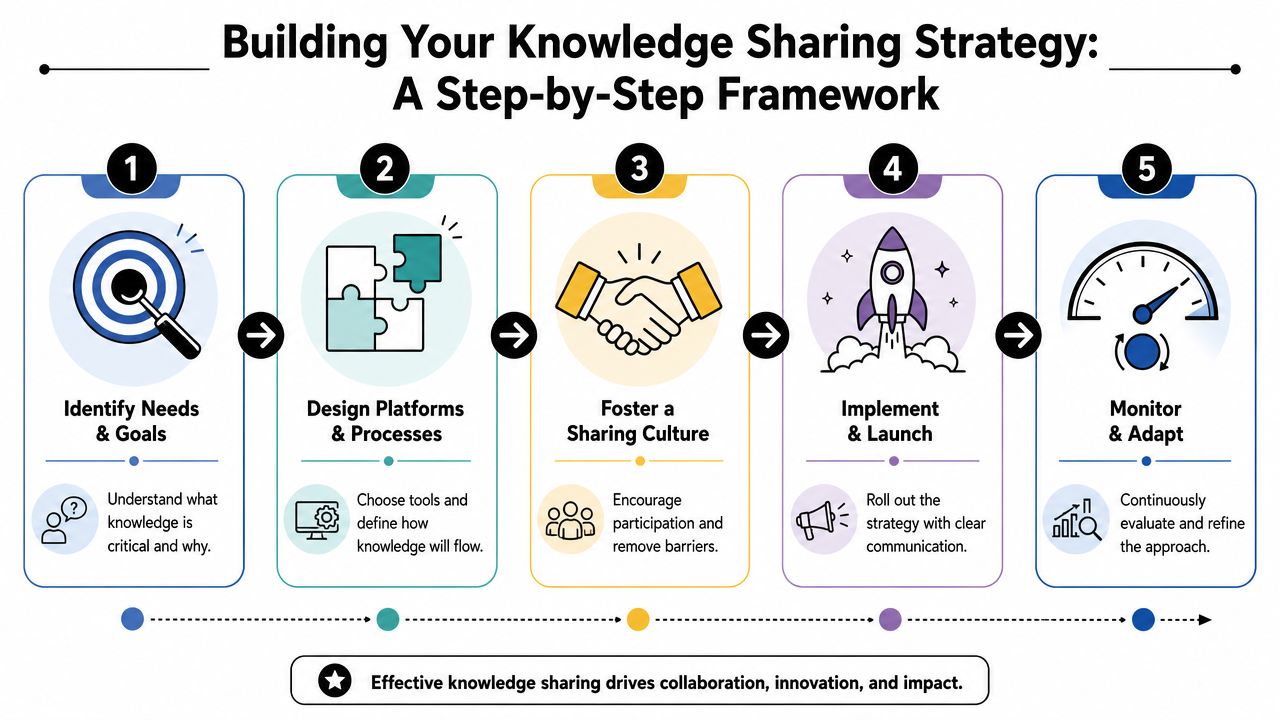
Do not start with a full document audit. Start with exposure.
Focus on high-value tacit knowledge first. That means the judgment, context, pattern recognition, and decision logic that live inside people's heads and disappear when they leave.
Prioritize roles such as:
If you want a simple filter, ask one question. “Whose absence would force the team to relearn expensive lessons from scratch?” Capture that knowledge first.
A strategy memo, a screen recording, and a two-minute founder voice note do different jobs. Use the right format for the right kind of knowledge.
The goal is reuse, not documentation volume.
A practical mix usually includes:
In this context, founders miss a major opportunity. The same insight that trains your team can also strengthen your authority in the market. If you want that captured knowledge to work twice, this guide to content repurposing for maximum impact is worth using.
Knowledge sharing fails when it depends on goodwill. Put it in the role.
Expect leaders to make their thinking accessible. Expect experts to teach, document, and update what they know. If someone holds critical knowledge but never transfers it, they are creating operational risk, not protecting value.
Set a few hard rules:
If your system requires extra effort, people will skip it. That is not a culture problem. It is a design problem.
Libraries decay. Rhythms stick.
Create recurring moments where knowledge gets captured while it is still fresh and useful:
These habits do more than improve execution. They train your company to speak in a consistent voice. Over time, that consistency becomes part of your brand, internally and externally.
For a broader view on where AI-supported knowledge systems are heading, especially for more modern operating environments, knowledge management for AI in 2026 gives useful strategic context.
A short explainer helps here if your team needs a visual overview:
A knowledge sharing strategy is mature when it stops feeling like a campaign.
Research on multinational knowledge-sharing initiatives shows a clear pattern. Teams move through initiation, ramp-up, and routinization. The ramp-up phase expands reach and repetition until the behavior becomes normal operating practice, as outlined in this study on multinational knowledge-sharing phases.
That standard matters for founders. If your best ideas still depend on you repeating them in meetings, your company has not institutionalized your thinking. It has only borrowed it.
Build the system until your standards, decisions, and point of view outlive your direct involvement. That is how knowledge sharing stops being a corporate checkbox and starts becoming part of your legacy.
Teams often measure the wrong things. They track page views, number of uploaded docs, or how many people attended a training. Those are activity signals, not proof that knowledge is helping the business think better.
Measure whether people can find, apply, and extend knowledge.
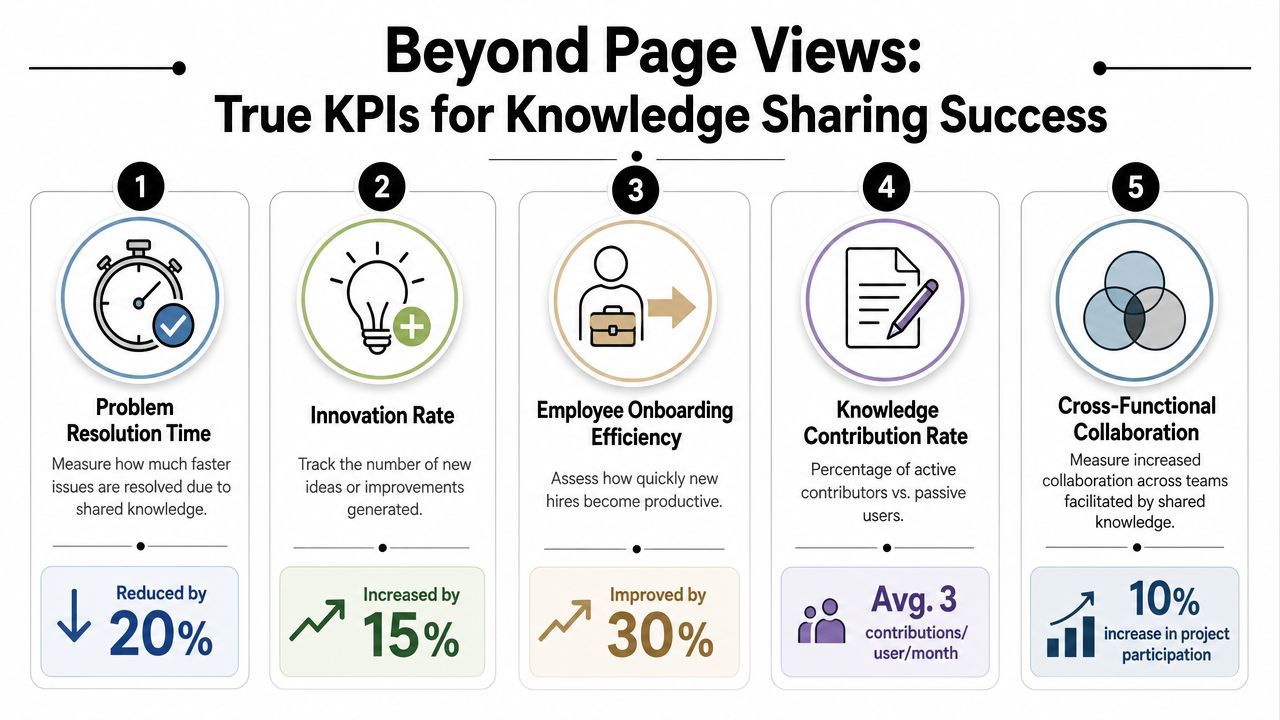
How quickly can a new hire operate independently in their role? If your knowledge sharing strategy is working, onboarding gets clearer and less dependent on heroic hand-holding.
How often does the team solve a problem by using an existing answer, framework, or documented lesson instead of starting from zero? This tells you whether the system is practical or decorative.
Which internal experts contribute, update, mentor, or review knowledge regularly? You don't need a vanity leaderboard. You need visibility into whether the people with the deepest judgment are shaping the system.
Is the information discovered trustworthy enough to act on? This can be tracked through search feedback, follow-up questions, and whether employees still escalate basic issues to the same few people.
Are sales, product, operations, and leadership drawing from the same body of insight, or are they still operating in separate realities?
These KPIs show whether your company is becoming teachable.
That matters for brand too. A founder who wants influence needs proof that their ideas travel well. Internal metrics can reveal that. If your principles shorten onboarding, improve decisions, and reduce reliance on a handful of people, you're not just sharing information. You're building a recognizable operating philosophy.
If you already think carefully about external authority, this guide on how to measure content performance for your personal brand complements the internal side well. Internal reuse and external resonance are different systems, but they both reward clarity, consistency, and useful ideas.
Don't ask, “How much content did we upload?” Ask, “Did people get better, faster, because this existed?”
You don't need a sprawling analytics setup. A simple dashboard reviewed monthly is enough if it covers competence, reuse, contribution, search quality, and cross-team adoption.
The point isn't reporting theater. The point is seeing whether the company is learning in a repeatable way.
Most knowledge sharing failures are predictable. The problem isn't mystery. The problem is leaders keep repeating the same mistakes and calling them rollout issues.
They aren't rollout issues. They're design issues.
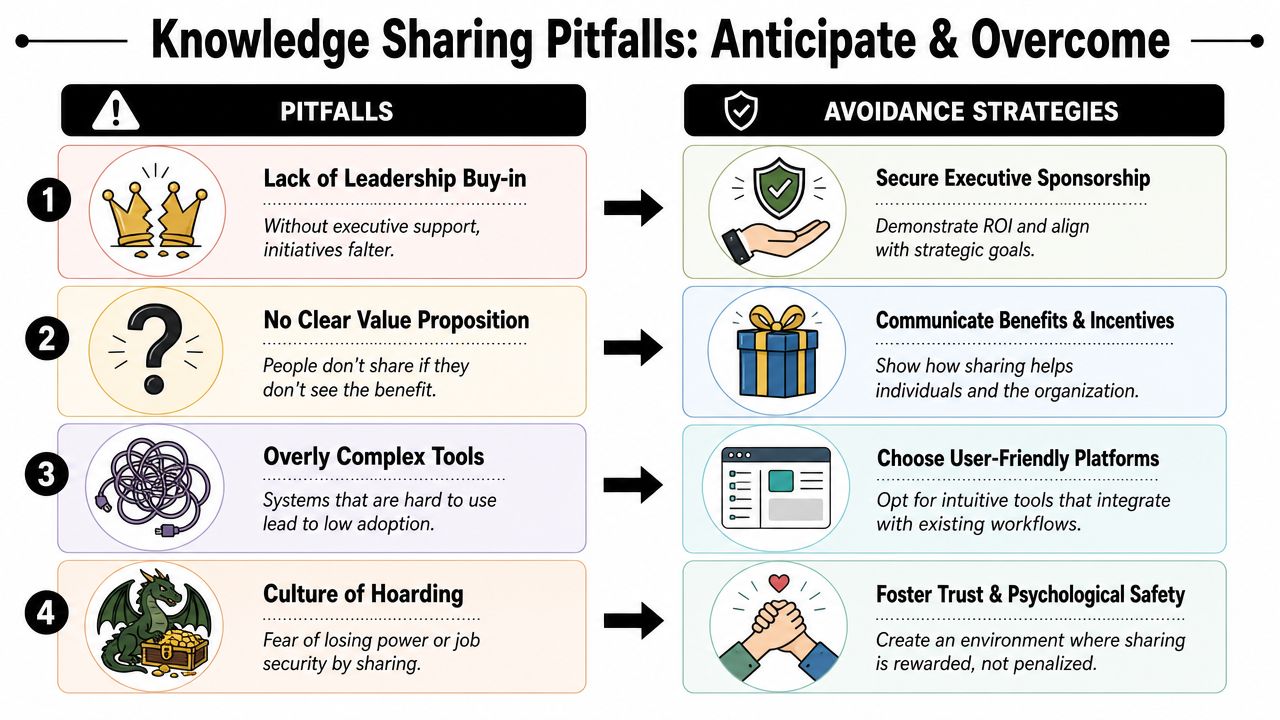
Informal knowledge doesn't transfer automatically in remote and hybrid environments. People lose the hallway moments, the overheard context, and the small corrections that build real competence.
That gap is not minor. Mentorcliq's perspective on knowledge-sharing culture argues that fully remote teams need dedicated virtual spaces and open mentoring programs to recreate lost informal knowledge flow, which is especially important for 50%+ of modern workforces.
Do this instead:
Budget approval is not buy-in.
If leaders don't contribute, cite the system, and reward participation, the team reads the truth fast. They conclude knowledge sharing is optional, junior, or administrative.
Fix it by making leadership visible inside the system. Founders should publish decision notes, share lessons from missed calls, and point people back to documented thinking.
If the platform sits outside the workflow, it becomes a guilt object. People intend to contribute later. Later never arrives.
Use tools that fit daily behavior. Slack, Teams, searchable AI layers, and lightweight capture formats beat beautiful but isolated repositories every time.
Some teams still treat information like a private advantage. People think being the only one who knows something makes them indispensable.
That's bad leadership design. Reward the opposite.
Knowledge hoarding doesn't protect the company. It weakens it and makes succession harder.
The fix is cultural, not just technical. Build trust. Remove the fear that sharing means becoming replaceable. In strong companies, sharing is what makes people more valuable because it increases their impact beyond their own output.
A knowledge sharing strategy works when people stop asking, “Should I document this?” and start asking, “Who else needs this to move faster?”
If you want your ideas to outlive meetings, moods, and algorithm cycles, you need more than content. You need a system that turns your expertise into assets people can use. That's where Legacy Builder comes in. They help founders and professionals turn lived insight into sharp, consistent content that strengthens authority, scales personal brand growth, and builds a legacy people can recognize.


You could – but most in-house teams struggle with the nuance of growing on specific platforms.
We partner with in-house teams all the time to help them grow on X, LI, and Email.
Consider us the special forces unit you call in to get the job done without anyone knowing (for a fraction of what you would pay).
Short answer – yes.
Long answer – yes because of our process.
We start with an in-depth interview that gives us the opportunity to learn more about you, your stories, and your vision.
We take that and craft your content then we ship it to you. You are then able to give us the final sign-off (and any adjustments to nail it 100%) before we schedule for posting.
No problem.
We have helped clients for years or for just a season.
All the content we create is yours and yours alone.
If you want to take it over or work on transitioning we will help ensure you are set up for success.
We want this to be a living breathing brand. We will give you best practices for posting and make sure you are set up to win – so post away.
Subscribe to our newsletter and get insights on how to grow your personal brand.
