.svg)
Subscribe to our newsletter and get insights on how to grow your personal brand.
Thank you! Your submission has been received!
Oops! Something went wrong while submitting the form.
.svg)



If you want to delegate effectively, you have to stop thinking about it as just offloading work. It’s a complete mindset shift—from simply getting tasks off your plate to strategically empowering your team.
This means you need to get crystal clear on outcomes, match the right tasks to the right people, and give them the resources to win. It’s a fundamental leadership skill that doesn't just save you time; it multiplies your impact.
Most founders I talk to see delegation as a necessary evil. A last resort when their plate is overflowing.
They get trapped by the same old fears: "It's just faster if I do it myself," or "No one can do it as well as I can." This is the mindset that keeps you stuck. It turns delegation into a reactive chore instead of what it really is: a proactive strategy for scaling your business.
When you nail delegation, you're not just clearing your calendar. You're investing in your people and the future of your company. That jump from "doer" to "leader" is one of the toughest but most critical transitions a founder can make. It's the difference between being the bottleneck and being the visionary.
Real delegation is an act of trust. It’s about empowerment.
When you hand off a project with a clear end goal and the autonomy to get there, you show your team you believe in them. This gives them a chance to build new skills, take real ownership, and feel more connected to the mission. You're not just assigning a task; you're building a culture of accountability and capability. That’s how you build a team that can run without you.
Think about the core benefits here:
"The inability to delegate is one of the biggest problems I see with managers at all levels." – Eli Broad
This isn’t just feel-good leadership fluff; it has a real impact on the bottom line. Research from Gallup found that CEOs who actually master delegation pull in 33% higher revenue than those who cling to every task.
That number says it all. Delegation isn't a soft skill—it's a critical driver of financial growth.
Moving from a doer to a delegator takes a conscious decision. You have to start seeing delegation as a tool for multiplying your impact through others. If you're looking for more inspiration on how to lead this way, check out these examples of authentic leadership that build trust and drive results.
This guide will give you the exact steps to make that happen.
If you want to delegate effectively, you have to get brutally honest about where your time is actually going.
So many founders I work with are stuck in the daily grind, buried in tasks that feel important but don't really move the needle. The goal here isn't just to offload work. It's to strategically abandon the stuff that's holding you and your business back.
It starts with a simple time audit. For one week, track everything. I mean everything—the "quick" five-minute emails, scheduling social media posts, chasing invoices, all of it. At the end of the week, you'll have a raw, unfiltered look at where your energy is truly going.
Once you have that list, it's time to get real. This isn't about what you can do; it's about what you should do.
Every single task on your list falls into one of two buckets. You either need to delegate it to someone else, or you need to elevate it by giving it your full, undivided attention.
So, how do you know which is which? Tasks that are screaming to be delegated usually have a few things in common:
This decision-making process is a straight line to growth. When you empower your team and free up your own time, your business expands. It's that simple.
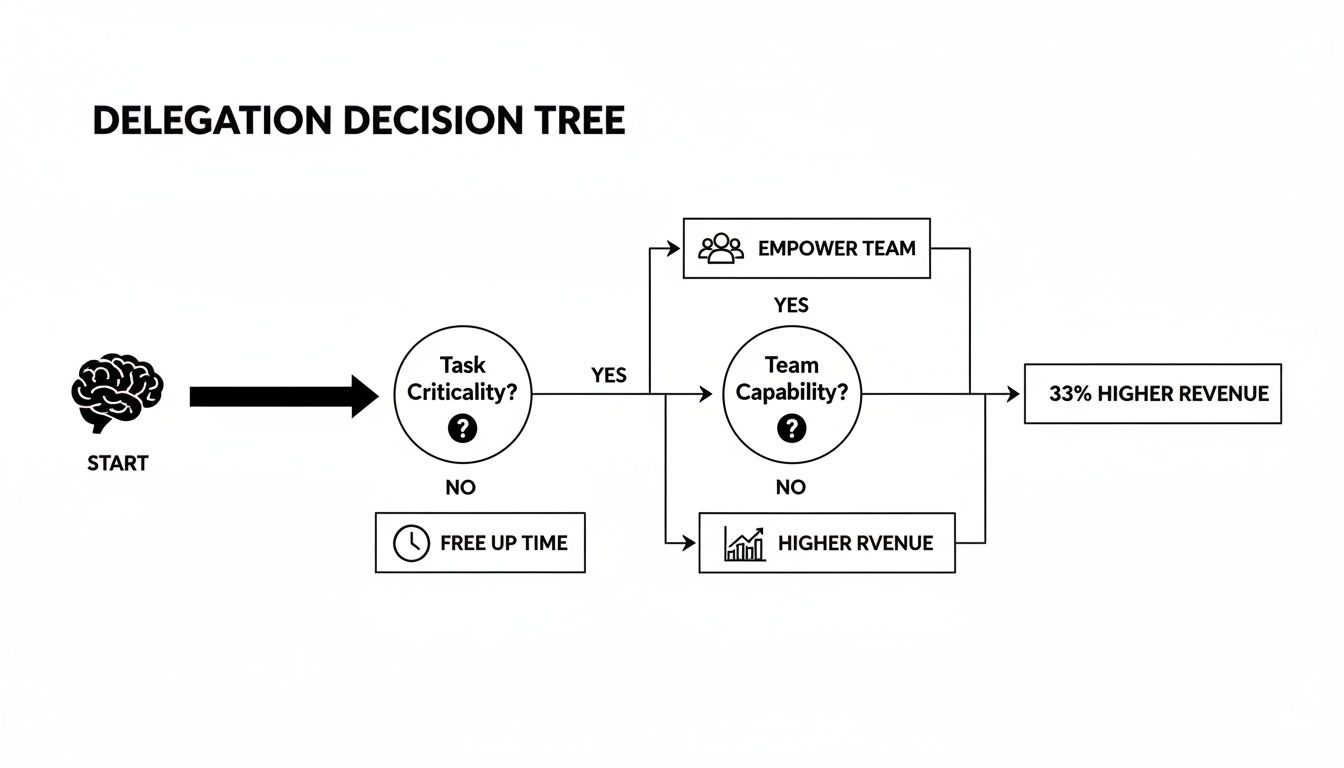
This isn't just about saving time. As the flowchart shows, making the strategic choice to delegate directly leads to higher revenue. It's a growth strategy, period.
To make this even clearer, I use a simple decision matrix with my clients. It helps you quickly sort tasks and decide what to do with them.
This matrix cuts through the noise. If it's not in that top-left box, you have no business doing it long-term.
Now, let's turn this into action. Create a literal "Stop Doing" list. This is your immediate game plan for getting low-value work off your plate.
For a founder focused on building their personal brand, that list might look something like this:
The most successful leaders aren't the ones who do the most. They're the ones who empower others to do their best.
This is a fundamental shift in thinking. You're moving from "What can I offload?" to "What must I stop doing to scale?"
Delegation isn't a sign of weakness; it's the mark of a strategic leader. You are intentionally clearing your plate for the high-impact work that only you can do—setting the vision, closing the deals, and building the future of your company. Every single task on your "Stop Doing" list is a chance for someone on your team to step up and a chance for you to level up.
Figuring out what to delegate is a huge first step, but it’s only half the battle.
The real art of delegation is in the next move: matching that task to the right person. This isn't just about offloading work to whoever has bandwidth. It's a strategic play that, when done right, not only gets the job done but also grows your people.
When you master this, you stop seeing your team as just a list of resources. You see them as individuals with their own skills, ambitions, and untapped potential. The goal is to create a win-win—the business moves forward, and your team members level up.
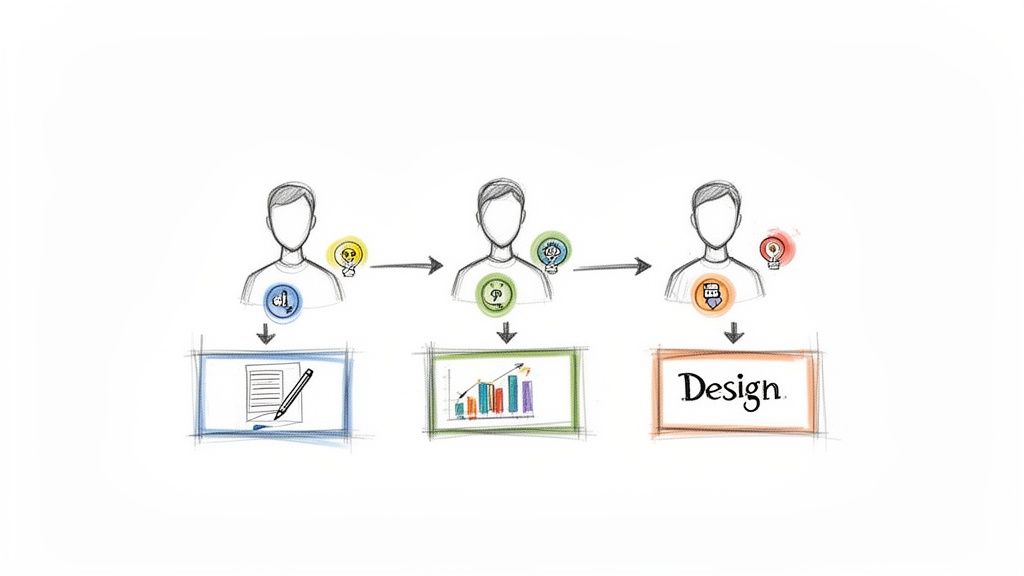
It’s tempting to take the path of least resistance. Got a social media task? Give it to the social media manager. Logical, but it’s a missed opportunity.
Transformational delegation means looking beyond the obvious job title.
Think about it: a task that’s become routine for you could be a massive growth opportunity for someone else. Before you hand something off, run through a few quick questions to find those hidden gems.
This mindset shift turns delegation from a simple handoff into a powerful engine for development. When people get challenges that align with their interests, their motivation and engagement go through the roof.
This isn't just a hunch; there's research to back it up. A study on the relationship between delegation and job satisfaction found a strong link between a high degree of delegation and how much variety employees feel in their work, which directly boosts their happiness on the job. It’s a positive feedback loop: engaged team members do better work.
How you delegate isn’t one-size-fits-all. Your approach with a full-time employee should be totally different from how you work with a freelancer or an agency. Getting this right is crucial for a smooth handoff.
Delegating to Internal Team Members
With an employee, you’re playing the long game. Your focus should be on their development.
Delegating to Freelancers or Agencies
With external partners, it’s a different ballgame. The relationship is more transactional, so absolute clarity is everything.
Great leaders don’t just delegate tasks; they delegate responsibility and authority. They create an environment where people feel trusted to make decisions and are motivated to deliver their best work.
Let’s say you’re a founder delegating content creation. With an internal team member, you might send a rough voice note and ask them to draft a blog post, coaching them on your tone. For a content agency, you’d provide a detailed brief, brand guidelines, and specific KPIs, then step back and let them execute.
Ultimately, matching talent to tasks is an art. It’s about knowing your people, understanding what drives them, and seeing delegation for what it really is: your best tool for building a more capable and resilient team.
Here's the truth: most delegation fails before it even starts. And it’s almost never about a lack of talent or effort. It’s about a lack of clarity.
When you hand off a task with a vague goal, you’re basically setting your team (and yourself) up for a painful round of revisions and frustration. The fix isn't to micromanage. It's to stop assigning work and start providing a crystal-clear roadmap for success.
That roadmap is your delegation brief. This isn't just a list of instructions. It's a quick, comprehensive guide that kills the guesswork and aligns everyone from day one. Think of it as your insurance policy against the dreaded phrase, "That's not what I had in mind."
Every single task, no matter how small, serves a bigger purpose. The most important part of any brief is explaining the why behind the work. Telling someone what to do is just management. Explaining why it matters? That’s leadership.
Instead of saying, "Turn this webinar into a blog post," frame it with the end goal: "Our goal here is to take the key ideas from our last webinar and create a top-of-funnel blog post. This needs to attract new organic traffic and, most importantly, capture email sign-ups."
That context changes everything. It gives the person the power to make smarter decisions on their own because they understand what a "win" actually looks like.
A great brief doesn't just list tasks; it transfers ownership of the outcome. When your team gets the 'why,' they can innovate on the 'how' and deliver results you never even thought to ask for.
A solid brief leaves zero room for misinterpretation. It needs to be the single source of truth that anyone can check back on. The format can be whatever works for you, but there are a few non-negotiable elements you absolutely have to include.
Your brief should always have these five things:
For more complex or repeatable tasks, it's worth learning how to write a standard operating procedure. An SOP can provide an even deeper framework, making sure the work is not only well-defined but also done consistently every time.
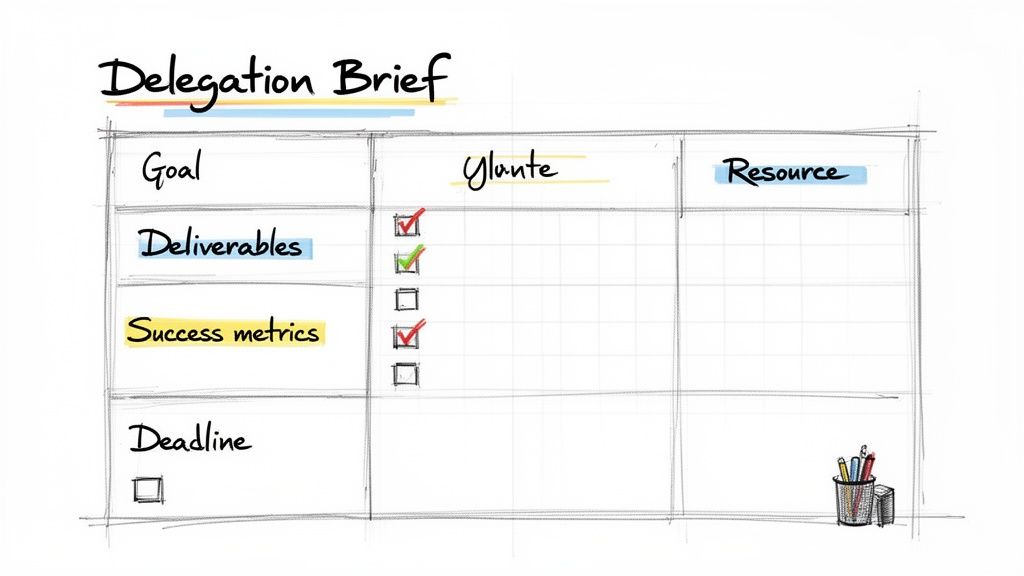
Let’s put this into practice. Imagine you're a founder who needs to delegate a competitive analysis project.
Here’s the weak, disaster-in-the-making brief: "Can you research our top three competitors and put a summary together?"
Now, here's what a strong, clear brief looks like:
By the way, if you need help crafting summaries that get straight to the point, you can learn more about how to write an executive summary here.
This level of detail isn't micromanagement—it's clarity. It gives your team member the confidence to run with the project, knowing exactly what's expected. Spend an extra 10 minutes creating a thorough brief upfront, and you'll save yourself hours of headaches and rework later.
You’ve handed off a task with a perfect brief. Huge win, right? But your job isn’t done. The final piece of the puzzle is creating a follow-up system that actually works—one that keeps people accountable without you breathing down their necks.
This is where so many leaders trip up. They're terrified the project will go off the rails, so they start checking in constantly. That kind of hovering kills the very autonomy you were trying to build in the first place. The goal isn’t to watch their every move; it's to create a rhythm of communication that keeps everyone aligned and feeling supported.
Your follow-up cadence has to match the task. A complex, urgent project needs a different touch than a simple, routine one. A one-size-fits-all approach just doesn't cut it.
The key is to set this rhythm from the very beginning. When you delegate the task, agree on the follow-up plan together. This small act of co-creation gets their buy-in and makes the whole process feel like a partnership, not a top-down mandate.
Here are a few cadences I've found work well:
To keep all this organized, it’s worth looking into some solid task management apps for teams that centralize everything and make progress easy to see.
The point of a check-in isn't to ask, "Is it done yet?" It's to ask, "What do you need to be successful?" This simple shift in framing changes the entire dynamic from one of pressure to one of partnership.
How you talk during these check-ins makes all the difference. You're either building your team up or tearing them down. The goal is always constructive improvement, which means being thoughtful and specific. Vague comments are useless.
Here are a few simple scripts you can steal and adapt:
This kind of feedback is direct, but it's also respectful. It focuses on the work, not the person, and opens the door for a real conversation about making the final result even better.
Mistakes are going to happen. It's just part of the game, especially when you're stretching someone with a new task. How you react in these moments defines your leadership.
When a mistake pops up, your first instinct should be curiosity, not criticism.
When you treat mistakes as learning opportunities, you remove fear from the equation. You create a safe environment where your team feels like they can take smart risks, knowing that a misstep won’t be the end of the world. That's how you build a resilient, smart team that gets better with every single project.
Let’s be real. Even with a perfect brief and the right person on the job, things can still go sideways.
Delegation isn't a "set it and forget it" activity. It's a skill. And like any other skill, you get better by learning from your mistakes. So when things don't go as planned, don't see it as a failure. Treat it as a data point to make your process better next time.
When a delegated task hits a snag, the problem usually falls into one of three buckets: it's an issue with the process, the person, or your own mindset. Figuring out which one it is is the first step to getting back on track.
When a piece of work comes back and it completely misses the mark, your first instinct might be to jump in and fix it yourself. Don't. That’s a short-term fix that solves nothing for the future.
Instead, take a breath and put on your detective hat. Ask yourself a few key questions:
Nine times out of ten, the problem started right at the handoff. An unclear expectation is the #1 killer of good delegation. It just creates a mess of confusion, rework, and frustration for everyone.
You get a first draft back, and it’s just… not there. It’s a classic delegation problem.
The key is to turn this into a coaching moment, not a confrontation. You have to frame the feedback around the work itself, focusing on specific, actionable things they can change.
Instead of saying, "This isn't what I wanted," try something more constructive. "This is a solid start. The section on competitor analysis is strong. Let's work on the recommendations section to make it more actionable. Can we brainstorm three specific tactics we could implement next quarter based on this data?"
This approach actually builds their skills and confidence. And if things do get tense, knowing some core workplace conflict resolution strategies can keep the conversation productive.
This isn't just a "nice to have" leadership style; it's a massive gap for most managers. Research shows that while delegation is a top skill for preventing burnout, very few are actually good at it. A DDI assessment of over 70,000 leaders found that only 19% showed strong delegation skills. That's a huge opportunity for growth. You can discover more about the link between delegation and burnout.
The goal of feedback isn't just to fix the task in front of you. It's to improve the outcome of all future tasks. Every piece of constructive criticism is an investment in your team's capability.
This is probably the hardest part, because the problem is you. It's that powerful, nagging urge to just take the task back.
When you see someone struggling or a deadline is creeping up, your brain screams, "It's just faster if I do it!"
You have to fight that impulse. Reclaiming a task sends a terrible message: "I don't trust you to handle this." It absolutely crushes their confidence and guarantees they won't want to take real ownership in the future.
Instead of taking over, offer support. Ask, "What roadblocks are you hitting, and how can I help clear them for you?" This shows them you're a safety net, not a micromanager waiting to pounce. Every time you guide someone through a challenge instead of doing it for them, you make your entire team stronger.
Look, I get it. The idea of handing off work brings up some common fears. Let's tackle them head-on, because these are the exact hurdles that keep most leaders stuck doing everything themselves.
This is the biggest trap, and it’s a short-term mindset. Yes, you might be faster this one time.
But think about it: every single time that task comes up again, it's back on your plate. When you invest a little time upfront to train someone, you're buying back all those future hours. This isn't about saving five minutes today; it's about reclaiming hundreds of hours over the next year.
Simple: delegation isn't abdication. You're not just tossing a task over the fence and hoping for the best.
You stay in control by defining the outcome, not micromanaging the process. Give your team a crystal-clear brief, define what "done" looks like, and set up a simple rhythm for check-ins. Trust them with the "how" while you stay focused on the "what" and "why."
They will. And that's okay. Mistakes are part of the process—they're how people learn and get better.
When a mistake happens, don't just fix it. Use it as a coaching moment. Was the brief unclear? Did they need a resource they didn't have? Figure out the root cause with them. This approach builds their confidence and problem-solving skills, creating a team that isn't afraid to step up.
Ready to build a personal brand that commands attention without draining all your time? At Legacy Builder, we handle the content creation so you can focus on being the visionary. Discover how we can help you build your legacy.


You could – but most in-house teams struggle with the nuance of growing on specific platforms.
We partner with in-house teams all the time to help them grow on X, LI, and Email.
Consider us the special forces unit you call in to get the job done without anyone knowing (for a fraction of what you would pay).
Short answer – yes.
Long answer – yes because of our process.
We start with an in-depth interview that gives us the opportunity to learn more about you, your stories, and your vision.
We take that and craft your content then we ship it to you. You are then able to give us the final sign-off (and any adjustments to nail it 100%) before we schedule for posting.
No problem.
We have helped clients for years or for just a season.
All the content we create is yours and yours alone.
If you want to take it over or work on transitioning we will help ensure you are set up for success.
We want this to be a living breathing brand. We will give you best practices for posting and make sure you are set up to win – so post away.
Subscribe to our newsletter and get insights on how to grow your personal brand.
