.svg)
Subscribe to our newsletter and get insights on how to grow your personal brand.
Thank you! Your submission has been received!
Oops! Something went wrong while submitting the form.
.svg)


Most advice about tone of voice guidelines is weak. It tells founders to “be authentic,” pick a few adjectives, and trust that their voice will emerge over time.
That's how you end up sounding like a different person every week.
If you're building a personal brand, your voice can't be a mood. It has to be a system. And if you're using AI to scale daily posting, that system has to be strong enough to survive automation without turning your content into polished mush.
Authority doesn't come from posting more. It comes from sounding unmistakably like yourself, across every post, email, comment, landing page, and script. The founders who win long term aren't just visible. They're recognizable.
Most personal brands don't have a voice. They have a pile of influences.
One day you sound like a thoughtful operator on LinkedIn. The next day you sound like a punchy copywriter on X. Then you write a newsletter that feels borrowed from a SaaS founder you've been reading too much. None of it is fake on purpose. It's just unmanaged.
If you haven't defined your tone of voice, your brain fills the gap with mimicry. You copy the cadence of creators you admire. You absorb phrases from podcasts. You borrow structure from high-performing posts. That's normal.
It's also a problem.
Your audience doesn't experience your content as a set of isolated posts. They experience a pattern. If that pattern shifts constantly, they don't build a clear impression of who you are, what you stand for, or why they should trust your judgment.
Your voice isn't what you meant to sound like. It's what your audience repeatedly hears.
Founders often treat voice like decoration. They obsess over hooks, formats, and platforms while ignoring the underlying character of the message. That's backward. Format changes. Character shouldn't.
When your tone swings too far, people notice even if they can't explain it. Your content feels less grounded. Your message feels less credible. Your expertise starts competing with your presentation.
That's especially dangerous for professionals building a legacy online. You're not just publishing content. You're training your market to associate you with a certain level of clarity, confidence, and judgment.
A scattered voice creates friction in places you care about most:
Your tone of voice guidelines should sit closer to strategy than style. They should shape how you explain ideas, how you handle nuance, how much warmth you show, and how firmly you make a point.
That's not branding fluff. It's operating discipline.
If you want authority, stop asking whether your voice feels authentic. Ask whether it's defined, repeatable, and usable by someone other than you.
Vague adjectives are useless. “Professional.” “Friendly.” “Bold.” Those words sound nice in a workshop and collapse the moment you try to write a real post.
A useful voice is built from decisions, not labels.
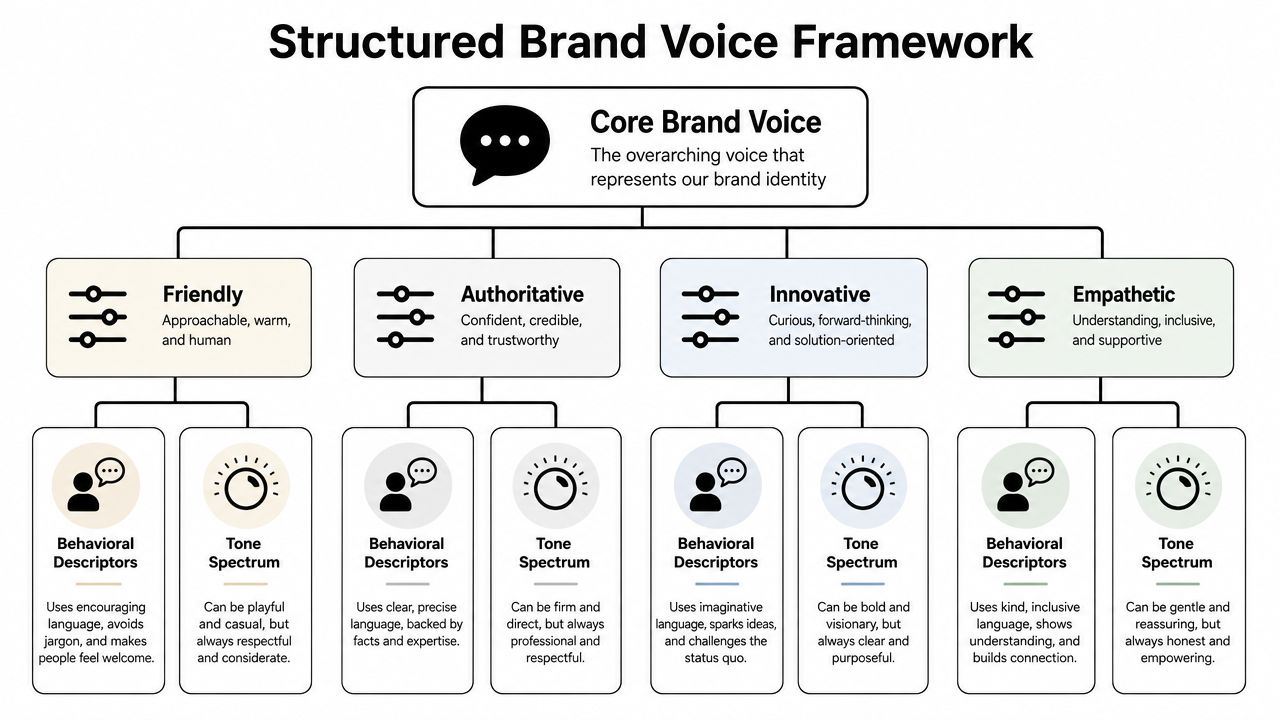
The strongest framework comes from Nielsen Norman Group's research on tone of voice dimensions. Their guidance is clear. Effective tone of voice guidelines are built on exactly four high-level dimensions, not an endless list of adjectives. They also validate alignment through 3-point or 5-point Likert rating scales.
That matters because most founders overdescribe and underdefine. They collect words instead of making tradeoffs.
Pick a few dimensions where your brand needs a clear stance. For example:
You don't need to sit at an extreme on every scale. You do need to decide where you lean.
Here's a practical way to do it.
Choose your four dimensions
Don't invent ten. Four is enough to force focus.
Mark your position on each spectrum
Example: casual, serious, outspoken, warm.
Translate that into target words
Use a small set. Words like “direct,” “grounded,” “calm,” or “sharp” work better than abstract brand language.
Add anti-tone words
Most founders get clarity fast at this point. If you are “direct,” maybe you are not “hype-driven.” If you are “warm,” maybe you are not “overfamiliar.”
Practical rule: Your anti-tone list is often more valuable than your tone list. It stops drift before it starts.
If you need help sharpening the language itself, this guide on writing tone for creators is useful because it turns abstract voice ideas into clearer writing choices. For a broader foundation on identity before tone, Legacy Builder's article on what brand voice is and how to build one that connects is a good companion.
A simple profile might look like this:
| Dimension | Your Position | Target Words | Anti-tone Words |
|---|---|---|---|
| Casual vs. Formal | Slightly casual | Clear, conversational | Stiff, corporate |
| Serious vs. Playful | Mostly serious | Grounded, thoughtful | Flippant, gimmicky |
| Reserved vs. Outspoken | Outspoken | Direct, decisive | Hesitant, vague |
| Warm vs. Detached | Warm | Respectful, human | Cold, performative |
Don't stop at naming traits. Put your profile against real content.
Take a recent post, email, and sales message. Ask whether each one matches your chosen dimensions. If it doesn't, your voice isn't established yet. It's still aspirational.
Later, when you scale content with AI or collaborators, these attributes become your filter. Without them, everyone writes from interpretation. With them, people can execute.
A short definition beats a poetic manifesto every time.
A distinct tone means nothing if your content keeps chasing random topics.
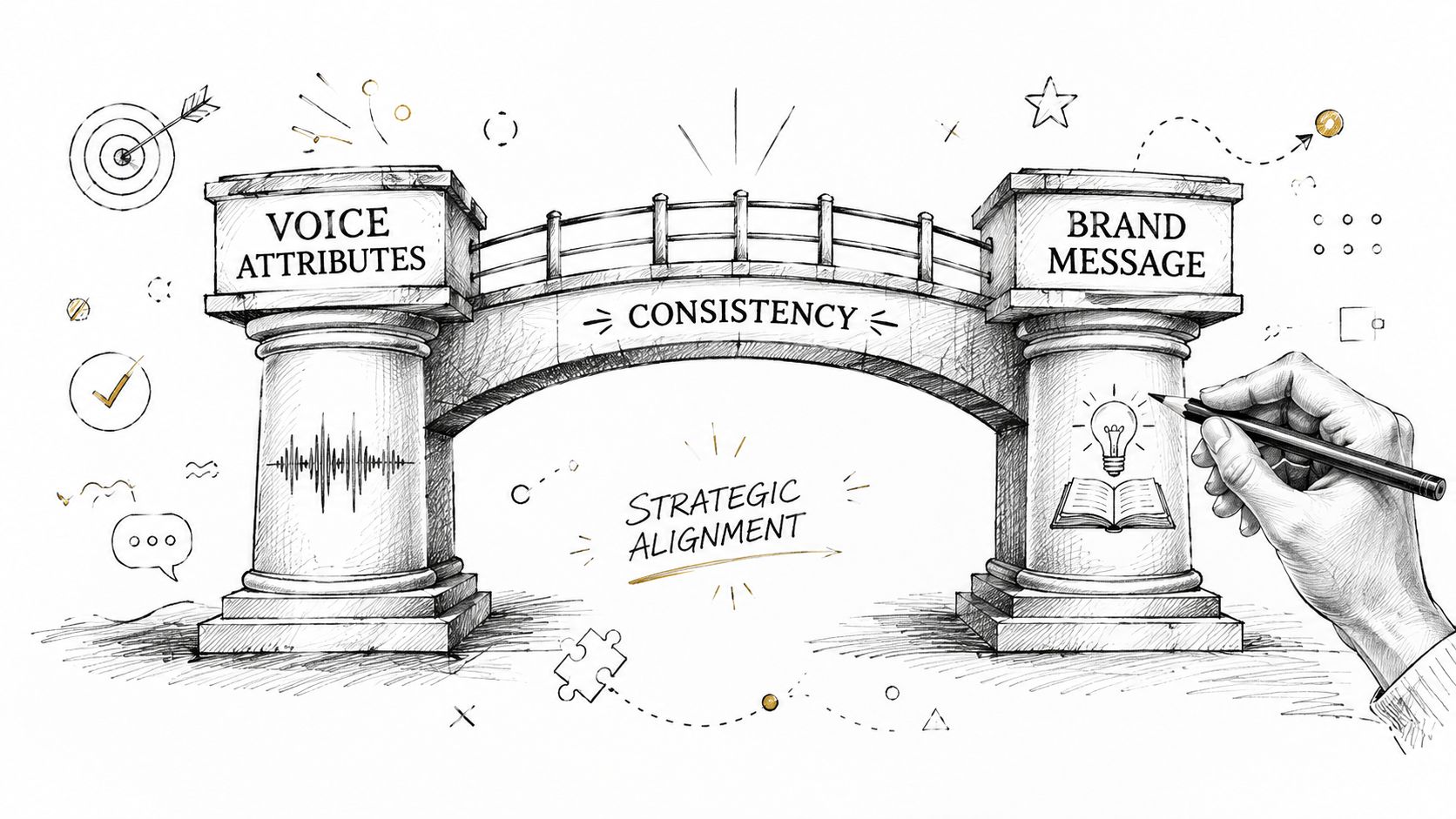
Voice tells people how you sound. Messaging pillars tell them what you stand for. If those two pieces aren't connected, your content may feel polished but forgettable.
Most founders choose pillars that are too broad. “Leadership.” “Marketing.” “Mindset.” Those aren't pillars. They're content buckets with no edge.
A real messaging pillar should do three things:
If you're a SaaS founder, your pillars might include product strategy, customer insight, category positioning, and operational decision-making. If you're a consultant, they may center on client transformation, process clarity, industry analysis, and common mistakes buyers make.
A significant failing of most brand advice emerges here. It treats message and tone as separate exercises. They're not.
If your voice is calm and authoritative, your pillars should lean toward explanation, pattern recognition, and judgment. If your voice is energetic and contrarian, your pillars can carry sharper opinions and faster pacing. The content topic stays the same, but the delivery changes what people remember.
A simple mapping exercise helps:
| Messaging Pillar | What You're Known For | How Your Voice Shows Up |
|---|---|---|
| Industry insight | Seeing shifts early | Direct analysis, no hype |
| Client education | Making complexity usable | Clear language, patient tone |
| Founder perspective | Hard-earned judgment | Honest, decisive phrasing |
| Offer positioning | Showing value without overselling | Confident, restrained CTA language |
Some founders sound smart but build weak brands because they publish disconnected expertise. Every post may be useful, but the body of work doesn't point anywhere.
That's why pillars matter. They create repetition with purpose.
If people can't predict the kinds of insights you bring, they won't remember you when they need them.
If you want a clean framework for turning ideas into a sharper narrative, Legacy Builder's breakdown of what brand messaging is and how you create it is worth reading.
Your job isn't to talk about everything you know. It's to repeat the few things you want to own.
A voice guide that doesn't change your writing is useless.
You need to see how your tone of voice guidelines affect actual words on the page. Not theory. Not mood boards. Sentences, bios, CTAs, and scripts.
Most founders try to sound distinct by becoming more complex. That's the wrong move. Clear writing is stronger branding because people can absorb it.
AbilityNet's tone of voice guidance gives a practical standard. They recommend about 25 words per sentence, roughly four sentences per paragraph, and headlines capped at six to eight words to support readability, especially for users with cognitive or learning disabilities.
That's not a creativity constraint. It's discipline.
Write like a smart person speaking plainly. Use everyday English. If you need a technical term, define it fast and move on.
Here's what this looks like in practice.
| Voice Profile | Generic 'Before' Copy | Authentic 'After' Copy |
|---|---|---|
| Calm Authority | We help businesses unlock growth through strategic content solutions. | We help founders publish clear content that builds trust and creates demand. |
| Maverick Mentor | Many people struggle with consistency on social media. | Most founders don't have a consistency problem. They have a clarity problem. |
| Warm Expert | I offer personalized support for your business journey. | I help you say what you do, why it matters, and how to show up with confidence. |
| Direct Operator | Book a call to learn more about our services. | Book a call if you want a sharper brand and a content system that holds up. |
The second column sounds like anyone. The third sounds like someone with a point of view.
Most brands only think about voice in long-form content. That's lazy. Tone shows up hardest in the tiny moments.
Here are better defaults for high-frequency assets.
Weak version:
Founder helping businesses grow online.
Stronger version:
I help founders turn expertise into clear content, stronger positioning, and steady authority.
Weak version:
Let me know if you'd like to chat.
Stronger version:
Reply if you want help tightening the message before you scale it.
Weak version:
Best regards,
Sam
Stronger version:
Keep it clear,
Sam
Weak version:
Today I want to talk about brand voice and why it matters.
Stronger version:
If your content sounds different every week, your brand isn't developing. It's drifting.
Short sentences don't make you sound less intelligent. They make your point harder to miss.
Your voice should stay recognizable, but tone should shift by context. A personal brand doesn't speak the same way in every situation.
Use a quick grid like this:
The mistake isn't changing tone. The mistake is changing identity.
If your content still sounds like a stranger wrote it depending on the channel, your guidelines aren't specific enough yet.
Most tone of voice guidelines fail because they're bloated.
Founders create long documents full of abstract language, then nobody uses them. Your team won't read a brand novel before writing a caption. Your AI tool won't infer your standards from a page of poetic brand philosophy.
Keep it tight. One page is enough if it's built properly.
Your document should answer one question fast: how do we sound when we communicate as this brand?
Include these parts:
Cut anything that requires interpretation without examples.
That means phrases like “sound forward-thinking but grounded” should either be translated into behavior or deleted. If you can't show what a rule looks like in a sentence, it won't survive real use.
A clean structure might look like this:
| Section | What to Write |
|---|---|
| Brand voice summary | Direct, credible, warm without being casual |
| We are | Clear, decisive, useful |
| We are not | Trendy, vague, overpolished |
| Sentence style | Short to medium sentences, active voice, minimal jargon |
| CTA style | Confident and specific, never pushy |
| Review triggers | Rewrite if it sounds generic, inflated, or interchangeable |
A useful guide reduces decisions. It doesn't create more of them.
If you want a reference point for format and team usability, this resource on how to ensure consistent content delivery is helpful because it shows how a writing guide becomes operational instead of decorative.
Your guide should change when you find weak spots.
If your assistant keeps overusing inspirational language, add a rule. If AI keeps writing vague openings, add a before-and-after fix. If your sales emails sound stiffer than your posts, tighten the channel notes.
A static document gets ignored. A working document gets sharper.
Founders assume that once a voice is documented, consistency takes care of itself. It doesn't.
Scale creates drift. Teams create drift. AI accelerates drift.

This is the blind spot. Founders use AI to publish more, then slowly lose the distinctiveness that made the content worth reading in the first place.
A 2025 industry audit on tone of voice guidelines and AI scaling found that 68% of brands using AI for content scaling experienced measurable tonal inconsistency within three months, yet only 12% of published guidelines include specific AI prompting notes or escalation protocols for high-risk automated drafts.
That gap is the problem.
If you rely on daily posting, your voice cannot live only in your head. It has to be executable by assistants, editors, and AI tools without being averaged into generic internet prose.
You don't need bureaucracy. You need checkpoints.
A simple workflow works well:
Draft with constraints
Feed AI your voice summary, target words, anti-tone words, and channel rules.
Review the opening and CTA first
Drift often shows up at the start and end of content before you notice it in the middle.
Check for banned habits
Generic hooks, inflated promises, empty motivational language, and jargon-heavy phrasing.
Escalate high-risk content
Founder posts, sales pages, personal story content, and controversial opinions should get human review.
Update the guide from failure patterns
Don't just fix the draft. Fix the system that allowed the bad draft.
The goal isn't to make AI sound human. The goal is to make AI follow your brand's rules.
Bad prompt:
Write a LinkedIn post in my brand voice. Sound authentic and professional.
Better prompt:
Write a LinkedIn post for a founder audience. Use a direct, grounded, warm tone. Open with a firm statement, not a question. Use short paragraphs. Avoid hype, clichés, and inspirational fluff. If a sentence sounds like it could belong to any creator, rewrite it.
That second prompt gives the model boundaries.
If you're building a broader review process across channels, Legacy Builder's article on content governance and how to build a powerful brand is a useful framework for turning standards into repeatable execution. Legacy Builder also offers services around defining and applying personal brand voice, which is relevant if you need outside support to formalize the system.
Don't ask, “Is this good?”
Ask:
That's how you protect authority while scaling output.
Most founders judge brand voice by gut feel. That's too loose.
You need evidence that your tone is doing its job. Not vanity metrics alone. Real signals that your content is clearer, more recognizable, and more aligned with the kind of audience you want to attract.

The strongest signs often show up in language, not dashboards.
Look at replies, comments, DMs, and sales conversations. Are people repeating your phrasing back to you? Are they describing your content in ways that match your intended voice? Do they say you're clear, sharp, thoughtful, grounded, practical, or honest?
That kind of feedback matters because it shows what stuck.
Review these sources regularly:
You don't need to overhaul your personality every quarter. You need controlled experiments.
The most useful reference point here is the four-week iterative AB testing methodology for tone validation. It uses four-week cycles. Week 1 establishes a baseline with daily AB comparison and KPI logging. Week 2 adapts tone to different situations. Week 3 tests three 30-second opening scripts daily. Week 4 moves into live application while correcting one KPI discrepancy at a time. That same source notes improved sales alertness when the base pitch is slightly high with falling cadence on key points and when speakers use 0.3–0.5 second silences before keywords.
You don't need to copy that process exactly for every content format, but the principle is excellent. Test one variable at a time.
For example:
| Test Area | Version A | Version B | What to Watch |
|---|---|---|---|
| LinkedIn opening | Calm observation | Firm opinion | Comment quality |
| Email CTA | Soft invitation | Specific next step | Reply relevance |
| Video delivery | Even pacing | More deliberate emphasis | Watch-through quality |
| Founder post tone | Reflective | More assertive | Inbound fit |
Decision rule: If the audience response improves but the content sounds less like you, don't scale it yet. Refine it until performance and identity both hold.
A viral post can still hurt your brand if it sounds off.
You're looking for signs of fit and repetition. Better leads. More aligned conversations. Cleaner handoff between content and sales. Fewer rewrites from your team. More consistency across formats.
That's the ultimate test of strong tone of voice guidelines. They don't just make your content sound better. They make your brand easier to recognize, trust, and extend over time.
If your content is growing faster than your clarity, fix the voice before you scale the volume. Legacy Builder helps founders turn lived expertise into consistent brand content, with strategy, writing, design, and distribution built around a voice people can recognize.


You could – but most in-house teams struggle with the nuance of growing on specific platforms.
We partner with in-house teams all the time to help them grow on X, LI, and Email.
Consider us the special forces unit you call in to get the job done without anyone knowing (for a fraction of what you would pay).
Short answer – yes.
Long answer – yes because of our process.
We start with an in-depth interview that gives us the opportunity to learn more about you, your stories, and your vision.
We take that and craft your content then we ship it to you. You are then able to give us the final sign-off (and any adjustments to nail it 100%) before we schedule for posting.
No problem.
We have helped clients for years or for just a season.
All the content we create is yours and yours alone.
If you want to take it over or work on transitioning we will help ensure you are set up for success.
We want this to be a living breathing brand. We will give you best practices for posting and make sure you are set up to win – so post away.
Subscribe to our newsletter and get insights on how to grow your personal brand.
