
Subscribe to our newsletter and get insights on how to grow your personal brand.
Thank you! Your submission has been received!
Oops! Something went wrong while submitting the form.


The popular advice on thought leadership vs content marketing is to pick a lane: publish useful content to attract an audience, or publish bold opinions to build authority. That's a bad way to allocate a founder's time. You don't need competing calendars. You need a publishing operation that helps people discover your expertise and gives the buying group a reason to rethink its priorities.
The harder question isn't whether to write another tutorial or an executive essay. It's whether the people evaluating your business have enough useful information to find you, enough evidence to trust you, and an argument they can defend when you're not in the room.
A founder can publish consistently, earn engagement, and still give a prospective buyer nothing distinctive to take into an internal meeting. The posts are useful. The missing ingredient is a defensible explanation of why the buyer should approach the problem differently.
Content marketing is the reach-and-education layer. Thought leadership is the problem-definition layer. Treating them as interchangeable encourages teams to mistake an active publishing schedule for a persuasive market position.
The distinction matters because buyers don't evaluate expertise solely through product descriptions. In the 2024 Edelman and LinkedIn B2B Thought Leadership Impact Report, 73% of B2B decision-makers considered thought-leadership content a more trustworthy basis for assessing an organization's capabilities than marketing materials or product sheets.
Your direct contact might understand your product perfectly. Their colleagues may still disagree about urgency, implementation risk, or what a successful purchase would accomplish.
My recommendation is to build content for those disagreements, not just for the contact who speaks to sales:
The operating relationship looks like this.
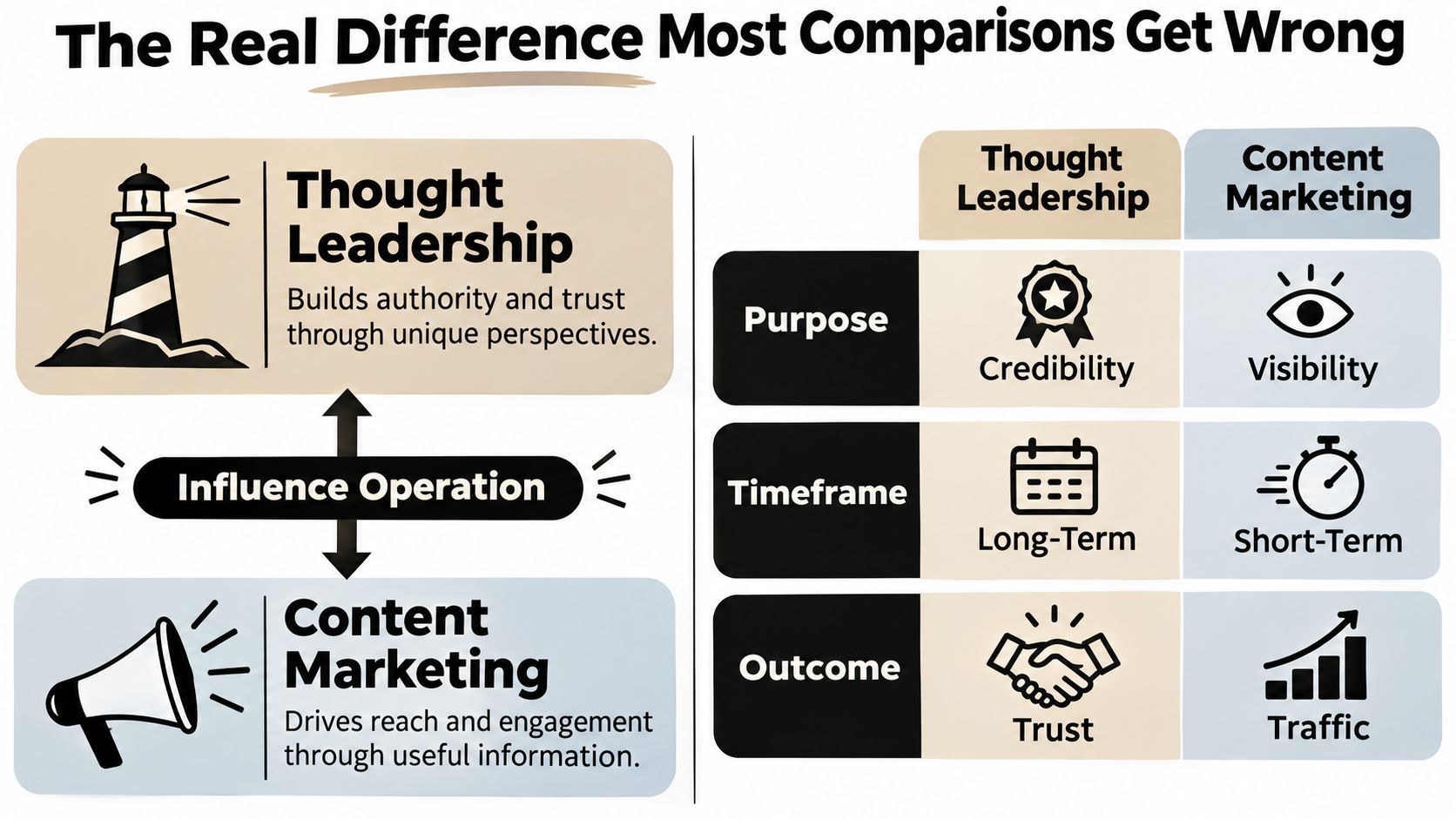
Don't interpret the visual's timeframe distinction as a rigid rule. Educational content can remain useful for years, while an incisive argument can influence an active buying conversation immediately. Purpose, not lifespan, determines the layer.
A tutorial can contain original judgment. A research report can be ordinary content marketing. The format doesn't settle the classification; the change you want in the reader's thinking does.
Use the buyer's task to classify a piece before commissioning it. If you can't name that task, the writer will usually default to explaining a topic rather than advancing a position.
The following comparison is a planning tool, not a hierarchy of good and bad content.
| Dimension | Content Marketing | Thought Leadership |
|---|---|---|
| Objective | Attract, educate, and nurture a defined audience | Change how an audience understands a strategic problem |
| Starting point | A question the audience already asks | An assumption worth examining or replacing |
| Audience job | Learn how to understand or complete something | Decide what matters and which approach deserves support |
| Formats | Tutorials, newsletters, explainers, videos, checklists | Research-led essays, executive commentary, analytical newsletters, presentations |
| Typical cadence | Predictable publishing matched to available capacity | Publication paced by evidence and genuine insight |
| Author contribution | Clear explanation and useful execution guidance | Accountable interpretation, trade-offs, and a defensible position |
| Success signals | Qualified reach, subscriptions, relevant inquiries | Stakeholder reuse, strategic invitations, changed evaluation criteria |
| Editorial failure | Useful but disconnected from business priorities | Provocative but unsupported or impractical |
Consider a hypothetical SaaS business selling customer onboarding software. A content-marketing article might explain how to document an onboarding process, identify handoff gaps, and assign responsibilities.
A thought-leadership piece would interrogate the operating model itself. For example, the founder could argue that onboarding should be managed as a cross-functional risk process rather than treated as a customer-success task. That argument needs evidence, boundaries, and a practical alternative, not just a confident headline.
Both pieces belong in the program. The tutorial helps a reader execute; the argument helps a leadership team decide what it should execute.
Editorial test: If you remove the author's name and nothing meaningful changes, you probably have educational content rather than distinctive thought leadership.
Separate editorial jobs don't require separate production teams. Use the same research repository, review process, design resources, and distribution channels, but assign a different acceptance standard to each piece.
A content marketing strategy framework can provide the planning foundation. Add an explicit field for the intended audience decision so a tutorial, an opinion piece, and a newsletter don't get commissioned under the same vague objective.
Don't replace practical guidance with executive commentary. Readers still need help applying the position you've persuaded them to consider.
The commercial value of a strong argument is that it can introduce a purchase the reader wasn't already considering. That's different from answering a question about an established need.
The 2024 thought leadership research summary from Edelman and LinkedIn reports that 75% of decision-makers said a specific piece prompted research into a previously unconsidered product or service, 90% were moderately or very likely to be more receptive to outreach from consistent producers of high-quality thought leadership, and 70% of C-suite executives had encountered content that made them question an existing supplier relationship.
That's evidence for treating thought leadership as a competitive positioning tool, not merely an engagement format.
For a SaaS founder, the useful sequence is to expose an overlooked business cost, explain why the standard response falls short, and propose better evaluation criteria. Only then should you connect the argument to your offering.
The supplied impact graphic is illustrative only; its displayed figures aren't substantiated by the findings cited here and shouldn't be used as evidence.

The important distinction is between explaining an existing requirement and persuading someone to recognize a different requirement. Educational content can contribute to both, but thought leadership makes the second job explicit.
For planning an argument-led program, Carlos Alba Media's resource on thought leadership content strategy is a relevant starting point to evaluate alongside your own editorial requirements. Don't outsource the position itself; the founder must be willing to defend it.
A persuasive piece should include:
The accompanying video offers another format for engaging with the topic.
A large impression count proves distribution occurred. It doesn't prove that a relevant executive trusted your argument, forwarded it to colleagues, or changed a purchase requirement.
Build a two-track scorecard and connect both tracks to actual opportunities. Keep publishing activity separate from audience response, and keep audience response separate from commercial attribution.
| Track | Recommended signals | What to check |
|---|---|---|
| Content delivery | Publishing consistency, completed assets, repurposing | Did the team ship useful work without avoidable delays? |
| Qualified attention | Relevant profile visits, subscriptions, substantive replies | Did the intended audience engage? |
| Assisted influence | Stakeholder forwarding, executive invitations, RFP inclusion | Did someone use the argument in a buying process? |
| Commercial connection | Inbound conversations, opportunities influenced, sales progression | Is there evidence linking the content to a business decision? |
The measurement pyramid is useful as an organizing view, not as a claim that every reader moves neatly through successive levels.

Add fields to your CRM for the specific asset mentioned, who encountered it, and how it entered the conversation. A prospect saying they liked a post is weaker evidence than explaining that their finance colleague circulated your argument before approving an evaluation.
Use self-reported attribution carefully. Record the prospect's explanation without converting every mention into a claim that content caused the sale.
Don't call an opportunity content-generated when you can only show that content was present somewhere in the journey.
A practical marketing ROI calculation approach should distinguish direct acquisition from assisted influence. Track production costs, sales context, and the strength of the attribution evidence together.
For podcast appearances, assess preparation separately from downstream outcomes. Let's Make A Podcast's podcast readiness review scoring is a relevant resource to consider for that preparation step; a readiness assessment isn't proof of buyer influence.
At the editorial review, retire pieces that draw attention without relevant response. Revise arguments readers misunderstand. Quality control means making those decisions, not merely celebrating that the calendar stayed full.
Choose your mix by identifying the bottleneck. A founder without an audience has a distribution problem; a visible executive whose expertise sounds interchangeable has a differentiation problem.
The following are operating scenarios, not client case studies. Use the one closest to your position, then adjust it to your sales process and available expertise.
Start with lean content marketing around questions your prospective customers genuinely ask. Publish clear explanations, practical checklists, and lessons you can support from your own work.
Don't attempt to sound like a category visionary before you can describe the customer's problem accurately. Seed a substantial perspective piece when you have something defensible, rather than assigning yourself a relentless schedule of hot takes.
The trade-off is slower development of a distinctive market position. Accept it while you're still learning, but don't let introductory education become your permanent ceiling.
Keep educational publishing active, but redirect meaningful editorial attention toward disagreements inside the buying group. Write for finance, operations, security, or procurement where those functions affect the purchase.
A hypothetical onboarding platform might address implementation responsibility for operations and the cost of incomplete adoption for finance. The founder's position should connect those concerns, not produce unrelated commentary for each department.
Make thought leadership the editorial center of gravity. Your audience doesn't need endless proof that you know the basics; it needs your judgment on consequential choices.
Use content marketing to make that judgment accessible through explainers, excerpts, and implementation guidance. The trade-off is greater executive involvement: writers can package your position, but they can't responsibly invent the conviction behind it.
The sustainable workflow starts with a claim and an evidence file, not an empty social calendar. Collect the founder's observations, supporting research, objections, and practical implications before drafting.
Use a shared document to record the proposed thesis, intended stakeholder, evidence links, counterargument, and desired reader action. Keep the central argument consistent across the newsletter, LinkedIn post, and supporting material.
Begin the week with an editorial conversation. Ask what the founder changed their mind about, what buyers are misdiagnosing, and which common recommendation fails under specific conditions.
Then draft the anchor piece. If the evidence doesn't support the thesis, narrow the claim or publish an educational explanation instead.
The workflow should make the sequence visible.

My recommendation is to leave the main argument accessible. Hidden stakeholders need to evaluate it without an unnecessary registration step.
If you use a gate, reserve it for a useful companion asset, such as a worksheet or implementation template. Don't remove the evidence required to judge your position and then ask readers to trust the summary.
Distribution rule: Every repurposed piece must deliver a complete useful idea, not merely advertise the original.
Keep the canonical version in your newsletter archive or website so your team can reference the full reasoning. Assign an owner to update supporting pieces if the underlying argument changes.
End the week by reviewing editorial lessons and relevant audience responses. Filling daily slots is optional; maintaining a reliable process for extracting and publishing expertise isn't.
The useful distinction isn't human-written versus AI-written. It's accountable judgment versus interchangeable explanation.
A founder can write generic content manually. An editor can use AI assistance while preserving a specific, evidence-backed position. Authorship method alone doesn't tell the reader whether the advice deserves trust.
In CMI's 2025 B2B content marketing research, 81% of marketers reported using generative AI, but only 4% expressed high trust in its outputs.
In the 2025 Edelman and LinkedIn thought leadership report, 91% of hidden decision-makers said quality thought leadership should reveal fresh industry or business insight, while 86% said it should challenge assumptions rather than merely validate them.
That doesn't make AI assistance incompatible with insight. It makes an unchecked draft an inadequate substitute for a responsible author.
I recommend tagging draft material by its contribution:
Protect the first categories from automated invention. Let assistance handle outlining, editing, summarizing approved material, and adapting formats.
For each substantive assertion, name the person responsible for checking it. Verify links against the original material, distinguish an inference from a reported finding, and remove generated anecdotes that nobody can substantiate.
MyMentions' frameworks for AI content governance are relevant resources to evaluate when formalizing that review process. Your governance requirements should remain explicit regardless of which tools you adopt.
An AI-assisted content creation approach should preserve the author's evidence, limitations, and vocabulary, not just their surface tone.
The founder's approval should mean they've checked the reasoning and would defend it in conversation. Approving a draft because it sounds polished isn't an editorial standard.
Ask: What must the right people understand or believe before they'll take the next commercial step?
If they don't understand the practical problem, prioritize education. If they understand it but see every supplier as equivalent, prioritize a distinctive argument. If they're interested but colleagues won't support the purchase, address the disagreement preventing consensus.
Don't build your mix around an arbitrary percentage. Protect meaningful time for thought leadership, but set that commitment according to the work required to produce credible judgment.
The CMI content marketing statistics summary reports that 52% of organizations expected to increase investment in thought-leadership content in 2025. Treat that as a reported investment intention, not proof that matching another organization's budget will improve your results.
Your allocation should follow your own constraints:
For most emerging entrepreneurs and SaaS founders, I recommend a dependable educational publishing rhythm with protected capacity for high-judgment work. Don't let routine production consume every available hour, and don't label ordinary summaries thought leadership to make the calendar look balanced.
This week, choose a consequential buyer objection that your current content doesn't resolve. Write a short argument stating your position, the evidence supporting it, the strongest counterargument, and the action a buyer should consider.
Then ask a relevant customer or prospect whether they could use it in an internal discussion. Their answer will tell you more about its usefulness than your own excitement about the headline.
Bring your stories, expertise, and positioning challenges to Legacy Builder for personalized personal-brand strategy, content creation, and distribution. Its strategists, writers, and designers can help turn your perspective into consistent publishing without separating educational content from the judgment that makes your brand distinctive. Visit to discuss a content operation built around the buyers you need to reach and the decisions you need to influence.


You could – but most in-house teams struggle with the nuance of growing on specific platforms.
We partner with in-house teams all the time to help them grow on X, LI, and Email.
Consider us the special forces unit you call in to get the job done without anyone knowing (for a fraction of what you would pay).
Short answer – yes.
Long answer – yes because of our process.
We start with an in-depth interview that gives us the opportunity to learn more about you, your stories, and your vision.
We take that and craft your content then we ship it to you. You are then able to give us the final sign-off (and any adjustments to nail it 100%) before we schedule for posting.
No problem.
We have helped clients for years or for just a season.
All the content we create is yours and yours alone.
If you want to take it over or work on transitioning we will help ensure you are set up for success.
We want this to be a living breathing brand. We will give you best practices for posting and make sure you are set up to win – so post away.
Subscribe to our newsletter and get insights on how to grow your personal brand.
