.svg)
Subscribe to our newsletter and get insights on how to grow your personal brand.
Thank you! Your submission has been received!
Oops! Something went wrong while submitting the form.
.svg)


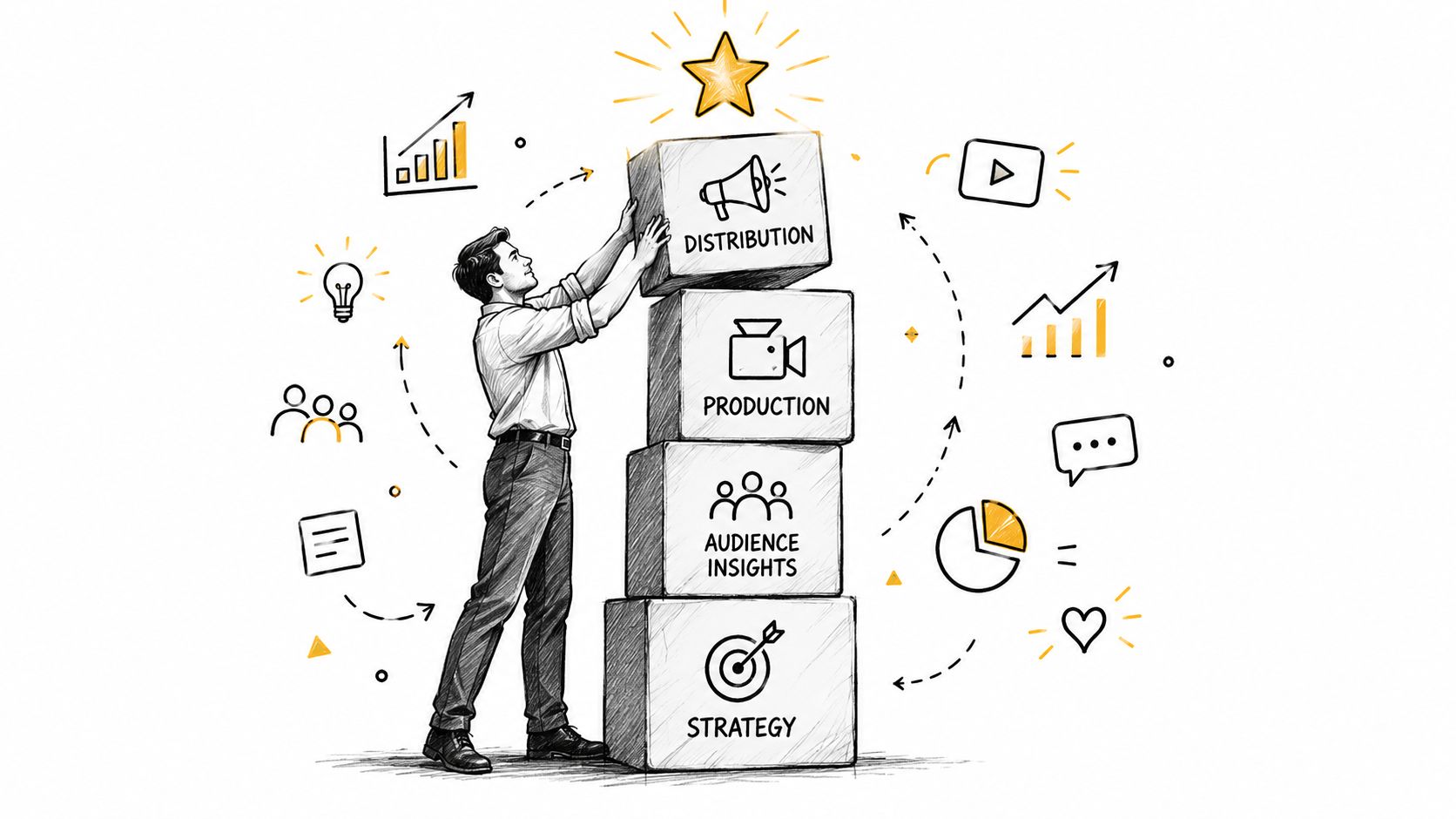
In 2026, 97% of marketers have a content strategy, but only 12% consider their content marketing highly effective. The missing link usually isn't more content. It's a governance model that connects your point of view, production, distribution, and commercial outcomes.
That finding should change how you approach a content marketing strategy framework. Consistent posting doesn't automatically create demand, authority, or sales conversations. A founder can publish every day and still produce a library of disconnected opinions that nobody remembers when a buying decision arrives.
After helping more than 200 founders build profitable personal brands, I've seen the same pattern repeatedly. The problem isn't a lack of ideas. It's the absence of a system that decides which ideas deserve attention, how they should sound, where they should appear, and what business job they must perform.
A serious framework is therefore not a calendar. It's a trust-engineering system. It turns lived expertise into recognizable intellectual property, protects the founder's voice as contributors join, and gives every asset a role in building durable business value.
Posting consistently feels productive because it creates visible activity. You publish, people react, and the dashboard moves. But activity is not evidence that your content is creating qualified demand.
The uncomfortable benchmark is clear. 97% of marketers reported having a content strategy, yet only 12% said their content marketing was highly effective and 47% said it was only somewhat effective, according to the Content Marketing Institute's 2026 B2B research. Strategy adoption is widespread. Strong execution is not.

Most personal brands confuse three separate jobs:
A motivational post may generate attention. A detailed teardown may build trust. A clear diagnostic offer may create action. None of those assets can carry the entire burden alone, and publishing them without coordination leaves the audience to assemble your positioning for you.
That's where governance matters. Your framework should define the claims you want to own, the audiences you serve, the proof you can provide, and the actions you want readers to take. It should also specify who can edit the founder's words, which topics require review, and what makes an idea worth publishing.
Strategic rule: If your team can publish content without explaining which business goal it serves, your system is producing output, not building an asset.
Revenue usually appears after a sequence of trust signals. A prospect must recognize the problem, understand your perspective, see evidence that you can solve it, and know how to begin. Random posting interrupts that sequence. Governance restores it by making content decisions deliberate, repeatable, and commercially connected.
Build the framework like a house. Business alignment is the foundation, audience insight is the structure, production is the operating system, and governance keeps the whole property intact. Remove one layer and the publishing machine becomes fragile.
Start with strategic alignment. Choose the business outcome before choosing the format. If you need qualified conversations, prioritize problem diagnosis, comparisons, objections, and decision support. If you need authority, publish a sharper point of view and defend it consistently. A content calendar should document these decisions rather than replace them.
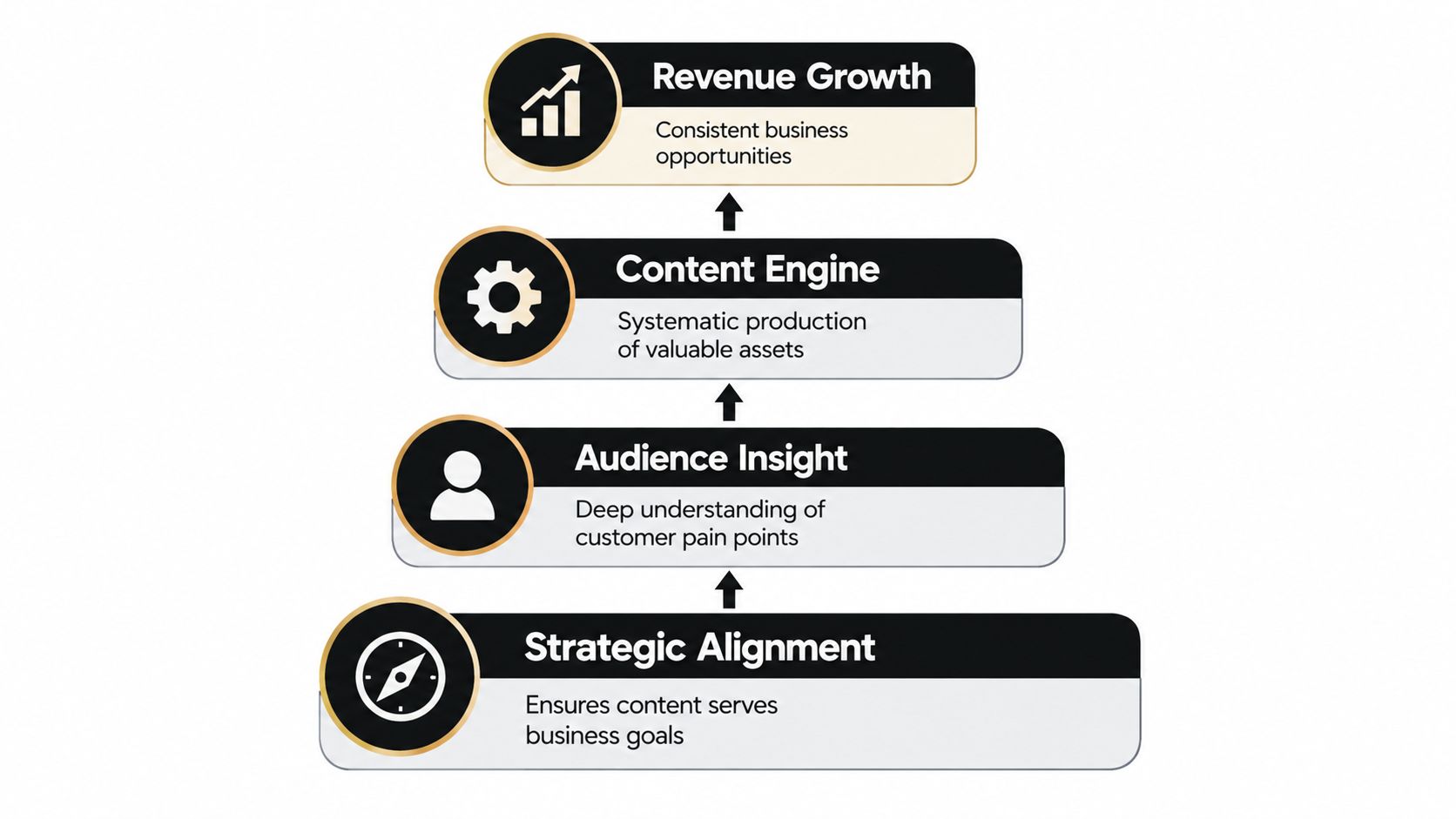
Audience insight goes deeper than age, job title, or industry. Capture the language prospects use, the risks they fear, the alternatives they compare, and the questions they ask before they trust a provider. Your best content often begins in sales calls, customer interviews, support tickets, and founder conversations, not in a keyword tool.
The content engine turns raw expertise into a repeatable workflow. Define how an idea becomes a brief, draft, review, final asset, distribution package, and performance note. A content lifecycle management framework can help teams manage that movement without treating publication as the finish line.
Distribution and governance determine whether the system remains coherent. Assign ownership for the founder's voice, editorial standards, approvals, channel adaptations, and updates. The founder should own the irreplaceable perspective. Writers and editors can improve clarity, but they shouldn't flatten the argument into safe corporate language.
Watch this practical explanation of how a structured content system can support repeatable execution:
The framework earns its keep when a new contributor can produce content that still sounds unmistakably like the person behind the brand. That requires documented decisions, not vague instructions such as “make it authentic.”
Likes are feedback, not revenue. They can tell you that an idea attracted a reaction, but they can't tell you whether the right buyer understood your offer or moved closer to a decision.
Use a staged measurement model. One neutral framework separates performance into awareness, engagement, conversion, and retention-like stages, with metrics that match the job of each stage. It recommends stage-specific content measurement, including impressions and search visibility early, followed by engaged sessions, leads, and downstream business outcomes.
At the awareness stage, track reach, impressions, branded search activity, and search visibility. These indicators answer a narrow question: are relevant people encountering your ideas? Don't demand immediate revenue proof from an introductory point-of-view post.
At the engagement stage, look for engaged sessions, meaningful replies, email responses, return visits, and movement to related resources. A thoughtful question from a qualified prospect can matter more than a large volume of passive reactions because it reveals attention with context.
At the conversion stage, measure content-driven leads, booked conversations, offer-page visits, qualified opportunities, and downstream business outcomes. Connect forms, analytics, and your CRM so the team can see which assets assisted a commercial journey rather than relying on a last-click verdict.
At the retention stage, examine repeat engagement, customer education usage, expansion conversations, referrals, and renewal support. Content doesn't stop working when someone buys. It can reinforce the decision, reduce confusion, and give customers reasons to share your work.
| Stage | Useful question | Appropriate signals |
|---|---|---|
| Awareness | Are relevant people finding us? | Impressions, reach, search visibility |
| Engagement | Are they paying attention? | Engaged sessions, replies, return visits |
| Conversion | Are they taking commercial steps? | Leads, booked calls, qualified opportunities |
| Retention | Does trust continue after purchase? | Education usage, referrals, repeat engagement |
For a practical companion to this model, review Narrareach's guidance on growth-driving metrics. Then connect your reporting to a clear financial model with this resource on calculating marketing ROI.
The point isn't to create a larger dashboard. It's to give each metric a job. When awareness is weak, improve distribution or topic selection. When engagement is weak, improve the argument or format. When conversion is weak, fix the offer, proof, or next step. A staged model tells you where the system is failing.
Scaling a personal brand creates a dangerous temptation. You hand your ideas to a writer, add an approval layer, increase production, and gradually remove everything that made the content worth reading.
That risk is real because most content marketing strategy frameworks explain what to create but rarely explain how to preserve authenticity across many contributors, as the discussion of governance in this content marketing FAQ makes clear. A calendar can coordinate publication. It can't protect a worldview.

Document the founder's voice principles, not just preferred adjectives. Define:
Then create decision rights. The founder owns the core perspective and final say on sensitive claims. A strategist owns positioning and topic prioritization. A writer owns structure and clarity. An editor checks accuracy, usefulness, and voice. A channel specialist adapts the asset without changing its underlying argument.
Voice protection starts before the first draft. If the source material is generic, no editor can manufacture a distinctive personality at the end.
Scale through repurposing, not dilution. A founder's detailed conversation can become a long-form article, a sharp social argument, an email explanation, and a sales enablement asset. Use the content repurposing framework that actually scales to preserve the central insight while adjusting the format for each channel.
The system should increase the founder's reach without pretending every sentence came directly from the founder's keyboard. Authenticity means preserving judgment, specificity, and lived experience. It doesn't mean refusing editorial help.
The strongest argument for value-led publishing predates social media, search engines, and creator platforms. John Deere launched The Furrow in 1895 as an early example of branded educational content, while Penton Custom Media later coined the term “content marketing” in 2001, according to this history of content marketing.
The underlying principle stayed consistent. Teach a defined audience something useful, earn attention through relevance, and let commercial trust develop from the quality of the education. The medium changed from print to websites, newsletters, podcasts, video, and social feeds. The strategic exchange did not.
A personal brand becomes a legacy when its ideas remain useful without the founder standing beside every asset. That requires a recognizable body of work, not an endless stream of disconnected updates.
Your framework should help you build:
This is why a framework matters beyond campaign performance. It gives your expertise a container. Instead of chasing every trend, you develop a coherent archive that compounds through repeated discovery, referrals, conversations, and customer education.
A legacy isn't the same as celebrity. It's the accumulation of useful decisions that continue to help people understand a problem and choose a better path. Founders who want to connect their marketing work to a broader mission can explore these personal legacy examples from vision to impact.
The practical implication is demanding but simple. Stop asking whether a post performed in isolation. Ask whether the asset strengthens a position you want to own, helps the right person make progress, and remains valuable when the publishing cycle moves on.
Broad educational content used to be a reliable default. It still has a role, but it no longer gives you a complete discovery strategy. Most content marketing strategy frameworks under-explain how to compete in an AI-disrupted environment, where buyers increasingly expect direct answers, comparisons, and visible trust signals rather than generic introductions. This shift is discussed in ClickMinded's content marketing strategy guide.
The amateur response is to publish more. The professional response is to become more useful and more difficult to replace.
Prioritize topics where a buyer needs judgment, not a definition. Answer questions about cost, fit, failure modes, comparisons, implementation risk, trade-offs, and what you'd refuse to recommend. These subjects force you to reveal how you think.
A generic article says that strategy matters. A trust-engineered asset explains which strategic choice to make, what evidence supports it, when the recommendation breaks down, and what the reader should do next. The second format creates a stronger memory because it gives the audience a decision, not just information.
| Random publishing | Trust engineering |
|---|---|
| Chases broad topics | Selects high-intent questions |
| Optimizes for activity | Optimizes for understanding and action |
| Hides behind neutral language | States a defensible point of view |
| Treats AI as a writing shortcut | Uses human judgment as the differentiator |
| Ends at publication | Updates, distributes, and measures the asset |
Before drafting, require every important claim to answer three questions:
Proof can include a transparent process, a specific observation, a clear limitation, a documented example, or a demonstration of the work. Don't add theatrical certainty where the evidence is limited. Precision builds more trust than inflated confidence.
Your framework should also create format diversity. A comparison article may earn search discovery, a founder video may communicate conviction, and an email may handle objections with more intimacy. The message stays coherent, but the delivery changes according to the context.
Start with an audit, not a new calendar. Review your recent content and mark each asset by audience, problem, business role, proof, call to action, and owner. If you can't classify an asset, it probably reflects an unclear strategy.
Use this sequence:
Keep the system small enough to operate. A framework that nobody follows is less valuable than a focused one that protects quality every week.
The asset you're building isn't a feed. It's a body of evidence that your judgment deserves attention.
Review your content monthly for voice drift and quarterly for commercial relevance. Ask which ideas prospects repeat back to you, which questions remain unanswered, and which assets help sales conversations move forward. Those answers should shape the next cycle more than reach alone.
Your next move is straightforward. Audit the last month of content, select the themes that reflect your strongest expertise, and write the approval rules before assigning more production. Legacy grows when your knowledge becomes a coherent, trusted system rather than a collection of posts.
Legacy Builder helps founders turn their positioning, voice, and lived expertise into structured content systems with clear pillars and a consistent publishing rhythm. Visit Legacy Builder to explore a practical way to scale an authentic personal brand without handing your voice over to generic agency output.


You could – but most in-house teams struggle with the nuance of growing on specific platforms.
We partner with in-house teams all the time to help them grow on X, LI, and Email.
Consider us the special forces unit you call in to get the job done without anyone knowing (for a fraction of what you would pay).
Short answer – yes.
Long answer – yes because of our process.
We start with an in-depth interview that gives us the opportunity to learn more about you, your stories, and your vision.
We take that and craft your content then we ship it to you. You are then able to give us the final sign-off (and any adjustments to nail it 100%) before we schedule for posting.
No problem.
We have helped clients for years or for just a season.
All the content we create is yours and yours alone.
If you want to take it over or work on transitioning we will help ensure you are set up for success.
We want this to be a living breathing brand. We will give you best practices for posting and make sure you are set up to win – so post away.
Subscribe to our newsletter and get insights on how to grow your personal brand.
