.svg)
Subscribe to our newsletter and get insights on how to grow your personal brand.
Thank you! Your submission has been received!
Oops! Something went wrong while submitting the form.
.svg)



Most advice on AI content is wrong. It tells founders to post faster, automate harder, and let the machine do the writing. That's exactly how smart people end up sounding interchangeable.
If you're a founder or executive, your content problem isn't just production. It's preservation. You need to stay visible without flattening your judgment, your stories, and your voice into polished mush. That's why AI assisted content creation only works when you use it for enhancement, not substitution.
I use AI daily. My opinion is simple. If AI is writing your point of view, you don't have a content system. You have a brand erosion system. But if AI helps you extract ideas, pressure-test arguments, organize raw thinking, and speed up execution, it becomes one of the best strategic tools available to a busy operator.
Founders know they need to publish. Visibility drives trust. Trust opens doors. People buy from leaders they recognize, remember, and respect.
The problem is that most founders don't lack ideas. They lack time, structure, and a repeatable way to turn expertise into content. So they either disappear for weeks or hand the whole thing off and get content that sounds clean, competent, and forgettable.
The usual advice is to “just post more.” That advice is lazy.
Posting more generic content doesn't build authority. It trains your audience to ignore you. Busy executives don't need more output. They need more signal. They need content that carries a real opinion, a lived lesson, or a pattern only they can see because of the seat they occupy.
That's the actual dilemma:
Most leaders think they have to pick two.
Practical rule: If your content could be posted by any other founder in your industry, it isn't personal branding. It's background noise.
AI assisted content creation becomes useful. Not as a replacement for thinking, but as a system for extracting and scaling it.
Used properly, AI helps you turn scattered expertise into usable assets. A voice note becomes a post. A client call becomes a content angle. A rough opinion becomes a sharp argument. The machine handles the messy middle. You still provide the substance.
That distinction matters. Your audience doesn't follow you because you can produce words. They follow you because you see something they don't, and you can explain it clearly.
The actual opportunity isn't speed alone. It's strategic depth at scale. You get to show up consistently while protecting the thing that made your brand valuable in the first place: your mind.
Let's clear this up. AI assisted content creation does not mean prompting a tool with “write me a LinkedIn post about leadership” and publishing the result.
That's not strategy. That's outsourcing your differentiation.
The best mental model is this: AI is a brilliant but inexperienced intern. It's fast. It's tireless. It can organize, summarize, expand, and remix. It can give you useful starting points in seconds.
It cannot replace your judgment.
An intern can gather notes, format insights, suggest angles, and draft a rough version. But you still decide what matters, what's true, what's original, and what sounds like you. The same rule applies here.
Human-in-the-loop means a person remains responsible for the idea, the argument, the voice, and the final approval. AI supports the process. It doesn't own the message.
If you're building a personal brand, that's essential.
| Attribute | Human-Only | AI-Assisted (Recommended) | AI-Only |
|---|---|---|---|
| Speed | Slower, especially for busy executives | Faster because drafting and organizing move quickly | Fastest at first |
| Cost of effort | High personal time investment | Lower effort with stronger leverage | Low effort upfront |
| Authenticity | Highest when the founder actually writes | High when the founder supplies ideas and edits voice | Low unless heavily rewritten |
| Strategic depth | Strong, but often limited by time | Strongest because AI helps surface and structure deeper thinking | Shallow and often generic |
| Consistency | Hard to maintain | Easier to sustain with a workflow | Easy to produce, hard to trust |
| Brand equity | Strong if execution stays consistent | Strongest balance of scale and credibility | Weakens over time if overused |
Use AI for support work. Keep the core signal human.
Good uses for AI
Jobs you should keep
If you're evaluating platforms, workflows, and formats, Seedance's content tools offer a helpful overview of the broader tool ecosystem without pretending one app solves the whole problem.
AI should reduce the friction around expression. It should never replace the source of the expression.
AI is often sold on convenience. That undersells it. Its key advantage is that it helps founders think in systems instead of isolated posts.
A founder usually has more valuable content in conversation than on the page. They explain a market shift on a sales call. They break down a hiring lesson in a team meeting. They challenge a bad assumption during an interview.
AI helps you capture those moments and turn them into assets.
One sharp discussion can become:
That's not content multiplication for vanity. It's message reinforcement. Repetition matters when the message is yours.
This is the part most how-to guides miss. AI isn't only useful for generating text. It's useful for identifying themes inside material you already own.
Feed it transcripts from interviews, podcast recordings, keynote notes, sales calls, newsletters, and old posts. Then ask it better questions. What beliefs keep showing up? What objections do you repeatedly address? Where do your best stories cluster? Which topics connect directly to client demand?
Those answers help you build a stronger brand narrative. You stop reacting to content prompts and start shaping a recognizable body of thought.
Writer's block usually isn't a lack of ideas. It's a lack of entry points. You know what you think, but the blank page slows you down.
AI solves that well. It can give you rough openings, alternate hooks, draft structures, or sharper ways to frame an idea. That gets you moving. Then you do the part that matters. You inject the tension, the nuance, the disagreement, the story.
Here's my recommendation. Never ask AI to finish your thought. Ask it to help you start, sort, or stress-test your thought.
That's how founders maintain consistency without publishing content that feels machine-made.
People say AI makes content inauthentic. That's too simplistic. A tool doesn't make something authentic or fake. The source of the idea does, and so does the final editorial judgment.
If your content starts with your real belief, your real story, and your real analysis, using AI to help shape it isn't dishonest. If the content starts as generic filler and you publish it because it's convenient, that's the problem.
Your voice is not just sentence rhythm. It's a combination of things AI doesn't naturally possess:
That means voice protection starts before the draft. You need raw material that belongs to you. Voice notes. Meeting debriefs. Memos. Founder journals. Podcast transcripts. Strong opinions captured in plain language.
If you haven't defined your voice yet, build that foundation first. This guide on how to find your brand voice is a useful place to sharpen the language patterns, beliefs, and tonal boundaries that make your content recognizable.
Most executives skip this and then complain that AI sounds generic. Of course it does. You gave it no identity to work with.
Create a simple voice guide with rules such as:
| Voice element | Your rule |
|---|---|
| Tone | Direct, clear, and grounded |
| Sentence style | Mix short punchy lines with longer explanation |
| Vocabulary | Use plain English, avoid buzzwords |
| Opinion level | Strong point of view, not neutral summary |
| Story use | Include practical founder examples where possible |
| Banned phrases | Remove clichés, inflated marketing language, and vague claims |
Then use that guide in your prompts and in your editing checklist.
Editorial test: Delete your name from the draft and ask whether someone who knows your work would still recognize you. If not, the voice pass isn't done.
You don't need to announce that AI helped polish a paragraph, summarize notes, or organize a draft. That's operational assistance.
You should consider disclosure when AI materially shapes the output in a way your audience would reasonably want to know. Examples include synthetic voiceovers, AI avatars, AI-generated images presented as real scenes, or content that appears deeply personal but was substantially machine-written.
The standard is simple. Don't mislead people about what they're consuming.
Use these absolute essentials:
If you follow those rules, AI doesn't weaken authenticity. It gives your authenticity a better operating system.
You don't need a complicated stack. You need a clean process. The best workflow is the one you'll repeat.
Start with raw material, not a blank prompt. Pull from call transcripts, meeting notes, keynote recordings, Loom videos, Slack messages, sales objections, and voice memos.
Ask AI to mine for angles inside that material. Look for tension, recurring questions, and strong claims. Don't ask, “What should I post today?” Ask, “What beliefs, lessons, or patterns appear in this transcript?”
That change alone improves output.
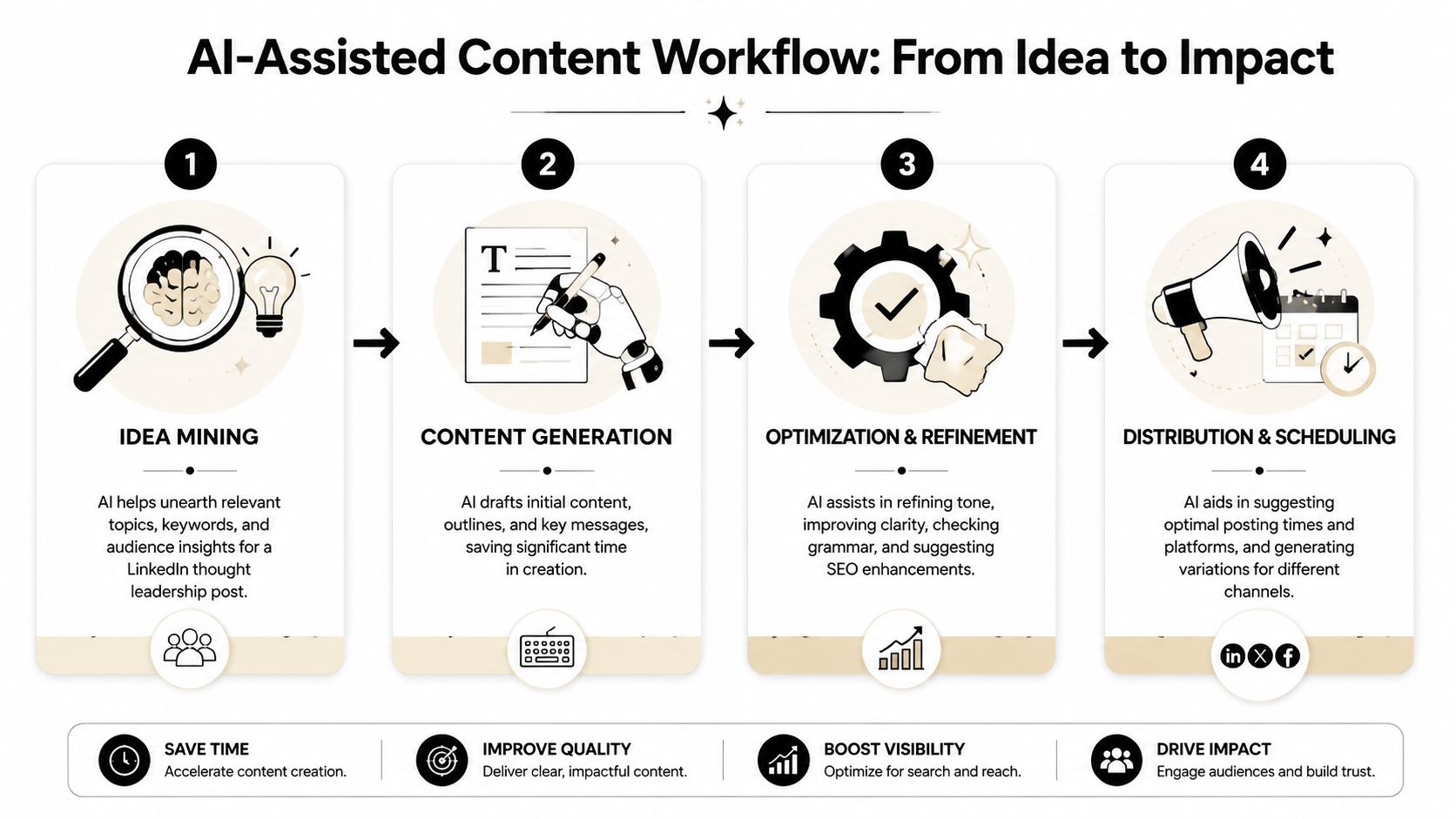
Once you've picked an angle, use AI to build the skeleton.
Have it produce:
This stage is where speed shows up. If you want a broader look at how teams build systems around this, Feather's guide to content automation is a useful reference for turning one-off effort into a repeatable publishing rhythm.
Use tools selectively. A writing model might help draft. Descript can help if your source material starts as audio or video. Grammarly can help with cleanup. A strategy stack doesn't need to be fancy. It needs to be disciplined. If you're comparing software for your broader brand system, this list of content creator tools for building your brand can help narrow your options.
This is the make-or-break stage. Many skip it, and that's why their AI content feels hollow.
Take the rough draft and rewrite the parts that carry meaning. Add the story from your board meeting. Replace the generic lesson with the hard truth you learned in a failed launch. Clarify the opinion. Sharpen the disagreement. Remove anything that sounds like a business school brochure.
Use AI to support the frame. Use your own mind to fill it.
A short walkthrough can help if you want to see how these workflows look in practice.
The final pass is not proofreading. It's alignment.
Read the piece out loud. Does it sound like how you speak when you're being clear, not performative? Cut sterile phrases. Tighten inflated claims. Remove abstractions. Make sure every strong statement is something you'd be willing to defend publicly.
Use this final checklist:
That's a practical AI assisted content creation workflow. It's fast enough to help a busy executive and controlled enough to protect the brand.
More output is not success. More relevance is. If your content operation gets faster but your message gets weaker, you didn't improve the system. You just increased the volume of mediocrity.
Likes are pleasant. They're not the main point.
A founder's content should create movement in the business. That movement usually shows up in conversations, perception, and demand quality before it shows up in dashboards.
Look for signs like these:
These are harder to fake, and they matter more.
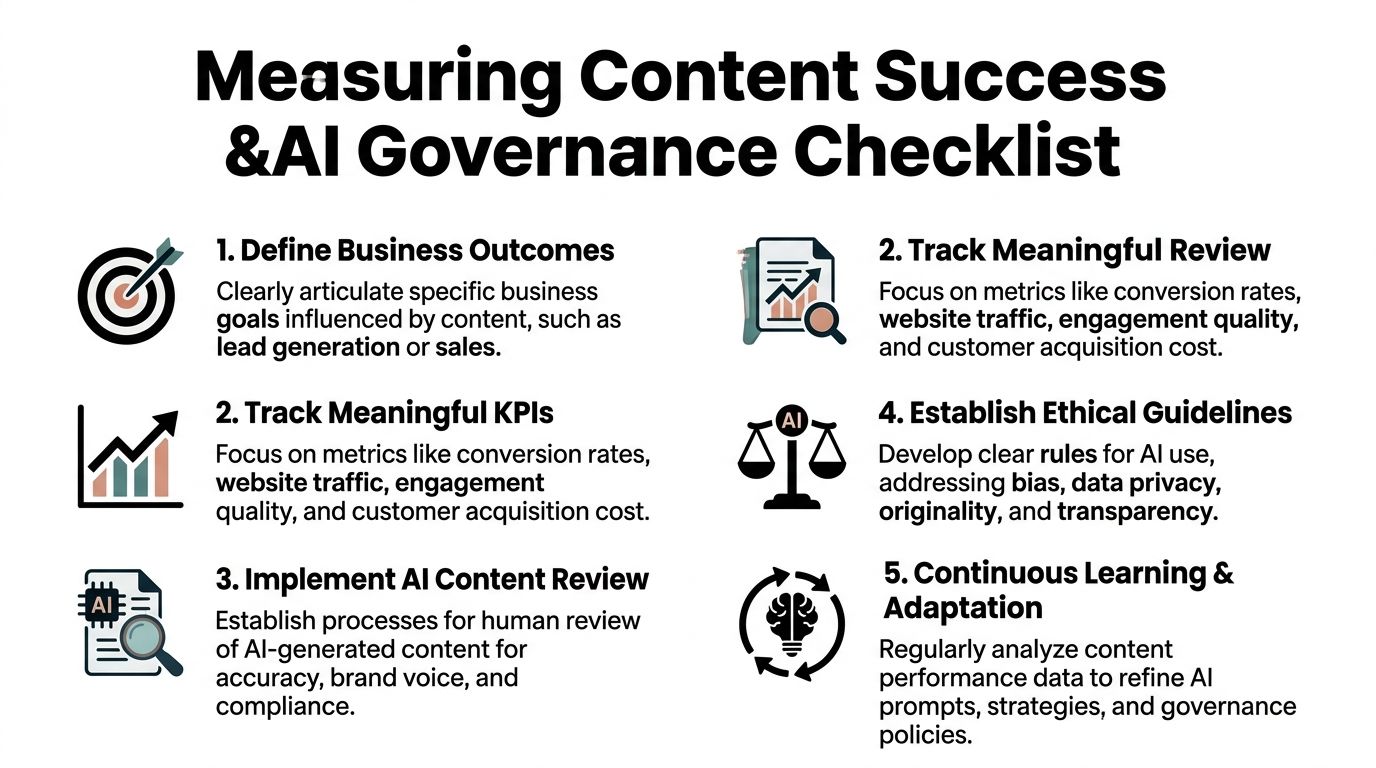
If an assistant, marketer, or agency touches your content, governance stops brand drift. Without it, everyone starts making small judgment calls that gradually change how you sound and what you stand for.
A solid governance system should define:
| Area | Standard |
|---|---|
| Brand voice | Approved tone, vocabulary, style rules, and banned phrases |
| Idea sourcing | Preferred inputs such as founder notes, transcripts, and firsthand experience |
| Fact verification | Every claim checked before publication |
| Review ownership | One person holds final approval authority |
| Disclosure rules | Clear guidance for synthetic media and heavily AI-shaped assets |
For a deeper framework on documenting these rules, this guide to content governance for a powerful brand is worth reading.
Strong governance doesn't slow great content down. It stops weak content from getting published.
Use this before anything goes live:
If you're scaling output with AI, governance is not optional. It's the price of consistency without reputational damage.
The executives who win with AI won't be the ones who automate the most. They'll be the ones who direct the best.
That's the shift. AI assisted content creation provides an advantage, but only if your expertise stays in the driver's seat. The machine can help you organize thought, uncover angles, repurpose ideas, and keep your publishing cadence alive. It cannot replace earned perspective.
Use AI to remove bottlenecks. Don't use it to manufacture authority.
That difference decides whether your personal brand compounds or collapses into sameness. Founders who understand this will publish with more consistency, more strategic clarity, and more message discipline than competitors who still treat content like a side project.
If video is part of your brand strategy, this perspective on how AI can accelerate YouTube channel growth gets one thing right: AI won't build the channel for you. It will remove friction that slows down execution.
Your goal isn't to flood feeds. It's to build a body of work people associate with your name. That requires repetition, judgment, and recognizable voice. AI helps with the first. It can support the second. It cannot impersonate the third for long.
So use it like a serious operator:
That's how you turn AI from a novelty into an asset. Not by giving it your job, but by giving it the tasks that let you do your real job better.
If you want a team that can turn your ideas, stories, and expertise into consistent personal brand content without losing your voice, Legacy Builder is built for that exact job. They help founders and executives turn raw insight into content that sounds human, builds authority, and compounds over time.


You could – but most in-house teams struggle with the nuance of growing on specific platforms.
We partner with in-house teams all the time to help them grow on X, LI, and Email.
Consider us the special forces unit you call in to get the job done without anyone knowing (for a fraction of what you would pay).
Short answer – yes.
Long answer – yes because of our process.
We start with an in-depth interview that gives us the opportunity to learn more about you, your stories, and your vision.
We take that and craft your content then we ship it to you. You are then able to give us the final sign-off (and any adjustments to nail it 100%) before we schedule for posting.
No problem.
We have helped clients for years or for just a season.
All the content we create is yours and yours alone.
If you want to take it over or work on transitioning we will help ensure you are set up for success.
We want this to be a living breathing brand. We will give you best practices for posting and make sure you are set up to win – so post away.
Subscribe to our newsletter and get insights on how to grow your personal brand.
