.svg)
Subscribe to our newsletter and get insights on how to grow your personal brand.
Thank you! Your submission has been received!
Oops! Something went wrong while submitting the form.
.svg)



Most advice about storytelling for business leaders is useless because it treats storytelling like stagecraft. Be vulnerable. Be inspiring. Be memorable.
That’s not enough.
If you’re a CEO, founder, or operator, your stories need to do a job. They need to sharpen positioning, align teams, move buyers, support fundraising, and make your expertise easier to trust. If a story can’t be tied to a business outcome, it’s not a leadership asset yet. It’s just a nice anecdote.
I take a hard line on this. Storytelling isn’t a soft skill. It’s an execution skill. People are 22 times more likely to remember a fact when it has been wrapped in a story, and retention rises from 5-10% with statistics alone to approximately 67% when stories and statistics are combined, according to storytelling statistics compiled here. If your market remembers your point, your sales conversations get easier. If they forget it, you keep re-explaining the same value proposition every week.
That’s why storytelling for business leaders has to be operational. You need a system for finding the right stories, shaping them into useful assets, deploying them across channels, and measuring what they change.
Calling storytelling a soft skill is lazy management.
Your market is not scoring you on how much your company knows. It is scoring you on how clearly your company makes that knowledge useful. If your expertise lives in slide decks, internal meetings, and half-finished talking points, it is not an asset. It is trapped value.
Storytelling fixes that because it turns scattered expertise into repeatable communication. A good story gives your sales team sharper language, gives your leadership team a shared frame for decisions, and gives buyers a faster path to trust. That is why I treat story as operating infrastructure, not executive decoration.
Yes, stories help people remember. As noted earlier, narrative consistently outperforms raw facts on recall.
But memory is not the true prize. Transfer is.
A strong business story lets one insight move across contexts without losing force. It can start in a leadership meeting, show up in a sales call, become a LinkedIn post, shape a recruiting pitch, and anchor a customer case study. Plain information rarely survives that trip. Stories do because they carry context, tension, and meaning together.
That is the standard you should use. If a message cannot travel across functions, it is not strong enough yet.
Practical rule: Build every important story so it can survive in five places: internal alignment, sales, marketing, hiring, and investor communication.
Many executives still believe more detail creates more credibility. It usually creates drag.
People trust clear judgment faster than exhaustive explanation. When you tell the story of a customer problem, the flawed assumption behind it, the decision your team made, and the result that followed, your audience can judge how you think. That matters more than sounding thorough.
This is the difference between content and narrative. Content fills space. Narrative carries a point.
If you need a clearer structure for that distinction, study how a brand narrative works in practice. The companies that win do not publish more. They publish from a tighter narrative system.
A story has no business value until it is tied to an outcome.
I want leaders to stop treating stories like one-off moments of inspiration. Treat them like assets with a job. One story should reduce friction in the sales process. Another should improve candidate quality. Another should sharpen category positioning. Another should increase response on founder-led channels, especially in places where reputation and trust are built in public, such as personal branding on LinkedIn.
Then track what changes.
Did a founder story improve time on page for your About content? Did a customer-change story raise demo conversion? Did a decision story get repeated by your managers in team meetings? If you are not measuring reuse, resonance, and downstream action, you are still treating storytelling like fluff.
You do not get to choose whether the market forms a story about you. That story is forming right now.
Prospects are deciding whether your company sounds expensive or cheap, disciplined or chaotic, proven or fragile. Recruits are deciding whether your standards are real. Investors are deciding whether your thinking is sharp enough to scale. They build those judgments from your posts, interviews, website copy, sales calls, hiring pages, and leadership communication.
So take control of it.
Define the stories you want repeated. Tighten them until they are easy for other people to tell. Put them into your content calendar, your sales process, and your internal language. Storytelling starts paying off when it stops being occasional and starts being operational.
Most leaders think they “don’t have stories.” That’s almost never true. What they have is a retrieval problem.
You’ve lived through hiring mistakes, product pivots, difficult decisions, ugly setbacks, customer breakthroughs, and moments when your standards got tested. That material is sitting there unused because nobody has turned it into a usable narrative library.
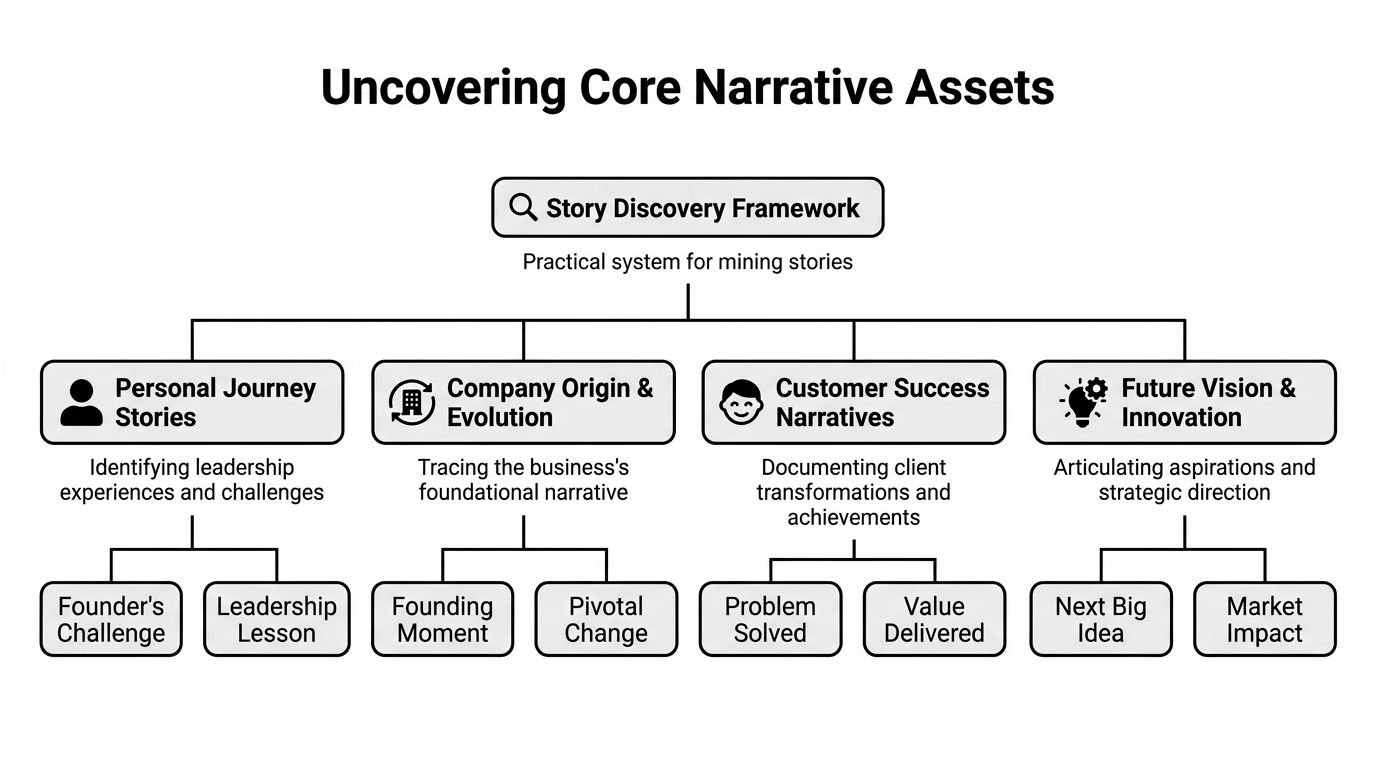
I recommend building a simple story bank around four categories. Not twenty. Four.
This isn’t your résumé in paragraph form. It’s the explanation for why you care enough to keep doing this when it gets hard.
Useful prompts:
A strong founder story helps buyers understand motive. It also helps recruits understand what kind of company they’re joining.
This is the category most leaders avoid and the one that often makes them credible.
Your failure story should show judgment under pressure, not performative confession. Don’t share pain for applause. Share a mistake that changed how you operate.
Questions worth answering:
When this is done well, it humanizes authority. It tells people you learn, you adapt, and you don’t need to pretend you’ve always been right.
The best leadership stories don’t make you look flawless. They make your judgment visible.
A mission story explains what bigger change your company exists to create. It gives context to your decisions, your messaging, and your standards.
This story matters most when the market sees your offer as a commodity. If buyers think your company is interchangeable, your mission story helps them understand the worldview behind the offer.
Prompts I use with clients:
If you need a useful companion piece for tightening that bigger message, Legacy Builder’s guide on what brand narrative is and how to build one is worth reading because it connects personal and company-level positioning in a practical way.
Customer stories are often the most commercially useful assets you own, but leaders usually flatten them into generic testimonials.
That’s lazy. A real customer narrative has movement.
Instead of “they got great results,” document the arc:
You don’t need to force every customer story into a dramatic transformation. You do need to make the shift visible. Buyers trust change they can picture.
Open a document, Notion database, or Airtable. Create one card per story. Add these fields:
| Story asset | What to capture |
|---|---|
| Story title | Short label you’ll recognize quickly |
| Category | Founder, failure, mission, customer |
| Core lesson | The single takeaway |
| Audience | Buyer, investor, recruit, team, peer |
| Best channel | LinkedIn, email, podcast, keynote, sales call |
| Proof points | Relevant facts, moments, or outcomes you can mention qualitatively if needed |
Leaders begin to act like operators rather than waiting for inspiration.
If LinkedIn is one of your main channels, I’d also review this guide to personal branding on LinkedIn. Not for vanity metrics. For understanding how your story bank becomes a repeatable publishing system.
Don’t only look at the polished moments. Look at conflict.
The richest stories often come from:
If you collect those moments consistently, you won’t run out of material. You’ll stop guessing what to post, what to say on podcasts, and how to explain your company in a way people remember.
A raw anecdote isn’t a business story yet. It becomes useful when you shape it around a decision.
That’s the mistake smart leaders make. They think storytelling means adding color. It doesn’t. It means adding structure so the audience can follow the logic, feel the stakes, and know what to do next.
The cleanest process I’ve seen is a five-phase method summarized by the World Economic Forum’s storytelling guidance: define the core message, gather and contextualize data, simplify and structure the narrative using a 3-act structure, incorporate emotional and audience-specific elements, and test and iterate for recall. That sequence is practical because it forces discipline. You stop rambling and start engineering communication.
Before you tell any story, answer one question.
What do you want the audience to believe, feel, or do after hearing it?
If you can’t answer that in one sentence, the story isn’t ready. Most weak storytelling fails before the opening line because the leader hasn’t chosen the takeaway.
Use this simple chain:
That’s how you keep a story commercially useful.
You don’t need to invent a new structure every time. Use a template that fits the context.
| Template Name | Structure | Best For |
|---|---|---|
| Before After Bridge | Current painful state, better future state, path from one to the other | Sales pages, offer messaging, product marketing |
| Hero’s Journey | Call to challenge, struggle, transformation, return with lesson | Founder story, keynote, brand film |
| Problem Agitate Solve | Identify the issue, intensify the cost of inaction, present the solution | Email marketing, webinars, landing pages |
| Challenge Choice Change | Show the obstacle, the decision made under pressure, the resulting shift | Leadership posts, interviews, team communication |
| Context Conflict Resolution | Establish the setting, surface the tension, resolve with a lesson | Investor conversations, customer stories, case-led selling |
Pick one and commit. Leaders lose persuasion when they mix structures inside the same story.
Analytical leaders often swing too far in one direction. They either tell a vague emotional story with no business substance, or they stuff the story with so much context that the message disappears.
Do this instead.
If a detail doesn’t increase tension, credibility, or relevance, cut it. Nobody needs the whole timeline. They need the decisive moments.
For example, if you’re telling a failure story about a bad hire, the audience probably doesn’t need every interview round and meeting recap. They need to know what looked promising, what you missed, and what standard you changed after the mistake.
A founder origin story can carry more texture and reflection. A sales email can’t. Different formats need different compression.
I see it like this:
Operator’s test: If the audience can’t summarize the story in one sentence, you gave them too much.
This is one of the easiest upgrades you can make.
Most business content sounds written, not said. It’s overloaded with qualifiers, stacked clauses, and abstract language. Stories work better when they sound like a real person making a clear point.
Read your draft out loud. If you wouldn’t say the sentence in a boardroom, on a podcast, or on a call, rewrite it.
Good business storytelling usually has these traits:
A story without direction creates admiration at best. A story with direction creates action.
Don’t fade out after the resolution. Close the loop. Tell the audience what the story means.
That might sound like:
That final move is where conversion lives. The story earns attention. The direction earns action.
A good story told once is underused.
Most leaders work far too hard to create insight and then distribute it far too narrowly. They tell a strong story on a podcast, then never turn it into a post. They send a sharp founder note to their team, then never adapt it into a recruiting asset. They write a useful customer story for sales enablement, then never turn it into email content.
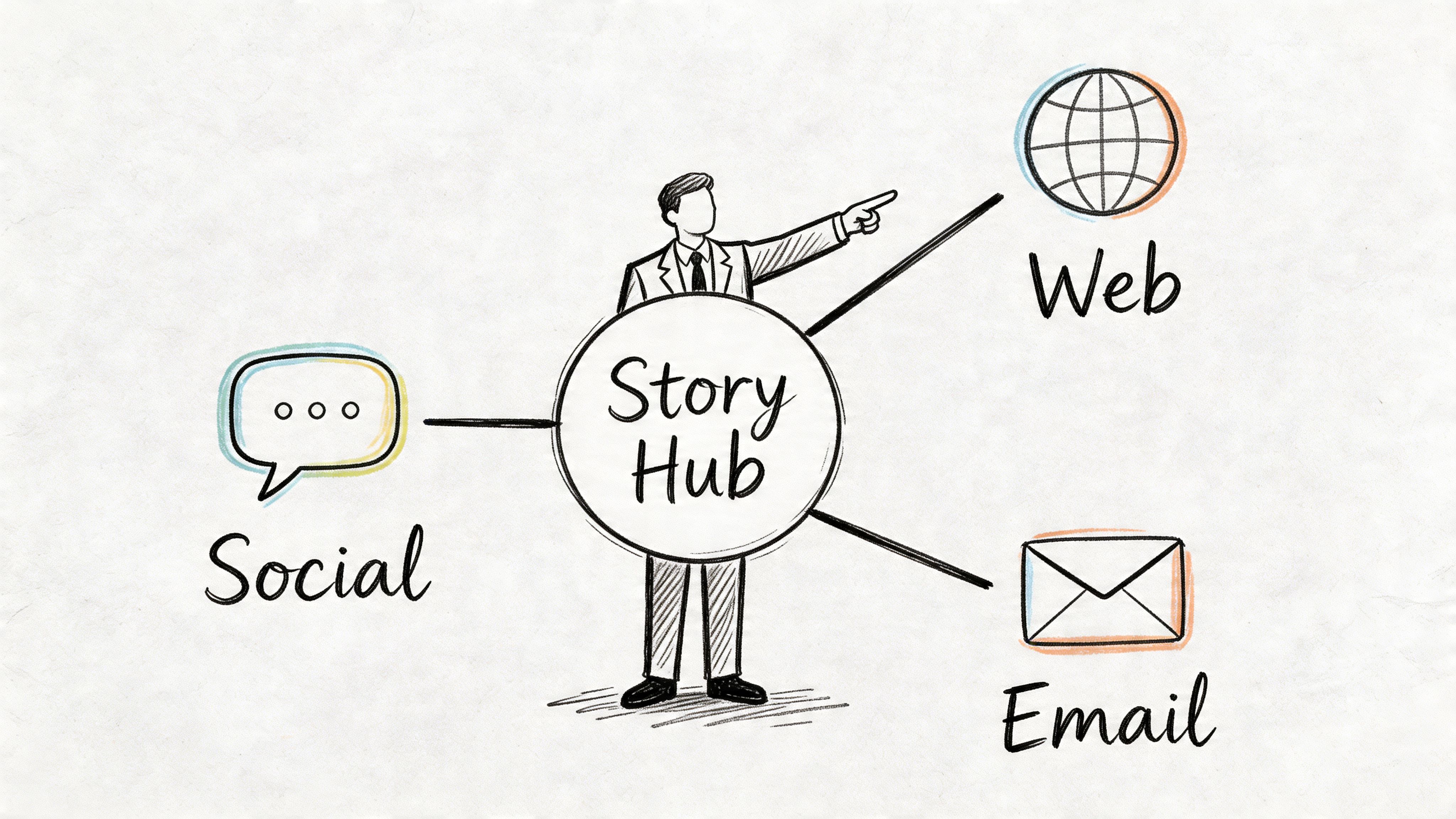
Treat each story like source material. The message stays consistent. The packaging changes.
A founder’s “aha moment” story might become:
That’s not duplication. That’s proper asset utilization.
Every platform trains people to consume differently. Ignore that and your stories lose force.
On LinkedIn, start closer to the tension. Don’t bury the insight in a slow introduction.
A useful format is:
If you’re trying to build a repeatable system around this, Legacy Builder’s article on how to repurpose content and multiply your reach is a practical reference for turning one idea into multiple publishable assets.
Email gives you more room, but don’t waste it. Write like you’re speaking to one informed person, not delivering a company announcement.
A good email story usually includes one scene, one tension point, and one commercial bridge. If you’re selling, the bridge should feel earned. The story should naturally reveal why your perspective or offer exists.
In spoken formats, pauses matter. Repetition matters. Contrast matters.
Give the audience signposts. “We thought X. We were wrong. Here’s what changed.” That kind of sequencing helps listeners keep up without a slide doing the work for you.
A quick example helps show how channel adaptation works in practice.
A founder story about realizing clients didn’t need “more content,” they needed sharper positioning could become a reflective LinkedIn post, a newsletter about messaging discipline, a short video on brand confusion, and a webinar opener that frames the cost of noisy marketing. Same core insight. Different wrapper.
This video is useful if you want a broader visual take on how business leaders can communicate stories more effectively across modern channels.
Don’t leave distribution to mood. Put it on a calendar.
Here’s a simple operating rhythm:
| Day | Content use |
|---|---|
| Monday | Founder or mission story post |
| Tuesday | Customer narrative in email or carousel |
| Wednesday | Short video clip or talking-head insight |
| Thursday | Sales enablement version of the week’s story |
| Friday | Reflection post, team lesson, or failure story |
This keeps your message coherent without making your content repetitive. Buyers start seeing patterns. Recruits start understanding the culture. Partners start repeating your language back to you.
Use a story hub. One source document. Multiple channel outputs. That’s how leaders publish consistently without sounding manufactured.
A lot of repurposed content feels dead because someone stripped out the tension and kept only the conclusion.
Don’t just copy the lesson. Preserve the movement. Keep the problem, the friction, the realization, and the shift. That arc is what makes the content feel human instead of automated.
That’s the standard. Every strong story should be able to travel across channels without losing its commercial purpose.
Storytelling only earns budget when you can measure what it changes.
A polished founder post means nothing if it attracts the wrong audience. A customer story has no strategic value if it gets applause but does not influence pipeline. You need a system that shows which narratives improve attention, trust, conversion, and retention.
This gap is significant. A lot of storytelling advice still stops at writing better anecdotes instead of helping leaders connect narrative to revenue, sales velocity, and brand strength.
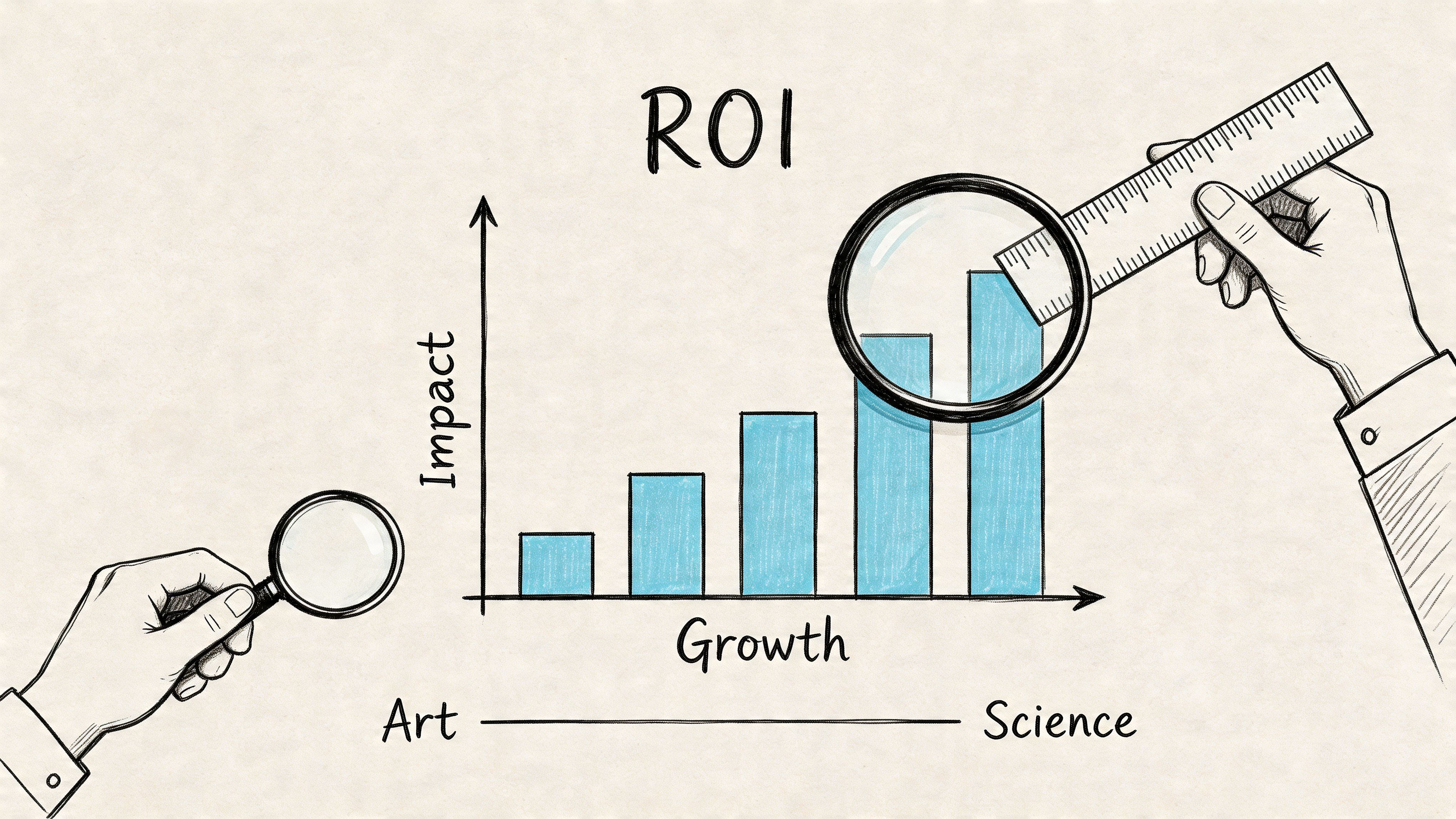
Track stories like business assets, not creative output. I recommend a three-level scorecard so you can see what performs in public, what shapes deals, and what strengthens market perception over time.
Start with response quality, not vanity metrics.
Track which stories produce:
You do not need an expensive reporting stack to start. Use LinkedIn analytics, email reporting, and disciplined UTM tagging so every story has a traceable path.
Here, stories prove commercial value.
Your CRM should capture story influence the same way it captures source, stage, and objection data. Ask your team to log:
If prospects say they have been following your point of view, or mention a specific post before the first meeting, that trust did not appear by accident. Your story did part of the selling before your team entered the room.
Some effects take longer. They still deserve measurement.
Monitor signals like these:
| Metric area | What to look for |
|---|---|
| Brand recall | Are prospects repeating your language, positioning, or point of view back to you? |
| Audience sentiment | Do replies show trust, relevance, and genuine interest instead of shallow praise? |
| Inbound quality | Are leads more aligned with your offer and easier for sales to qualify? |
| Conversion context | Are buyers arriving with a clearer understanding of why you matter? |
If you want a stronger baseline for channel tracking, this guide on how to measure social media ROI helps connect engagement activity to business outcomes instead of vanity reporting.
Skip the bloated analytics project. Build one monthly dashboard and review it with discipline.
Include these fields:
That framework turns storytelling into an operating system. You will see which stories attract qualified attention, which ones help sales move deals, and which ones create noise without commercial value.
Executives often overvalue neat dashboards and ignore buyer language. That is sloppy management.
Log direct quotes from prospects, candidates, customers, and partners. If a buyer says a post clarified your difference, capture it. If a recruit references a mission story in an interview, capture it. If multiple prospects repeat the same anecdote, you have evidence that story is shaping perception at scale.
For broader top-of-funnel tracking, Legacy Builder’s guide on how to measure brand awareness and fuel your growth complements this approach by connecting narrative visibility to market recognition.
Do not judge every story by leads alone.
A failure story can build trust. A customer story can support conversion. A mission story can attract aligned talent and partners. A founder story can sharpen recall and differentiation.
Set the intended job before you publish. Then measure whether the story did that job. That is how you stop guessing, protect good narrative assets, and build a storytelling system your business can use.
Bad business storytelling usually starts with bad executive judgment.
I see the same pattern over and over. Leaders use stories to defend their image, cram in proof points, or please every audience at once. That turns a useful narrative asset into vague, forgettable content. If your story does not help someone understand your value, remember your point of view, or make a decision faster, it is not doing its job.
That matters because storytelling is not decoration. It is a business system. If you want measurable return from it, you need to spot the failure patterns early and correct them before they spread across sales decks, founder posts, recruiting messages, and customer marketing.
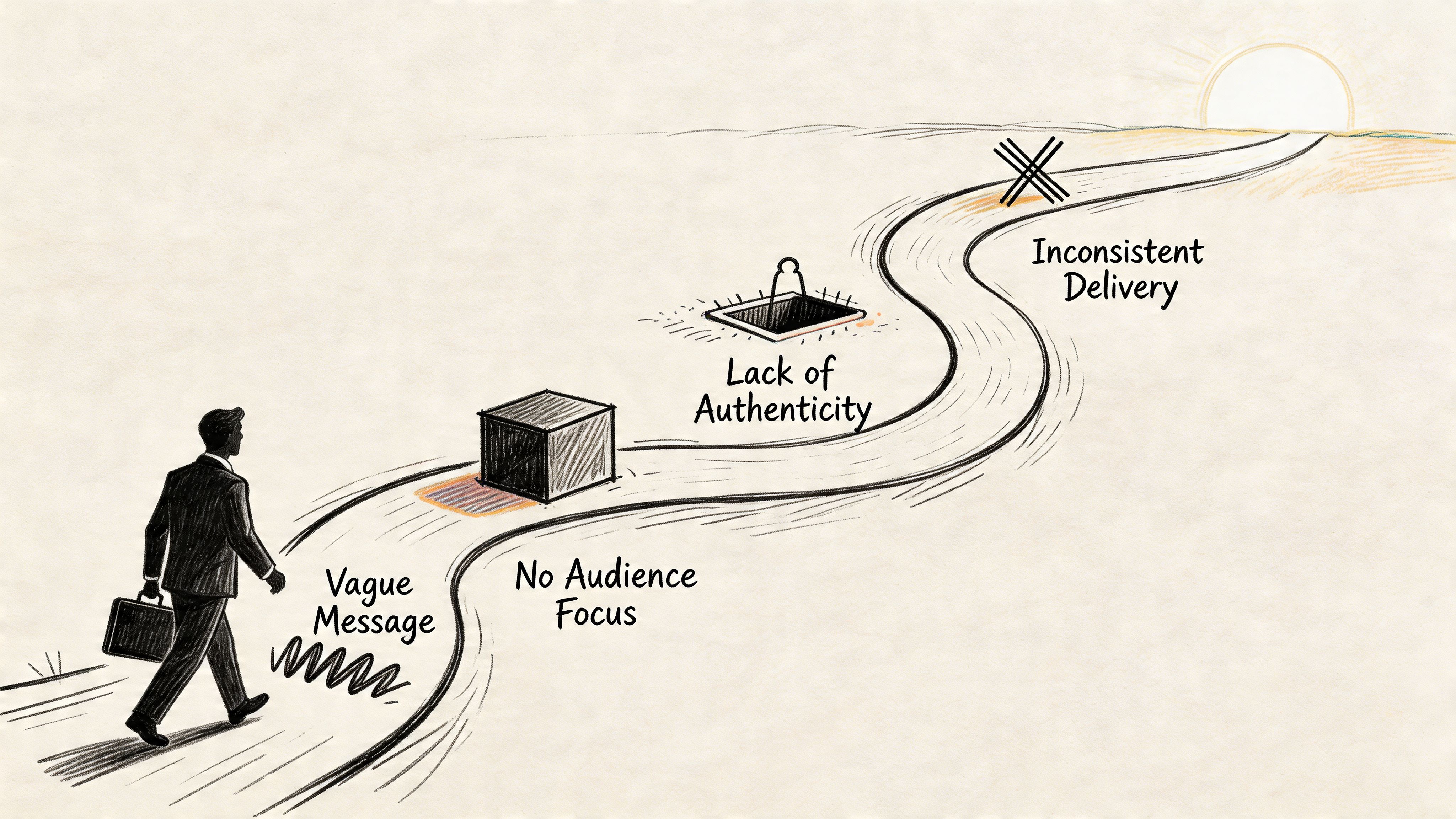
This kills credibility fast.
When you tell stories that present you as consistently sharp, certain, and ahead of everyone else, people hear positioning, not truth. Strong leaders do not look stronger by hiding the messy parts. They look stronger by showing how they made sense of pressure, error, and change.
Use a simple filter:
That structure gives your audience something useful to apply. It also gives your team a repeatable way to turn experience into content with commercial value.
Executives often lose confidence halfway through a story and start piling on facts. That breaks the narrative.
A story needs movement. Something was true, then something changed, then a decision or consequence followed. Data supports that sequence. Data cannot replace it.
Keep only the details that sharpen the point. If a metric does not clarify the decision, raise the stakes, or prove the result, cut it.
Do not use facts to rescue a weak story. Fix the story first, then add the proof that makes it credible.
A wandering story exposes a planning problem.
If you have not decided what the story is supposed to do, it will drift. You will start with a customer insight, slide into company history, add two personal lessons, and end with no clear takeaway. Your audience will remember fragments, not meaning.
Force the discipline before you publish anything. Write one sentence: “The point of this story is...” Then finish it in plain language. If you cannot do that cleanly, the story is not ready for your content calendar, your LinkedIn post, or your next leadership talk.
You cannot sound thoughtful in one place, stiff and corporate in another, and performatively casual somewhere else, then expect the market to trust your brand.
Channels can change. Your standards should not. Your voice should still reflect the same judgment, same priorities, and same level of candor, whether you are speaking to buyers, recruits, investors, or partners.
Use this checklist before a story goes live:
| Risk | Better standard |
|---|---|
| Overpolished language | Speak like a real operator |
| Generic inspiration | Tie every story to a business lesson |
| Constant self-focus | Connect your experience to the audience’s problem |
| Forced vulnerability | Share only what builds relevance or trust |
The point is consistency people can recognize and your team can execute.
If your expertise is strong but your message still feels scattered, Legacy Builder helps turn your stories, insights, and perspective into structured content for your online brand. If you want your narrative to function like a business asset instead of a loose collection of posts, make that shift.


You could – but most in-house teams struggle with the nuance of growing on specific platforms.
We partner with in-house teams all the time to help them grow on X, LI, and Email.
Consider us the special forces unit you call in to get the job done without anyone knowing (for a fraction of what you would pay).
Short answer – yes.
Long answer – yes because of our process.
We start with an in-depth interview that gives us the opportunity to learn more about you, your stories, and your vision.
We take that and craft your content then we ship it to you. You are then able to give us the final sign-off (and any adjustments to nail it 100%) before we schedule for posting.
No problem.
We have helped clients for years or for just a season.
All the content we create is yours and yours alone.
If you want to take it over or work on transitioning we will help ensure you are set up for success.
We want this to be a living breathing brand. We will give you best practices for posting and make sure you are set up to win – so post away.
Subscribe to our newsletter and get insights on how to grow your personal brand.
